EUDR UK Guide: Goods from the Rest of the World to Great Britain, Northern Ireland and EU Customers
- John Hall
- Customs Specialist at iCustoms.ai
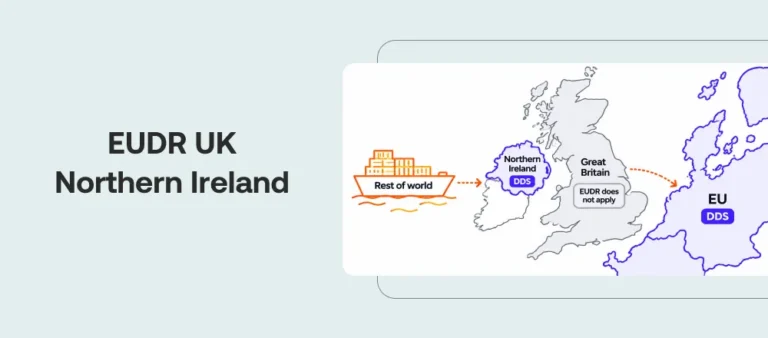
Does the EUDR apply in the UK? The EUDR UK answer: not in Great Britain, but yes in Northern Ireland, and yes to anything a UK business sells into the EU. England, Scotland and Wales sit outside the EU Deforestation Regulation. Northern Ireland applies it under the Windsor Framework, on the same dates as the EU. So the question for a UK business is not whether the EUDR applies to it, but which of its routes it applies to. This guide answers that route by route.
Does the EUDR Apply in the UK? EUDR UK Rules by Territory
| Territory | EUDR applies? | What it means for you |
|---|---|---|
| England, Scotland, Wales | No | No EUDR duties for goods sold only in Great Britain. A separate GB regime is planned (see below). |
| Northern Ireland | Yes | Full EUDR duties for goods placed on the NI market, moved into NI from GB, or exported from NI outside the UK and EU. |
| EU customers | Yes | Goods entering the EU need a due diligence statement (DDS) reference at customs, wherever your company is based. |
The dates match the EU. Medium and large operators apply the rules from 30 December 2026, micro and small primary operators from 30 June 2027 (or 30 December 2026 for wood already under the EU Timber Regulation), and newly added products such as soap, other palm oil derivatives and soluble coffee from 30 December 2027. For a full overview of the law itself, see our EUDR guide.
EUDR Northern Ireland Rules and the Windsor Framework
The Windsor Framework EUDR position is simple: Northern Ireland follows EU rules on goods, so the EUDR replaces the EU Timber Regulation there. Defra’s guidance, first published on 17 July 2026 and updated on 27 August 2026, sets out how this works in practice.
Who enforces the EUDR in Northern Ireland?
Two competent authorities share the job. The Office for Product Safety and Standards (OPSS) covers wood and rubber. The Department of Agriculture, Environment and Rural Affairs (DAERA) covers cattle, cocoa, coffee, palm oil and soya.
Which roles apply in Northern Ireland?
The EU’s four roles apply unchanged: operator, micro or small primary operator (MSPO), downstream operator and trader. The test is who is first to place the product on the Northern Ireland or EU market, or first to export it from Northern Ireland outside the UK and EU. Defra gives three useful examples of operators: an NI meat processor importing Brazilian beef, a GB timber merchant selling wood products to an NI consumer, and an NI coffee shop buying beans from a GB roastery. In each case, the product enters the EU and NI market for the first time on that sale.
To file in the EUDR Information System, a business moving goods from GB to NI also needs an XI or EU EORI number.
What are the EUDR exempt products in the UK?
Defra lists product samples, goods made entirely from recycled or second-hand material, end-of-life goods that would otherwise be discarded, and products made from bamboo or rattan. Packing materials such as shipping boxes and pallets are exempt when used only to support, protect or carry another product, and not sold in their own right. There is no general exemption for goods bought for a company’s own internal use. Our EUDR commodities and products list covers the full scope.
Author’s view · Freya Jane: treat Northern Ireland as an EU market |
|---|
The easiest mistake for a GB business is to treat a Northern Ireland customer as a domestic sale. For EUDR purposes it is not. If you ship coffee, timber or rubber goods across the Irish Sea, plan as if you were exporting to Dublin: the plot data, the statement and the reference all need to exist before the lorry leaves. The good news is that the Windsor Framework schemes still work, so the extra step is data, not a new customs route. |
Scenario Table: Who Files What on Each Route
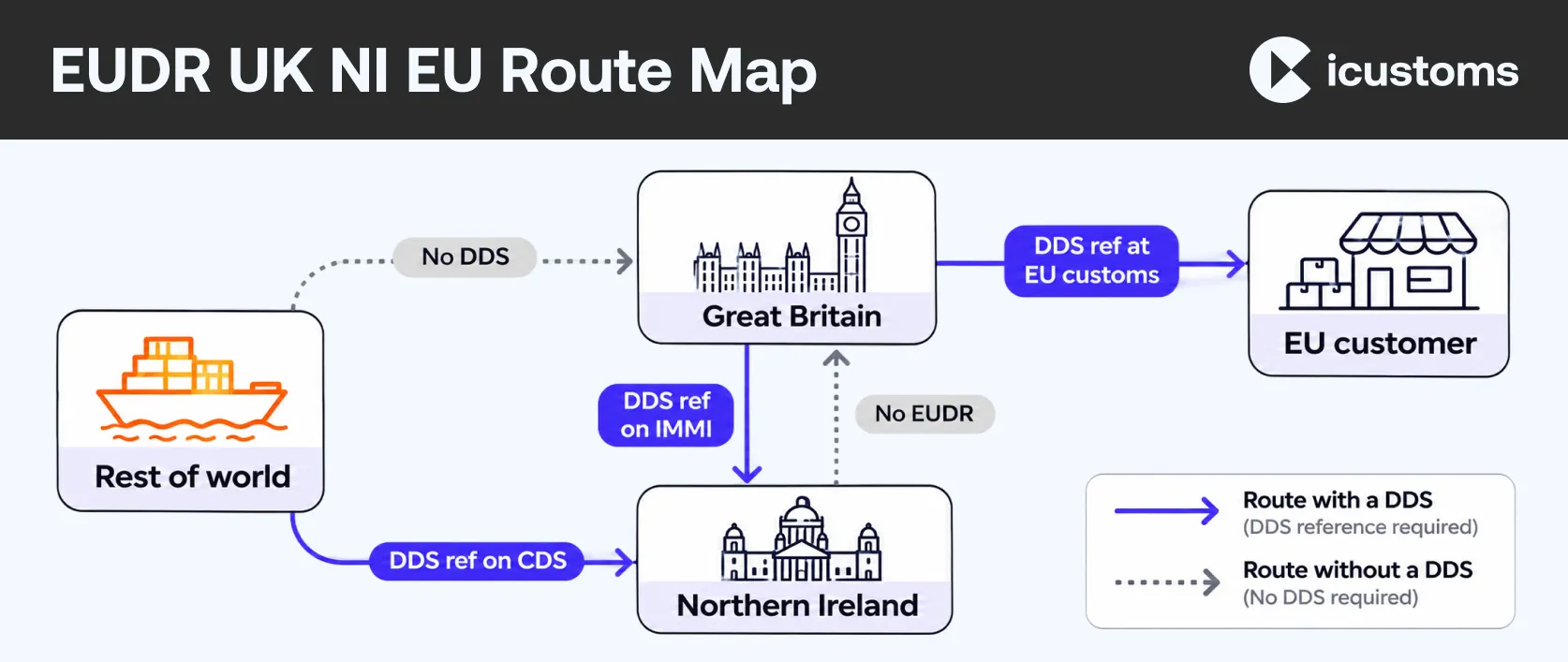
This is the EUDR UK table most importers and forwarders need. It follows the Defra guidance and the Commission’s EUDR FAQ.
| Route | Who is the operator? | What has to happen |
|---|---|---|
| Rest of world to Great Britain | No EUDR operator | No EUDR duties. Keep supplier plot data if the goods may later go to NI or the EU. |
| Rest of world to Northern Ireland (business) | The NI importer | File a DDS before arrival and put the reference on the customs declaration. UKIMS ‘not at risk’ still available. |
| Rest of world to Northern Ireland (consumer) | The seller placing the goods on the NI market | DDS reference on the CDS declaration or given to the express operator. UK Carrier Scheme still available where eligible. |
| Great Britain to Northern Ireland (business) | Usually the GB seller or NI buyer, whoever first places on the NI market | DDS reference or declaration identifier on the IMMI or customs declaration. UKIMS, IMMI with Trader Goods Profile and NIRMS still usable. |
| Great Britain to Northern Ireland (consumer) | The GB seller | Give the DDS reference to the UK Carrier Scheme carrier, who enters it in the ‘Supporting Document Reference Number’ field. |
| Northern Ireland to Great Britain | None | No EUDR requirements. Qualifying NI goods keep unfettered access to GB. |
| Northern Ireland to rest of world | The NI exporter | DDS reference on the export declaration. A downstream operator uses the dedicated TARIC code instead. |
| Great Britain to EU customer | The importer of record into the EU, and the first EU company to make the goods available | DDS filed before release for free circulation; reference on the EU customs declaration. |
| Re-importing goods already placed on the EU or NI market into NI | Downstream operator | Reuse the supplier’s reference (or a conventional reference) and keep evidence of the earlier placing for five years. |
Author’s view · Freya Jane: treat Northern Ireland as an EU market |
|---|
The easiest mistake for a GB business is to treat a Northern Ireland customer as a domestic sale. For EUDR purposes it is not. If you ship coffee, timber or rubber goods across the Irish Sea, plan as if you were exporting to Dublin: the plot data, the statement and the reference all need to exist before the lorry leaves. The good news is that the Windsor Framework schemes still work, so the extra step is data, not a new customs route. |
Importing a product from the rest of the world (ROW) to the UK and selling to an EU customer: who is the operator?
Importing into Great Britain creates no EUDR duty. The duty starts when the goods enter the EU. Whoever is the importer of record for release into free circulation in the EU places the goods on the EU market and is the operator. If your UK company imports into the EU (usually with an EU EORI and an indirect customs representative), you file the DDS. Under the Commission’s FAQ (question 3.7), when the company placing the goods is not established in the EU, the first EU-established company to make them available is also treated as an operator, so your EU customer carries duties too. If your customer imports the goods themselves, for example on DAP terms where they act as importer, they are the operator and will ask you for the plot data.
Either way, the data has to come from your Asian supplier. A customs agent or forwarder acting for you is never the operator (FAQ 3.15), so this cannot be passed to them. Our EUDR customs and shipping guide covers the EU side in detail.
Author’s view · Freya Jane: agree the incoterm before the deadline |
|---|
For UK companies with EU customers, the most useful conversation right now is commercial, not legal. Sit down with each EU buyer and agree who will be importer of record from 30 December 2026, and therefore who files the statement. Once it is settled, the data request to your supplier writes itself. |
The UK Forest Risk Commodities Regime: Where It Stands
Great Britain has its own route. The Environment Act 2021 (Schedule 17) gives the government power to ban large businesses from using forest risk commodities produced on illegally deforested land. In June 2026 the government set out its proposed approach in a policy paper: the same seven commodities as the EUDR, a focus on illegal deforestation at first, and a turnover threshold of £1 million for GB businesses. A consultation is expected, with the aim that scope and data requirements stay broadly in line with the EUDR, and secondary legislation is expected in 2027.
Until that legislation is made and in force, nothing in the GB regime is binding, and this article draws no legal conclusions from it. The practical point is simple: the plot data you collect for the EUDR is likely to serve the GB regime too. You can follow progress on GOV.UK in the UK’s approach to deforestation regulations.
EUDR UK Customs Practicalities: CDS, References and Schemes
- Declarations into Northern Ireland go through HMRC’s Customs Declaration Service (CDS). The DDS reference or declaration identifier goes on the declaration, or on the IMMI for GB to NI business movements.
- Movement schemes stay. UKIMS, the IMMI with a Trader Goods Profile, NIRMS and the UK Carrier Scheme all remain available; the EUDR adds a reference, not a new route.
- Imports into the EU use the EU document code for EUDR references at customs. Our guide to EUDR TARIC document codes lists them.
- References must be valid before filing. Customs checks that the reference exists and matches the goods, so the DDS has to be submitted before the declaration, not after.
- Records last five years. Keep statements, supplier data and the evidence behind each decision for five years.
How iEUDR by iCustoms Helps with EUDR UK Compliance
iEUDR covers both the EU and Northern Ireland, including movements from Great Britain into Northern Ireland. Your non-UK suppliers, many already onboarded in iEUDR, are checked against official EU TRACES records and enter plots in a free supplier portal with built-in guidance. Every point and polygon is validated against the EUDR geolocation rules and converted to GeoJSON, and AI classifies the CN codes of your products. iEUDR then creates, validates and submits each DDS, singly or in bulk, and retrieves, verifies and validates statements your suppliers file themselves. Each reference goes to your forwarder or customs agent before they file in CDS or an EU system, with a five-year audit trail. iCustoms’ customs software is recognised by HMRC and Irish Revenue. See the EUDR compliance software page.
For example, a Manchester furniture distributor importing oak tables from Vietnam sells into Great Britain, Belfast and Dublin. GB sales need nothing under the EUDR. For Belfast and Dublin orders, the Vietnamese factory uploads its forest plots once, iEUDR builds a DDS per consignment and sends the reference to the customs agent for the IMMI or the Irish import declaration.
Frequently Asked Questions
Does the EUDR apply in the UK?
Not in Great Britain. Under the EUDR UK rules, it applies in Northern Ireland under the Windsor Framework, and to any UK goods placed on the EU market.
Does the EUDR apply to goods moved from Great Britain to Northern Ireland?
Yes. The first business to place in-scope goods on the NI market is the operator and the DDS reference goes on the IMMI or customs declaration.
Do I need a DDS to move goods from Northern Ireland to Great Britain?
No. NI to GB movements have no EUDR requirements.
Who enforces the EUDR in Northern Ireland?
OPSS for wood and rubber, and DAERA for cattle, cocoa, coffee, palm oil and soya.
Can I still use UKIMS for EUDR products?
Yes. UKIMS, IMMI, NIRMS and the UK Carrier Scheme remain available; you add the DDS reference.
What is the UK's own deforestation law?
The Environment Act 2021 allows a GB regime on forest risk commodities. Secondary legislation is expected in 2027 and is not yet in force.

See how iEUDR gets the right DDS reference onto every declaration, before the goods move.
You may also like:
Selling into Northern Ireland or the EU?

iEUDR files and validates your DDS and sends each reference to your customs agent.
Subscribe to our Newsletter
About iCustoms
iCustoms is an all-in-one solution helping businesses automate customs processes more efficiently. With AI-powered and machine-learning capabilities, iCustoms is designed to streamline your all customs procedures in a few minutes, cut additional costs and save time.
One platform for GB, NI and EU shipments.
iEUDR covers movements into Northern Ireland and imports into the EU from one dashboard.