

EUDR Commodities: The 7 Covered Commodities, Exemptions and 2026 Changes
- John Hall
- Customs Specialist at iCustoms.ai
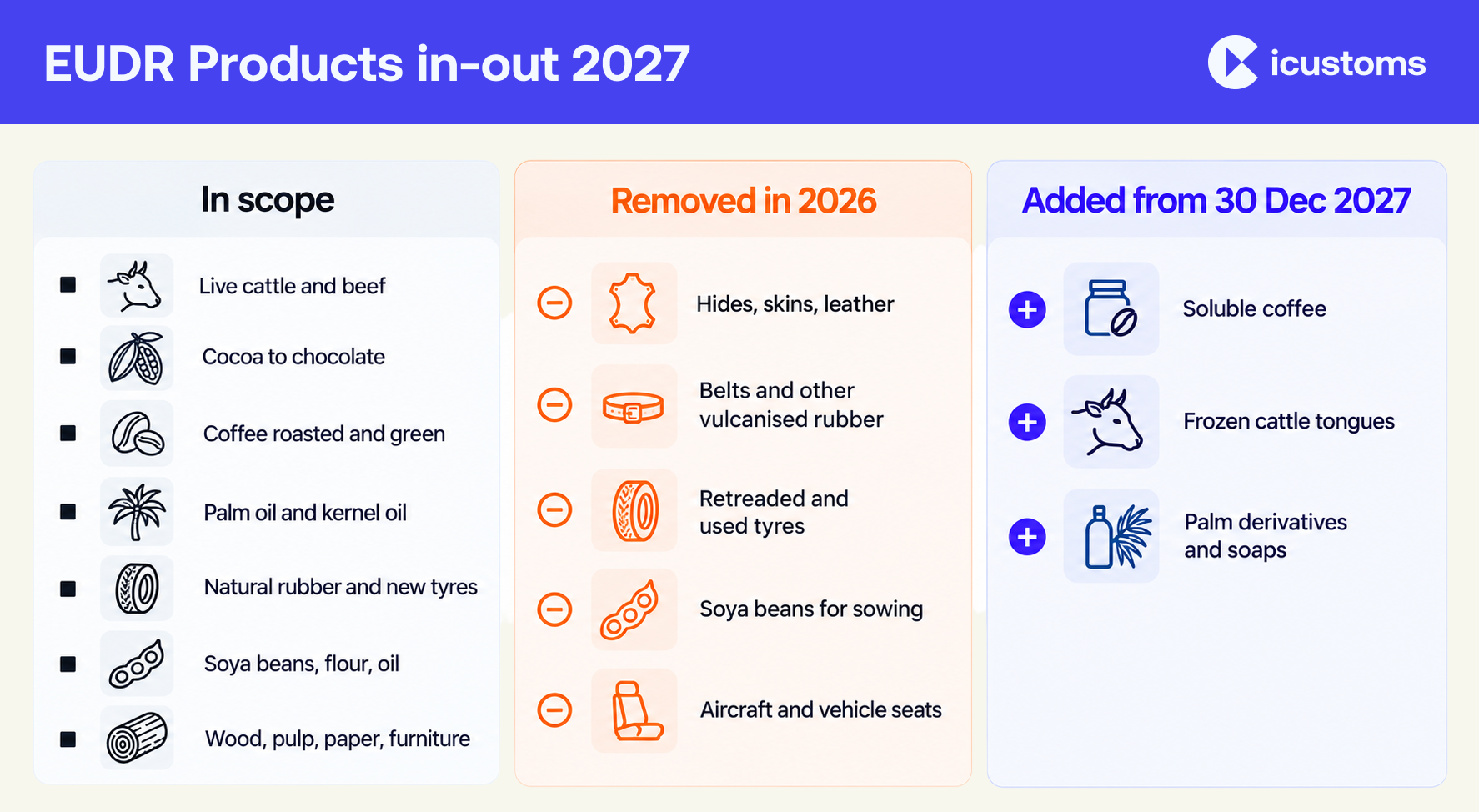
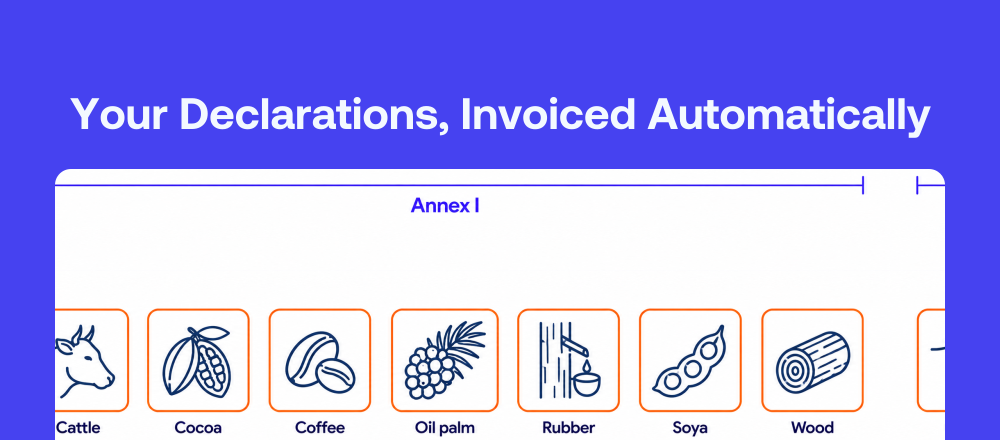
The seven EUDR commodities are cattle, cocoa, coffee, oil palm, rubber, soya and wood. The covered commodities and the products made from them are listed by HS code in Annex I of the regulation, which was updated by Delegated Regulation (EU) 2026/2102 from 18 September 2026. That update removed leather, several rubber articles and soya beans for sowing, and adds soluble coffee and more palm oil derivatives from 30 December 2027.
This guide sets out the current inclusion list, what is exempt, the tricky cases such as packaging and paper, and how to check your own products.
The 7 EUDR Commodities: Covered Commodities List
The EUDR targets the commodities most linked to global deforestation. The regulation names them as relevant commodities, and the products made from them as relevant products.
- Cattle: live animals and beef.
- Cocoa: beans through to chocolate.
- Coffee: green, roasted and, from 2027, soluble coffee.
- Oil palm: palm oil, palm kernel oil and a long list of derivatives.
- Rubber: natural rubber and selected rubber products.
- Soya: beans, flour, oil and oilcake.
- Wood: logs and timber through to pulp, paper and furniture.
How Annex I Works
Annex I lists products by Harmonized System (HS) code. Many entries start with ‘ex’, which means only part of that heading is covered. A soap heading, for example, is only in scope where the soap contains or is made using oil palm.
The 2026 update also added species notes that narrow each commodity:
- Cattle means cattle of the genus Bos only, so buffalo and bison are out.
- Oil palm means Elaeis species only, not oils from other palms.
- Rubber means natural rubber from Hevea brasiliensis, not synthetic rubber.
- Wood excludes bamboo, rattan and similar materials such as reeds, raffia and straw.
Annex I lists products by HS heading, but EU customs works with eight-digit CN codes, so check both levels. The reliable test is always your product’s code and composition, not its name.
What Is a Customs Chapter and Why Does It Matter for the EUDR?
Every traded product has a customs code, and the first two digits are its chapter. Chapters group related products: chapter 09 covers coffee and tea, chapter 18 cocoa, chapter 44 wood and chapter 48 paper and paperboard. The next digits narrow it down to a heading (4 digits), a subheading (6 digits) and, in the EU, an 8-digit CN code. Annex I of the EUDR names products by these codes, so a chapter tells you where to look, but only the full code shows whether your product is in scope.
EUDR Inclusion Product List and Commodity Codes
| Commodity | Main products in scope (commodity codes, HS) | Changed in 2026 |
|---|---|---|
| Cattle | Live cattle (ex 0102); fresh, chilled and frozen beef (0201, 0202); edible offal (ex 0206 10, ex 0206 22, ex 0206 29); prepared or preserved beef (ex 1602 50) | Hides, skins and leather removed; frozen tongues (ex 0206 21) added from 2027 |
| Cocoa | Beans (1801); shells, husks and skins (1802); paste (1803); butter (1804); powder (1805); chocolate (1806) | Waste under the Waste Framework Directive excluded from 1802 |
| Coffee | Coffee, roasted or not, husks and skins (0901) | Soluble coffee (2101 11) added from 2027 |
| Oil palm | Palm nuts and kernels (1207 10); palm and palm kernel oil (1511, 1513); oilcake (2306 60); glycerol, fatty acids and fatty alcohols made using oil palm (2905, 2915, 3823) | Many derivatives added from 2027, including soaps and oleochemicals |
| Rubber | Natural rubber (ex 4001); compounded and unvulcanised rubber (ex 4005, ex 4006); thread and cord (ex 4007); vulcanised plates and sheets (ex 4008); new tyres (ex 4011); tyre treads (ex 4012 90 30); inner tubes (ex 4013); rubber apparel and gloves (ex 4015); hard rubber (ex 4017) | Retreaded and used tyres, belts and other vulcanised articles removed |
| Soya | Soya beans other than for sowing (1201 90 00); flour (1208 10); oil (1507); oilcake (2304) | Soya beans for sowing removed |
| Wood | Chapter 44 wood and wood products; pulp (ex 47); paper and paperboard (ex 48); wooden seats (ex 9401); wooden furniture (ex 9403); prefabricated wooden buildings (ex 9406 10) | Aircraft and vehicle seats removed; used, waste and packaging exclusions clarified |
This table is a summary. Confirm the exact eight-digit code and any ‘ex’ conditions in the consolidated Annex I on EUR-Lex, as amended by Delegated Regulation (EU) 2026/2102. Our guide to EUDR HS and CN codes lists every code.
Often missed
- Fuel wood and wood pellets (4401) and charcoal (4402).
- Rubber gloves (4015), when made of natural rubber.
- Wooden kitchen units and other furniture (ex 9403).
- Paper products such as notebooks and cartons sold as stock
What Has Been Removed: The EUDR Exempted Product List
Two amendments have narrowed the scope so far.
Removed by Regulation (EU) 2025/2650
Printed products such as books, newspapers, pictures, manuscripts and plans are out of scope. The paper used to make them, under chapter 48, is still covered when placed on the market as paper.
Removed by Delegated Regulation (EU) 2026/2102
- Raw and tanned cattle hides, skins and leather (ex 4101, ex 4104, ex 4107).
- Conveyor and transmission belts (ex 4010) and other vulcanised rubber articles (ex 4016).
- Retreaded and used tyres (only tyre treads remain).
- Soya beans for sowing.
- Aircraft and motor vehicle seats.
Excluded across commodities
- Samples of negligible value used to win orders, and products used up in testing or analysis.
- Waste, and used or second-hand products.
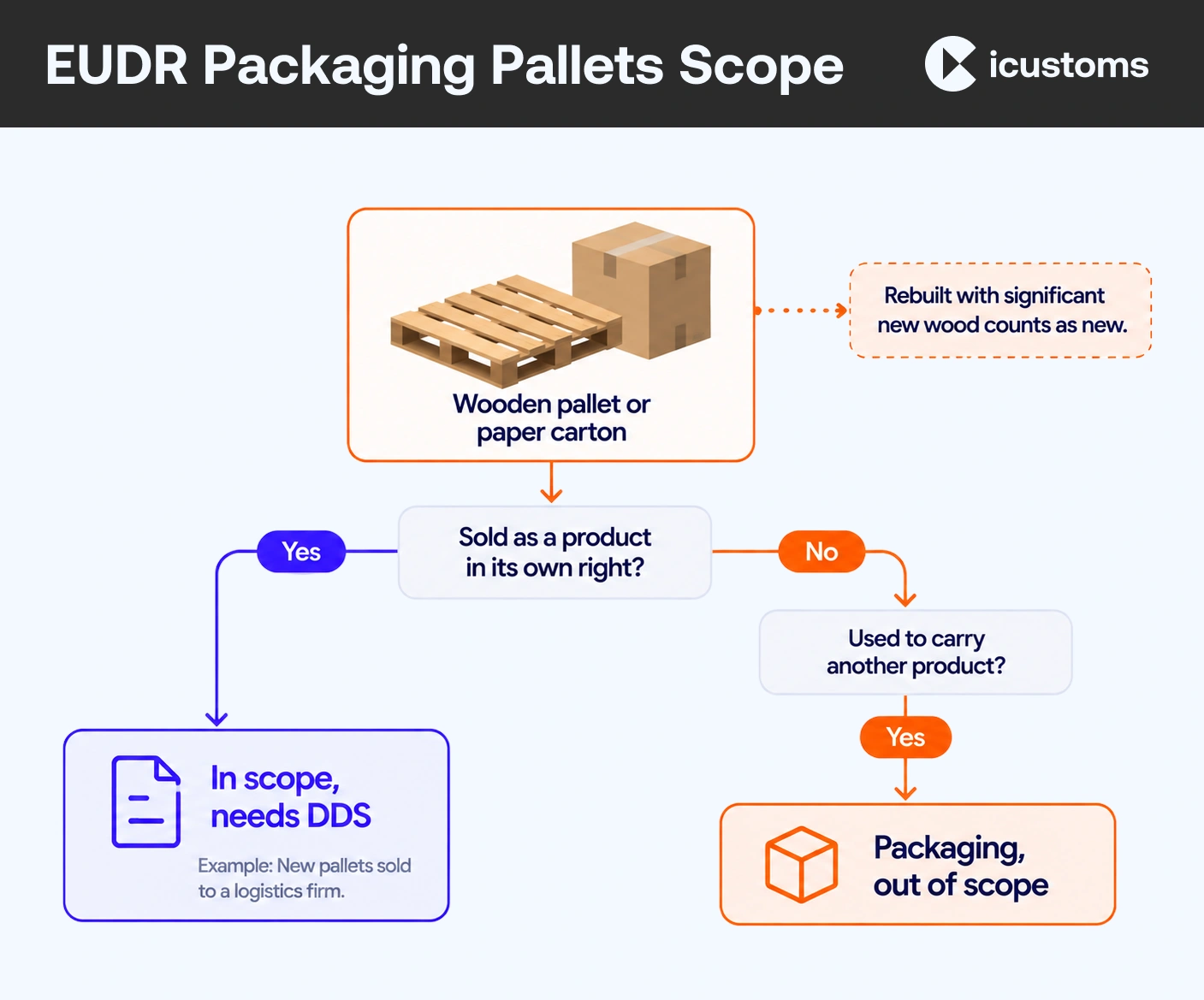
- Packaging used to support, protect or carry another product.
- Correspondence and marketing materials, such as brochures and catalogues.
- Products used in medicines, for several palm-based entries.
- Recycled goods made entirely from material that has completed its life cycle.
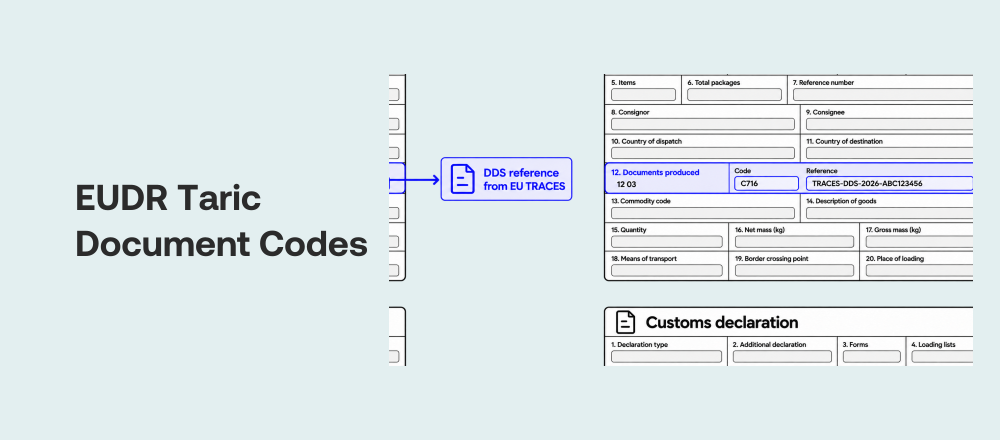
- Products produced before 29 June 2023, when the EUDR entered into force, declared with TARIC code Y132.
What Is Being Added From 30 December 2027
The 2026 update brings three groups into scope, with a year’s notice: soluble coffee and other coffee extracts (2101 11 00); frozen cattle tongues (ex 0206 21 00); and a wide range of palm oil derivatives, including hydrogenated palm oils, crude glycerol, fatty acids, fatty alcohols, amines, chemical preparations and soaps made using oil palm. Businesses in personal care, cleaning products and oleochemicals should treat 2027 as their EUDR start date.
Packaging, Pallets and Paper: The Tricky Cases
Wooden pallets and crates (ex 4415) are in scope when sold as products in their own right, for example new pallets sold to a logistics company. Once they are used to carry other goods, they are packaging and fall outside scope. A used pallet rebuilt with significant new wood can count as a new product.
Paper and board (ex 48) are in scope when placed on the market as paper, such as copier paper, notebooks or cartons sold as stock. Paper used as packaging for another product, items of correspondence and marketing materials are excluded.
Mixed products are judged by their code. A chocolate bar is in scope because chapter 18 is listed; a biscuit containing chocolate under a heading that is not in Annex I is not.
Three Real-World Scenarios
A leather goods importer bringing finished cattle leather into Italy would have needed due diligence under the original scope. Since 18 September 2026, ex 4107 is no longer listed, so those imports fall outside the EUDR.
A cosmetics manufacturer in France buys palm-based fatty alcohols and makes soap bars. Some of its inputs, such as palm oil and certain fatty alcohols, are already covered and arrive with supplier references. Its finished soaps (ex 3401 11 00) come into scope on 30 December 2027, giving it a year to map palm origin through its chemical suppliers.
An office supplies distributor imports copier paper from Asia and printed calendars from a separate supplier. The copier paper (chapter 48) needs a DDS. The printed calendars (chapter 49) do not, since printed products left scope in 2025.
How to Check Your Own Products
- List every product you import, export or place on the EU market, with its eight-digit CN code.
- Match each code against the consolidated Annex I, including ‘ex’ conditions and species notes.
- Check the exclusions: samples, waste, used goods, packaging, recycled material and medicinal use.
- Flag 2027 additions separately so they are planned, not forgotten.
Confirming scope is only the first step. For every in-scope product you then need to trace the commodity back to the plots where it was produced and check that land for deforestation after 2020, which we cover in our guide to verifying deforestation-free products.
For a business with hundreds or thousands of product lines, this is where errors creep in. iEUDR by iCustoms uses AI classification to suggest CN codes and flag in-scope products across your catalogue, with your team confirming each result, and the supplier portal shows whether each product falls within EUDR scope. Because each commodity asks for something different, such as species names for wood, every establishment for cattle, natural rather than synthetic rubber, and palm content for ‘ex’ codes, suppliers are asked for the data their commodity needs. In-scope lines then flow into DDS creation, validation and bulk submission to EU TRACES, and supplier statements are retrieved, verified and validated.
Frequently Asked Questions
What are the 7 EUDR commodities?
Cattle, cocoa, coffee, oil palm, rubber, soya and wood. Products made from them are covered where they are listed in Annex I.
What are the EUDR commodity codes?
They are the HS codes listed in Annex I, for example 1801 for cocoa beans, 0901 for coffee, 1511 for palm oil, 1201 90 00 for soya beans, 4001 for natural rubber, ex 0102 for live cattle and chapter 44 for wood. Check the eight-digit CN code of each product, since many entries only partly fall in scope.
Is leather still covered by the EUDR?
No. Delegated Regulation (EU) 2026/2102 removed cattle hides, skins and leather from Annex I from 18 September 2026.
Are books and printed products in EUDR scope?
No. Printed products under chapter 49 were removed by Regulation (EU) 2025/2650. Paper and paperboard under chapter 48 remain in scope.
Is packaging covered by the EUDR?
Packaging used to support, protect or carry another product is excluded. Packaging sold as a product in its own right, such as new wooden pallets or cartons sold as stock, is in scope.
Is soluble coffee covered by the EUDR?
Yes, from 30 December 2027. Roasted and green coffee under heading 0901 are covered from the general application date.
Are bamboo and rattan products covered?
No. The 2026 update confirms bamboo, rattan and similar woody materials are not wood for EUDR purposes.
Is palm oil in cosmetics covered?
Only where the product's code is listed. Several palm-based ingredients, such as glycerol and certain fatty alcohols, are already covered, and soaps made using oil palm join on 30 December 2027. Finished cosmetics under other headings are not in Annex I.
Are rubber gloves covered?
Yes, if they are made of natural rubber (ex 4015). Gloves made entirely of synthetic materials such as nitrile or vinyl are not covered.
You may also like:
Which of your products are actually in EUDR scope?

iEUDR’s AI classification flags in-scope CN codes across your catalogue, for your team to confirm.
Subscribe to our Newsletter
About iCustoms
iCustoms is an all-in-one solution helping businesses automate customs processes more efficiently. With AI-powered and machine-learning capabilities, iCustoms is designed to streamline your all customs procedures in a few minutes, cut additional costs and save time.
Leather out, soluble coffee in. Does your product list know?
Classify products once in iEUDR and see which lines need a DDS today and which join in 2027.