
EUDR TARIC Document Codes Explained: C716, C717, Y132 and the 2026 Update
- John Hall
- Customs Specialist at iCustoms.ai
Every customs declaration for goods listed in Annex I of the EUDR must carry an EUDR TARIC document code. Use C716 with the due diligence statement (DDS) reference number in the standard case, C717 with the identifier of a simplified declaration, or a Y code such as Y129, Y132 or Y133 when the goods are exempt. Without a valid code, the declaration is blocked.
The European Commission updated the code list on 23 September 2026 to reflect the 2025 amendment and the new product scope. To see which EUDR conditions apply to your product, enter its CN code in the EU TARIC consultation tool. This guide covers every current code, what changed, and how to choose the right one.
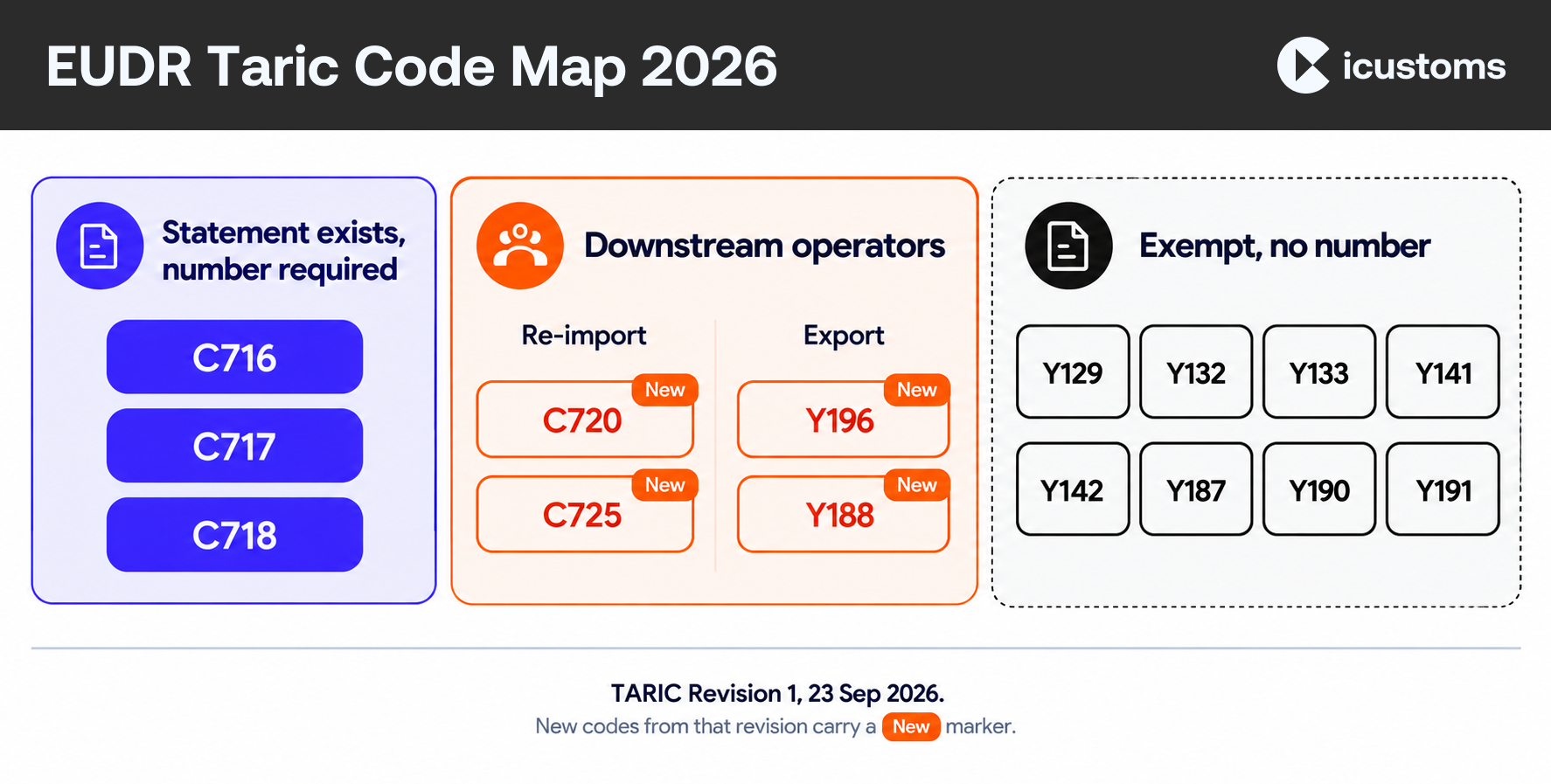
EUDR TARIC Codes at a Glance
| Code | Use it when | Number needed | Applies to |
|---|---|---|---|
| C716 | A due diligence statement covers the goods | DDS reference | Import and export |
| C717 | A micro or small primary operator’s simplified declaration covers the goods | Declaration identifier | Import and export |
| C718 | Goods were placed on the market in the transitional period and are now exported or re-imported | Conventional number | Export and re-import |
| C720 | A registered (non-SME) downstream operator re-imports goods | Upstream reference or identifier | Re-import |
| C725 | An unregistered (SME) downstream operator re-imports goods | Upstream reference or identifier | Re-import |
| Y129 | The goods fall under an ‘ex’ code but are outside EUDR scope | None | Import and export |
| Y132 | The goods were produced before 29 June 2023 | None | Import and export |
| Y133 | Used or second-hand goods, waste, recovered or end-of-life material | None | Import and export |
| Y141 | Micro or small enterprise established by 31 December 2024, until 29 June 2027 | None | Import and export |
| Y142 | Non-commercial activity | None | Import and export |
| Y187 | Samples or products used up in testing and analysis | None | Import and export |
| Y188 | An unregistered (SME) downstream operator exports | None | Export |
| Y190 | Packaging used only to carry another product (listed wood and paper codes) | None | Import and export |
| Y191 | Inputs for medicines, or correspondence and marketing material with another product | None | Import and export |
| Y196 | A registered (non-SME) downstream operator exports | None | Export |
What Changed in September 2026
| Code | Before (2024 list) | Now (Revision 1) |
|---|---|---|
| C717 | Reference of an earlier DDS, used by SMEs | Identifier of a micro or small primary operator’s simplified declaration |
| Y133 | Goods made from end-of-life material | Also used and second-hand goods, waste and recovered products |
| Y141 | Micro and small transitional exemption, earlier dates | Established by 31 December 2024; usable until 29 June 2027 |
| C718 | Transitional goods declared under C716 with a conventional number | Own code for transitional goods exported or re-imported |
| New | None | C720, C725, Y187, Y188, Y190, Y191, Y196 |
If your team learned the 2024 list, update declaration templates and any automatic code rules before 30 December 2026.
Where EUDR Codes Go on the Customs Declaration
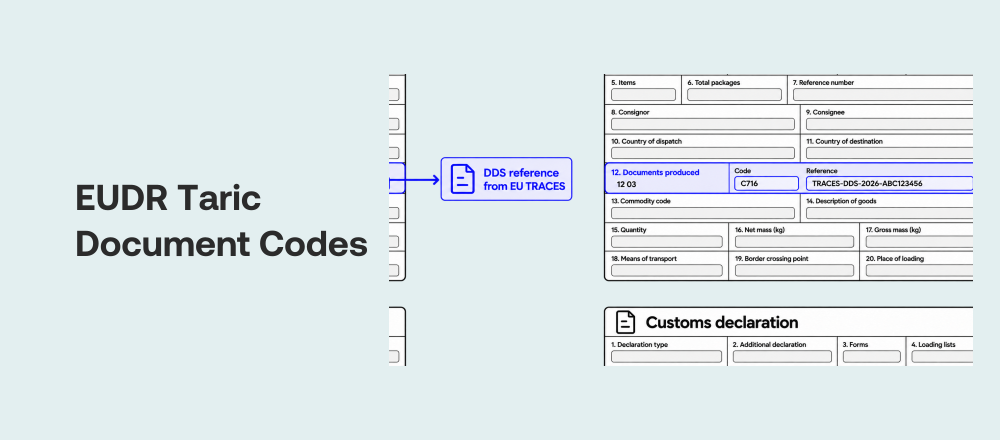
EUDR codes are entered as documents in the documents produced section of the declaration (data element 12 03 in the EU customs data model), together with the reference number where one is required. No new data elements were created for the EUDR. In Northern Ireland, declarations are made in HMRC’s Customs Declaration Service, where the same codes appear in the CDS document code list (Appendix 5).
The codes are needed when goods are released for free circulation or exported. Goods can enter customs warehousing, inward processing or transit without a DDS; the code and reference are needed when they are finally released.
TARIC applies a condition to every Annex I code: if no due diligence statement, simplified declaration or valid exemption is declared, the declaration is rejected. In practice, a missing or mistyped reference stops the goods at the border.
Codes When a Statement Exists
C716: EUDR due diligence statement
C716 is the standard EUDR document code. Use it whenever an operator’s DDS covers the goods being imported or exported, and enter the DDS reference number issued by the EUDR Information System. Most importers and exporters of in-scope goods will use C716 on almost every declaration. One declaration can carry several DDS references, and one reference can be used on several declarations, as long as the statement covers the goods (see our guide to the EUDR due diligence statement).
C717: simplified declaration identifier
C717 changed meaning in the September 2026 update. It now covers goods supplied by a micro or small primary operator who has filed a simplified declaration under Article 4a. Enter that declaration’s identifier. Earlier guidance, still widely quoted online, described C717 as a reference to someone else’s earlier DDS; that use no longer applies.
C718: transitional period goods
C718 covers products placed on the EU market between 30 June 2023 and the application date that are later exported or re-imported. Instead of a DDS reference, declare the conventional number 99EU9999999999. Earlier guidance used C716 with this number; Revision 1 gives it a code of its own.
Codes for Downstream Operators
The 2025 amendment created downstream operators, and the 2026 update gave them their own codes. They apply when products that already went through due diligence in the EU leave and come back, or are exported.
- C720 and C725 (re-import): enter the reference number received from your supplier or, if none was provided, the conventional reference 22EU2222222222. Use C720 if you are a non-SME registered in the Information System, C725 if you are an SME.
- Y196 and Y188 (export): no reference number is required. Use Y196 if you are a registered non-SME, Y188 if you are an SME.
If you cannot show the products were placed on the EU market and went through due diligence before export, a re-import is treated as a first import and needs C716.
Exemption Codes: When No Statement Is Needed
A Y code is a claim, not an automatic exemption. Keep evidence that the condition is met, such as production dates or proof that goods are used, because customs or the competent authority can ask for it.
Y129: outside scope under an 'ex' code
Many Annex I entries start with ‘ex’, meaning only part of the heading is covered. Use Y129 when your goods sit under such a heading but fall outside scope, for example soap with no palm content.
Y132: produced before 29 June 2023
The EUDR does not apply to products produced before it entered into force on 29 June 2023. Use Y132 and keep evidence of the production date.
Y133: used goods, waste and recycled material
The September 2026 update extended Y133. It now covers used and second-hand products, waste, recovered products and goods made entirely from material that has completed its life cycle.
Y141: micro and small enterprises in transition
Y141 covers natural persons and micro or small enterprises established as such by 31 December 2024, under the transitional rule in Article 38(3). It can be used until 29 June 2027.
Y142: non-commercial activity
Y142 applies when goods are not part of a commercial activity, including consumer-to-consumer consignments.
Y187, Y190 and Y191: new exemptions
Y187 covers samples of negligible value and products used up in testing. Y190 covers packaging used only to support, protect or carry another product, and only for the listed wood and paper codes (4401, 4405, 4415, 4416 and chapter 48). Y191 covers inputs for medicinal products and correspondence or marketing material sent with another product.
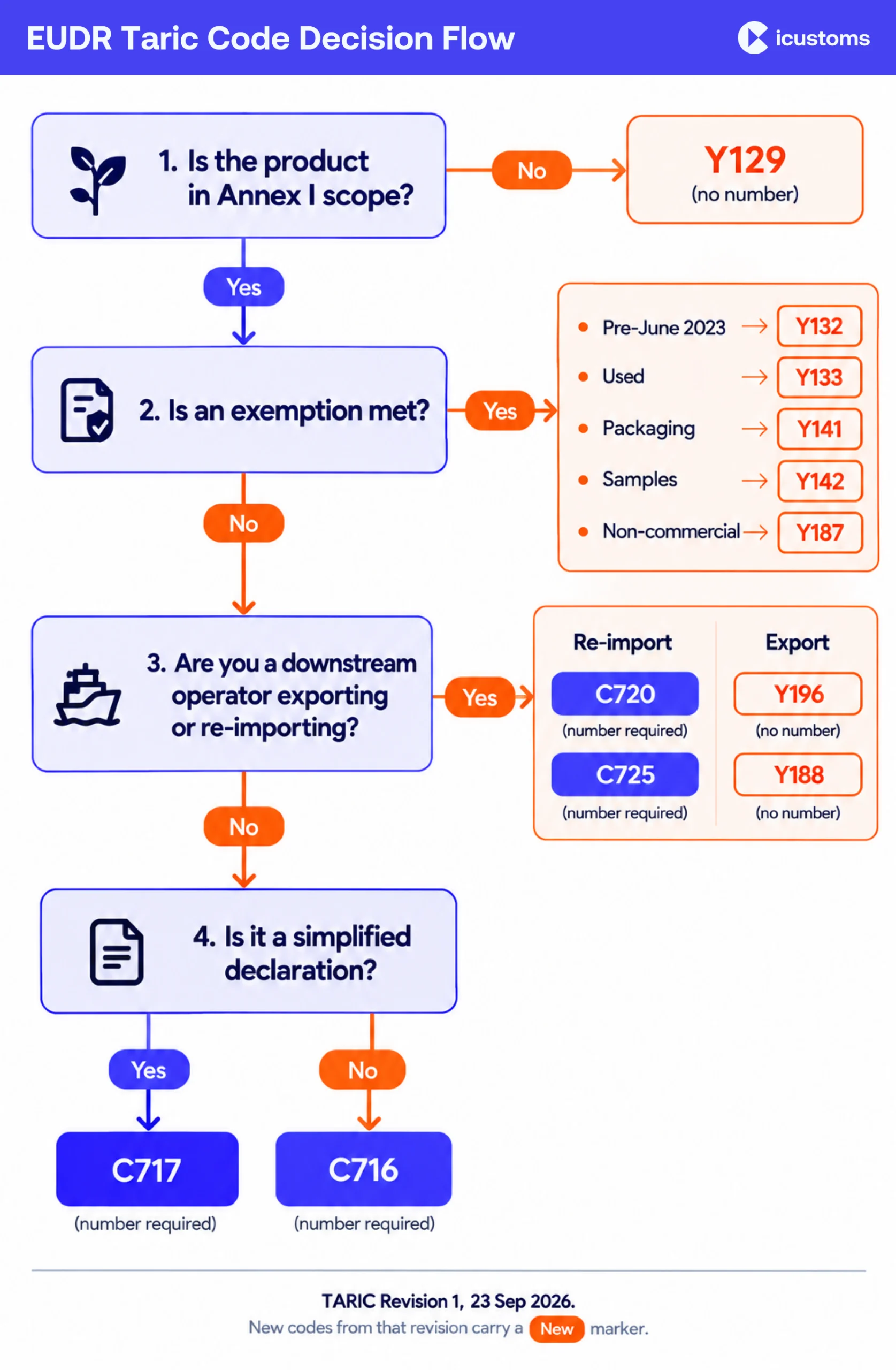
Which EUDR Code Should You Use?
| Situation | Code |
|---|---|
| Importing or exporting in-scope goods covered by a DDS | C716 + DDS reference |
| Buying direct from a micro or small primary operator with a simplified declaration | C717 + identifier |
| Goods under an ‘ex’ code that are outside scope | Y129 |
| Old stock produced before 29 June 2023 | Y132 |
| Used, second-hand, waste or recycled goods | Y133 |
| Pallets or cartons used only to carry other goods | Y190 |
| Non-SME downstream operator exporting | Y196 |
| SME downstream operator exporting | Y188 |
| Re-importing goods that already went through EU due diligence | C720 (non-SME) or C725 (SME) |
Real-World Scenarios
A forwarder in Rotterdam clears soya bean meal from Brazil for a feed producer. The importer is the operator and submits the DDS. The forwarder declares C716 with the reference number. If the reference arrives after the vessel, the declaration cannot be lodged.
A customs agent in Dublin clears machinery arriving on wooden pallets. The pallets are packaging and are not declared as separate goods, so no EUDR code is needed for them. If the client imports new pallets to sell, they are declared under 4415 and need C716.
A large German furniture maker exports chairs made from timber already placed on the EU market by its supplier. As a registered non-SME downstream operator, it declares Y196 on export, with no reference number required.
A timber trader in Antwerp imports logs from a stockpile felled in 2022. It declares Y132 and keeps harvest records to prove the production date.
How iEUDR Helps Customs Agents, Forwarders and Importers
Most EUDR customs problems are not about knowing the codes. They happen when the DDS reference is missing, late or does not match the goods on the declaration. iEUDR by iCustoms is built to close that gap.
- References reach the declarant before filing: the forwarder portal and notifications send each DDS reference to the forwarder or customs agent as soon as it is issued.
- Pre-submission checks: iEUDR warns or blocks when a reference is missing or does not match the shipment, before the declaration is lodged.
- Statements ready before goods arrive: supplier data comes in through the supplier portal, and iEUDR builds and validates each DDS, then submits it to EU TRACES, in bulk if needed.
- Supplier DDS verification: when a supplier gives you its DDS, iEUDR retrieves, verifies and validates it, so the reference you declare under C716 belongs to a valid statement.
- AI classification: iEUDR suggests CN codes and flags in-scope and ‘ex’ products for your team to confirm, which helps decide between C716 and Y129.
- Audit-ready records: every reference, statement and change is kept with the shipment in a time-stamped audit trail for five years.
iEUDR covers the EU and Northern Ireland, and comes from a customs software provider recognised by HMRC and Irish Revenue.
Frequently Asked Questions
What is TARIC code C716?
C716 is the EUDR document code for goods covered by a due diligence statement. It is declared with the DDS reference number on import and export declarations.
What does C717 mean now?
Since the September 2026 update, C717 is used for goods covered by a simplified declaration from a micro or small primary operator, declared with the declaration identifier.
What is TARIC code Y132?
Y132 is the exemption for products produced before 29 June 2023, the date the EUDR entered into force.
Do I need an EUDR code for goods in transit or a customs warehouse?
No. A DDS is not needed to place goods under transit, warehousing or inward processing. The code and reference are needed when the goods are released for free circulation or exported.
What happens if the EUDR code is missing or wrong?
The declaration is rejected under the TARIC condition for Annex I goods, and the goods cannot be released until a valid code and reference are declared.
Which code applies to wooden pallets?
Pallets that arrive carrying other goods are not declared separately, so they need no EUDR code. Y190 applies only when packing material is itself declared under a listed code (4401, 4405, 4415, 4416 or chapter 48) and is used only to carry other goods. New pallets imported to sell need C716 with a DDS reference.
Can I use Y129 for synthetic rubber?
Yes, where the goods sit under a rubber heading marked 'ex' in Annex I but are made entirely of synthetic rubber, since only natural rubber is covered. Keep the material specification as evidence.
You may also like:
Declaration blocked for a missing EUDR code?

iEUDR sends the DDS reference to your declarant before filing, so C716 is never left blank.
Subscribe to our Newsletter
About iCustoms
iCustoms is an all-in-one solution helping businesses automate customs processes more efficiently. With AI-powered and machine-learning capabilities, iCustoms is designed to streamline your all customs procedures in a few minutes, cut additional costs and save time.
C716, C720 or Y196? Get it right first time.
iEUDR checks each shipment’s reference against the goods before your forwarder files.