
EUDR Customs and Shipping: How the DDS Reference Reaches Customs
- John Hall
- Customs Specialist at iCustoms.ai
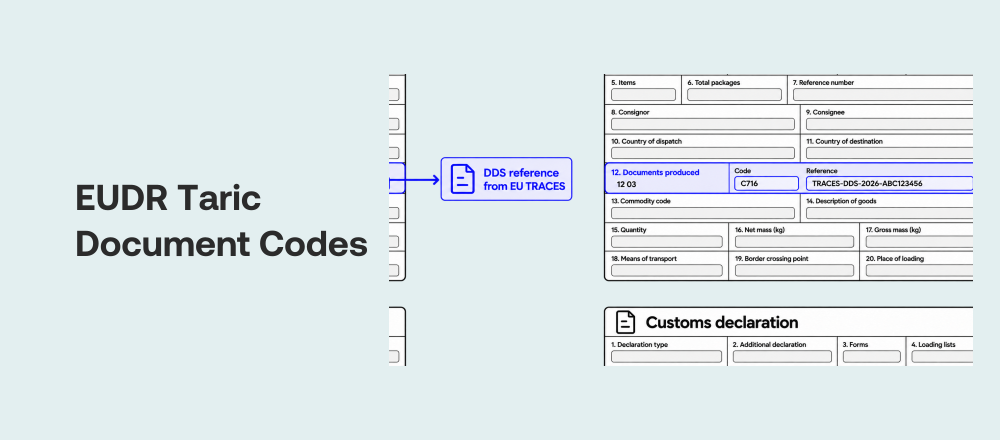
EUDR customs checks come down to one rule: goods listed in Annex I of the EU Deforestation Regulation cannot be released for free circulation or exported unless the customs declaration carries a valid due diligence statement (DDS) reference, a simplified declaration identifier or an exemption code. The operator files the DDS, the forwarder or customs agent puts its reference on the declaration under TARIC code C716, and customs checks it before release.
From 30 December 2026, that handoff becomes part of every relevant shipment for large and medium companies. This guide shows how the reference moves, who needs which documents, how split shipments and Incoterms affect the picture, and what customs does at the border.
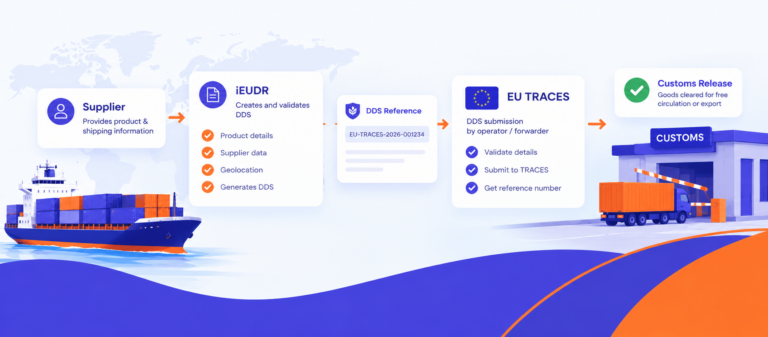
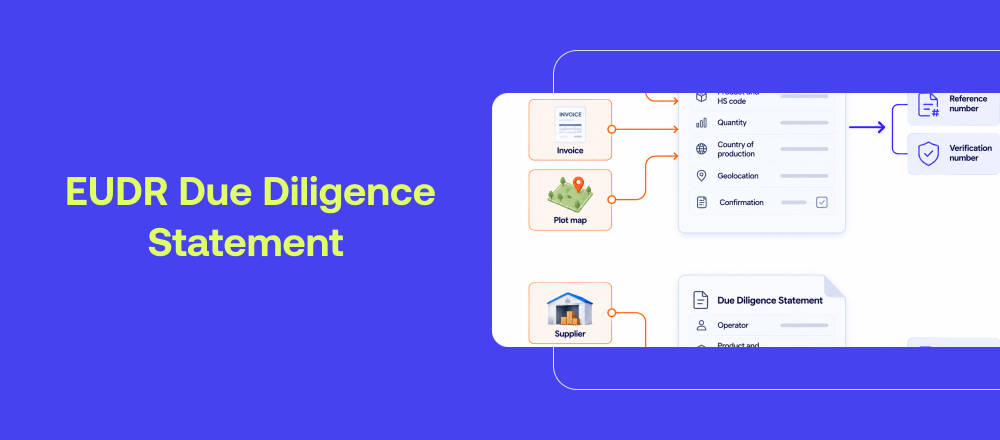
How the DDS Reference Moves from Supplier to Customs
- The supplier sends origin data: geolocation of every plot, production dates, quantities and legality evidence.
- The operator files the DDS in the EUDR Information System and receives a reference number and a verification number.
- The operator shares the reference with its forwarder or customs agent, matched to the right shipment and quantity.
- The declarant enters the code and reference on the declaration: C716 with the DDS reference in the documents field (data element 12 03).
- Customs checks the reference and can ask for more information or suspend release if the authority responsible for the EUDR asks it to.
- Goods are released, and everyone keeps the reference and supporting records for five years.
The weak point is step 3. A reference that arrives late, by email, or attached to the wrong consignment holds the goods just as surely as a missing health certificate.
Who Is Responsible for What
| Party | EUDR responsibility | What they need at customs |
|---|---|---|
| Non-EU supplier | No direct EUDR duty, but its data makes the DDS possible | Plot geolocation, production dates and legality evidence sent to the operator |
| Importer (operator) | Carries out due diligence and files the DDS | DDS reference and verification number for each consignment |
| EU buyer (downstream operator or trader) | Collects and keeps the references it receives | Supplier references, kept for five years |
| Freight forwarder | Usually none, unless it places goods on the market | The right reference for each shipment before filing |
| Customs agent (declarant) | Declares the code and reference correctly | C716 plus reference, or the correct Y code, with evidence |
| Customs authority | Checks references and enforces release rules | A valid reference that matches the goods |
The Commission’s EUDR FAQ is clear: a customs representative is never the EUDR operator, because it neither places goods on the market nor exports them. Filing a DDS for a client is a separate role, the authorised representative, which needs its own written mandate. The operator stays responsible either way.
The EUDR Documents Pack for Each Shipment
Customs may ask for evidence that the declared code and reference are right. Keep these EUDR documents together for every consignment:
- DDS reference and verification number, or the simplified declaration identifier.
- Commercial invoice and packing list with eight-digit CN codes, quantities and net mass that match the DDS.
- Transport document, such as the bill of lading or air waybill.
- EORI number of the operator, which also appears in the DDS.
- Evidence for any exemption, such as proof of production before 29 June 2023 (Y132) or an ingredient specification for an ‘ex’ code (Y129).
- Supplier references received from upstream operators, for downstream buyers.
Split, Partial and Consolidated Shipments
Managing EUDR reference numbers across shipments is where most errors happen. Three rules from the Commission’s EUDR FAQ help.
- One DDS can cover several shipments for up to a year, within the quantity it states. Track how much of that quantity each shipment uses.
- One declaration can carry several references when a consignment combines products covered by different statements.
- In a groupage container, each importer’s declaration carries its own references, even though the goods travel together.
Quantities must add up. If three shipments draw on one statement for 60 tonnes of cocoa, the third shipment cannot push the total past 60 tonnes.
Incoterms and EUDR: Who Is the Operator?
Incoterms 2020 decide delivery, cost and risk. They do not decide EUDR roles. The operator is the company that places the goods on the EU market or exports them, which for imports usually follows who clears the goods for free circulation.
| Incoterm | Who clears import | Likely EUDR operator |
|---|---|---|
| EXW, FCA, FAS, FOB | Buyer | EU buyer |
| CFR, CIF, CPT, CIP | Buyer | EU buyer |
| DAP, DPU | Buyer | EU buyer |
| DDP, seller established in the EU | Seller | The seller |
| DDP, seller outside the EU | Seller, through a customs agent | Two operators: the seller, and the first EU company that makes the goods available, usually the buyer (Article 7) |
For exports, the exporter is the operator if the goods were never placed on the EU market before, and a downstream operator if they were; under EXW, agree in the contract who exports. This section is guidance, not legal advice; confirm your position with your customs adviser.
Customs Controls and Release
Under Article 26 of the EUDR, customs authorities check relevant products entering or leaving the market and work with the authorities that enforce the regulation. If those authorities ask, customs can suspend release. A suspension normally lasts up to three working days, or 72 hours for perishable goods, unless the authority confirms that the goods must be held.
- No valid code or reference: the declaration is rejected and the goods are not released.
- Transit, customs warehousing and inward processing: no DDS is needed until the goods are released for free circulation or exported.
- Exports: an operator declares the DDS reference on the export declaration in the same way; a downstream operator exporting goods already placed on the EU market uses a dedicated TARIC code instead.
- Northern Ireland: goods moving from Great Britain or the rest of the world into Northern Ireland need the DDS reference too.
Our guide to EUDR TARIC document codes explains C716, C717 and every exemption code.
Common EUDR Customs Mistakes
Most holds at the border come from a handful of avoidable errors.
- CN code mismatch: the code on the declaration differs from the code in the DDS, often because the supplier used a six-digit HS code.
- Quantity overrun: a shipment pushes the total past the quantity stated in the DDS.
- Withdrawn or amended statement: the forwarder declares a reference the operator changed or withdrew within the 72-hour window.
- Wrong document code: C716 used where a simplified declaration (C717) or an exemption code applies.
- Retyped references: a reference copied from a PDF or email with one character wrong.
- Missing export code: teams set up imports correctly but forget that exports need an EUDR code too, either the DDS reference or the downstream operator code.
Each of these can be caught before filing if the reference, product, code and quantity are checked together.
Two Real-World Scenarios
Groupage coffee into Rotterdam. A forwarder consolidates green coffee from Colombia for three Dutch roasters in one container. Each roaster files its own DDS. The forwarder receives three references, and the customs agent lodges three declarations, each with C716 and the matching reference. One late reference holds only that roaster’s goods, if the paperwork is kept separate.
Wooden furniture sold DDP. A Vietnamese manufacturer sells oak tables to a German retailer on DDP terms and uses a customs agent to clear import. The seller imports in its own name, so it is an operator and files a DDS. Because the seller is established outside the EU, the German retailer, as the first EU company to make the tables available, is also an operator and must carry out its own due diligence and file its own DDS. The contract should say who supplies the plot data and when.
Checklist for Customs Agents and Forwarders
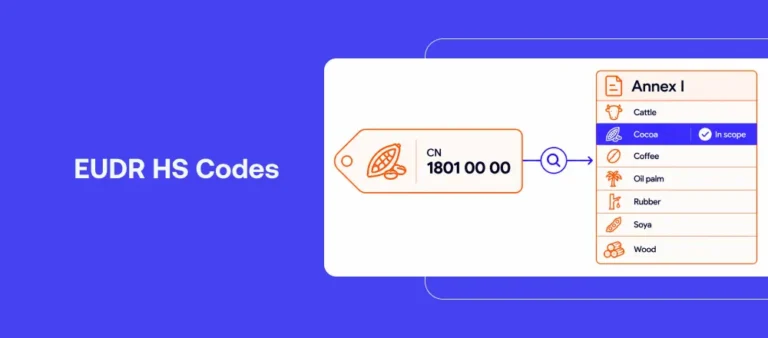
- Ask clients which CN codes they ship and which are in Annex I scope.
- Agree how references reach you, and how far ahead of arrival.
- Match every reference to a shipment, product and quantity before filing.
- Confirm the representation type and who carries EUDR obligations in writing.
- Keep references and evidence for five years.
- Train staff on C716, C717 and the main Y codes.
How iEUDR by iCustoms Connects the DDS to Customs
iEUDR by iCustoms is AI-powered, cloud-based EUDR compliance software built by a customs software provider, so the handoff to customs is part of the design, not an afterthought.
- DDS created, validated and submitted: iEUDR builds each statement from supplier data, validates it and submits it, singly or in bulk. Supplier statements are retrieved, verified and validated.
- Forwarder portal and notifications: each DDS reference reaches the forwarder or customs agent as soon as it is issued, matched to its shipment.
- Pre-submission checks: iEUDR warns or blocks when a reference is missing or does not match the shipment.
- Customs filing on one platform: iCustoms files customs declarations across the UK, Ireland and 22 EU countries, so the reference travels from statement to declaration without retyping.
- Five-year audit trail: every reference, statement and change is kept with the shipment it supports.
For the coffee forwarder above, each roaster’s reference arrives in the forwarder portal tagged to its consignment, so the container clears without chasing three inboxes.
Frequently Asked Questions
What do customs agents need for EUDR?
The DDS reference for each in-scope consignment, or the simplified declaration identifier or exemption code, plus evidence that the code and reference match the goods declared.
Who provides the DDS reference to customs?
The operator files the DDS and passes the reference to its forwarder or customs agent, who declares it with TARIC code C716.
Can goods be released without a DDS reference?
No. Annex I goods without a valid reference, simplified declaration identifier or exemption code cannot be released for free circulation or exported.
Who is the EUDR operator under DDP?
If the seller is established in the EU, the seller. If not, there are two operators: the non-EU seller that imports, and the first EU company that makes the goods available, usually the buyer. Both file a DDS.
Do goods in transit or a customs warehouse need a DDS?
No. The reference is needed when goods are released for free circulation or exported, not while they are in transit, warehousing or inward processing.
Is a freight forwarder an EUDR operator?
No, not when it only moves and clears goods for clients. The Commission's FAQ confirms customs representatives are never operators. It becomes one only if it places the goods on the market or exports them in its own right.
You may also like:
Waiting on a DDS reference while goods sit at the port?

iEUDR sends each DDS reference to your forwarder before they file, so clearance is never held up.
Subscribe to our Newsletter
About iCustoms
iCustoms is an all-in-one solution helping businesses automate customs processes more efficiently. With AI-powered and machine-learning capabilities, iCustoms is designed to streamline your all customs procedures in a few minutes, cut additional costs and save time.
Ten shipments, ten references, one spreadsheet?
iEUDR matches every DDS reference to its shipment and warns you before a mismatch reaches customs.