
EUDR for SMEs: A Lean Compliance Setup for Micro and Small Businesses Before 30 June 2027
- John Hall
- Customs Specialist at iCustoms.ai
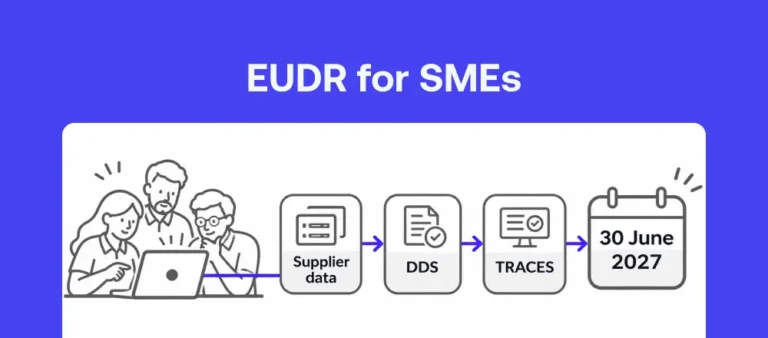
EUDR for SMEs comes down to three questions: are you micro, small or medium, are you importing or producing, and do your products come from low-risk countries? Micro and small companies apply the EU Deforestation Regulation from 30 June 2027, six months after larger firms. Most of them still file a due diligence statement (DDS) for every import. Only micro or small primary operators that grow or harvest their own products in a low-risk country can use the one-off simplified declaration instead. This guide shows which case you are in and the leanest setup that works for a small team.
Does the EUDR Apply to SMEs, and When? The EUDR Small Business Deadline
Yes. EUDR for SMEs works on the same principle as for large firms, with no size exemption: any company that places cattle, cocoa, coffee, oil palm, rubber, soya, wood or products made from them on the EU market, or exports them, is in scope. What changes with size is the date and the paperwork.
| Your size | Applies from | Main duty as an importer |
|---|---|---|
| Large or medium company | 30 December 2026 | Full due diligence and a DDS before each placing on the market |
| Micro or small company (established as such by 31 December 2024) | 30 June 2027 | Same due diligence and DDS, six months later |
| Micro or small primary operator in a low-risk country | 30 June 2027 | A one-off simplified declaration instead of a DDS |
Special rules apply to timber products that were already covered by the EU Timber Regulation, so wood businesses should check the transition rules in Article 38(3). For your exact role and date, use our EUDR role and deadline check.
Who counts as an SME under the EUDR?
The EUDR uses the thresholds of the Accounting Directive (2013/34/EU), not the EU’s general SME recommendation. You are a small undertaking if you do not exceed two of these three limits: a balance sheet total of €5 million, net turnover of €10 million and 50 employees on average. Medium undertakings stay within two of €25 million, €50 million and 250 employees. Size is tested per legal entity and per financial year, and a change only counts after two consecutive years above or below the limits. For the 30 June 2027 date, what matters is whether you were micro or small on 31 December 2024.
Micro or Small Primary Operator: The Four Tests
A micro or small primary operator (MSPO) is a special type of operator with lighter reporting. The Commission’s FAQ sets four tests, and you must meet all of them:
- Size: a natural person or a micro or small undertaking under the Accounting Directive.
- Location: established in a country classified as low risk.
- Direct sale: you place the products on the EU market, or export them, yourself, not through an intermediary outside the EU.
- Own production: you grew, harvested, raised or obtained the products yourself, in your country of establishment.
In practice, EUDR for SMEs that import means a DDS. MSPOs are mainly EU farmers and forest owners. An EU importer of cocoa or coffee, however small, is not an MSPO, because it did not produce the beans.
Can a large company qualify as an MSPO?
Sometimes. The FAQ’s part-of-business test lets a company count only the turnover, staff and assets linked to EUDR commodities. A business earning 70% of its turnover from wood and 30% from transporting metal, for example, counts only the 70%. If that share stays within the small-undertaking limits and the other three tests are met, it can qualify. You must be able to show the split in your accounts if a competent authority asks.
The EUDR Simplified Declaration and Declaration Identifier
An MSPO submits an EUDR simplified declaration once in the EUDR Information System (TRACES), instead of a DDS for every shipment. It contains your name and address, the commodity codes and descriptions of your products, a one-off estimate of annual quantity, and the location of your plots.
- Postal address instead of geolocation: an MSPO may give the postal address or cadastral reference of the plots, but only where it clearly matches the place of production. An office address is not enough.
- Declaration identifier: the system returns an identifier, which you pass to your first buyer instead of a DDS reference number.
- Updates: you may update the declaration after major changes, and must submit a new one before selling a product type it does not cover.
- Several products: one declaration can cover several products and several plots.
Micro businesses and individuals can also ask the next company in the chain to act as their authorised representative and submit for them, as long as that company is established in the EU and is not itself a micro business. Responsibility stays with the operator.
Author’s view · John Hall: know which form you are filing |
|---|
The words ‘simplified declaration’ have caused a lot of hope among small importers, and most of them will not use it. If you buy coffee from Brazil and import it into Rotterdam, you file a DDS like everyone else, just six months later. The simplified route is for the primary producer. Getting this right early saves a small team from planning around a form it will never be allowed to submit. |
Low-Risk Countries: Simplified Due Diligence
A separate simplification applies to sourcing, not size. Under Article 13, if all your products come from low-risk countries, you still collect the full information, including geolocation, and file a DDS, but you do not have to carry out a full risk assessment or risk mitigation, unless you learn of a concern. You still check the risk of mixing with products from standard or high-risk countries. Ghana, Vietnam and most of Europe, the UK and North America are low risk; Brazil, Côte d’Ivoire and Indonesia are standard risk. Competent authorities check at least 1% of operators sourcing from low-risk countries each year.
The Minimum EUDR Setup for a 10-Person Team
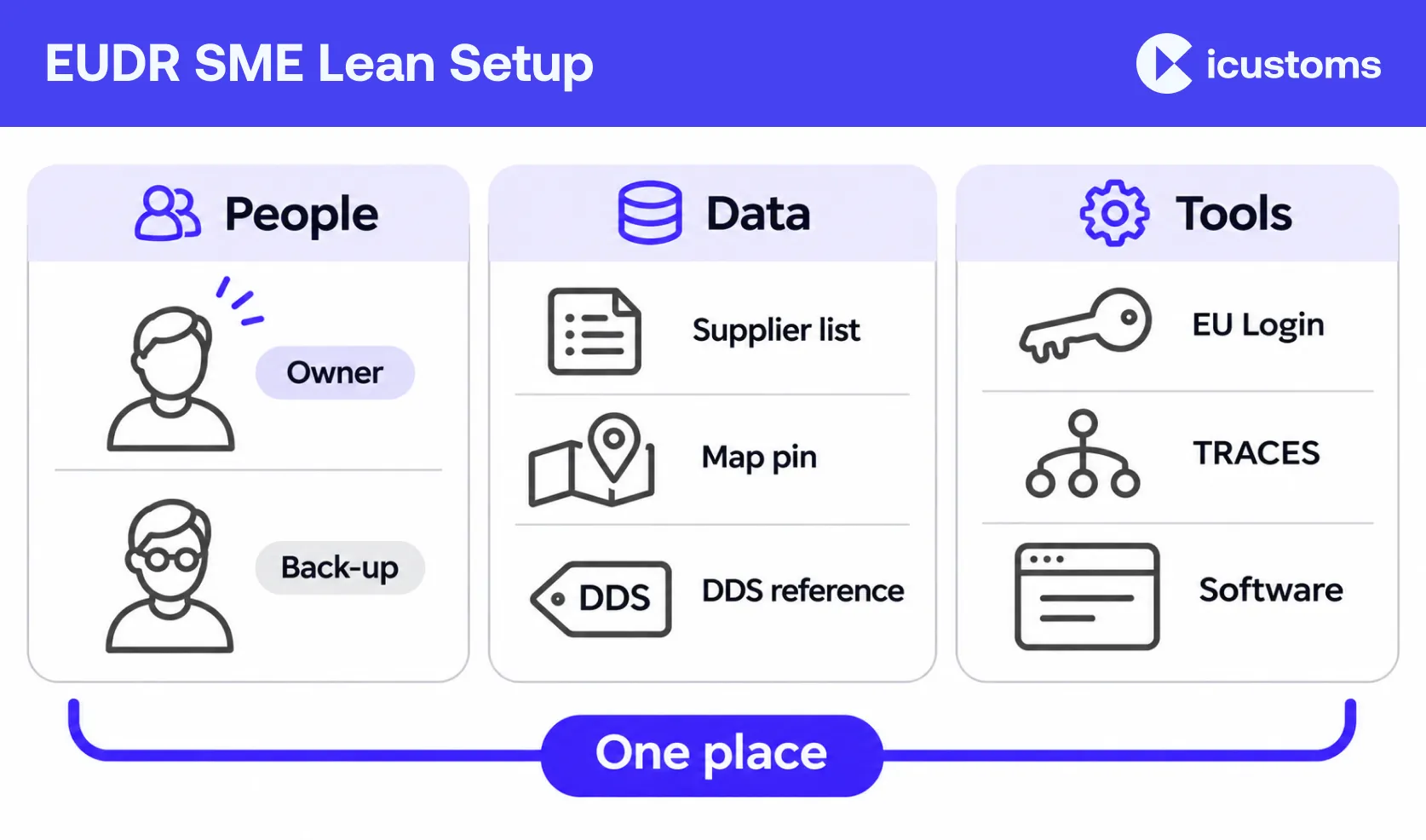
A lean starter setup for EUDR for SMEs needs three things, not a new department.
| Element | What it looks like for a small team |
|---|---|
| People | One named owner (often the operations or purchasing lead) with about a day a week in the first months, plus a back-up who can file when they are away. |
| Data | A supplier list with contacts, product codes, countries and volumes; plot geolocation or a DDS reference from every supplier; legality evidence; a simple record of each risk decision. |
| Tools | An EU Login account and access to the EUDR Information System (TRACES), an EORI number, and either a disciplined spreadsheet process or EUDR software that keeps supplier data, DDS and TRACES submission in one place. |
The single most useful step is a supplier data request that goes out now, not in June 2027. Ask each supplier for the country and plot geolocation of what they sell you, or whether they will file their own DDS and give you the reference. Our EUDR compliance guide has the full checklist.
EUDR for SMEs: A Time and Effort Planning Guide
| Task | With spreadsheets and email | With EUDR software |
|---|---|---|
| Map suppliers and products in scope | 1 to 2 weeks | Days, from your import data |
| Collect plot data from 10 to 30 suppliers | 4 to 12 weeks of follow-up | Suppliers self-serve in a portal; weeks |
| File each DDS | 30 to 60 minutes each, by hand | Minutes, singly or in bulk |
The 21 April 2026 Implementation Dialogue between Executive Vice-President Raffaele Fitto and businesses from the EU’s outermost regions heard the same message: EU rules weigh hardest on micro and small enterprises, which have no compliance team to absorb them. The lean approach to EUDR for SMEs above is designed with that in mind.
Author’s view · John Hall: spend the extra six months on suppliers |
|---|
The 30 June 2027 date is a gift if you use it on supplier data and a trap if you use it to wait. Your large customers and competitors will be filing from December 2026, so the tools, the templates and many of your suppliers will already be set up by the time your date arrives. A small team that sends its supplier request this winter can arrive at June with nothing left to do but file. |
What to Look For in EUDR Software for SMEs
Good EUDR software for SMEs should make compliance made easy rather than add another system to run. Check that it:
- Keeps supplier data, DDS and TRACES submission in one place.
- Gives suppliers a free portal with guidance, so you do not chase them by email.
- Validates geolocation before submission, and retrieves and checks DDS references from suppliers who file their own.
- Submits statements singly or in bulk and shares each reference with your forwarder.
- Keeps a five-year audit trail you can search in minutes.
- Prices and onboards for a small team, without a long implementation project.
Our guide to EUDR software covers the full checklist, and if your customers ask for sustainability data, see EUDR and ESG reporting.
How iEUDR by iCustoms Helps SMEs
iEUDR by iCustoms gives a small team one place for EUDR for SMEs, from supplier to customs. Many suppliers are already onboarded in iEUDR and checked against official EU TRACES records; new ones join a free supplier portal with built-in guidance, direct support and online learning. Every plot location is validated against the EUDR rules and converted to GeoJSON, AI classifies your CN codes, and iEUDR creates, validates and submits each DDS, singly or in bulk. Supplier statements are retrieved, verified and validated, each reference reaches your forwarder before they file, and everything sits in a five-year audit trail. See the EUDR compliance software page.
For example, a 10-person Belgian chocolate maker importing cocoa beans from Ghana and Côte d’Ivoire applies the EUDR from 30 June 2027. It sends one request through iEUDR to its four exporters, who upload plot data in the portal. Ghanaian lots get simplified due diligence; Ivorian lots get a full risk review. iEUDR files a DDS per shipment and sends each reference to the customs agent.
Frequently Asked Questions
When do small businesses need to comply with the EUDR?
Micro and small companies, as defined by the Accounting Directive and established as such by 31 December 2024, apply the EUDR from 30 June 2027. Medium and large companies apply it from 30 December 2026.
What is the EUDR simplified declaration?
A one-off declaration that a micro or small primary operator in a low-risk country submits instead of a DDS for each shipment. It returns a declaration identifier that is passed to the first buyer.
Do small importers file a simplified declaration?
No. Small importers are not primary producers, so they file a DDS for each placing on the market, from 30 June 2027.
Can a large company qualify as a micro or small primary operator?
Only if the part of its business linked to EUDR commodities stays within the small-undertaking limits, it meets the other three tests, and it can document the split.
What is the minimum EUDR setup for a small team?
For EUDR for SMEs, the minimum is one named owner, a supplier list with plot data or DDS references, an EU Login and TRACES account, and a reliable way to file and keep records for five years.
Is there EUDR software for SMEs?
Yes. Look for software that keeps supplier data, DDS and TRACES in one place, offers a free supplier portal and needs no long implementation.
You may also like:
Small team? EUDR still fits.

iEUDR keeps supplier data, DDS and TRACES submission in one place, sized for SMEs.
Subscribe to our Newsletter
About iCustoms
iCustoms is an all-in-one solution helping businesses automate customs processes more efficiently. With AI-powered and machine-learning capabilities, iCustoms is designed to streamline your all customs procedures in a few minutes, cut additional costs and save time.
Suppliers onboard for free.
Your suppliers enter plot data in iEUDR’s free portal, with built-in guidance and support.