
EUDR Supplier Data Requests by Country: What Mills in China, the US and India Can Realistically Provide
- John Hall
- Customs Specialist at iCustoms.ai
EUDR supplier data for paper and pulp is not about where the mill is. It is about where the trees were cut. A mill in China, the US or India can usually tell you what it makes, how much and under which customs code; the hard part is the plot geolocation and harvest dates of the wood behind it. This guide sets out what to ask for, what mills in each country can realistically provide today, what to do when a supplier cannot share geolocation, and gives you a free EUDR supplier questionnaire to send.
What EUDR Supplier Data You Need from Every Supplier
For each product you import, your DDS needs the following. Ask for all of it up front, in one request:
| Data | What it means for paper and pulp |
|---|---|
| Product description and CN code | For example 4802 copy paper, 4819 cartons, 4820 notebooks, 4703 pulp |
| Quantity | Net mass in kg, plus units where relevant |
| Country of production | Where the wood was harvested, not where the paper was made |
| Plot geolocation | Points or polygons for every forest plot, with at least six decimal places |
| Harvest date or period | When the wood was harvested |
| Tree species | Common and scientific name |
| Legality evidence | Harvest permits, concession or land-use rights, tax and labour compliance |
| Supplier details | Name, address and email of the supplier, and of any EU-side reference holder |
Fully recycled paper made only from post-consumer waste is out of scope. Mixed products need data for the virgin fibre only. Our EUDR commodities and products list covers the codes in full.
Why the Mill Is Not the Origin
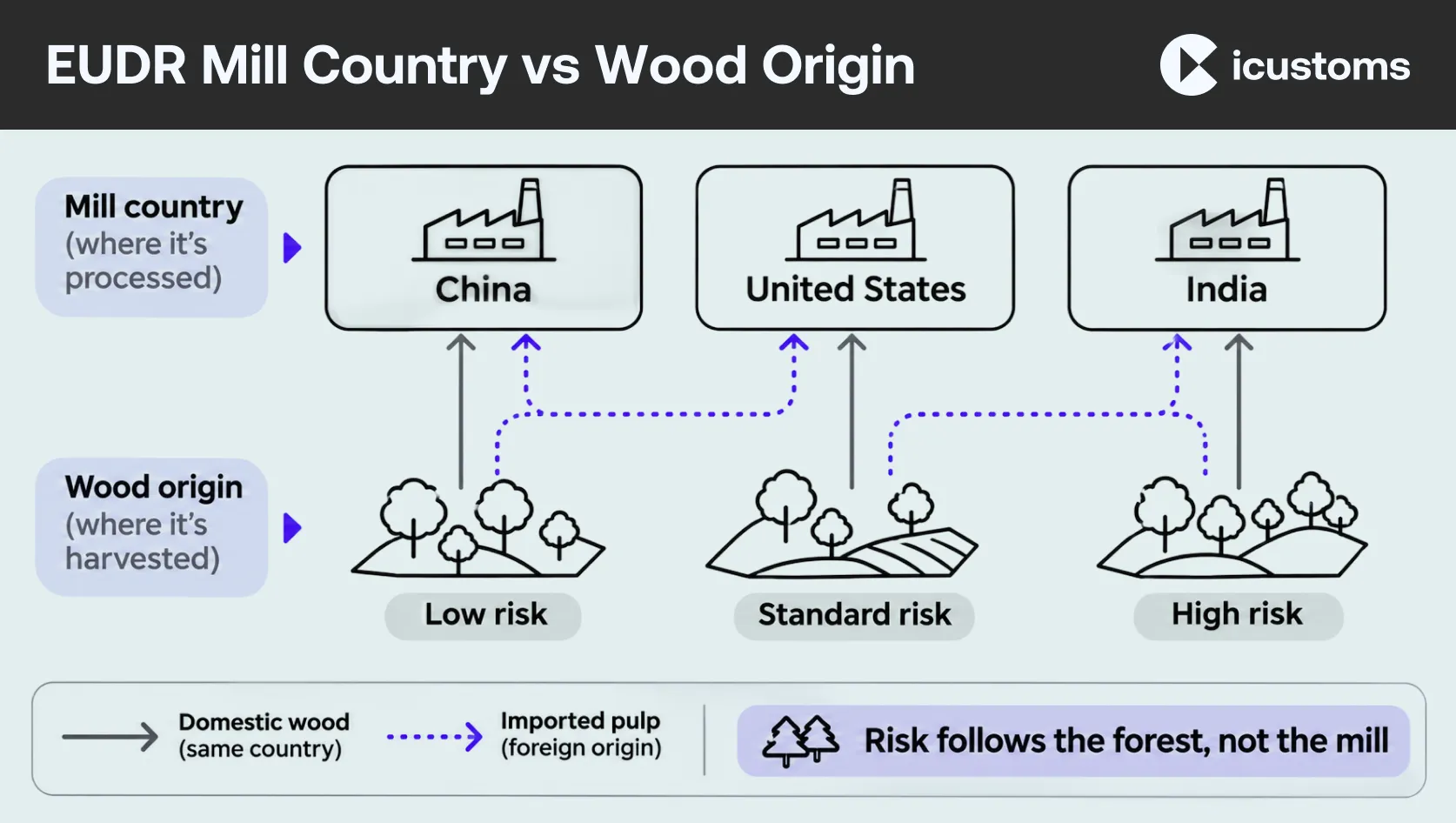
Under the EUDR, the country of production is where the commodity was produced, which for wood means where the trees were harvested. A paper mill only processes it. So the risk category that matters is the forest’s country, not the mill’s. China, the United States and India are all classified as low risk, but a Chinese mill running on Brazilian eucalyptus pulp brings standard-risk wood, and one using Russian or Belarusian wood brings high-risk wood that is also under EU sanctions.
This is the single most important question in any EUDR paper and pulp request: where did the fibre come from? Ask it before you ask anything else.
EUDR Supplier Data by Country: What Mills Can Realistically Provide
| Mill country | Usually easy to get | Usually hard to get | Typical wood origin |
|---|---|---|---|
| China | Product codes, quantities, species, certification, pulp supplier names | Plot geolocation for imported pulp and chips; data from small domestic plantations | Mix of imported pulp and chips (standard and low-risk origins) and domestic plantations |
| United States | State or county of harvest, species, certification (SFI, FSC, PEFC) | Plot polygons from many small private landowners | Mostly domestic, low risk |
| India | Product codes, quantities, paper grade, recycled share | Origin of imported pulp; plot data for virgin fibre | Mix of recycled fibre, imported pulp and domestic plantations |
What EUDR data can a Chinese paper mill provide?
Most Chinese mills can give you product, quantity, species and certification data quickly. The gap is upstream: many use imported pulp or woodchips, so the plot data sits with the pulp producer. Ask the mill to name its pulp suppliers and request their plot data directly or through the mill. Large integrated pulp producers increasingly prepare EUDR data packs; small domestic plantation supply is harder. Some Chinese suppliers have raised concerns about sharing precise geographic data abroad, so agree early how the data will be shared.
Do US mills have plot-level geolocation?
Often not at the polygon level, at least not yet. US mills tend to buy wood from many private landowners through loggers and dealers, so records are commonly held by state, county or procurement area. The good news is that the US is low risk, so simplified due diligence applies, but you still need the geolocation of every plot. Ask whether the mill can map its supplying tracts, and whether its certification body offers an EUDR data option.
Do Indian printers still need to provide EUDR data?
It depends on the code. Printed books, newspapers and other chapter 49 products left the EUDR in 2025, so an Indian printer exporting books has nothing to provide. But printed cartons (4819), notebooks and diaries (4820) and printed paper still classified in chapter 48 remain in scope, and so does the paper the printer buys. For those, the printer must pass on data from its paper supplier, which often means imported pulp.
Author’s view · Freya Jane: ask about the fibre before the paperwork |
|---|
When a supplier sends back a neat certificate and a product spec, it is tempting to tick the box. For paper, I would always ask one more question first: what pulp went into this, and from where? That one answer tells you whether you are dealing with low, standard or high-risk wood, who actually holds the plot data, and how much work the rest of the request will take. |
Low-Risk Countries and Simplified Due Diligence
If all the wood in a product was harvested in low-risk countries, Article 13 lets you skip the full risk assessment and mitigation, unless you learn of a concern. You still need all the EUDR supplier data in the table above, including geolocation, and you still check the risk of mixing with wood from standard or high-risk countries. For a Chinese or Indian mill using imported pulp, that mixing check is where most of the work sits.
When a Supplier Cannot Share Geolocation
The rule is simple: without geolocation for every plot, the product cannot be placed on the EU market. In practice you have five options:
- Go one tier up. Ask for the pulp or wood supplier’s contact and request the plot data from them directly.
- Use a secure channel. Some suppliers will share coordinates through a supplier portal but not by email.
- Use what the scheme holds. FSC and PEFC chain of custody does not give you geolocation on its own, but both schemes have introduced EUDR data options; ask whether your supplier uses them.
- Change the product. Fully recycled grades are out of scope; a different grade or mill may have mapped supply.
- Change the supplier. If none of this works, the product cannot come into the EU from that source.
Author’s view · John Hall: set a date, not an open question |
|---|
An open-ended request for EUDR supplier evidence tends to get an open-ended answer. I would put a date on it, explain which customs code and which shipments it is for, and say plainly that without the data the order cannot ship to the EU after your deadline. Suppliers respond to specific requests far better than to a general questionnaire. |
The EUDR Supplier Questionnaire: Free Template
Copy this into an email or form. It covers the minimum EUDR supplier data for paper, pulp and packaging, and helps you exchange supplier data, harvest dates and land plot coordinates in one round.
| # | Question to the supplier | Why we ask |
|---|---|---|
| 1 | Product name, CN or HS code, and net mass per shipment | Identifies the product and quantity on the DDS |
| 2 | Is the product made from 100% post-consumer recycled fibre? If not, what share is virgin fibre? | Recycled content is out of scope |
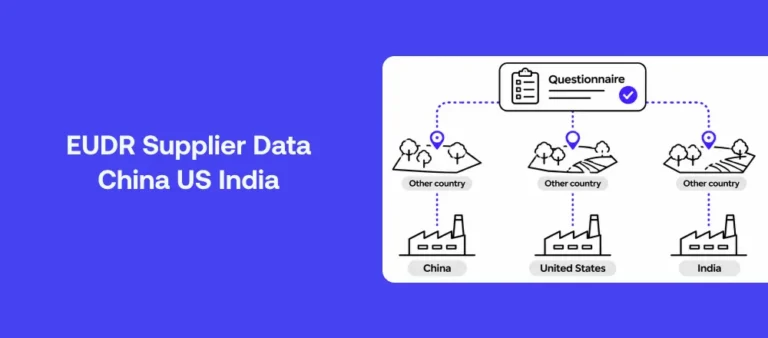
| 3 | Name and address of each pulp or wood supplier | The mill is not the origin |
| 4 | Country of harvest of all virgin fibre | Sets the risk category |
| 5 | Plot geolocation: points, or polygons for plots over 4 ha, in GeoJSON or WGS84 with six decimals | Required for every plot |
| 6 | Harvest date or period | Needed to check for deforestation since the 2020 cut-off |
| 7 | Tree species (common and scientific name) | Required for wood products |
| 8 | Legality evidence: harvest permit, land rights, tax and labour compliance | Legal in the country of production |
| 9 | Certification and chain of custody numbers (FSC, PEFC, SFI), if any | Supports the risk assessment |
| 10 | If you or your customer already filed a DDS, the supplier’s EUDR reference number and verification number | For products already on the EU market |
| 11 | Contact person and date by which you can provide the data | Keeps the request moving |
For timber rather than paper, the same template works for any EUDR compliant timber supplier. For the next step, turning the answers into a statement, see our EUDR compliance guide, and to check the plots, see how to verify products are deforestation-free.
How iEUDR by iCustoms Handles EUDR Supplier Onboarding
iEUDR by iCustoms turns this template into an EUDR supplier portal. You send one request; mills and pulp suppliers answer in their own portal, free of charge, with built-in guidance, direct support and online learning, and many are already onboarded and checked against official EU TRACES records. You can see who has answered and what is missing. Every plot location is validated against the EUDR rules and converted to GeoJSON before it reaches your DDS, AI classifies the CN codes, and iEUDR creates, validates and submits each statement, singly or in bulk. Where a supplier already holds an EUDR reference number, iEUDR retrieves, verifies and validates it. Everything is kept in a five-year audit trail. See the EUDR compliance software page.
For example, a Dutch office supplies wholesaler buying copy paper from a Chinese mill, cartons from India and coated board from the US sends one EUDR supplier data request through iEUDR. The Chinese mill names its pulp suppliers, who upload their plots; the US mill maps its supplying tracts; the Indian printer confirms which lines are chapter 49 and out of scope.
Frequently Asked Questions
What EUDR data can a Chinese paper mill provide?
Usually product, quantity, species and certification data. Plot geolocation for imported pulp often has to come from the pulp supplier, through the mill or directly.
Do US mills have plot-level geolocation?
Many hold records by state or county rather than by plot. The US is low risk, but plot geolocation is still required for every plot.
Do Indian printers still need to provide EUDR data?
Not for printed books and other chapter 49 products, which left scope in 2025. Yes for cartons, notebooks and other chapter 48 paper products.
What if a supplier cannot share geolocation?
Ask the next supplier up, offer a secure supplier portal, check certification data options, or switch to recycled grades or another supplier. Without geolocation the product cannot be placed on the EU market.
Is the mill's country the country of production?
No. For wood, the country of production is where the trees were harvested, which sets the risk category.
What should an EUDR supplier questionnaire include?
All the EUDR supplier data for your DDS: product and code, quantity, recycled share, fibre suppliers, country of harvest, plot geolocation, harvest dates, species, legality evidence, certification and any existing EUDR reference number.
You may also like:
Stop chasing mills by email.

Send one EUDR supplier data request from iEUDR and track every answer in one place.
Subscribe to our Newsletter
About iCustoms
iCustoms is an all-in-one solution helping businesses automate customs processes more efficiently. With AI-powered and machine-learning capabilities, iCustoms is designed to streamline your all customs procedures in a few minutes, cut additional costs and save time.
Turn this template into a portal.
Suppliers answer in iEUDR’s free supplier portal, with every plot validated on the way in.