
EUDR Regulation Guide 2026: What Importers, Traders and Forwarders Must Do
- John Hall
- Customs Specialist at iCustoms.ai
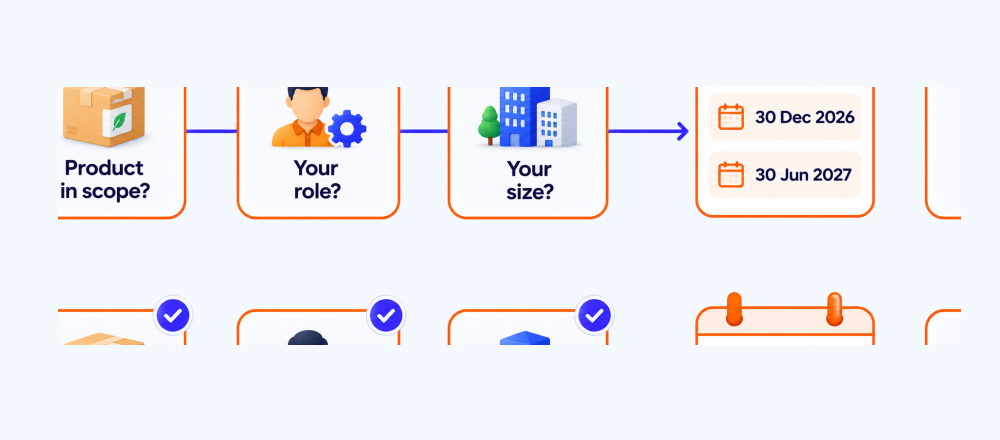
The EUDR regulation, Regulation (EU) 2023/1115, requires companies that place cattle, cocoa, coffee, oil palm, rubber, soya or wood products on the EU market, or export them, to show those products are deforestation-free, legally produced and covered by a due diligence statement. It applies from 30 December 2026 for large and medium companies and from 30 June 2027 for most micro and small ones.
This guide explains what the regulation covers, who it applies to after the 2025 amendment, the dates that matter and what to do before they arrive.
What Is the EUDR Regulation?
EUDR is short for the European Union Deforestation Regulation. Its full title is the European Union Regulation on Deforestation-free Products, in force since 29 June 2023. It replaces the EU Timber Regulation, which only covered wood.
The core rule sits in Article 3. A relevant product can only be placed on the EU market, made available on it, or exported from it if it is:
- Deforestation-free: produced on land not deforested after 31 December 2020, the EUDR cutoff date. Wood must also be harvested without forest degradation after that date.
- Legally produced: in line with the laws of the country of production, including land use, environment, labour and human rights, tax, anti-corruption, trade and customs rules.
- Covered by a due diligence statement: or, for some micro and small producers, a simplified declaration.
The regulation has been amended twice. Regulation (EU) 2024/3234 delayed application by twelve months, and Regulation (EU) 2025/2650, in force since 26 December 2025, set new dates and simplified obligations further down the supply chain. The Commission’s simplification review of May 2026 proposed no further postponement.
Why the EU Introduced the Deforestation Regulation
The UN Food and Agriculture Organization estimates that around 420 million hectares of forest were lost between 1990 and 2020, mostly to agricultural expansion. Earlier rules relied on voluntary pledges and certification labels. The EUDR instead places responsibility on the companies that bring products into the EU market, and asks for evidence that traces back to the plot of land where the commodity was produced.
The Seven EUDR Commodities and Derived Products
The EUDR covers seven commodities and a list of products made from them, set out by HS code in Annex I.
| Commodity | Examples of covered products |
|---|---|
| Cattle | Live cattle, fresh and frozen beef |
| Cocoa | Cocoa beans, cocoa paste, butter and powder, chocolate |
| Coffee | Green and roasted coffee, coffee husks and skins |
| Oil palm | Palm oil, palm kernel oil, palm nuts and kernels, selected derivatives |
| Rubber | Natural rubber, new tyres, selected rubber articles |
| Soya | Soya beans, soya flour and meal, soya oil, soya bean oilcake |
| Wood | Logs, sawn wood, plywood, pulp, paper and paperboard, wooden furniture |
Scope has already changed. Printed products such as books and newspapers were removed in 2025. Delegated Regulation (EU) 2026/2102, in force since 18 September 2026, removed cattle hides, skins and leather, conveyor belts and other vulcanised rubber articles, retreaded and used tyres, soya beans for sowing, and aircraft and vehicle seats. It adds soluble coffee, more palm oil derivatives and frozen cattle tongues from 30 December 2027. Samples, waste, used and second-hand goods and packaging that only carries other products are excluded. Always check your CN code, not just the commodity name.
Who Does the EUDR Apply To?
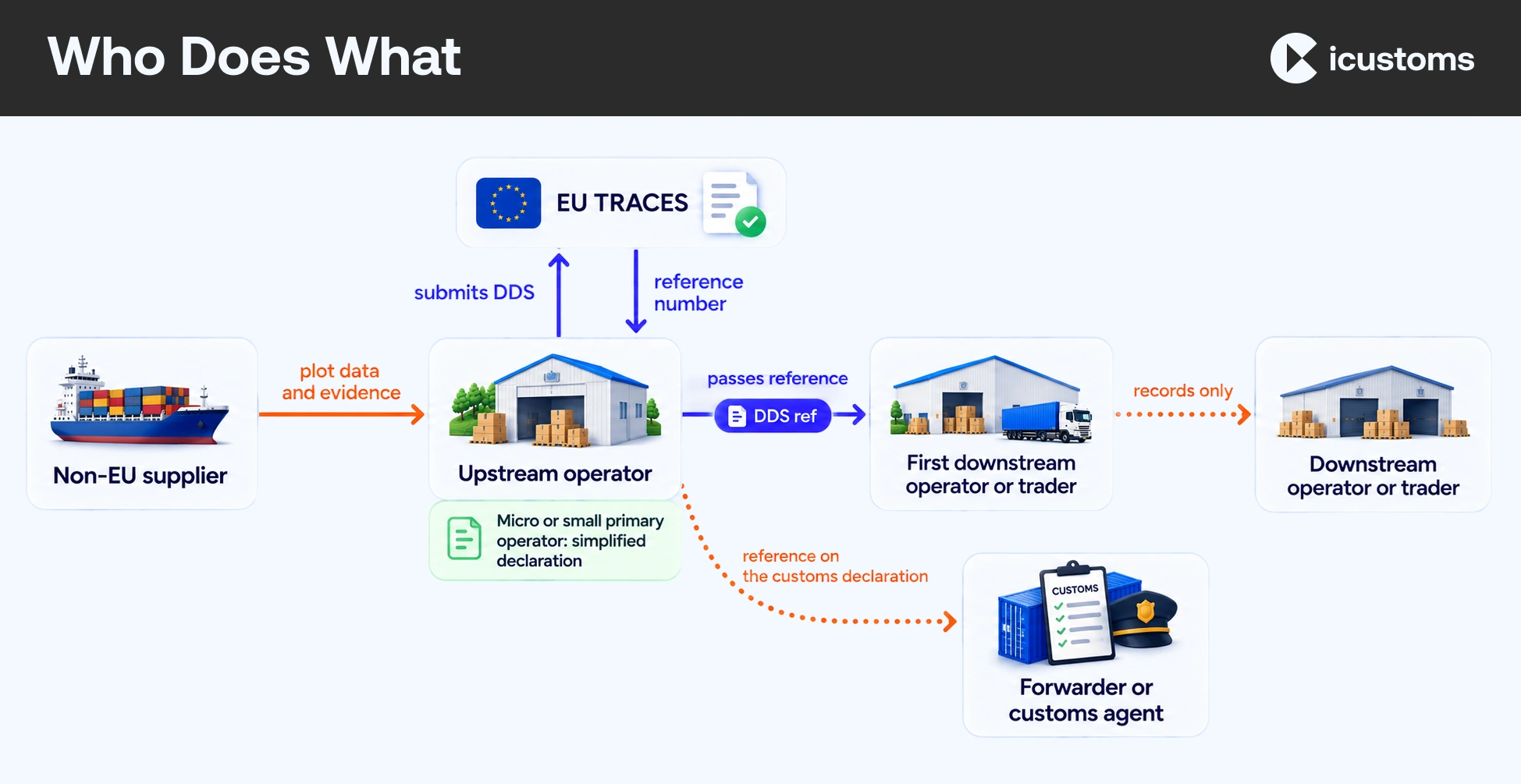
The 2025 amendment means due diligence happens once, where a product first enters or leaves the EU market. The European Commission describes four key roles.
| Role | Who it is | Main obligation |
|---|---|---|
| Upstream operator | The business that first places a product on the EU market or exports it, such as an importer of cocoa beans or an EU farmer selling its own harvest | Carry out due diligence, submit a due diligence statement (DDS) before placing or export, and pass the DDS reference number to its direct buyers |
| Upstream micro or small primary operator | A natural person or micro or small business in a low-risk country selling what it grew or harvested itself | Carry out due diligence and submit a one-off simplified declaration instead of a DDS |
| First downstream operator or trader | The first buyer from an upstream operator | Collect and keep the DDS reference number or declaration identifier for five years |
| Downstream operator or trader | A business that processes the product into a new product code (downstream operator) or resells it unchanged (trader) | No DDS. Keep supplier and buyer records for five years and tell buyers and authorities if a product may not comply |
Large downstream operators and traders, meaning those that are not SMEs, must also register in the EUDR Information System. Size is tested per legal entity using the EU Accounting Directive thresholds, which we set out in our guide to EUDR deadlines by role and size.
Non-EU suppliers have no direct EUDR obligation, but their EU customer cannot file without their plot data. Freight forwarders and customs agents are never operators; their job is to get the DDS reference onto the customs declaration.
Key EUDR Dates: 2020 to 2027
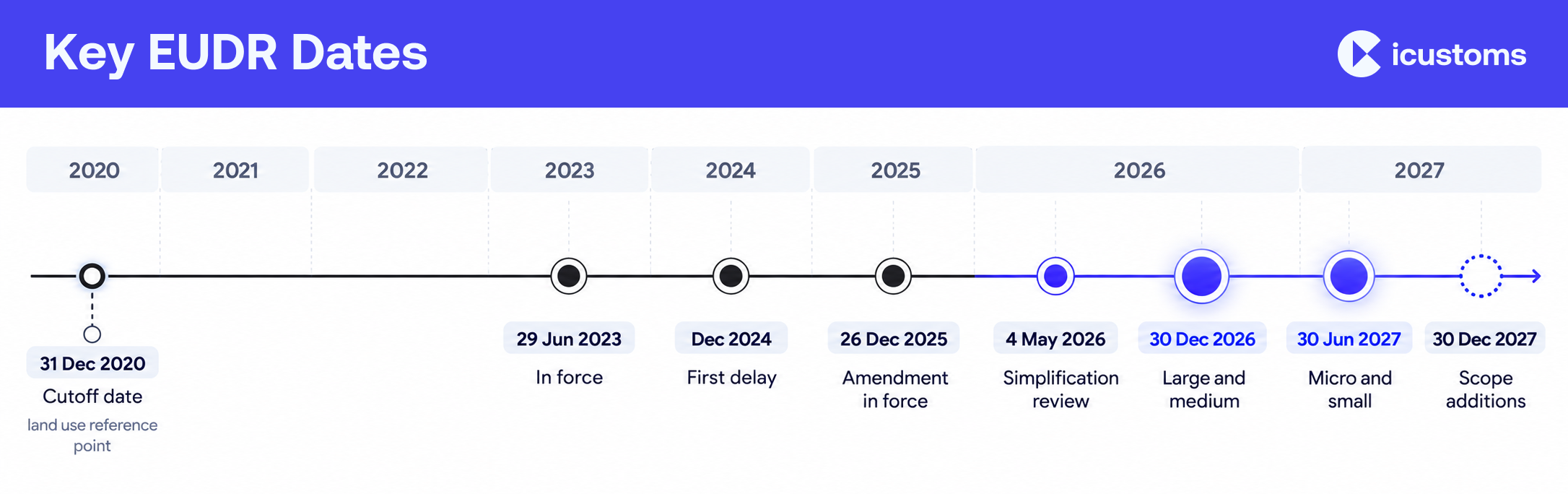
| Date | What happens |
|---|---|
| 31 December 2020 | Cutoff date. Land deforested after this date cannot supply compliant products |
| 29 June 2023 | Regulation (EU) 2023/1115 enters into force |
| 26 December 2025 | Regulation (EU) 2025/2650 in force: new dates, simplified downstream regime |
| 18 September 2026 | Delegated Regulation (EU) 2026/2102 in force: product scope updated |
| 30 December 2026 | Applies to large and medium companies, and to micro and small businesses already covered by the EU Timber Regulation |
| 30 June 2027 | Applies to all other micro and small operators |
| 30 December 2027 | Products added in 2026, such as soluble coffee, come into scope |
The cutoff date is a reference point for land use. The application date is when your obligations start.
What EUDR Compliance Involves
For operators, EUDR compliance rests on a due diligence system with three steps.
- Information collection (Article 9): product, quantity, country of production, geolocation of every plot, production date, supplier and customer details, and evidence that the product is deforestation-free and legal. Plots over four hectares need a polygon, not a single point.
- Risk assessment (Article 10): weigh that information against criteria such as country risk, forest cover, supply chain complexity and the risk of mixing with products of unknown origin.
- Risk mitigation (Article 11): where risk is more than negligible, request more evidence, commission audits or support suppliers until it is negligible.
Under Implementing Regulation (EU) 2025/1093, countries are rated low, standard or high risk. Products sourced only from low-risk countries, which include China, the United States, the UK and EU member states, qualify for simplified due diligence: information is still collected, but steps two and three apply only if there are signs of a problem.
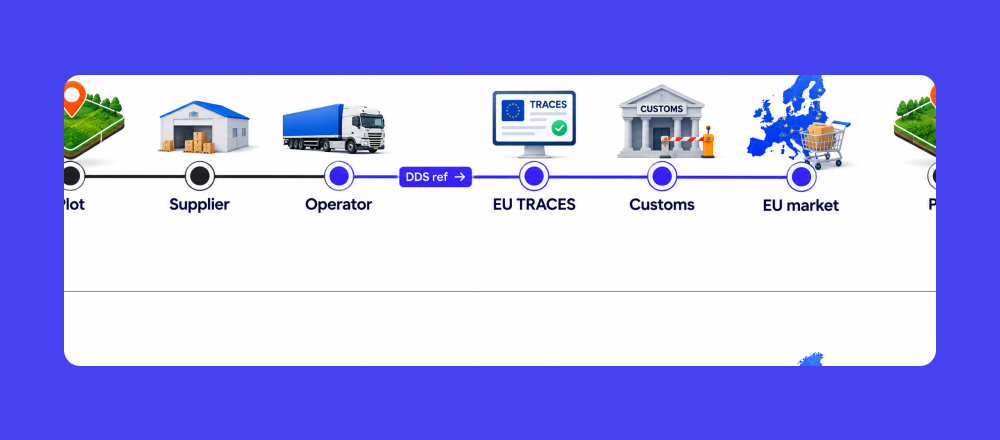
The operator then submits a DDS in the EUDR Information System, which returns a reference number and a verification number. The reference goes on the customs declaration and to direct buyers. Records are kept for five years.
A Worked Example: One Cocoa Shipment
A Dutch cocoa importer buys 20 tonnes of beans from a cooperative in Ghana. Before the container arrives, the cooperative shares the GPS points and polygons of the farms that supplied the beans, with harvest dates and land documents. Ghana is rated low risk, so the importer collects and checks this information, finds nothing that suggests a problem, and submits a DDS in the EUDR Information System.
The system returns a reference number. The importer sends it to its customs agent, who declares it on the import declaration with TARIC document code C716, and the goods are released. The importer then passes the same reference to its buyer, a Belgian chocolate maker. As the first downstream operator, the chocolate maker keeps that reference with its supplier records for five years. It files no DDS of its own when it sells the chocolate.
How the EUDR Connects to Customs, TRACES and ESG Reporting
Customs
When relevant products are released for free circulation or exported, the declaration carries an EUDR document code. C716 with the DDS reference is the standard case; C717 is used with the identifier of a micro or small primary operator’s simplified declaration; Y codes such as Y129 and Y132 declare goods that are out of scope or exempt. We explain every code in our guide to EUDR TARIC document codes.
TRACES
The EUDR Information System runs on the Commission’s TRACES platform. It reopened for registrations at the end of June 2026, and Implementing Regulation (EU) 2026/1565 sets its current rules, including simplified declarations. Statements can be entered through the web form or sent through the official API.
ESG reporting
Plot-level data and supplier records gathered for EUDR are also useful evidence for sustainability disclosures, such as biodiversity reporting under the European Sustainability Reporting Standards. One well-kept data set can serve both.
EUDR in the UK and Northern Ireland
The EUDR does not apply to goods placed on the market in Great Britain, but British suppliers to EU customers will be asked for origin and geolocation data. Under the Windsor Framework, it applies in Northern Ireland, including to goods moving there from Great Britain. A separate GB regime is planned under the Environment Act 2021.
What to Do Before 30 December 2026
- Map your products against Annex I by CN code, including the 2026 changes.
- Confirm your role and size for each product flow, and so your application date.
- Request supplier data now: plot geolocation, production dates and legality evidence take longest to collect.
- Register in the EUDR Information System and test a statement in the acceptance environment.
- Agree who sends the DDS reference to your forwarder or customs agent, and when.
Getting Ready with iEUDR
iEUDR by iCustoms is built around the three parties that do the EUDR work: non-EU suppliers, operators and downstream operators.
- Supplier portal: suppliers share origin, geolocation and legality evidence in one place.
- Validation: supplier checks against EU TRACES records and geolocation validation before anything is submitted.
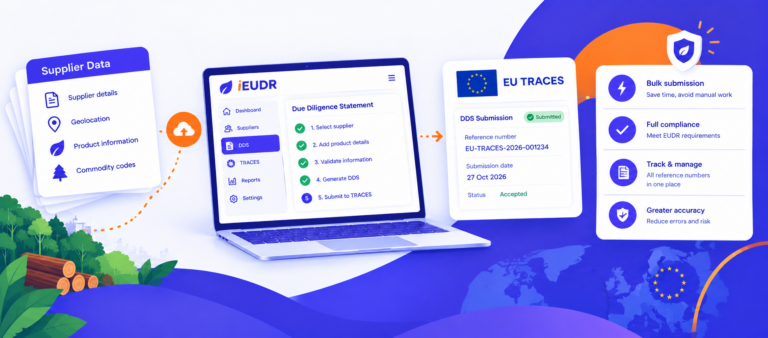
- DDS creation, validation and verification: iEUDR builds, validates and submits each DDS to EU TRACES and returns the reference and verification numbers. It also retrieves, verifies and validates your suppliers’ DDS.
- Audit trail: references reach your forwarder before they file, and every record is kept for five years.
iEUDR covers the EU and Northern Ireland, from a customs software provider recognised by HMRC and Irish Revenue and certified to ISO 27001:2022.
Frequently Asked Questions
What is the full form of EUDR?
EUDR stands for European Union Deforestation Regulation. Its official title is the Regulation on Deforestation-free Products, Regulation (EU) 2023/1115.
When does the EUDR come into force?
The regulation entered into force on 29 June 2023. Its obligations apply from 30 December 2026 for large and medium companies and from 30 June 2027 for most micro and small companies.
Is the EUDR delayed again?
No. After delays in 2024 and 2025, the Commission's May 2026 review proposed no further postponement, so the 2026 and 2027 dates stand.
What is the EUDR cutoff date?
31 December 2020. Commodities must come from land not deforested, and for wood not degraded, after that date.
Do downstream operators and traders need to submit a due diligence statement?
No. Only the upstream operator submits a DDS. Downstream operators and traders keep supplier and buyer records for five years, the first buyer also keeps the reference number, and large companies register in the Information System.
How much does EUDR compliance cost?
The main costs are supplier data collection, geolocation checks, risk assessment and staff time, and they grow with the number of suppliers and shipments. Simplified due diligence for low-risk sourcing and automation both reduce that effort.
Does certification such as FSC or RSPO prove EUDR compliance?
Not on its own. Certification can support your risk assessment, but you still need plot-level geolocation, legality evidence and your own due diligence.
What are the penalties under the EUDR?
Member states set penalties, which must include fines of at least 4% of total annual EU turnover for the most serious breaches, confiscation and temporary exclusion from public procurement.
You may also like:
Not sure what EUDR means for your next shipment?

iEUDR creates, validates and submits your due diligence statement, then shares the reference with your forwarder.
Subscribe to our Newsletter
About iCustoms
iCustoms is an all-in-one solution helping businesses automate customs processes more efficiently. With AI-powered and machine-learning capabilities, iCustoms is designed to streamline your all customs procedures in a few minutes, cut additional costs and save time.
Supplier data still arriving by email and spreadsheet?
Collect origin and geolocation data in one supplier portal, validated before it reaches your DDS.