
Ireland Customs for Freight Forwarders & Clearing Agents: The Complete Guide
- John Hall
- Customs Specialist at iCustoms.ai
If you move goods in or out of Ireland, every shipment eventually runs into the same two systems: AIS for imports and AES for exports. Between them sit an EORI number, a customs declaration, a duty and VAT calculation, and a release decision from Revenue. None of this is optional, and getting any one part wrong is what turns a routine shipment into a delayed one, a rejected declaration, or in some cases a penalty.
This guide walks through the whole journey freight forwarders, clearing agents, and importers or exporters deal with every day: what AIS and AES actually are, how the two systems fit together end to end, who has to file and under what kind of representation, the documents every declaration needs, the step-by-step process for imports and exports, EORI, VAT, what changed after Brexit, the mistakes that cause the most delays, and how software like iAIS and iAES removes most of the manual work. Every section links out to a dedicated, deeper guide on that specific topic, so treat this as the map of the whole cluster, not the last word, on any one part of it.
What is AIS (Automated Import System)?
AIS, the Automated Import System, is Revenue’s electronic system for import declarations into Ireland. It replaced the older Automated Entry Processing (AEP) system for imports in November 2020, built to comply with the EU’s Union Customs Code (UCC), which requires all communication between traders and customs authorities to be electronic. AIS is built on the EU Customs Data Model (EUCDM), the common data structure every EU member state’s import system maps to, with some national variations specific to Ireland.
In practice, AIS replaced the old Single Administrative Document (SAD) with a family of declaration types, each suited to a different scenario: H1 for standard release into free circulation, H2 for customs warehousing, H3 for temporary admission, H4 for inward processing, H5 for trade with special fiscal territories, H6 for postal traffic, H7 for low-value consignments, and I1/I2 for simplified declarations. Most freight forwarders will spend nearly all their time on H1 declarations, the standard “these goods are entering free circulation” case.
AIS is also the system currently being upgraded to AIS V2, which introduces Centralised Clearance for Import (CCI) and a revised Annex B data structure. If your business already files through AIS, it’s worth knowing this change is coming, though the detail belongs in its own guide.
What is AES (Automated Export System)?
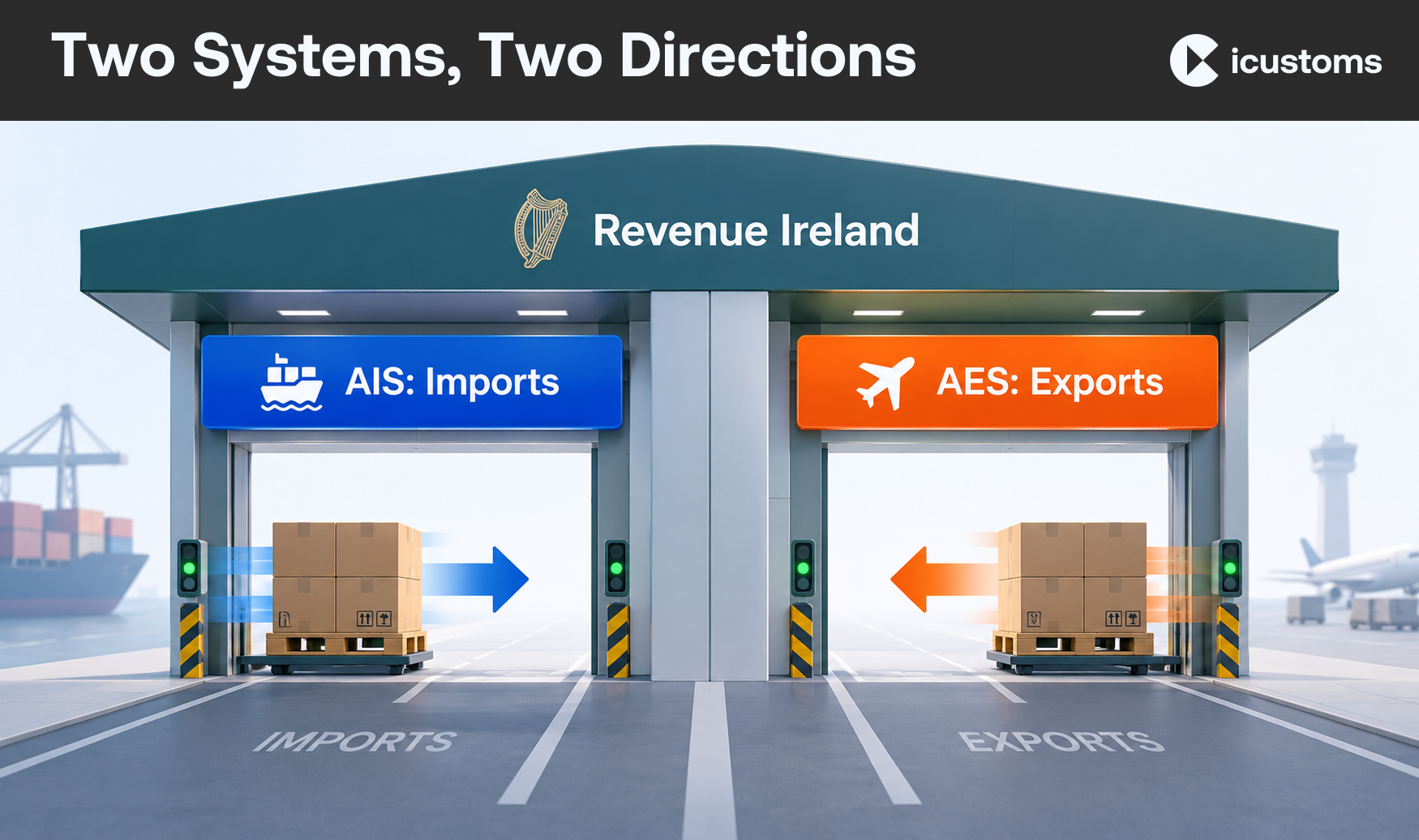
AES, the Automated Export System, is the export-side counterpart to AIS. It went live on 21 March 2023, later than AIS, and likewise replaced AEP, this time for outbound declarations. Where AIS governs what happens when goods arrive into Ireland, AES governs what happens when goods leave: the export declaration, the exit confirmation, and in some cases an accompanying safety and security dataset.
AIS and AES are built to the same underlying philosophy (electronic-only, UCC-compliant, EUCDM-based), but they are two separate systems with two separate registrations, two separate sets of declaration mechanics, and two separate places you can go wrong. Most freight forwarders end up needing both, since very few businesses only ever import or only ever export. The full side-by-side comparison, including which declaration types belong to which system and how to tell at a glance which one a given shipment needs, is covered in our dedicated AES Ireland guide.
The Legal Backbone: UCC, Revenue, and Risk-Based Controls
Underneath both AIS and AES sits the same legal foundation: the Union Customs Code, the EU-wide legislation that governs how customs works across every member state, Ireland included. The UCC is why declarations are electronic, why data has to follow a common structure, and why the same core concepts (customs value, origin, classification, procedure codes) show up in every EU country’s system, Ireland’s just implemented through AIS and AES specifically. We cover the UCC in more depth, including what it means for simplified procedures and authorisations, in our Union Customs Code Ireland guide.
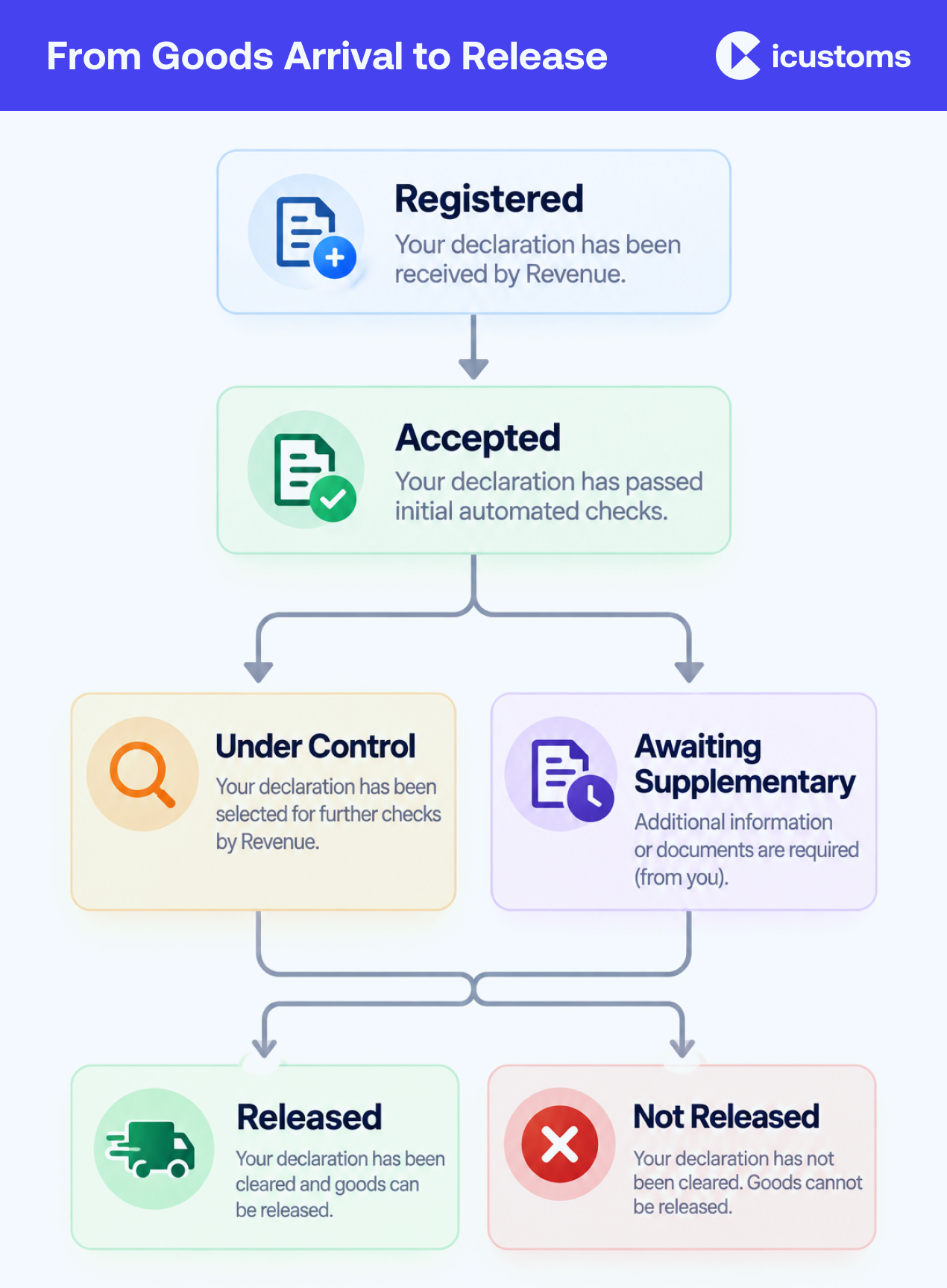
Revenue is the customs authority in Ireland, and every declaration ultimately gets assessed, risk-scored, and either released or held by Revenue’s systems. A declaration moves through a defined set of statuses: registered, accepted, potentially flagged for documentary or physical control, and finally released or not released. Revenue’s risk engine decides which declarations get a closer look. Businesses with Authorised Economic Operator (AEO) status typically see fewer of these holds, since AEO signals a lower-risk trader to Revenue’s system; more on that in our AEO status guide.
It also helps to understand that “customs” and “statistics” are two different obligations that happen to run on related data. A customs declaration through AIS or AES is what gets goods legally released or cleared for departure. A separate statistical return, Intrastat, tracks the movement of goods between Ireland and other EU member states for trade-statistics purposes, and is a different filing with different thresholds, not part of the AIS or AES declaration itself. We’ve kept the two deliberately separate in our Intrastat reporting guide for exactly this reason: conflating them is a common source of confusion for teams handling both.
Who Needs to File Customs Declarations in Ireland?
Anyone moving goods commercially across a customs border into or out of Ireland needs a declaration, with the practical exception of trade within the EU single market, which isn’t a customs border at all. That means:
- Importers bringing goods into Ireland from Great Britain, or from any non-EU country, need an AIS import declaration.
- Exporters sending goods from Ireland to Great Britain or any non-EU destination need an AES export declaration.
- Freight forwarders and clearing agents filing on behalf of clients need to be registered and authorised to declare for both systems, and typically hold EORI, AIS, and AES access under their own or their client’s identity depending on the representation arrangement.
- Trade between Ireland and the rest of the EU generally does not require a customs declaration, since goods move freely within the EU single market. This is the most common point of confusion for newer traders, who sometimes assume every cross-border movement needs a customs filing when only movements across the EU’s external border do.
Northern Ireland sits in its own category, governed by the Windsor Framework rather than treated as a standard non-EU destination or origin. We’ve covered that arrangement in detail elsewhere on the site, and it’s worth reading separately if NI forms any part of your trade lane.
Direct representation vs indirect representation. If you’re a freight forwarder or clearing agent filing on behalf of a client rather than for your own goods, the basis on which you file matters legally, not just administratively. Under direct representation, you act and file in the name of your client, and the client alone carries the customs debt. Under indirect representation, you act in your own name on the client’s behalf, which typically makes you jointly and severally liable for any customs debt alongside the client. Which basis applies is usually set out in the authorisation your client gives you, and it’s worth confirming before you file rather than assuming, since the two carry meaningfully different exposure if a declaration turns out to be wrong.
Documents Every Declaration Needs
Regardless of which declaration type applies, most AIS and AES filings draw on the same core set of supporting documents:
- Commercial invoice: the primary source for value, buyer, seller, and goods description.
- Packing list: quantities, weights, and how the shipment is physically packed, used to reconcile against the invoice.
- Transport document: a bill of lading, air waybill, or CMR consignment note depending on the mode of transport.
- Proof of origin: a supplier’s declaration, certificate of origin, or equivalent evidence where a preferential tariff (such as under the Trade and Cooperation Agreement) is being claimed.
- Licences, certificates, or permits: where the goods are restricted, controlled, or subject to a specific import/export regime (certain foodstuffs, chemicals, and dual-use goods being common examples).
- Authorisation references: where a special procedure, AEO status, or postponed VAT accounting is being applied on the declaration.
Missing or inconsistent documentation is one of the most common reasons a declaration ends up under documentary control rather than passing straight through, so having these ready and matching before submission, rather than assembling them once a hold notice arrives, is worth the discipline.
Step-by-Step: The Irish Import Process
Every AIS import broadly follows the same sequence, regardless of what’s being imported:
- Classify the goods. Every product needs a commodity code, which determines the duty rate, whether any restrictions or licences apply, and what data the declaration needs to carry.
- Determine origin and duty. Where the goods come from affects whether a tariff applies at all: goods that qualify as UK or EU origin under the Trade and Cooperation Agreement, for example, can move tariff-free with the right proof of origin.
- Prepare your documents. Commercial invoice, packing list, transport document, and proof of origin where relevant, all need to be ready before the declaration is lodged.
- Submit the AIS declaration. Data flows into the correct declaration type (H1, in most cases), with the goods classified, valued, and matched to the right procedure code.
- Customs assessment. Revenue’s system risk-scores the declaration; most pass straight through, some get flagged for a documentary check, and a smaller number for physical inspection.
- Pay duty and VAT. Once assessed, any duty and import VAT due gets calculated and paid, unless Postponed VAT Accounting applies (more on that below).
- Goods released. The declaration moves to a released status and the goods can proceed.
We’ve broken this process down in far more operational detail, including what each declaration status actually means and how long each stage typically takes, in our dedicated Ireland customs clearance process guide.
Step-by-Step: The Irish Export Process
The export side runs in the opposite direction but follows a similar shape: goods are classified and valued, an AES export declaration is lodged before or at the point of departure, Revenue (or the relevant exit point) confirms the goods have left, and an exit certification is generated once departure is confirmed. Depending on the destination and the goods involved, an accompanying safety and security declaration may also be required.
The practical difference most freight forwarders notice is timing: export declarations generally need to be in place before the goods physically leave, which puts more pressure on getting documentation sorted early rather than resolving issues after the fact, as sometimes happens on the import side. Our AES Ireland guide covers the export-specific mechanics in full.
EORI Requirements
Before any of the above is possible, you need an EORI number, the Economic Operators’ Registration and Identification number that identifies your business to customs authorities across the EU. No EORI, no AIS or AES access, no declarations, full stop. It’s the single prerequisite everything else in this guide depends on.
In Ireland, EORI registration is handled through Revenue’s eRegistration service, linked to your Revenue Online Service (ROS) account. Once granted, an Irish EORI number is prefixed “IE” followed by your tax reference number. If you already trade with the UK or other EU countries, you may already hold an EORI under a different country prefix, but for Irish import and export declarations specifically, you need an Irish one. We cover the full registration walkthrough, including common rejection reasons, in our EORI number guide and our dedicated AIS and AES registration guide, which picks up immediately after EORI to walk through ROS, AIS access, and AES access.
VAT on Imports
Import VAT applies to most goods entering Ireland from outside the EU, calculated on the customs value of the goods plus any duty payable, not on the goods value alone, which catches out businesses used to calculating VAT domestically. Ireland’s standard VAT rate is 23%, with reduced rates of 13.5%, 9%, and 4.8% applying to specific categories of goods.
The detail that changes cash flow the most is Postponed VAT Accounting (PVA), available since Brexit changed the trading relationship with Great Britain. Rather than paying import VAT at the point of entry and reclaiming it later, PVA lets an eligible, authorised importer declare and reclaim the same VAT on the same VAT return, with no cash outlay at the border at all. It has to be elected at the time of the original declaration and can’t be added retroactively after release, which makes it something to plan for rather than fix after the fact. The full mechanics, the exact calculation, and how PVA interacts with your AIS declaration are covered in our VAT on imports Ireland guide; duty specifically (rather than VAT) is covered in our import duty Ireland guide.
Post-Brexit Changes for Irish Traders
Since 1 January 2021, trade between Great Britain and Ireland has required full customs declarations on both sides, something that simply didn’t exist before Brexit. The Trade and Cooperation Agreement (TCA) keeps tariffs off goods that qualify as UK or EU origin, but origin has to be proven, not assumed. A UK-manufactured product doesn’t automatically qualify just because it shipped from a UK address, and a product merely passing through the UK from elsewhere usually doesn’t qualify at all.
Northern Ireland runs under a separate arrangement, the Windsor Framework, which determines whether goods moving from Great Britain into Northern Ireland are treated as “not at risk” of onward movement into the EU (and therefore able to use a lighter-touch process) or as “at risk” and subject to fuller controls. This is a genuinely different question from GB-Ireland trade covered in this guide, and conflating the two is a common source of confusion. See our Windsor Framework coverage for that arrangement specifically, and our dedicated Brexit and GB-Ireland trade rules guide and moving goods from Great Britain to Ireland guide for the direct GB-Ireland route this guide focuses on. For where things stand today, several years on, our post-Brexit customs requirements guide covers what traders are still getting wrong and how to stay current.
Common Mistakes to Avoid
A handful of errors account for most of the delays and penalties freight forwarders see:
- Missing or incorrect EORI details. A mismatch between your EORI registration and your declaration details is one of the fastest ways to get a declaration rejected outright.
- Wrong or vague commodity codes. Misclassification affects duty owed, whether restrictions apply, and can trigger a Revenue review even when the underlying shipment is entirely legitimate. Our commodity codes Ireland guide covers how to get this right.
- Assuming origin without proof. Claiming TCA preference without the paperwork to back it up is a common and costly assumption.
- Treating postponed VAT as automatic. PVA has to be actively elected and requires a valid authorisation; it isn’t the default treatment.
- Filing late or incompletely. Especially on the export side, where declarations generally need to be in place before departure, not after.
- Not knowing what a hold actually means. A documentary or physical control isn’t automatically a problem, but not understanding Revenue’s declaration statuses leads traders to either panic unnecessarily or, worse, ignore a status that needs action. See our Ireland customs penalties guide for what actually triggers enforcement action versus routine checks.
- Confusing direct and indirect representation. Agents who don’t confirm which basis they’re filing on can end up carrying liability they didn’t intend to take on.
- Mixing up customs declarations and Intrastat. Filing one doesn’t satisfy the other, and the two run on different thresholds and deadlines entirely.
- Leaving AEO or special-procedure authorisations undeclared. An authorisation that exists but isn’t correctly referenced on the declaration doesn’t help you; the system has to be told it applies.
Why iAIS/iAES from iCustoms?
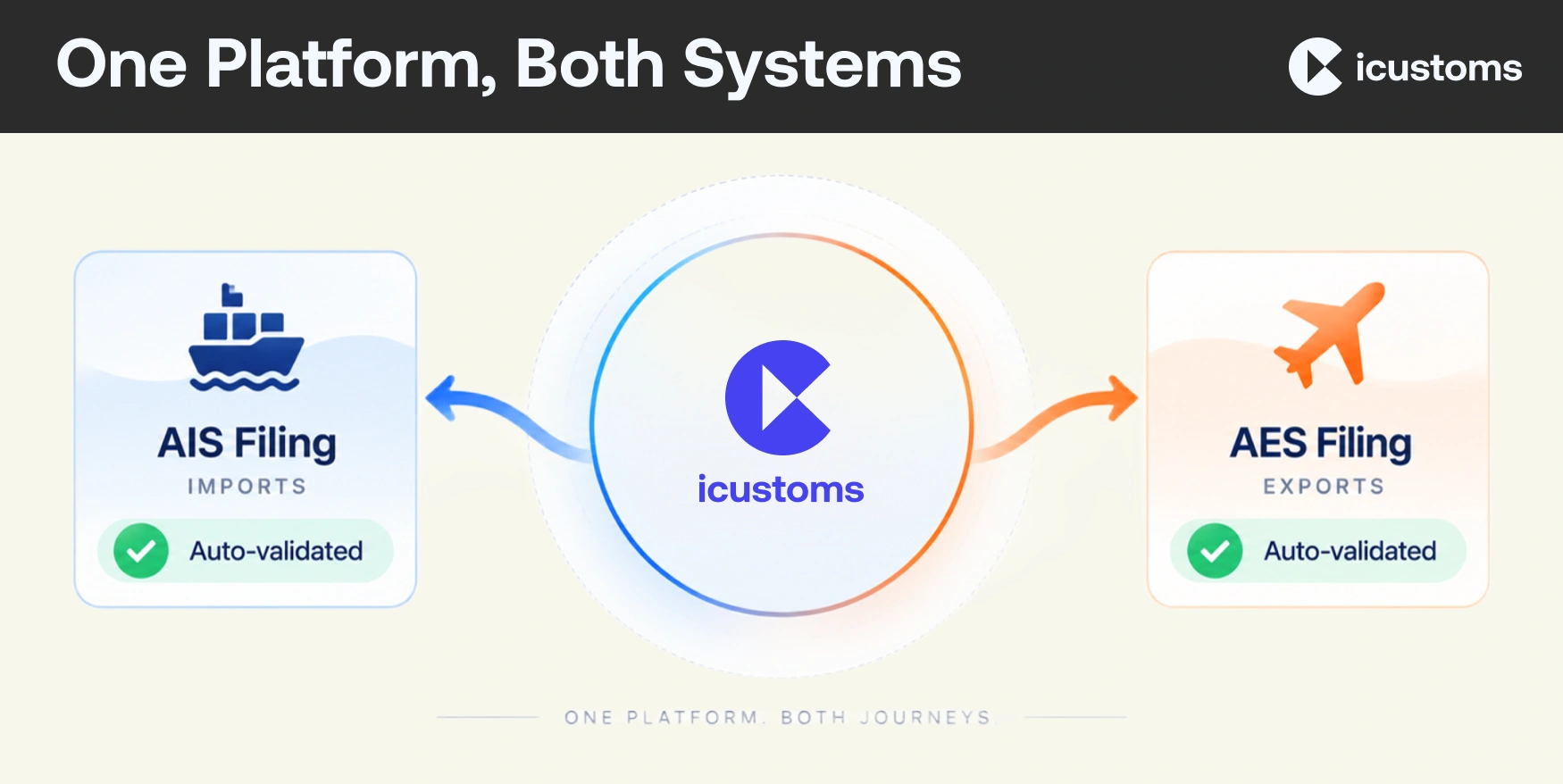
Everything described in this guide (classification, origin checks, EORI validation, declaration submission, duty and VAT calculation, status tracking across both AIS and AES) is manual work by default. iCustoms’ iAIS and iAES platform automates it from one interface: declarations are pre-filled and validated before submission, commodity codes are classified automatically rather than looked up manually, VAT and duty are calculated on the correct basis without spreadsheets, and both import and export filings live in the same place instead of two separate portals.
For freight forwarders and clearing agents handling volume across multiple clients, that difference compounds: fewer manual touchpoints per declaration means fewer opportunities for the mistakes listed above, and faster clearance on the declarations that would otherwise sit waiting on a manual data entry queue.
It also means the cluster of separate obligations covered in this guide (EORI validation, AEO-aware risk handling, postponed VAT election, correct representation basis, Intrastat data drawn from the same shipment record) stop being separate manual checklists run in parallel by different people, and become one consistent, auditable workflow. That matters as much for compliance as it does for speed: the same automated checks that get a declaration through faster are the ones that catch the errors that would otherwise turn into a penalty months later.
Frequently Asked Questions
What’s the difference between AIS and AES?
AIS handles import declarations into Ireland; AES handles export declarations out of Ireland. They’re separate systems with separate registrations, though most freight forwarders end up needing both. See our full AIS vs AES comparison for the complete breakdown.
Do I need an EORI number to use AIS or AES?
Yes. An EORI number is the prerequisite for both; you cannot register for AIS or AES access without one.
Is trade between Ireland and the rest of the EU affected by AIS or AES?
No. AIS and AES apply to Ireland’s external border: trade with Great Britain and non-EU countries. Trade within the EU single market doesn’t require a customs declaration.
What happened to the old AEP system?
AEP, the Automated Entry Processing system, was replaced by AIS for imports in November 2020 and by AES for exports in March 2023.
Do I need to pay import VAT immediately, or can I defer it?
Postponed VAT Accounting lets eligible, authorised importers declare and reclaim import VAT on the same VAT return instead of paying it at the border. It has to be elected on the original declaration.
Does the Windsor Framework apply to shipments between Great Britain and Ireland?
No. The Windsor Framework governs Great Britain to Northern Ireland movements specifically. Direct trade between Great Britain and Ireland (not via Northern Ireland) is governed by the standard post-Brexit customs rules and the Trade and Cooperation Agreement, covered in this guide.
What is AIS V2?
AIS V2 is Revenue’s upgrade to the current AIS system, introducing Centralised Clearance for Import (CCI) and a revised data structure. It’s a significant technical change for anyone filing through AIS, worth tracking even before it fully takes effect.
Can software replace a customs agent entirely?
For many businesses, yes, though it depends on volume and complexity. We cover the trade-offs in detail in our customs agent vs customs software guide.
How long does customs clearance actually take in Ireland?
Most declarations that aren’t flagged for control clear quickly, often within minutes to hours of submission. A documentary or physical control extends that, sometimes by days, depending on what’s being checked and how fast supporting evidence can be provided. Our clearance process guide covers typical timelines stage by stage.
What’s the difference between a customs declaration and Intrastat?
A customs declaration (AIS or AES) is a legal requirement to clear goods across Ireland’s external border. Intrastat is a separate statistical return tracking goods movements between Ireland and other EU countries, with its own thresholds. Filing one does not satisfy the other.
You may also like:
Filing AIS and AES From One Screen?

iCustoms brings Irish import and export declarations into a single workflow, so your team stops switching between two portals for two systems
Subscribe to our Newsletter
About iCustoms
iCustoms is an all-in-one solution helping businesses automate customs processes more efficiently. With AI-powered and machine-learning capabilities, iCustoms is designed to streamline your all customs procedures in a few minutes, cut additional costs and save time.
See a Declaration Clear in Minutes, Not Hours
Watch how iAIS automates the steps in this guide end to end, from classification through to release, without re-keying data between systems.