
AIS Ireland: Complete Guide to the Automated Import System, Irish TARIC Codes and Import Declarations
-
 Freya Jane
- Director of Customer's Success
Key Takeaways
- The Automated Import System (AIS) is Ireland’s official electronic platform for submitting import customs declarations, administered by Revenue (the Irish Revenue Commissioners).
- AIS v2 is the current operational version, aligned with the EU Customs Data Model (EUCDM) and the Union Customs Code (UCC).
- Every business importing goods into Ireland must have a valid Irish EU EORI number (format: IE followed by the VAT registration number) before filing AIS declarations.
- TARIC codes are Ireland’s customs procedure codes used in AIS declarations to identify the procedure under which goods are being declared.
- IOSS (Import One-Stop Shop) applies to goods imported into Ireland valued at 150 euros or less and simplifies VAT collection for e-commerce shipments from outside the EU.
- iCustoms automates AIS import declarations for Irish importers, freight forwarders, and customs brokers through iWiz (guided filing), iZap (batch filing), and iClassification (HS code automation).
Automated Import System (AIS) Ireland: The Complete Guide
The Automated Import System (AIS) is Ireland’s official electronic platform for submitting import customs declarations, administered by Revenue, the Irish Revenue Commissioners. It is the system through which every importer bringing goods into Ireland from outside the European Union must file a declaration, providing Revenue with the information needed to assess customs duties, VAT, and safety and security risks before goods are released.
AIS is Ireland’s national implementation of the EU customs declaration infrastructure, aligned with the EU Customs Data Model (EUCDM) and the requirements of the Union Customs Code (UCC). The current operational version is AIS v2, which was introduced to bring the system fully in line with EUCDM data standards and to modernise the declaration interface for traders and software providers.
This guide covers everything you need to know about AIS in Ireland: how it works, how to access it, what data your declarations need to include, what TARIC procedure codes are, how IOSS applies to low-value imports, how to register for and validate your EORI number, and how automated import declaration software removes the manual workload from the process.
This blog serves as a comprehensive guide to understanding and utilising the Automated Import System (AIS) Ireland in 2026 and beyond.
What is the Automated Import System (AIS)?
The Automated Import System (AIS) is not to be confused with other systems that share the same abbreviation. In the context of Irish trade and customs, AIS refers specifically to Revenue’s electronic customs declaration system for imports. It replaced earlier electronic declaration systems and became Ireland’s primary import declaration gateway under the EU’s modernised customs framework.
When goods arrive in Ireland from outside the EU — whether by air, sea, road, or rail — the importer or their customs agent must lodge an AIS import declaration with Revenue before or at the point of arrival. AIS receives the declaration data, validates it against Revenue’s rules, issues a Movement Reference Number (MRN) confirming acceptance, and performs risk analysis to determine whether goods should be released or subject to further checks.
AIS connects directly to other EU customs systems, meaning a declaration lodged in Ireland feeds into the shared EU customs risk management infrastructure. For goods arriving from the UK since 1 January 2021, when the UK’s post-Brexit transition period ended, Irish AIS import declarations are mandatory for every commercial consignment from Great Britain.
AIS v2: Ireland's Current Import Declaration System
AIS v2 is the current and fully operational version of Revenue’s Automated Import System. It was introduced as part of Ireland’s implementation of the Union Customs Code (UCC) and aligns the system with the EU Customs Data Model (EUCDM), the standardised data framework used by all EU member states for customs declarations.
Key changes introduced in AIS v2 include alignment with the EUCDM data structure for all declaration fields, updated procedure code requirements, enhanced validation rules that check data quality before declaration submission, and improved API connectivity for software providers integrating directly with Revenue’s systems. Businesses and software platforms that were integrated with the earlier AIS version have needed to update their data mappings and submission processes to comply with AIS v2 requirements.
If you are using customs declaration software to file with Revenue, confirm that your platform is fully AIS v2 compatible. iCustoms is fully aligned with AIS v2, submitting declarations directly through Revenue’s authorised API gateway.
Looking for full visibility and control over imports?
Track shipments, improve transparency, and streamline processes with iCustoms.
AIS Import Declarations: What You Need to Submit
An AIS import declaration is a formal electronic statement to Revenue describing the goods you are importing into Ireland. It is based on the Single Administrative Document (SAD) data structure, which is the standardised customs declaration form used across the EU and in many third countries.
The Single Administrative Document (SAD) in AIS
The SAD is the structured declaration form that underpins all AIS import declarations. It is divided into numbered boxes covering every aspect of the import transaction. The key data fields required in an AIS import declaration include:
- Declarant and representative details (EORI numbers, contact information)
- Goods description: a clear, accurate description of the nature, composition, and intended use of the goods
- Commodity code: a minimum 8-digit EU Combined Nomenclature (CN) code, or 10-digit TARIC code where applicable
- Customs value: the transaction value including cost, insurance, and freight (CIF) to the EU border
- Country of origin and country of dispatch
- Customs procedure code (TARIC code): identifies the customs procedure under which the goods are being declared
- Transport details: mode of transport, container number, vessel or flight details
- Previous document references: links to transit declarations, bills of lading, airway bills, or other preceding documents
- IOSS number (where applicable): for low-value consignments where VAT has been collected at point of sale under the IOSS scheme
Ireland TARIC Codes: Customs Procedure Codes Explained
TARIC codes are the customs procedure codes used in AIS import declarations in Ireland to identify the customs procedure under which goods are being declared. TARIC codes are commodity codes used to enter in Box 37 of the SAD declaration and is a combination of a requested procedure code and a previous procedure code.
TARIC codes follow the EU standard format: a four-digit code where the first two digits represent the requested procedure and the second two digits represent the previous procedure. Ireland’s Revenue uses the standard EU TARIC procedure codes but refers to them as TARIC codes in the context of AIS filings.
| Common TARIC Code | Procedure Name | When It Applies |
|---|---|---|
| 4000 | Release for free circulation with simultaneous entry for home use | Standard import of goods for use or consumption in Ireland, the most common procedure |
| 4200 | Release for free circulation with simultaneous entry for home use — IOSS | Import of low-value goods where VAT has been collected via IOSS at point of sale |
| 4071 | Release for free circulation with simultaneous entry for home use — AEO | Simplified procedure for Authorised Economic Operators |
| 2100 | Customs warehousing (Type I) | Goods placed in a customs warehouse pending a future customs procedure |
| 5100 | Inward processing | Goods imported for processing or manufacture before re-export |
| 5300 | Temporary admission | Goods admitted temporarily for a specific purpose and to be re-exported |
| 3151 | Re-importation for release for free circulation | Goods being re-imported into Ireland after temporary export |
Selecting the wrong TARIC code in an AIS declaration is one of the most common sources of customs queries and delays. iClassification within the iCustoms platform supports TARIC code selection as part of the declaration preparation process, reducing the risk of incorrect procedure code assignment.
HS Code Classification Ireland
HS code classification Ireland is a critical component of every AIS import declaration, directly influencing duty rates, VAT liability, and compliance with EU trade measures. Under the EU Combined Nomenclature, goods must be classified using an 8 digit CN code, extended to 10 digit TARIC where applicable, ensuring alignment with the EU Customs Data Model used in AIS v2. Incorrect HS code classification Ireland can lead to overpayment of duties or regulatory breaches, particularly where trade defence measures, licensing requirements, or preferential origin rules apply. For Irish importers, classification is not just a data field, it is the foundation of accurate customs treatment.
HS Code Classification Ireland in AIS Declarations
Within AIS, HS code classification Ireland is embedded in the core declaration dataset and validated against EUCDM rules before submission. Each commodity code determines applicable duty rates under the Common Customs Tariff, eligibility for preferential treatment such as the EU UK Trade and Cooperation Agreement, and whether additional controls such as SPS or dual use restrictions apply. Manual classification often introduces inconsistency, especially at scale, whereas automated classification through iCustoms iClassification uses AI to assign precise CN and TARIC codes based on product descriptions, ensuring consistency, auditability, and reduced risk of customs queries or post clearance amendments.
EORI Number Ireland: Registration, Format, and Validation
An EORI (Economic Operators Registration and Identification) number is mandatory for any business filing AIS import declarations in Ireland. It is the unique identifier that Revenue and EU customs authorities use to identify your business in the customs system. Without a valid EORI number, you cannot submit AIS declarations.
Irish EORI numbers are formatted as IE followed by your VAT registration number (for example, IE1234567T). If your business is already VAT-registered in Ireland, your EORI is typically derived directly from your VAT number.
How to register for an EORI number in Ireland:
- Step 1: Log in to Revenue Online Service (ROS) using your digital certificate
- Step 2: Navigate to the customs registration section within ROS
- Step 3: Complete the EORI registration form with your business details, VAT number, and the customs activities you will be undertaking
- Step 4: Submit the application — EORI numbers are typically issued within a few working days
- Step 5: Share your EORI number with any freight forwarder or customs broker filing AIS declarations on your behalf
To validate or check an existing EORI number, use the EU EORI validation tool available at the European Commission’s Taxation and Customs Union website. This tool confirms whether an EORI number is active and registered to the correct entity. Automating EORI validation as part of your import declaration workflow is possible through iCustoms, which checks EORI validity before declaration submission.
IOSS Ireland: Import One-Stop Shop for Low-Value Imports
The Import One-Stop Shop (IOSS) is an EU VAT simplification scheme that applies to goods imported into Ireland (and all EU member states) from outside the EU with a customs value of 150 euros or less. Under IOSS, the seller or marketplace collects VAT at the point of sale at the rate applicable in the buyer’s EU member state, and the goods are released at the EU border without additional VAT being charged on importation.
IOSS became particularly significant for Irish importers and e-commerce businesses after Brexit on 31 January 2020 and the end of the transition period on 1 January 2021, because goods previously arriving VAT-free from the UK under the EU low-value consignment relief (LVCR) now require either IOSS treatment or standard VAT payment at the border.
Looking for reliable customs support at every step?
From setup to ongoing assistance, iCustoms simplifies your AIS imports.
IOSS Number Ireland: What It Is and How It Works
An IOSS number is a unique VAT identification number issued to sellers or electronic interfaces (marketplaces) registered for the IOSS scheme. When an IOSS-registered seller ships goods to Ireland valued at 150 euros or less, the IOSS number is included in the AIS import declaration (in the designated IOSS field), which signals to Revenue that VAT has already been collected and remitted, and the goods should be released without further VAT liability at import.
IOSS numbers follow the format: IM followed by the country code of registration and a unique identifier (for example, IMxxx12345678 for an EU-registered seller).
IOSS Registration Ireland
If your business is established in Ireland and sells goods to consumers elsewhere in the EU from outside the EU, you can register for IOSS directly with Revenue via the ROS portal. Non-EU businesses selling to Irish or EU consumers must register for IOSS either in any EU member state or through an EU-established intermediary.
Once registered, IOSS filers submit monthly VAT returns to Revenue covering all EU-wide IOSS sales, and Revenue distributes the VAT to the relevant member states. iCustoms supports IOSS number validation within its import declaration workflow, confirming that the IOSS number declared in an AIS filing is valid and matches the seller of record for the consignment.
Import Duty Calculator: What You Will Pay on Goods Entering Ireland
Import duties on goods entering Ireland are determined by three factors: the commodity code (CN code) of the goods, the country of origin, and the customs value. Ireland, as an EU member state, applies the EU’s Common Customs Tariff (CCT), which sets the standard (MFN) duty rates for all goods entering the EU from third countries.
For goods originating in the United Kingdom, the EU-UK Trade and Cooperation Agreement (TCA) provides preferential tariff rates of zero on most goods, provided the rules of origin requirements are met. This means that most goods from the UK entering Ireland can claim zero import duty under the TCA, though VAT at the Irish standard rate (currently 23% for most goods) is still payable at import unless IOSS applies.
| Import Duty Calculation Factor | How It Affects Your Duty Bill |
|---|---|
| Commodity code (CN code) | The 8-digit CN code determines which duty rate applies under the Common Customs Tariff. Incorrect codes can result in overpayment of duty or, worse, underpayment which creates compliance liability. |
| Country of origin | Origin determines eligibility for preferential duty rates under FTAs. UK-origin goods are zero-rated under the TCA provided rules of origin are met. Non-UK origin goods may be subject to MFN rates. |
| Customs value | Import duty is calculated as a percentage of the customs value (CIF value to EU border). Higher declared values result in higher duty bills. |
| Customs procedure (TARIC code) | Some procedures suspend or relieve duty at import (e.g. inward processing, customs warehousing). The TARIC code you select determines whether duty is payable immediately or deferred. |
| IOSS applicability | For goods valued at 150 euros or less with a valid IOSS number, customs duty is zero and VAT has been pre-collected. This changes the duty and VAT position entirely. |
iCustoms includes an import duty calculation function that applies the correct CCT or preferential duty rate based on the commodity code and origin declared, ensuring accurate duty liability assessment before declaration submission.
Import Declaration Software for Ireland: Manual AIS vs Automation
Irish importers and customs professionals have two options for filing AIS import declarations: manually through Revenue’s online AIS portal, or through dedicated import declaration software that connects directly to AIS via an authorised API.
| Feature | Manual AIS Portal vs iCustoms Software |
|---|---|
| Data entry | Manual AIS: All fields entered manually for each declaration. iCustoms: Automated data extraction from commercial invoices and shipping documents using AI-powered Intelligent Document Processing. |
| Commodity classification | Manual AIS: User must research and enter CN code manually. iCustoms iClassification: AI-powered automatic CN code assignment from product description. |
| TARIC code selection | Manual AIS: User selects procedure code manually from Revenue's code list. iCustoms: Guided procedure code selection based on import scenario. |
| Batch processing | Manual AIS: One declaration at a time. iCustoms iZap: Batch-process hundreds of AIS declarations simultaneously from structured data. |
| EORI validation | Manual AIS: Manual checking against EU validation tool. iCustoms: Automated EORI validation before submission. |
| IOSS validation | Manual AIS: No automated IOSS number checking. iCustoms: Automated IOSS number validation for low-value consignments. |
| Error checking | Manual AIS: Errors discovered at submission or post-release. iCustoms: Real-time validation against AIS v2 rules before submission. |
| MRN tracking | Manual AIS: Manual checking of declaration status. iCustoms: Automated MRN tracking and clearance status notifications. |
| Audit trail | Manual AIS: Manual record keeping required. iCustoms: Full digital audit trail with declaration history and Revenue responses. |
AIS Ireland vs UK CDS: What Cross-Border Traders Need to Know
For businesses involved in trade between Ireland and Great Britain, customs obligations exist on both sides of the border. Irish AIS handles the import declaration on the Irish side, while HMRC’s Customs Declaration Service (CDS) handles the export declaration on the UK side.
Since 1 January 2021, every commercial consignment moving from Great Britain to Ireland requires both a CDS export declaration submitted to HMRC in the UK and an AIS import declaration submitted to Revenue in Ireland. These are separate systems with separate submission processes, meaning cross-border operators effectively manage two declaration workflows for every GB-IE movement.
iCustoms covers both AIS declarations in Ireland and CDS declarations in the UK within a single platform, making it the natural choice for Irish importers sourcing from Great Britain and UK exporters sending goods to Irish customers.
AI Customs Declaration Software Ireland
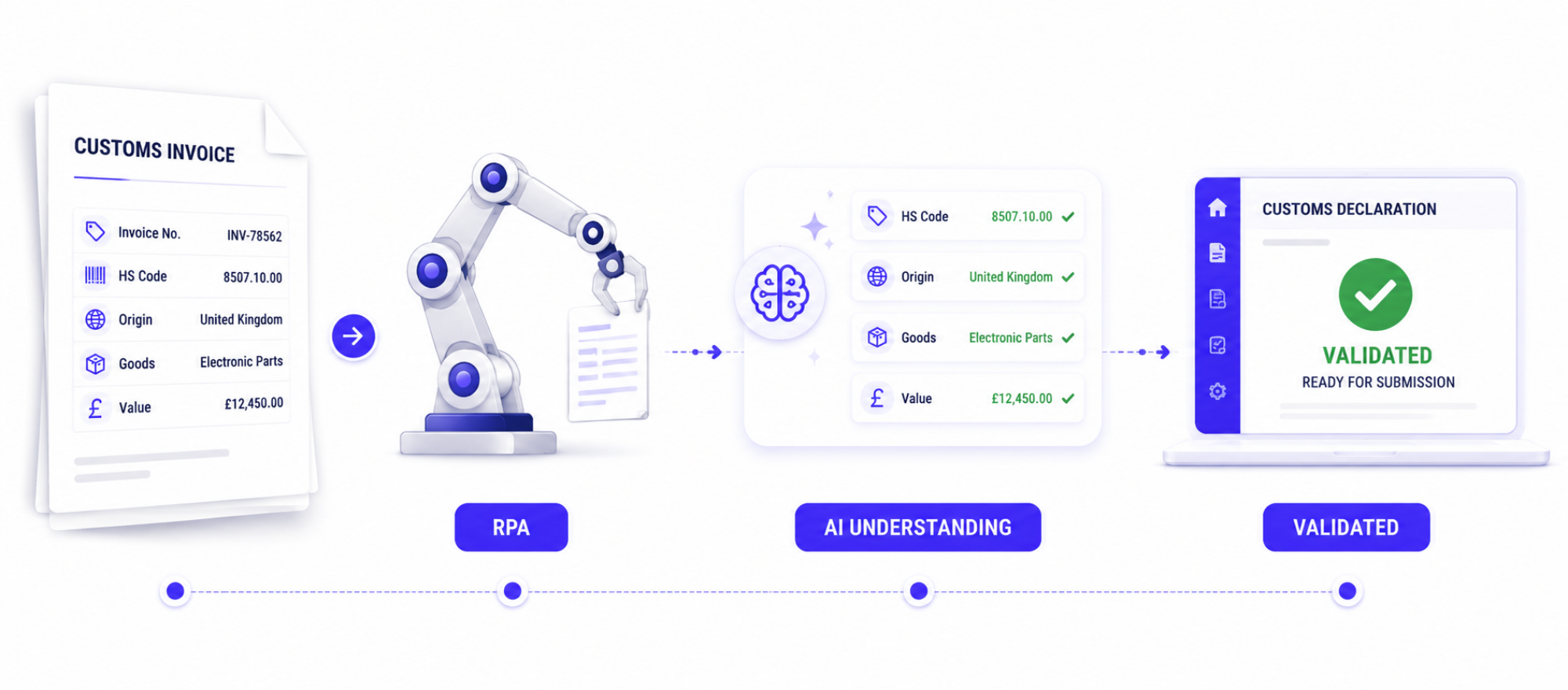
Businesses searching for AI customs declaration software Ireland are typically looking to reduce manual data entry, improve declaration accuracy, and automate repetitive import filing workflows under AIS v2. Traditional customs filing methods require operators to manually extract data from invoices, packing lists, and transport documents before completing the AIS declaration. AI-driven customs software replaces this process by automatically reading trade documents, assigning commodity codes, validating EORI and IOSS numbers, and preparing declarations for submission through Revenue’s AIS API.
For Irish importers, freight forwarders, and customs brokers handling high declaration volumes, AI customs declaration software Ireland solutions improve operational efficiency while reducing the risk of customs queries, delayed cargo release, and incorrect duty calculations. iCustoms combines AI-powered document processing, automated HS code classification, duty calculation, and AIS API connectivity within a single platform designed specifically for Irish and EU customs workflows.
Supplementary Declaration Ireland AIS
A supplementary declaration Ireland AIS workflow applies when importers use simplified customs procedures that allow goods to be released with reduced initial declaration data before the full dataset is submitted later through AIS. Under Revenue and EU customs rules, supplementary declarations are commonly used by authorised operators managing high-volume imports, customs warehousing procedures, or deferred declaration models.
Within AIS v2, supplementary declaration Ireland AIS submissions must follow the EU Customs Data Model structure and include complete commodity classification, customs valuation, origin, and procedure code information linked to the original simplified declaration. Businesses using automated customs software can streamline this process by automatically connecting commercial invoices, transport documents, MRNs, and previous declaration references into the supplementary filing workflow, reducing manual reconciliation and improving compliance accuracy.
Automated Customs Clearance and AIS Filing in Ireland
Irish importers increasingly rely on automated customs clearance workflows to manage AIS import declarations at scale. Automated customs systems connect commercial invoices, transport documents, EORI validation, tariff classification, and Revenue AIS submission into a single digital workflow, reducing manual intervention and improving declaration accuracy. For businesses managing regular imports from Great Britain and non-EU countries, automated AIS filing reduces clearance delays, supports faster MRN processing, and improves visibility across customs operations.
Modern AIS platforms such as iCustoms combine AI-driven data extraction, customs validation, and API-based declaration submission to automate customs clearance processes while maintaining compliance with AIS v2 and EU Customs Data Model requirements.
AIS Ireland vs UK CDS: What Cross-Border Traders Need to Know
For businesses involved in trade between Ireland and Great Britain, customs obligations exist on both sides of the border. Irish AIS handles the import declaration on the Irish side, while HMRC’s Customs Declaration Service (CDS) handles the export declaration on the UK side.
Since 1 January 2021, every commercial consignment moving from Great Britain to Ireland requires both a CDS export declaration submitted to HMRC in the UK and an AIS import declaration submitted to Revenue in Ireland. These are separate systems with separate submission processes, meaning cross-border operators effectively manage two declaration workflows for every GB-IE movement.
iCustoms covers both AIS declarations in Ireland and CDS declarations in the UK within a single platform, making it the natural choice for Irish importers sourcing from Great Britain and UK exporters sending goods to Irish customers.
How iCustoms Automates AIS Import Declarations
| iCustoms Product | AIS Use Case |
|---|---|
| iWiz: Guided AIS Declaration Wizard | Step-by-step AIS declaration builder for Irish importers new to the process or managing complex one-off consignments. iWiz validates each data field in real time and guides users through TARIC code selection, commodity classification, and IOSS treatment before submission. |
| iZap: Batch AIS Filing Module | High-volume AIS declaration processing for freight forwarders, customs brokers, and large importers. iZap extracts declaration data from commercial documents and batch-submits to Revenue's AIS v2 API, processing hundreds of declarations per hour without manual entry. |
| iClassification: HS Code Automation | AI-powered commodity code assignment for goods being declared in AIS. Assigns accurate 8-digit EU CN codes and 10-digit TARIC codes from product descriptions, eliminating the most common source of AIS declaration errors. |
| iNCTS: Transit Declaration Filing | For goods in transit through Ireland, iNCTS files NCTS transit declarations and generates T1 transit documents and Transit Accompanying Documents automatically, complementing AIS import workflow for multi-modal shipments. |
| Duty Calculator | Automatic application of EU Common Customs Tariff or TCA preferential rates based on commodity code and origin, with IOSS zero-duty treatment for qualifying low-value consignments. |
| EORI and IOSS Validation | Automated validation of EORI numbers and IOSS numbers before submission, preventing rejections caused by invalid trader identifiers in AIS declarations. |

Operating across Ireland and the UK?
iCustoms helps you navigate both systems seamlessly for smoother cross-border trade.
AIS Ireland Frequently Asked Questions
What is the Automated Import System (AIS) in Ireland?
The Automated Import System (AIS) is Ireland's official electronic customs platform for submitting import declarations, administered by Revenue (the Irish Revenue Commissioners). All businesses importing goods into Ireland from outside the EU must file an AIS import declaration before or at the point of arrival. AIS v2 is the current operational version.
What are TARIC codes in Irish AIS declarations?
TARCI codes are the customs procedure codes used in AIS import declarations in Ireland to identify the customs procedure under which goods are being declared. They follow the EU standard four-digit format (two digits for the requested procedure and two for the previous procedure). The most common code is 4000, which covers standard release of goods for free circulation and home use in Ireland.
What is IOSS and when does it apply to Irish imports?
IOSS (Import One-Stop Shop) is an EU VAT simplification scheme that applies to goods imported into Ireland (and other EU member states) from outside the EU with a customs value of 150 euros or less. Under IOSS, the seller collects and remits VAT at the point of sale, and the goods are released at the Irish border without additional VAT. The seller's IOSS number is declared in the AIS import declaration.
How do I register for an EORI number in Ireland?
Register for an EORI number through Revenue Online Service (ROS) at revenue.ie. Your Irish EORI number will be formatted as IE followed by your VAT registration number. The EORI is mandatory for filing any AIS import declaration and must be provided to any freight forwarder or customs broker acting on your behalf.
What is AIS v2?
AIS v2 is the current version of Revenue's Automated Import System, introduced to align the Irish import declaration system with the EU Customs Data Model (EUCDM) requirements under the Union Customs Code (UCC). AIS v2 updated declaration data fields, validation rules, and API connectivity standards. Import declaration software must be AIS v2 compatible to file with Revenue.
What is the difference between AIS in Ireland and CDS in the UK?
AIS (Automated Import System) is Ireland's Revenue-administered customs declaration system for Irish import declarations. CDS (Customs Declaration Service) is HMRC's system for UK customs declarations. For goods moving between Great Britain and Ireland, both systems are involved: CDS handles the UK-side export declaration while AIS handles the Irish-side import declaration. iCustoms covers both in a single platform.
How does import declaration software improve AIS filing?
Import declaration software such as iCustoms connects directly to Revenue's AIS v2 API, automating data extraction from commercial documents, commodity code assignment, TARCI code selection, EORI and IOSS validation, and declaration submission. For high-volume importers and freight forwarders, this reduces per-declaration processing time significantly and eliminates the manual errors that cause Revenue queries and cargo delays.
You may also like:

Subscribe to our Newsletter
About iCustoms
iCustoms is an all-in-one solution helping businesses automate customs processes more efficiently. With AI-powered and machine-learning capabilities, iCustoms is designed to streamline your all customs procedures in a few minutes, cut additional costs and save time.