
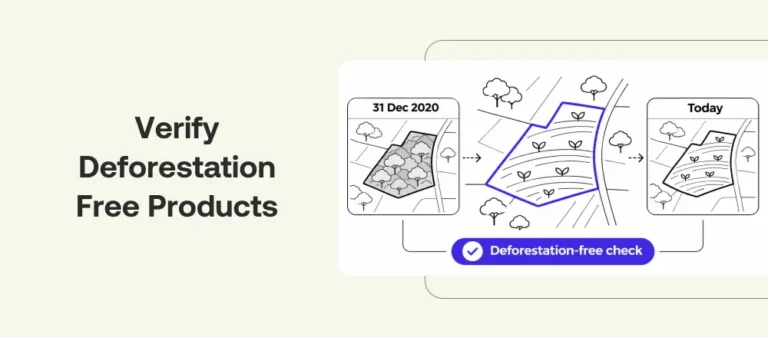
EUDR ESG Reporting: How Deforestation Data Supports CSRD, GRI and CDP
- John Hall
- Customs Specialist at iCustoms.ai
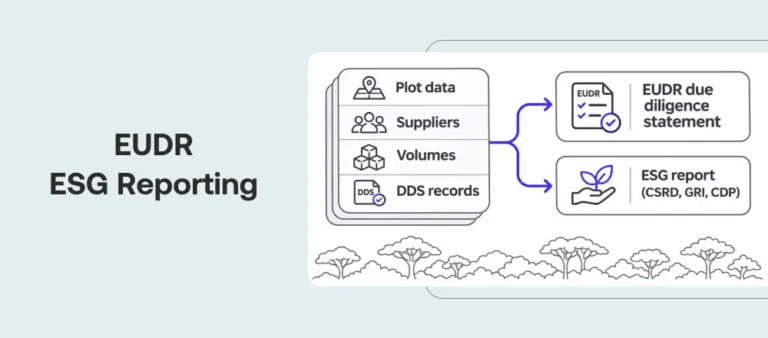
EUDR ESG reporting works because the EUDR and ESG reporting ask for much of the same evidence. The EU Deforestation Regulation is a legal requirement: you cannot place cattle, cocoa, coffee, oil palm, rubber, soya or wood products on the EU market without proving they are deforestation-free and legal. ESG reporting is disclosure: you explain your impacts, risks and progress to investors, customers and regulators. The plot data, supplier records and due diligence you build for EUDR ESG reporting can feed both, if you collect it once and keep it in one place.
What Is ESG Reporting and What Is It For?
ESG reporting, short for environmental, social and governance reporting, is how a company discloses its sustainability impacts and the sustainability risks to its business. The purpose of ESG reporting is comparability and trust: investors price risk, customers check supplier commitments, and regulators see whether companies do what they say.
Is ESG reporting mandatory? For large EU companies under the Corporate Sustainability Reporting Directive (CSRD), yes. For most others it is voluntary, but customers and lenders increasingly ask for it. On ESG reporting requirements in the UK, the new UK Sustainability Reporting Standards are voluntary for now, although many large UK companies already make mandatory climate-related disclosures.
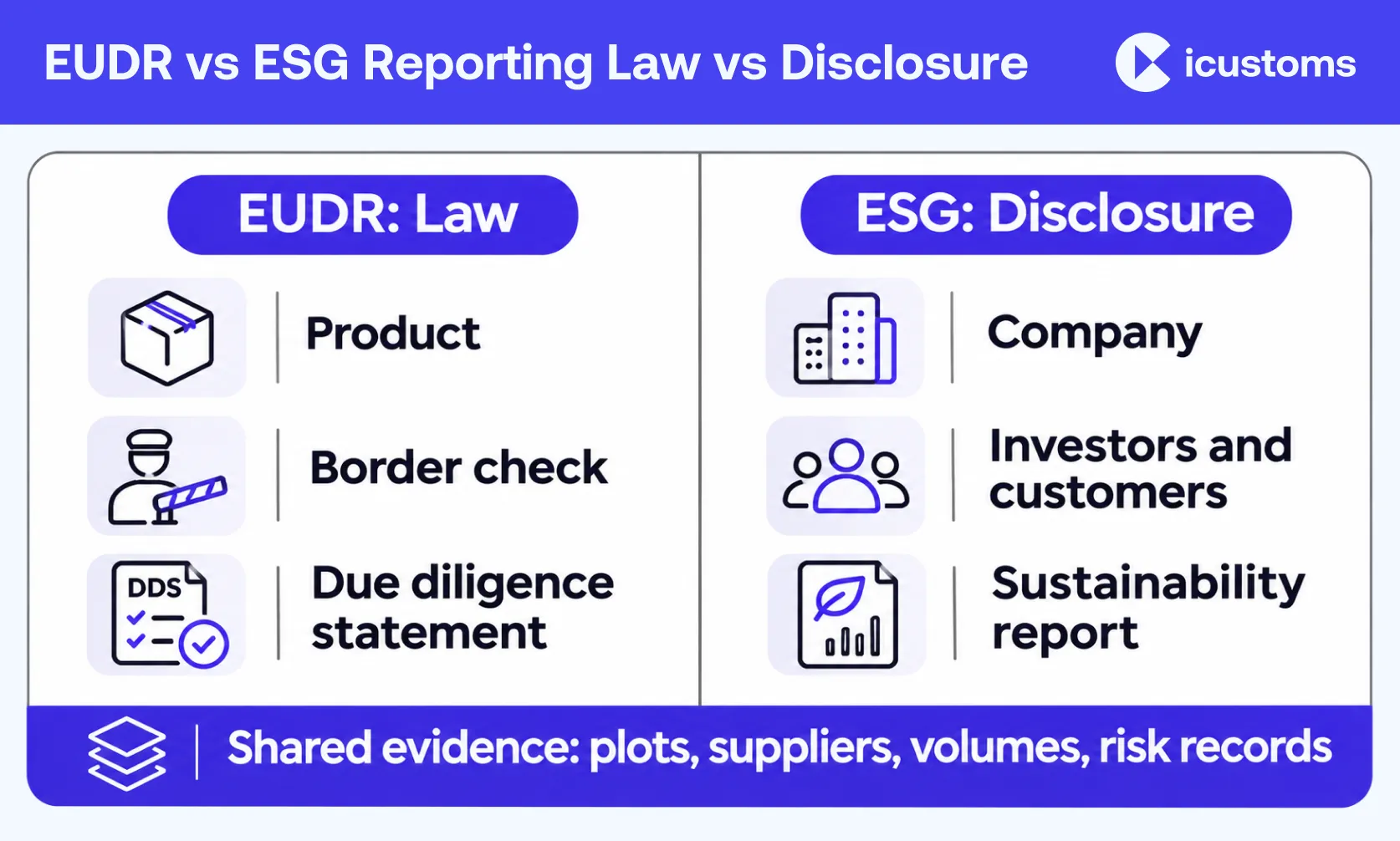
EUDR vs ESG Reporting: Law vs Disclosure
| EUDR | ESG reporting | |
|---|---|---|
| What it is | A product rule with border checks | Company-level disclosure |
| Question it answers | Is this product deforestation-free and legal? | How do we affect nature and people, and how does that affect us? |
| Unit | Each product and shipment | The company and its value chain |
| Proof | Due diligence statement, plot geolocation, five-year records | Sustainability statement or report, metrics and targets |
| If you get it wrong | Goods held, fines, exclusion from the market | Audit findings, reputational and investor risk |
Where Deforestation Shows Up in the Main ESG Reporting Frameworks
Deforestation appears in every major framework, though each frames it differently. Status as of October 2026:
| Framework | Status | Where deforestation fits |
|---|---|---|
| CSRD and ESRS | After the Omnibus I Directive (EU) 2026/470, applies to EU companies with over 1,000 employees and €450m turnover; revised ESRS apply from financial year 2027 | ESRS E4 Biodiversity and ecosystems (land-use change), E1 Climate change (land emissions), and social standards on affected communities |
| GRI | Voluntary, widely used; GRI 101 Biodiversity in effect since 1 January 2026 | GRI 101 drivers of biodiversity loss, including land-use change; GRI 13 sector topics on natural ecosystem conversion and supply chain traceability |
| ISSB (IFRS S1 and S2) | Global baseline; nature-related proposals open for comment until February 2027 | Climate-related land emissions now; nature risks under the proposals, which draw on TNFD |
| UK SRS | UK Sustainability Reporting Standards, based on ISSB, published February 2026, voluntary | As ISSB |
| CDP Forests | Annual questionnaire; from 2026 covers all seven EUDR commodities | Commodity volumes, traceability and deforestation-free commitments with a cutoff date |
| TNFD | Voluntary nature framework, now feeding ISSB work | Locating nature dependencies and impacts, including sourcing areas |
| SBTi FLAG | Voluntary targets for land-intensive sectors | Requires a no-deforestation commitment |
| Voluntary Standard for SMEs | EU voluntary standard for companies up to 1,000 employees | Basic environmental data that larger customers may request |
The Corporate Sustainability Due Diligence Directive (CSDDD), also amended in 2026, now covers companies with over 5,000 employees and €1.5bn turnover and applies from 26 July 2029.
Mapping EUDR Data to ESG Disclosures
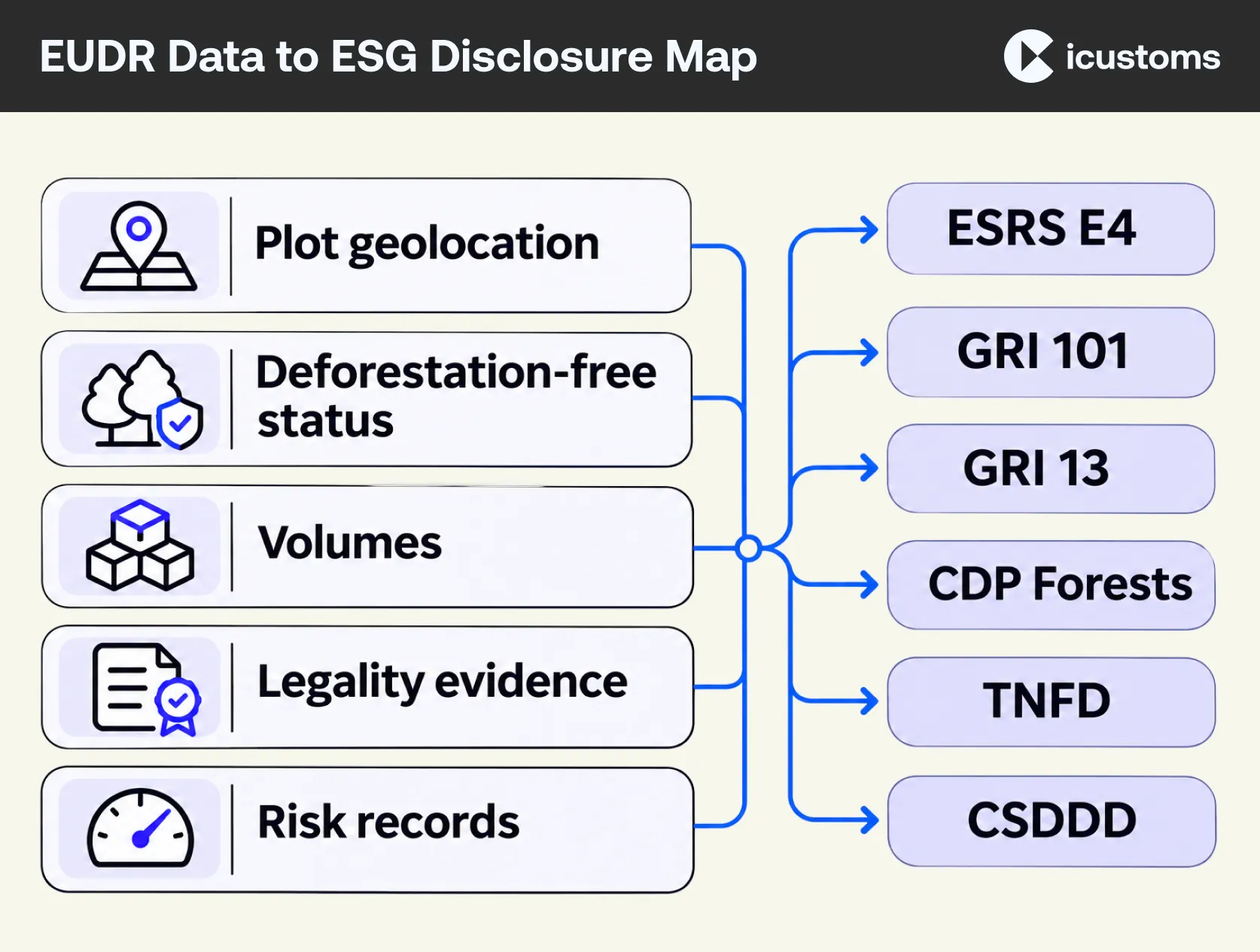
This is where EUDR ESG reporting pays twice, with one round of ESG data collection, tracking and disclosure. Each EUDR data point below already exists if you are EUDR ready.
| EUDR data point | ESG disclosure it supports | Frameworks |
|---|---|---|
| Plot geolocation for every sourcing area | Location-specific biodiversity and land-use disclosures | ESRS E4, GRI 101, TNFD |
| Deforestation-free status against the 31 December 2020 cutoff | No-deforestation commitments and progress | CDP Forests, SBTi FLAG, GRI 13 |
| Volumes by commodity and country | Commodity footprint and exposure | CDP Forests, ESRS E4 |
| Legality evidence (land rights, labour, permits) | Human rights and affected communities | ESRS social standards, GRI 13, CSDDD |
| Supplier list and country risk | Value chain mapping and risk assessment | ESRS E4, CSDDD, ISSB |
| Risk mitigation records | Due diligence actions and their results | CSDDD, ESRS E4 |
| Due diligence system and annual review | Governance and policies | EUDR Art. 12(3), CSRD |
Two cautions. EUDR data covers seven commodities only, so it will not cover your whole nature footprint. And ESG reports need trend data over years, so keep EUDR records in a structure you can count, not just as PDFs.
EUDR ESG Reporting: Report Once, Not Twice
Under Article 12(3) of the EUDR, operators that are not small or medium companies must publish an annual report on their due diligence system. According to the Commission’s EUDR FAQ, the first report covers 2027 and is published after 30 December 2027. Companies that already report those elements under the CSRD or CSDDD do not have to repeat them.
The FAQ also confirms that an EUDR due diligence system can support compliance with the CSDDD and the Forced Labour Regulation, which applies from 14 December 2027, although both ask for extra steps such as stakeholder engagement and complaints procedures. Plan one evidence base for all three.
Is EUDR Software the Same as ESG Reporting Software?
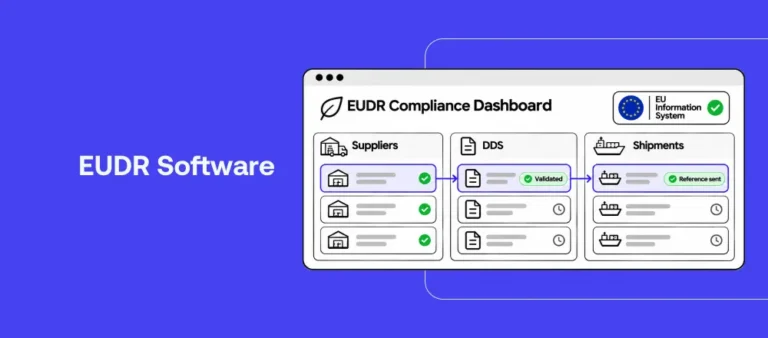
Not quite. EUDR software sits within the wider family of ESG and sustainability software, but it does a narrower job: it collects supplier and plot data, builds due diligence statements and keeps the evidence. ESG reporting software calculates metrics across the business, such as emissions, and produces the sustainability report. The best setup links the two, so the EUDR evidence flows into your ESG report instead of being retyped. Our guide to EUDR software explains what EUDR tools should do.
Sustainable Logistics and Transparent ESG Data Reporting: Practical Tips
- Collect once, use twice. Agree one supplier data request that covers EUDR and your ESG frameworks.
- Keep geolocation as data. Store GeoJSON files, not screenshots, so you can map and count sourcing areas later.
- Tag shipments by commodity and country. That makes CDP and ESRS volume questions easy to answer.
- Date every decision. Risk assessments and mitigation steps with dates double as governance evidence.
- Include logistics data. Shipment records, routes and references help with transport emissions and transparency claims.
A Real-World Scenario
A Dutch coffee importer with 1,200 staff and turnover above €450 million is in CSRD scope and answers CDP Forests. For EUDR it collects plot data from 60 cooperatives in Brazil and Uganda, files a DDS before each shipment and keeps five years of records. When its sustainability team prepares the ESRS E4 disclosure and the CDP questionnaire, the sourcing areas, volumes and deforestation-free status are already there. The team adds context and targets instead of chasing suppliers a second time. That is EUDR ESG reporting in practice.
How iEUDR by iCustoms Helps
iEUDR by iCustoms is EUDR compliance software, not an ESG reporting tool. It builds the evidence base that ESG reporting relies on:
- Supplier data at source: many suppliers are already onboarded in iEUDR, and new ones enter products, quantities and production sites in their own portal, with geolocation validated.
- DDS created, validated and verified: every statement is built from that data and submitted, singly or in bulk, and supplier statements are retrieved, verified and validated.
- A five-year audit trail: every record, change and reference is kept with the shipment it supports, ready for your EUDR report and your ESG team.
See how it works on the EUDR compliance software page.
Frequently Asked Questions
What is EUDR ESG reporting?
EUDR ESG reporting means reusing the evidence gathered for the EUDR, such as plot data and supplier records, in deforestation and biodiversity disclosures. The EUDR is a legal product rule; ESG reporting is company-level disclosure.
What are the ESG reporting requirements in the UK?
The UK SRS, based on ISSB, are voluntary for now, while many large UK companies already make mandatory climate-related disclosures. UK suppliers to EU companies are often asked for CSRD and EUDR data by their customers.
Can EUDR data be reused for CSRD?
Yes. Plot geolocation, volumes, legality evidence and risk records support ESRS E4 and related disclosures, and CSRD reporting can cover the EUDR's annual reporting duty.
Which ESG frameworks cover deforestation?
CSRD through ESRS E4, GRI 101 and GRI 13, CDP Forests, TNFD, SBTi FLAG and the ISSB's nature-related proposals all address deforestation or land-use change.
Is ESG reporting mandatory?
It is mandatory for companies in CSRD scope in the EU. Elsewhere, including under the UK SRS, it is largely voluntary for now, though customers and lenders often require it.
Is EUDR software ESG reporting software?
EUDR software belongs to the wider ESG software family but focuses on due diligence and evidence. It complements, rather than replaces, ESG reporting software.
You may also like:
One dataset. Two jobs.

iEUDR keeps the supplier, plot and DDS records that your EUDR and ESG teams both need.
Subscribe to our Newsletter
About iCustoms
iCustoms is an all-in-one solution helping businesses automate customs processes more efficiently. With AI-powered and machine-learning capabilities, iCustoms is designed to streamline your all customs procedures in a few minutes, cut additional costs and save time.
Supplier data in. Customs-ready DDS out.
Collect plot data once in iEUDR’s supplier portal, validated before it reaches your DDS.