
Import Duty Ireland: Rates, Calculation and How to Pay Less in 2026
- John Hall
- Customs Specialist at iCustoms.ai
Before your shipment arrives, you need to know what it will cost to clear customs. The iCustoms import duty Ireland calculator lets you enter your product type, country of origin and customs value to get an instant duty and VAT estimate.
Use the iCustoms iCalculator: Enter your commodity code (or describe your product), the country it is shipping from, and the declared customs value. The calculator returns the applicable TARIC duty rate, the duty amount and the import VAT liability before and after Postponed Accounting. Visit icustoms.ai/icalculator or connect via API to integrate duty calculation into your existing procurement or ERP system.
Not sure which commodity code applies to your goods? iClassification uses AI to identify the correct 8-digit EU TARIC commodity code and corresponding TARIC duty rate across 30 countries.
What Is Import Duty Ireland and Who Has to Pay It?
Import duty Ireland is a tax levied by Revenue Ireland on goods arriving from countries outside the European Union. The rate is set by the EU’s Common Customs Tariff and varies by product type and country of origin. As an EU member state, Ireland applies EU customs rules uniformly — it cannot set its own duty rates independently of EU policy.
Customs Duty Calculation Ireland
Any business or individual importing goods with a customs value above EUR 150 from a non-EU country is subject to customs duty. Import VAT at 23% applies to most goods regardless of value once they cross the EU border commercially. Customs duty is calculated and paid as part of the customs declaration submitted to Revenue Ireland through the Automated Import System (AIS) before goods are released for delivery.
Who does NOT pay import duty in Ireland: Businesses importing goods from other EU member states (free movement within the single market applies, no customs duty). Goods with a customs value of EUR 150 or less (de minimis exemption from customs duty — import VAT may still apply). Goods qualifying for inward processing, temporary admission or other customs procedure suspensions.
Customs Duty vs Import VAT: What Is the Difference?
Irish importers often confuse customs duty and import VAT. They are two separate charges with different purposes, different rates, and different payment mechanisms.
| Charge | What It Is and How It Works |
| Customs Duty | A tariff set by the EU on imported goods based on the TARIC code and country of origin. Rates range from 0% to over 30% depending on product type and any trade agreement. Paid to Revenue Ireland as part of the customs declaration. Calculated on the customs value of the goods (typically transaction value plus freight and insurance to the EU border). |
| Import VAT (23% standard rate) | Irish VAT applied to imported goods at the standard rate of 23% (or reduced rates of 13.5% and 9% for qualifying goods). Calculated on a base that includes customs value, duty and any other costs up to the point of entry into the EU. Not the same as domestic Irish VAT — it is assessed and collected by Revenue as part of customs clearance. |
| Postponed VAT Accounting (PIVA) | Not a separate charge — a mechanism that allows VAT-registered Irish businesses to defer import VAT to their periodic VAT return instead of paying at the border. Customs duty cannot be postponed under PIVA; only import VAT can be deferred. The cash flow benefit is substantial for businesses with regular import volumes. |
Import Duty Rates in Ireland: Sample Rates by Product Category
The EU’s Common Customs Tariff sets duty rates for all product categories. The following table shows indicative TARIC third-country duty rates for common import categories. These are standard Most Favoured Nation (MFN) rates applied to imports from countries without a preferential trade agreement with the EU. Always verify the exact rate using the EU TARIC database or iClassification before filing.
| Product Category | TARIC Code Range | Standard MFN Rate | EU-UK TCA Rate (eligible UK goods) | Key Notes |
| Clothing and apparel | 6101 to 6217 | 12% | 0% (if rules of origin met) | High duty category; TCA preference valuable; check origin documentation carefully |
| Footwear | 6401 to 6403 | 3.7% to 17% | 0% (if rules of origin met) | Rate varies significantly by material and type of footwear |
| Consumer electronics | 8471 to 8544 | 0% to 14% | 0% | Most electronics benefit from Information Technology Agreement (ITA) zero rates |
| Smartphones and tablets | 8517, 8471 | 0% | 0% | ITA zero rate applies regardless of origin |
| Passenger cars | 8703 | 6.5% | 0% (if rules of origin met) | High value x 6.5% rate makes TCA origin very important for automotive importers |
| Food and beverages | 0201 to 2208 | Varies widely 0% to 150%+ | Varies by product | Agricultural products have complex duty structures including seasonal rates and quotas |
| Raw materials (industrial) | 2501 to 2852 | 0% to 6.5% | 0% | Many raw materials have tariff suspensions or zero MFN rates |
| Machinery and equipment | 8401 to 8486 | 0% to 4.2% | 0% | Most industrial machinery is at low or zero duty; check specific CN heading |
| Plastics and articles | 3901 to 3926 | 0% to 6.5% | 0% (if rules of origin met) | Duty rate depends on plastic type and form; many industrial grades at 0% |
| Steel and metal products | 7201 to 7326 | 0% to 5% (plus potential safeguard duties) | Varies | EU steel safeguard measures may apply; check for anti-dumping measures on Chinese origin |
| Pharmaceutical products | 2936 to 3004 | 0% | 0% | Pharmaceuticals benefit from zero MFN rate under ITA/sectoral agreements |
| Cosmetics and personal care | 3301 to 3307 | 3.7% to 6.5% | 0% (if rules of origin met) | Moderate duty category; origin documentation important for UK suppliers |
| Furniture | 9401 to 9403 | 0% to 5.6% | 0% (if rules of origin met) | Rate varies by material; upholstered furniture often at 5.6% MFN |
| Toys and games | 9501 to 9508 | 0% to 4.7% | 0% | Most toys at low or zero MFN rate |
| Motor vehicle parts | 8708 | 3.5% to 4.5% | 0% (if rules of origin met) | Important category for automotive supply chain importers from UK |
Important: Duty rates change annually as part of the EU’s integrated tariff revision process and may change at short notice for anti-dumping or safeguard measures. Always verify the current rate using the EU TARIC database (ec.europa.eu/taxation_customs/dds2/taric) or iClassification before filing your AIS declaration. Rates shown above are indicative standard MFN rates and may not reflect current EU TARIC measures.
How to Calculate Import Duty in Ireland: Step by Step
Import duty calculation follows a consistent five-step process under the EU Union Customs Code (Regulation EU 952/2013). The same process applies to every import declaration filed through the AIS system.
Step 1: Classify Your Goods (HS Code and TARIC Code)
Find the correct 8-digit EU Combined Nomenclature (CN) code for your goods. The CN code is the EU’s expansion of the 6-digit World Customs Organisation (WCO) Harmonised System (HS) code. For Ireland, this becomes a 10-digit TARIC code when EU-specific measures (anti-dumping, quotas, suspensions) are added.
Your TARIC code determines your duty rate, any anti-dumping duties, any quota eligibility, and any tariff suspension that may reduce your duty to zero. Getting this wrong is the single most common and costly customs error Irish importers make. iClassification uses AI to determine the correct commodity code and returns the applicable duty rate, removing the risk of manual misclassification.
Step 2: Determine the Country of Origin
Country of origin determines which duty rate applies. Goods from countries with an EU preferential trade agreement (such as the UK under TCA, Japan, Canada under CETA, South Korea, New Zealand, Kenya and others) may qualify for a reduced or zero preferential duty rate. To claim preference, you need proof of origin — typically a statement on origin placed on the commercial invoice by the exporter.
Goods from countries without a preferential agreement (including Australia and the USA in most categories, and China for most products) pay the standard EU Most Favoured Nation (MFN) rate. Some goods from China and other markets are also subject to anti-dumping duties on top of the standard MFN rate.
Step 3: Establish the Customs Value
The primary customs valuation method under the EU UCC is transaction value (Article 70 UCC): the price actually paid or payable for the goods when sold for export to the EU, adjusted for costs that are to be added or deducted under the UCC rules. In most straightforward cases, this means CIF (cost, insurance and freight) value up to the point of entry into the EU.
Revenue Ireland uses monthly exchange rates published by the European Central Bank for converting non-EUR invoices. Using the wrong exchange rate is a common compliance error. iCustoms iCalculator applies the correct monthly rate automatically.
Step 3: Establish the Customs Value
The primary customs valuation method under the EU UCC is transaction value (Article 70 UCC): the price actually paid or payable for the goods when sold for export to the EU, adjusted for costs that are to be added or deducted under the UCC rules. In most straightforward cases, this means CIF (cost, insurance and freight) value up to the point of entry into the EU.
Revenue Ireland uses monthly exchange rates published by the European Central Bank for converting non-EUR invoices. Using the wrong exchange rate is a common compliance error. iCustoms iCalculator applies the correct monthly rate automatically.
Step 4: Calculate the Duty
Duty is calculated by multiplying the customs value by the applicable TARIC duty rate for the correct CN code and origin. The formula is:
Customs duty = Customs value (EUR) x TARIC duty rate (%)
Step 5: Calculate Import VAT
Import VAT in Ireland is charged at 23% on a base that includes the customs value plus customs duty plus any additional charges (such as freight and insurance if not already included in the customs value). The formula is:
Import VAT base = Customs value + Customs duty + any additional charges to EU entry point
Import VAT = Import VAT base x 23% (standard rate)
If you are VAT-registered in Ireland and use Postponed VAT Accounting, you do not pay this amount at the border. Instead, you declare it on your VAT return and reclaim it in the same period, resulting in a net zero cash flow impact.
Worked Example: Importing Electronics from China
A Dublin-based retailer imports 500 laptop computers from China. The purchase price is EUR 150,000. Freight and insurance to Dublin Port: EUR 3,500.
| Calculation Step | Amount |
| Commodity code | 8471 30 (portable automatic data processing machines) |
| TARIC duty rate | 0% (ITA zero rate applies — most laptops are duty-free) |
| Customs value (transaction value CIF) | EUR 153,500 (purchase price EUR 150,000 + freight/insurance EUR 3,500) |
| Customs duty | EUR 0 (0% rate) |
| Import VAT base | EUR 153,500 |
| Import VAT (23%) | EUR 35,305 |
| Without PIVA: pay at border | EUR 35,305 |
| With PIVA: defer to VAT return | EUR 0 at border; declared and reclaimed on next VAT return — net cash impact nil |
| Annual saving from PIVA (monthly importer of similar value) | Depending on payment terms, PIVA defers EUR 35,000+ per shipment — a significant working capital improvement for regular importers |
Worked Example: Importing Clothing from the UK Two Scenarios
An Irish fashion retailer imports EUR 20,000 of clothing from a UK manufacturer. The key question post-Brexit is whether the goods qualify for TCA preferential zero duty.
| Step | Scenario A: Goods qualify for TCA preference | Scenario B: Goods do not qualify for TCA |
| TARIC code | 6104 43 (women’s knitted dresses) | 6104 43 (women’s knitted dresses) |
| Standard MFN duty rate | 12% | 12% |
| TCA preferential rate | 0% (with valid statement on origin) | 12% (TCA preference cannot be claimed) |
| Customs value | EUR 20,000 | EUR 20,000 |
| Customs duty | EUR 0 | EUR 2,400 (12% of EUR 20,000) |
| Import VAT base | EUR 20,000 | EUR 22,400 |
| Import VAT (23%) | EUR 4,600 | EUR 5,152 |
| Without PIVA: total at border | EUR 4,600 | EUR 7,552 |
| With PIVA: total at border | EUR 0 | EUR 2,400 (duty only — VAT deferred) |
| Annual cost of failing TCA check (monthly importer) | Each shipment where TCA is missed costs EUR 2,400 in unnecessary duty. At 12 shipments per year: EUR 28,800 in avoidable duty. | Proper TCA origin documentation and supplier engagement eliminates this cost. |
The worked example above illustrates why getting UK-origin documentation right is so financially important. iClassification checks the rules of origin for your specific commodity code and helps you identify whether your UK supplier’s goods qualify for TCA preference before your declaration is submitted.
Import Duty from the UK to Ireland after Brexit
Before 1 January 2021, goods moving between the UK and Ireland as EU member states were in free circulation. No customs duty applied to UK-Ireland trade because both countries were inside the EU Single Market and Customs Union.
When the UK’s transition period ended on 31 December 2020, this changed. From 1 January 2021, goods imported into Ireland from the United Kingdom (excluding Northern Ireland, which has a special arrangement under the Windsor Framework) are treated as imports from a third country. They are subject to EU TARIC customs duty unless they qualify for preferential zero duty under the EU-UK Trade and Cooperation Agreement (TCA).
Northern Ireland note: Under the Windsor Framework, Northern Ireland remains aligned with EU single market rules for goods. Goods moving from Northern Ireland to the Republic of Ireland are not subject to customs duty or standard AIS import declaration requirements in the same way as goods from Great Britain. If you import from Northern Ireland specifically, seek specific guidance from Revenue Ireland on the applicable procedure.
How TCA Preferential Duty Works for UK Imports
The EU-UK Trade and Cooperation Agreement provides for zero customs duty on goods of UK origin imported into the EU, including Ireland. However, the zero rate only applies if:
- The goods genuinely originate in the United Kingdom — meaning they were wholly obtained in the UK, or substantially transformed there according to the product-specific rules of origin for their commodity code.
- The UK exporter provides a valid statement on origin on the commercial invoice or in a separate document. This statement certifies the origin of the goods and the exporter’s REX (Registered Exporter) number if the shipment value exceeds EUR 6,000.
- The Irish importer retains the statement on origin and can produce it in the event of a Revenue audit.
If these conditions are not met, the standard EU TARIC duty rate applies. For clothing and footwear (12% duty), vehicles (6.5% duty) and agricultural products, the financial difference between qualifying and not qualifying for TCA preference can be very large. Checking the rules of origin for your specific commodity code before placing an order with a UK supplier is essential planning for any regular Ireland-UK importer.
What Is Ireland TARIC Code and How Do I Find Mine?
A TARIC code is a 10-digit product classification code used by the European Union to apply customs duty rates, anti-dumping measures, tariff suspensions and quotas to specific goods. It is the key that connects your product to its customs duty rate in Ireland and across all EU member states.
TARIC codes are built in layers. The first six digits are the WCO Harmonised System (HS) code, which is internationally recognised and used by over 200 countries. Digits 7 and 8 are added by the EU to create the Combined Nomenclature (CN) code, which is the classification system specific to the European Union. Digits 9 and 10 are the TARIC sub-heading, which captures EU-specific measures such as anti-dumping duties, tariff suspensions, import quotas and preferential rate conditions.
| Code Level | Digits | Used For |
| HS code (WCO international) | 6 digits (e.g. 640399) | Global baseline classification — same across all countries |
| CN code (EU Combined Nomenclature) | 8 digits (e.g. 64039900) | EU-specific duty rate, agricultural measures, EU customs union |
| TARIC code (EU TARIC database) | 10 digits (e.g. 6403990090) | EU-specific measures: anti-dumping, suspensions, quotas, preferential rates |
To find the correct TARIC code for your goods manually, use the EU TARIC database at ec.europa.eu/taxation_customs/dds2/taric. Enter a description of your product or start from the HS chapter and navigate the classification tree. The database shows the current duty rate, any anti-dumping measures and any applicable tariff suspensions.
For regular importers with many product lines, manual TARIC lookup is time-consuming and error-prone. iClassification uses AI to classify goods from a product description, invoice text or image, returning the correct CN code and current duty rate in seconds across 30 countries including Ireland.
Import Duty from Australia, the USA and Other Countries
For goods imported into Ireland from countries without a preferential trade agreement with the EU, the standard Most Favoured Nation (MFN) duty rate under the EU Common Customs Tariff applies. The MFN rate is the same as the standard TARIC third-country rate shown in the product category table above.
| Origin Country | Duty Framework and Key Notes |
| Australia | MFN rates apply. No EU-Australia free trade agreement is currently in force (negotiations were ongoing as of 2025 but an agreement was not finalised). Irish importers from Australia pay standard TARIC MFN rates. |
| United States of America | MFN rates apply. No EU-USA free trade agreement is currently in force. Irish importers from the USA pay standard TARIC MFN rates. Certain US-origin goods were subject to EU retaliatory tariffs in prior years — check current TARIC database for any specific measures on your commodity. |
| China | MFN rates apply, but significant additional anti-dumping and countervailing duties apply to a wide range of Chinese-origin goods including steel products, solar panels, ceramic tiles, certain chemicals and many consumer goods. Always check the EU TARIC database for additional duties beyond the standard MFN rate before importing from China. |
| India | MFN rates apply. EU-India trade agreement negotiations were ongoing as of 2025. Some GSP (Generalised Scheme of Preferences) preferential rates may apply to certain goods from India — check TARIC for GSP eligibility. |
| Japan | EU-Japan Economic Partnership Agreement (EPA) provides preferential rates for many product categories. Check TARIC for applicable EPA rates and rules of origin requirements. |
| Canada | EU-Canada Comprehensive Economic and Trade Agreement (CETA) provides preferential rates for most product categories. Requires certificate of origin or origin declaration. CETA has been provisionally applied since 2017. |
| South Korea | EU-South Korea Free Trade Agreement provides preferential rates. Check TARIC for applicable rates and origin requirements. |
Anti-Dumping Duties: What Irish Importers Must Check
Anti-dumping duties are additional tariffs imposed by the EU on specific goods from specific countries where the EU has determined those goods are being exported at unfairly low prices that damage EU industry. Anti-dumping duties are applied on top of the standard TARIC MFN rate and can be very large — sometimes 20% to 70% on top of the standard duty.
Anti-dumping duties change frequently and are product-specific and country-of-origin-specific. Common categories subject to EU anti-dumping duties include certain steel and aluminium products from China and other markets, ceramic tiles from China, solar panels, certain chemicals and some textile products. The only way to be certain whether an anti-dumping duty applies to your specific goods is to check the EU TARIC database or use iClassification, which incorporates current anti-dumping measures in its classification output.
An Irish importer who does not check for anti-dumping duties before importing goods from China risks a Revenue assessment for unpaid duty, with interest and potential penalties. Anti-dumping duty assessments can go back four years. This is one of the most common and expensive compliance errors for Irish importers with Chinese supply chains.
The De Minimis Threshold and IOSS for Low-Value Imports
Until 30 June 2026, goods with a customs value of EUR 150 or less are generally exempt from customs duty in Ireland under the EU’s low value consignment relief. Import VAT, however, continues to apply to commercial goods regardless of value. From 1 July 2026, the EUR 150 customs duty exemption will be abolished as part of the EU’s ecommerce customs reform package, introducing a new simplified duty regime for low value consignments.
For low value goods valued at EUR 150 or less and sold into Ireland through non EU ecommerce platforms, the Import One Stop Shop, IOSS, VAT scheme has applied since July 2021. Learn how IOSS works, eligibility requirements, and common compliance pitfalls in our detailed guide to IOSS for EU imports.
Under IOSS, the seller, or the online marketplace facilitating the sale, registers for IOSS in an EU Member State and collects VAT at the point of sale on behalf of the customer. This allows VAT to be remitted through a single monthly return and helps streamline customs clearance. Until 30 June 2026, qualifying IOSS consignments valued at EUR 150 or less are not subject to customs duty. Businesses importing goods for their own use through ecommerce channels should note that commercial shipments without IOSS registration may have VAT assessed and collected at import, even where customs duty relief applies.
UCC (Union Customs Code) Ireland Explained
The Union Customs Code, established under Regulation (EU) No 952/2013, is the legal framework that governs every customs transaction in Ireland. It replaced the Community Customs Code (Regulation EC 450/2008) and came into full effect on 1 May 2016. Every import declaration filed through Revenue Ireland’s Automated Import System (AIS), every customs valuation decision, every procedure code applied to a shipment, and every origin determination made at an Irish port or airport operates under UCC rules. Ireland, as an EU member state, applies the UCC uniformly and cannot deviate from it.
The UCC modernised EU customs law for an era of electronic trade. It mandated fully electronic customs declarations across all member states, reformed customs valuation methodology, introduced a unified set of customs procedure codes, and aligned the Authorised Economic Operator (AEO) framework with modern supply chain risk standards. For Irish importers, the most visible effect of the UCC is the AIS declaration system itself, which exists because the UCC requires all customs entries to be submitted and processed electronically before goods are released.
What the UCC Replaced and What Changed
The Community Customs Code had been in operation since 1992. By the time the UCC replaced it, ecommerce had grown from negligible to a dominant trade channel, supply chains had become multi-jurisdictional, and the paper-based declaration processes the CCC assumed were incompatible with the volumes and speeds of modern trade. The UCC addressed this directly.
The most significant operational changes for Irish importers under the UCC compared to its predecessor were the requirement for pre-lodgement of customs declarations in most scenarios, reformed customs debt rules under Articles 198 to 216 (including the extension of Revenue’s assessment window and the clarification of joint and several liability for customs agents), reformed customs valuation under Articles 70 to 74, and the introduction of centralised EU customs decision-making for certain authorisations.
Key UCC Provisions Every Irish Importer Should Know
The UCC runs to 288 articles. The provisions most directly relevant to day-to-day importing into Ireland are set out below.
| UCC Provision | What It Governs | Practical Impact for Irish Importers |
|---|---|---|
| Article 70 (Transaction Value) | Primary customs valuation method: price paid or payable for goods when sold for export to the EU, adjusted per UCC rules | The standard basis for calculating customs value on AIS. Incorrectly excluding or deducting freight costs from the CIF value is one of the most common declaration errors filed through AIS. |
| Articles 71-74 (Alternative Valuation Methods) | Fallback methods when transaction value cannot be used: identical goods, similar goods, deductive value, computed value, reasonable means | Applies when goods are transferred between related parties, gifted, or invoiced at non-arm’s-length prices. Revenue may challenge transaction value and apply an alternative method. |
| Articles 56-58 (Customs Tariff) | Application of the EU Common Customs Tariff to all goods entering the EU | All AIS declarations in Ireland reference the TARIC code, which is the EU’s operative implementation of UCC tariff rules. |
| Articles 77-112 (Customs Procedures) | Release for free circulation, inward processing, customs warehousing, temporary admission, end-use, transit | Irish importers using bonded warehouses, importing goods for processing and re-export, or using temporary admission must apply the correct UCC procedure code. An incorrect procedure code causes declaration rejections and shipment delays. |
| Articles 198-216 (Customs Debt) | When a customs debt arises, who is liable, and how long Revenue has to collect it | The importer of record is the principal debtor. Revenue can assess unpaid duty for up to three years from the declaration date in standard cases, and up to ten years where the error is fraudulent or grossly negligent. |
| Articles 246-247 (Appeals) | Right to appeal customs decisions | Irish importers can request a formal review of any Revenue customs decision, including duty rate assessments, valuation challenges, and classification determinations, before escalation to the Tax Appeals Commission. |
The UCC and AIS: What Irish Importers Submit in Practice
Revenue Ireland’s Automated Import System (AIS) is the electronic platform through which all UCC-compliant import declarations are filed in Ireland. Every commercial import of goods with a customs value above EUR 150 from outside the EU requires an AIS entry before Revenue will release the goods. The AIS declaration must include the 10-digit TARIC commodity code, the applicable UCC customs procedure code, the customs valuation method and the calculated customs value, the country of origin, and any proof of preferential origin where a reduced duty rate is claimed.
For businesses managing regular import flows, manual AIS submission is time-intensive and carries classification and procedural error risk. iAIS from iCustoms automates AIS declaration preparation and submission, flags compliance issues before filing, and integrates with existing procurement and ERP systems to pull product and supplier data directly into the declaration workflow.
VAT on Imports Ireland: How It Works
VAT on imports Ireland is a tax applied by Revenue to goods arriving from countries outside the European Union, collected as part of the customs clearance process rather than through the normal domestic VAT system. It is calculated on a different base than customs duty, operates through a separate payment mechanism, and can be deferred by VAT-registered businesses under Revenue’s Postponed Import VAT Accounting (PIVA) scheme. For any business importing goods into Ireland on a regular basis, understanding how import VAT works is foundational to cash flow planning, pricing accuracy, and VAT return compliance.
VAT Rates That Apply to Imports in Ireland
The VAT rate applied to imported goods is determined by the type of goods, not by their country of origin or the customs duty rate. The same rates that apply to domestically supplied goods in Ireland apply to their imported equivalents. The applicable rate is governed by the Value-Added Tax Consolidation Act 2010 and the EU VAT Directive.
| VAT Rate | Rate | Applies To |
|---|---|---|
| Standard rate | 23% | Most goods imported into Ireland: electronics, clothing, footwear, furniture, most manufactured goods and consumer products |
| Reduced rate | 13.5% | Construction materials, certain agricultural inputs, fuel products, and other goods listed in Schedule 3 of the VAT Consolidation Act |
| Second reduced rate | 9% | Certain printed publications, newspapers, and e-books where the reduced rate applies; check current Revenue guidance as this rate has been subject to legislative change |
| Zero rate | 0% | Qualifying food (unprocessed and basic food items), children’s clothing and footwear, oral medicines, and books. Zero-rated goods are not VAT-exempt; they are rated at 0% and can still generate a deductible input tax credit on the VAT return |
How Ireland Import VAT Is Calculated
Import VAT in Ireland is not calculated on the invoice value of the goods alone. The calculation base is broader than the customs value used for duty: it includes the customs value of the goods (cost plus insurance plus freight to the EU border, CIF), the customs duty payable on those goods, and any other incidental charges due up to the first place of destination in the EU. This means that even where a product attracts a 0% customs duty rate, import VAT is still charged on the full CIF value of the goods.
Import VAT base = Customs value (CIF) + Customs duty + other incidental charges to EU entry point
Import VAT = Import VAT base x applicable VAT rate (23% standard)
The worked example below shows the full calculation for a standard import from the US where both customs duty and import VAT apply.
| Calculation Step | Example: Footwear imported from the USA (customs value EUR 10,000) |
|---|---|
| Customs value (CIF to EU border) | EUR 10,000 |
| TARIC duty rate | 17% (leather footwear, MFN rate for US origin) |
| Customs duty | EUR 1,700 |
| Import VAT base | EUR 11,700 (customs value EUR 10,000 + duty EUR 1,700) |
| Import VAT (23% standard rate) | EUR 2,691 |
| Total at border without PIVA | EUR 4,391 (duty EUR 1,700 + VAT EUR 2,691) |
| Total at border with PIVA | EUR 1,700 (duty only; VAT EUR 2,691 deferred to next VAT return) |
Postponed Import VAT Accounting (PIVA) in Ireland
Postponed Import VAT Accounting, known as PIVA, is a Revenue mechanism that allows VAT-registered businesses to defer payment of import VAT from the point of customs clearance to their periodic VAT return. Instead of paying import VAT at the border as part of the AIS declaration, the business accounts for it on the next VAT return as a simultaneous output tax entry and input tax reclaim. For fully taxable businesses, the net VAT cash flow impact is zero, but the timing benefit is significant: import VAT that would otherwise be paid at clearance is deferred by up to two months depending on VAT return frequency.
PIVA is available to all VAT-registered businesses in Ireland without a separate application. The business selects PIVA on the AIS import declaration. Revenue generates a monthly PIVA statement through ROS (Revenue Online Service) showing all import VAT deferred in that calendar month. This statement is the primary supporting document for the VAT return entry and must be retained for audit purposes.
Three points frequently misunderstood about PIVA
Customs duty cannot be deferred under PIVA. Only import VAT qualifies. Duty remains payable at AIS declaration stage. PIVA does not reduce the amount of import VAT payable; it changes when it is paid. Businesses that cannot reclaim input VAT (fully exempt businesses) will still owe the full import VAT on their return. Revenue cross-references PIVA statement totals against VAT return declarations; discrepancies trigger compliance interventions.
Commodity Codes Ireland: What Are They?
Commodity codes in Ireland are the standardised numerical codes assigned to goods to classify them for customs purposes. The commodity code on an import declaration determines the applicable customs duty rate, whether any anti-dumping duties apply, whether the goods qualify for a preferential tariff rate under an EU free trade agreement, and whether any import licensing or quota restrictions are in force. Every product imported into Ireland from outside the EU must carry the correct commodity code on the AIS import declaration before Revenue will release the goods. The code also appears on the commercial invoice and any preferential origin documents that accompany the shipment.
How Commodity Codes in Ireland Are Structured
Irish commodity codes are built in three layers, each adding specificity beyond the internationally standardised base.
| Level | Digits | Name | Used By | Example: Leather Footwear |
|---|---|---|---|---|
| Harmonised System (HS) | 6 digits | HS code | All 200+ WCO member countries worldwide | 6403.99 |
| EU Combined Nomenclature (CN) | 8 digits | CN code / commodity code | All EU member states including Ireland | 6403 99 00 |
| EU TARIC | 10 digits | TARIC code | EU customs authorities; AIS declarations in Ireland | 6403 99 00 90 |
The first six digits are identical across every country using the Harmonised System and form the internationally recognised baseline for product classification. The EU adds digits 7 and 8 to create the Combined Nomenclature code, which carries EU-specific duty rate information and agricultural policy measures. Digits 9 and 10 are the TARIC sub-heading, which identifies EU-specific measures attached to that specific product: anti-dumping duties, tariff suspensions that reduce the duty rate below the standard MFN rate, preferential rate conditions tied to specific origin countries, and import quotas. In Ireland, the 10-digit TARIC code appears on every AIS import declaration.
Why Commodity Code Accuracy Matters for Irish Importers
The commodity code is the most consequential single decision in the customs declaration process. An incorrect code applies the wrong duty rate to every shipment filed under it. If the applied rate is too low, Revenue will issue a retrospective duty assessment with interest. If too high, the overpayment must be reclaimed through a formal amendment process.
The consequences extend beyond the duty rate. The commodity code also determines whether the goods are subject to anti-dumping duties that could represent an additional 20% to 70% on top of the standard rate, whether an import licence is required before the goods can be cleared, whether quota restrictions limit the volume that can be imported at the preferential rate, and whether specific product standards or safety checks apply at the border.
Revenue can reassess customs duty going back three years from the date of the import declaration in standard error cases, and up to ten years where the error involves fraud or gross negligence. A misclassification applied consistently across twelve months of imports does not produce one declaration error: it produces twelve, compounding into a retrospective assessment that can be commercially disruptive. Classifying goods correctly before the first import declaration is filed, using iClassification or a formal Revenue ruling, is the most cost-effective risk management step an Irish importer can take.
Frequently Asked Questions: Import Duty in Ireland
What is import duty in Ireland and who has to pay it?
Import duty in Ireland is a customs tax collected by Revenue Ireland on goods imported from countries outside the European Union. Any business or individual importing goods with a customs value above EUR 150 from a non-EU country is liable to pay customs duty at the applicable TARIC rate. Import duty does not apply to goods moving between EU member states, which are in free circulation within the Single Market. Since January 2021, goods from Great Britain are treated as imports from a non-EU country and are subject to TARIC duty unless they qualify for TCA preferential zero duty.
How much import duty will I pay in Ireland?
The amount of import duty you pay depends on three things: the commodity code (TARIC code) of your goods, the country they originate from, and their customs value. TARIC duty rates range from 0% on many electronics and industrial goods to 12% or more on clothing, footwear and certain consumer goods. Standard MFN rates for common categories are shown in the rate table above. Use the iCustoms iCalculator to get an instant duty estimate for your specific shipment before it arrives. You should also factor in import VAT at 23% on top of the duty, unless you are using Postponed VAT Accounting.
What import duty applies to goods from the UK after Brexit?
Since 1 January 2021, goods imported into Ireland from Great Britain are subject to EU TARIC customs duty at the standard MFN rate unless they qualify for zero duty under the EU-UK Trade and Cooperation Agreement. To claim zero duty under TCA, the goods must originate in the UK under the TCA rules of origin, and the UK exporter must provide a statement on origin on the commercial invoice. For high-duty categories like clothing (12% MFN rate) and cars (6.5% MFN rate), the difference between qualifying and not qualifying for TCA preference is commercially very significant. iClassification helps Irish importers check TCA rules of origin by commodity code.
How is import VAT calculated on goods coming into Ireland?
Import VAT in Ireland is charged at the standard rate of 23% (or reduced rates of 13.5% or 9% for qualifying goods). It is calculated on a base that includes the customs value of the goods plus any customs duty payable plus any other charges up to the point of entry into the EU. For example, goods with a customs value of EUR 10,000 and a 6% duty of EUR 600 attract import VAT on EUR 10,600 at 23%, giving an import VAT liability of EUR 2,438. If you are VAT-registered in Ireland, you can use Postponed VAT Accounting to defer this payment to your VAT return rather than paying it at the border.
What is the de minimis threshold for import duty in Ireland?
The de minimis exemption from customs duty in Ireland is EUR 150. Goods with a customs value of EUR 150 or less are not subject to customs duty. Import VAT at 23% continues to apply on commercial shipments above EUR 22, though since July 2021 the EUR 22 VAT de minimis for commercial goods has been largely removed through IOSS registration requirements for ecommerce sellers. Businesses importing goods for their own use from non-IOSS ecommerce platforms will have VAT assessed at the point of importation if the goods exceed EUR 22 in value.
What is Postponed VAT Accounting and how does it help my cash flow?
Postponed VAT Accounting (PIVA) is a Revenue Ireland scheme available to all VAT-registered Irish businesses that import goods. Instead of paying import VAT to Revenue at the point of customs clearance (which can mean paying large sums weeks before the goods are sold or used), PIVA allows you to record the import VAT on your periodic VAT return. If you are entitled to full input VAT recovery, the import VAT recorded and reclaimed in the same return period results in zero net cash flow impact. For a business importing EUR 50,000 per month of goods at 23% import VAT, PIVA eliminates a EUR 11,500 per month cash flow cost at the border.
What is a TARIC code IN Ireland and how do I find the duty rate for my goods?
In Ireland, A TARIC code is a 10-digit product classification code that determines the customs duty rate and any additional EU measures (anti-dumping duties, tariff suspensions, quotas) for a specific product imported into the EU. To find your TARIC code manually, use the EU TARIC database at the European Commission's customs portal. Enter a description of your product and navigate the classification tree to find the correct code and current duty rate. If you import many different products or want to eliminate classification error risk, iClassification uses AI to return the correct TARIC code and current duty rate from a product description in seconds.
Can I get relief from import duty in Ireland?
Yes. There are several ways to reduce or eliminate import duty on goods imported into Ireland. Tariff suspensions temporarily remove or reduce duty on specific raw materials or components not widely produced in the EU. Autonomous Tariff Quotas (ATQs) allow a set volume of goods to enter at a reduced or zero rate before the standard rate kicks in. Inward Processing Relief suspends duty and VAT for goods imported for processing and re-export. Returned Goods Relief allows EU-origin goods to re-enter Ireland duty-free within three years if they return in the same state. Claiming these reliefs requires correct TARIC code and procedure declaration on your AIS import declaration. iCustoms AIS automation ensures the correct procedure codes are applied.
How do I import goods from Australia into Ireland and what duty will I pay?
Goods imported from Australia into Ireland are subject to EU TARIC Most Favoured Nation (MFN) duty rates. There is currently no EU-Australia free trade agreement in force, so no preferential rate applies. You will pay the standard MFN duty rate for your product's commodity code. For clothing and footwear from Australia, this means 12% to 17% duty. For electronics, the rate may be 0% under the Information Technology Agreement. For food and agricultural products, rates vary widely and can be very high. Use the iCustoms iCalculator to get an exact duty and VAT estimate for your specific goods from Australia before ordering.
You may also like:
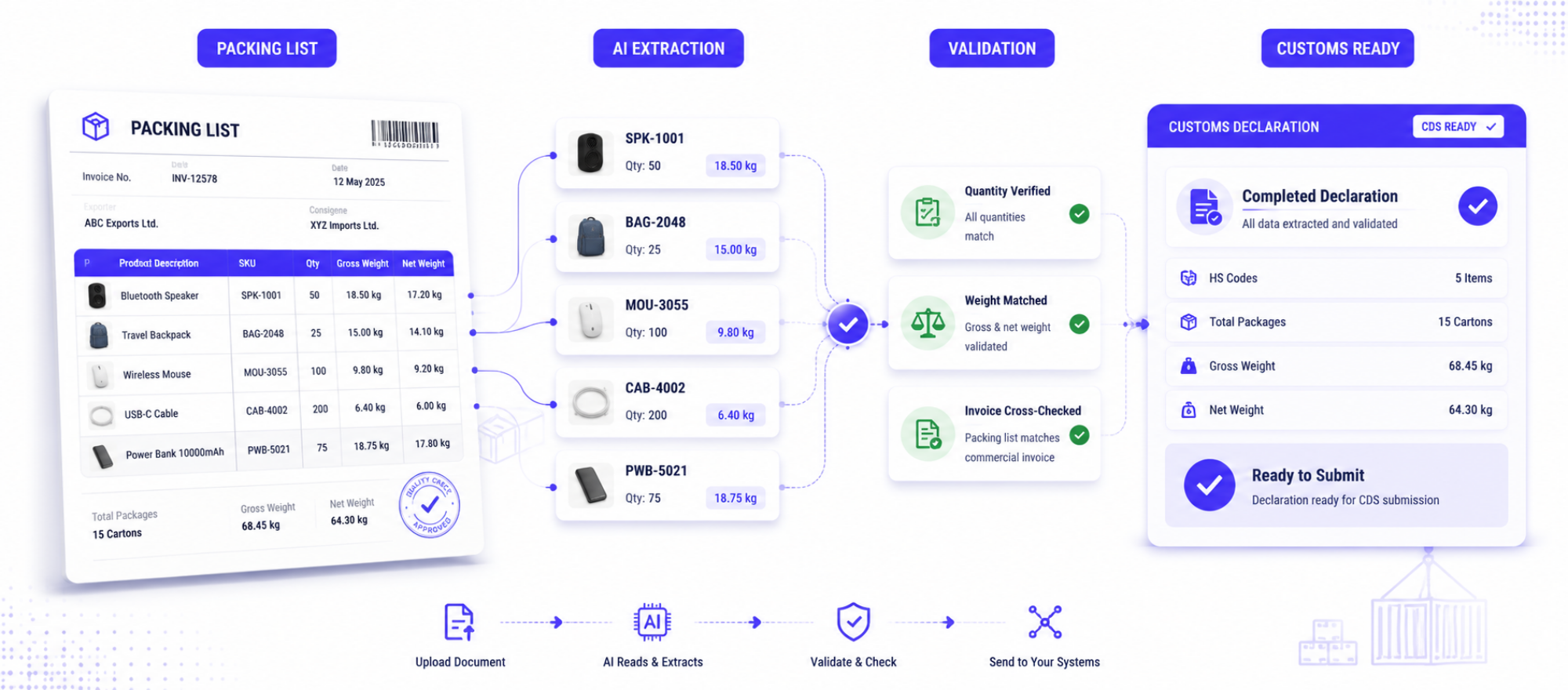
Struggling to Extract, Catagorise & Validate Your Documents?

Capture & Upload Data in Seconds with AI & Machine Learning
Subscribe to our Newsletter
About iCustoms
iCustoms is an all-in-one solution helping businesses automate customs processes more efficiently. With AI-powered and machine-learning capabilities, iCustoms is designed to streamline your all customs procedures in a few minutes, cut additional costs and save time.
Struggling to Extract, Catagorise & Validate Your Documents?
Capture & Upload Data in Seconds with AI & Machine Learning