
EUDR Software: What It Should Do and How to Choose the Right Platform
- John Hall
- Customs Specialist at iCustoms.ai
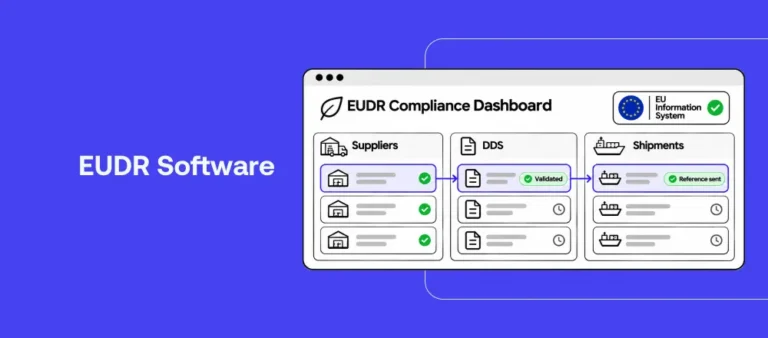
EUDR software collects supplier and plot data, checks it, builds due diligence statements (DDS), submits them to the EU Information System and keeps the records the regulation asks for. Good software also hands each DDS reference to the people who need it, from downstream buyers to the forwarder filing the customs declaration.
You can comply without software, using the Information System’s web form. But once you have more than a handful of suppliers or shipments, the manual route becomes the risk. This guide explains what EUDR compliance software should do, how integration with TRACES and your ERP works, and how to choose.
Why Teams Look for EUDR Software
Most teams start with spreadsheets and email. The same three problems then appear.
- Supplier data arrives incomplete. Plot coordinates come in different formats, polygons are missing for larger plots, and production dates or quantities do not match the shipment.
- Evidence is spread across teams. Procurement holds supplier contracts, sustainability holds origin data, customs holds the declarations, and nobody sees the whole file.
- Volume outgrows people. Each statement takes time to prepare and submit, and every reference must reach the right shipment before the goods arrive.
EUDR software exists to fix these three problems. Everything else is detail.
What EUDR Compliance Software Should Do
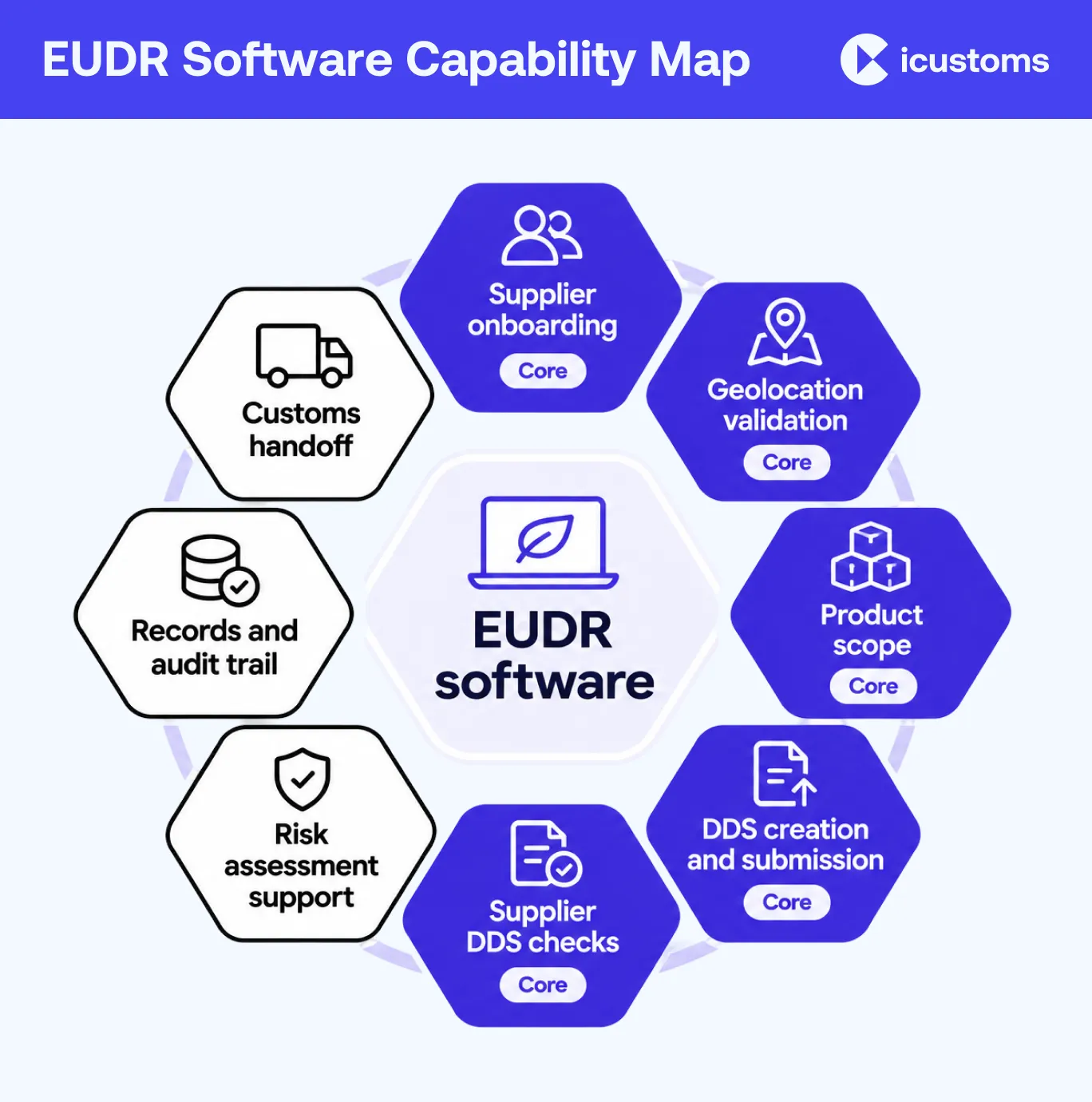
Use this table as a checklist. Not every business needs every capability on day one, but the first five are the core of any EUDR compliance software.
| Capability | What good looks like | Also searched as |
|---|---|---|
| Supplier onboarding | A supplier portal where suppliers enter products, quantities, plots and legality evidence themselves | EUDR supplier software |
| Geolocation validation | Checks coordinates and polygons against the EUDR rules and converts them to GeoJSON before submission | EUDR geolocation mapping software |
| Product scope | Flags which CN codes are in Annex I, including ‘ex’ codes and 2027 additions | EUDR HS code checker |
| DDS creation and submission | Builds each DDS from supplier data, validates it and submits it, singly or in bulk | EUDR DDS and TRACES integration |
| Supplier DDS checks | Retrieves, verifies and validates statements received from suppliers | EUDR reference number check |
| Risk assessment support | Organises country, supplier and plot information so your team can assess and record risk | EUDR risk assessment software |
| Records and audit trail | Keeps every statement, change and piece of evidence for five years | EUDR audit software |
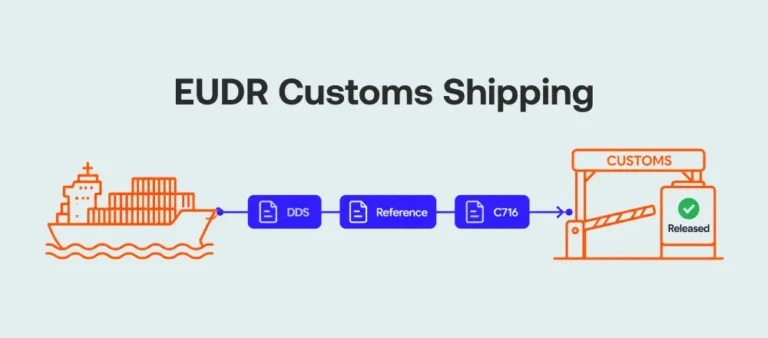
| Customs handoff | Sends each reference to the forwarder or customs agent, matched to its shipment | EUDR customs software |
Two cautions. First, software supports due diligence but does not take on your legal responsibility: the operator remains accountable for every DDS. Second, satellite checks and risk scores are useful inputs, but the regulation asks for a documented assessment that your team can explain.
EUDR DDS and TRACES Integration: How the Official API Works
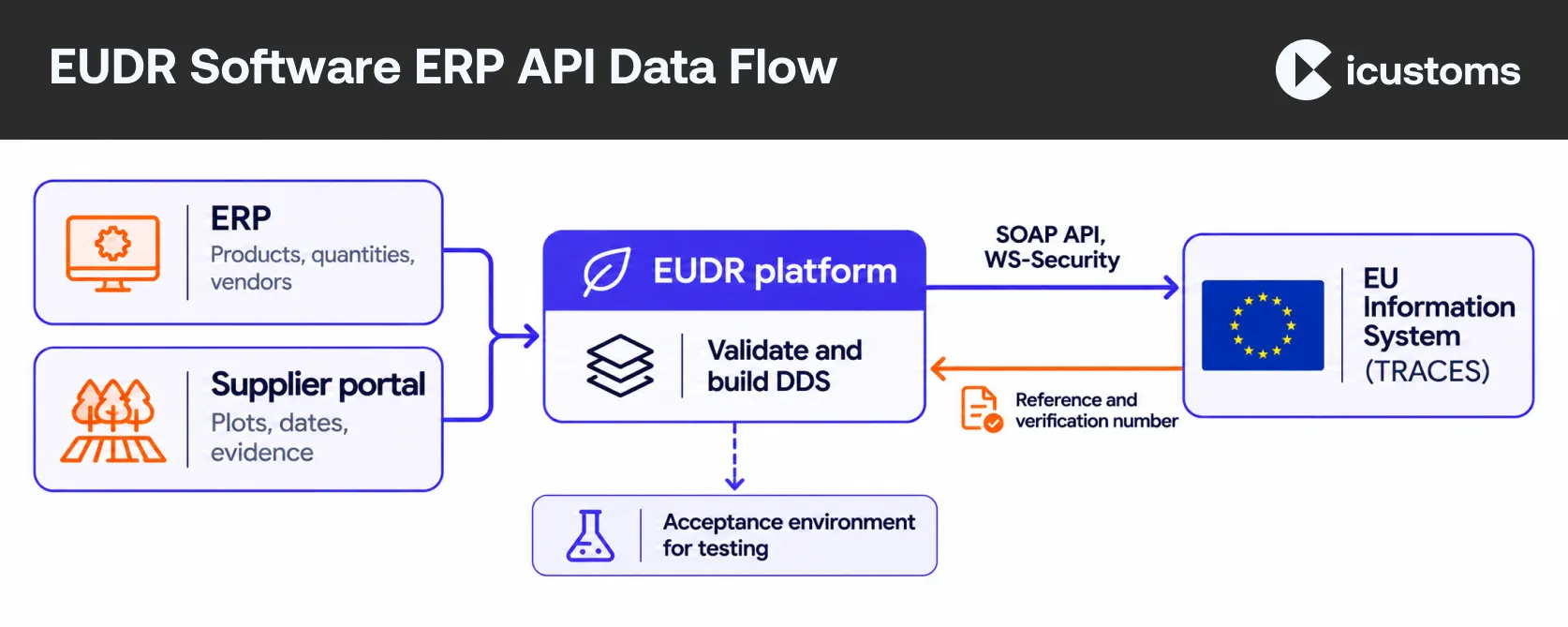
The EUDR Information System runs on the EU’s TRACES platform. Besides the web form, it offers an official API for system-to-system filing. The facts most vendor pages leave out:
- It is a SOAP API, not REST. Services are described in WSDL files and exchanged as XML.
- Authentication uses WS-Security: a UsernameToken with a hashed password (PasswordDigest), a timestamp, and a WebServiceClientId shown in your operator profile.
- There are two environments: acceptance for testing and production for real statements, each with its own credentials.
- Version 3 matches the amended regulation. It adds simplified declarations and grouped statements, and replaces versions 1 and 2.
- An echo service lets you test connectivity and credentials before you send real data.
When a provider advertises an EUDR REST API, it means its own interface, which then talks SOAP to the EU on your behalf. That can be easier to build against, as long as you know where the official connection sits. The EUDR Operator API Reference is the official EUDR API documentation.
EUDR ERP Integration and Data Mapping
Most of the data a DDS needs already sits in your ERP or purchasing system. The gap is usually supplier origin data, which no ERP holds today. A typical mapping looks like this:
| DDS field | Usual source | Common gap |
|---|---|---|
| Operator details and EORI | Company master data | Rarely a gap |
| Product description and CN code | Item master | Six-digit HS codes instead of eight-digit CN codes |
| Quantity and net mass | Purchase order or goods receipt | Units that do not match the DDS |
| Supplier name and address | Vendor master | Producer differs from the trading supplier |
| Country of production | Supplier declaration | Country of export used instead |
| Geolocation (GeoJSON) | Supplier portal | Not held in any ERP |
| Production date or period | Supplier declaration | Missing or approximate |
That is why EUDR ERP integration projects often stall: the ERP connection works, but the origin data still has to come from suppliers. A supplier portal fills that gap whether or not you integrate.
EUDR Bulk Declarations: Three Ways to Handle Volume
- One DDS for several shipments. A single statement can cover shipments for up to a year, within the quantity it states.
- Grouping your own statements. Implementing Regulation (EU) 2026/1565 lets you combine your own statements; since API version 3 you cannot reference other operators’ statements this way.
- Bulk submission through software. The web form handles one statement at a time; bulk filing needs the API or a platform that uses it.
Most businesses combine all three. Our guide to the EUDR due diligence statement covers the fields and the filing steps.
Build or Buy: Direct Integration vs a Platform
| Build your own API connection | Use an EUDR platform | |
|---|---|---|
| Best for | Large operators with an in-house integration team | Most importers, traders and SMEs |
| Effort | SOAP client, WS-Security, error handling, retries and testing in acceptance | Configuration and supplier onboarding |
| Supplier data | Still needs a way to collect it | Usually included through a supplier portal |
| Rule changes | Your team updates the code | The provider updates the platform |
| Customs handoff | Separate project | Included in some platforms |
EUDR Software for SMEs
Micro and small companies apply most EUDR rules from 30 June 2027, and some primary producers can file a simplified declaration instead of a full DDS. They still need supplier data, references and records. For them, the right tool is one that is quick to set up, charges for what they use, and does not need an IT project.
Three Real-World Scenarios
A coffee importer with 40 farm suppliers. A Spanish importer buys green coffee from cooperatives in Peru and Ethiopia. Its team collects plot coordinates by email and files each DDS by hand. With EUDR software, cooperatives enter plots once in a supplier portal, errors are flagged before submission, and statements go to the Information System in bulk ahead of each shipment.
A furniture retailer buying from manufacturers. A Dutch retailer buys oak furniture from EU manufacturers who file their own DDS. It mainly needs to receive, verify and keep those references for five years, and to know which product lines are in scope. A lighter setup focused on supplier statements and records fits better than a full due diligence suite.
A large operator with its own integration team. A chocolate maker with thousands of statements a year connects its ERP directly to the official SOAP API. It still needs a supplier-facing way to collect geolocation data, so it pairs its own integration with a supplier portal rather than building one.
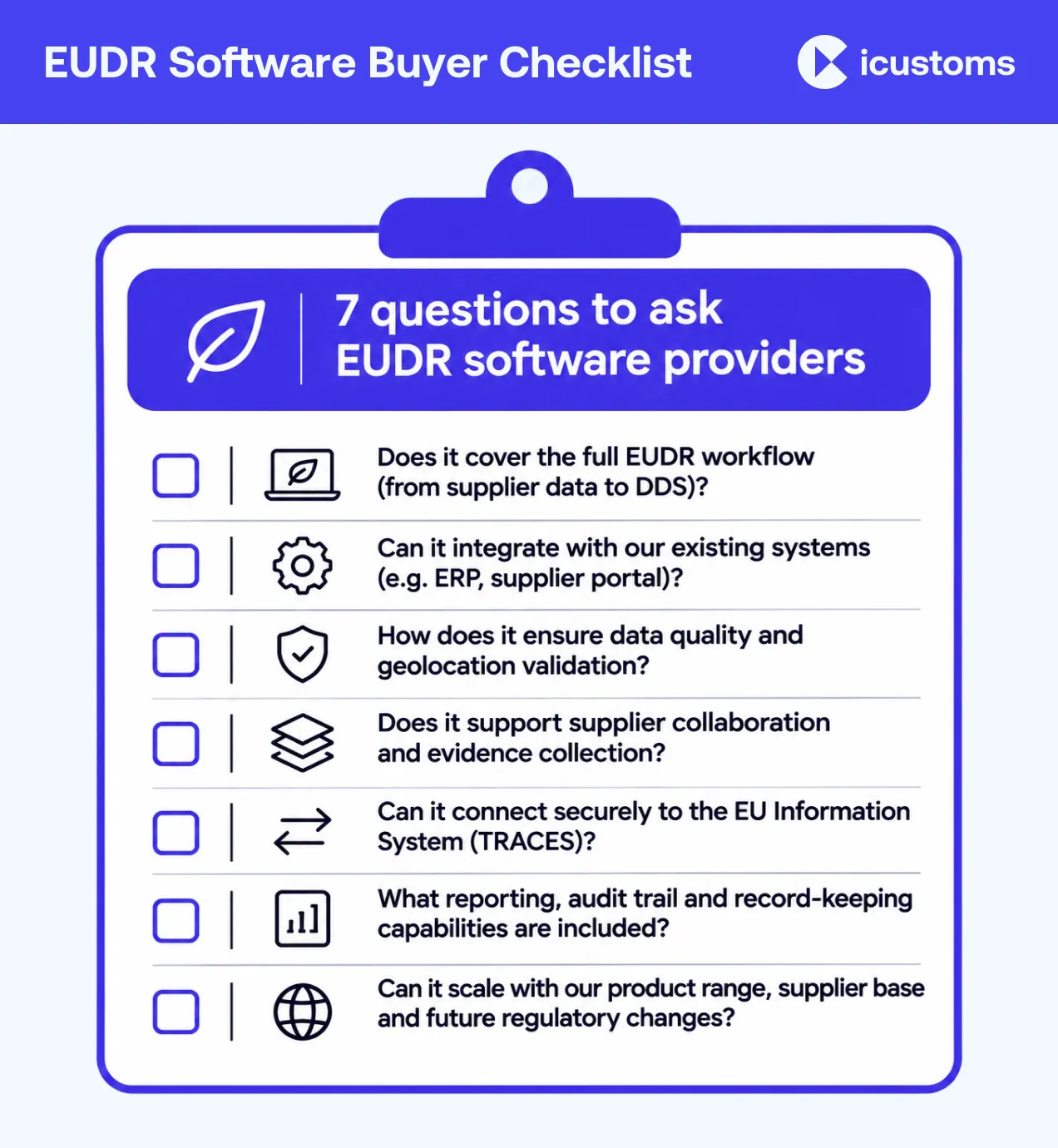
Questions to Ask Before You Choose
- Does it submit to the EU Information System, or only prepare files for you to upload?
- Can suppliers enter their own data, and is it validated before submission?
- Can it retrieve and verify the DDS your suppliers send you?
- Does it handle bulk submission and statements covering several shipments?
- How does the reference reach your forwarder and customs agent?
- Where is the data hosted, and what security certifications does the provider hold?
- How fast does it update when the regulation, TARIC codes or API change?
How iEUDR by iCustoms Fits
iEUDR by iCustoms is AI-powered, cloud-based EUDR compliance software built by a customs software provider recognised by HMRC and Irish Revenue and certified to ISO 27001:2022. It covers the core of the checklist above:
- Supplier network and portal: many suppliers are already onboarded in iEUDR, so you can connect them instead of starting from zero. New suppliers are checked against official EU TRACES records and enter their data in their own portal, free of charge, with built-in guidance, direct support and online learning.
- Geolocation validation and AI classification: every point and polygon is checked against the EUDR rules, such as WGS84, six decimal places, closed rings and polygons for non-cattle plots over four hectares, then converted to GeoJSON. In-scope CN codes are flagged for your team to confirm.
- DDS created, validated and verified: iEUDR builds and validates each DDS, submits it to the Information System singly or in bulk, and retrieves, verifies and validates supplier statements.
- No API project: iEUDR handles the official connection, so your team does not build or maintain a SOAP client.
- Customs-ready: references reach your forwarder before they file, with a five-year audit trail.
Coming in the next phase: satellite imagery comparison as part of risk assessment, incident alerts with corrective action plans, and multilingual supplier forms. See the full feature set on the iEUDR compliance software page.
Frequently Asked Questions
Do I need EUDR software to comply?
No. You can file each DDS through the EU Information System's web form. Software becomes worthwhile when supplier numbers, shipments or statements grow beyond what a team can handle by hand.
Is the EUDR API REST or SOAP?
The official EUDR Information System API is SOAP, secured with WS-Security. Some providers offer REST interfaces that connect to it on your behalf.
Is there a test environment for the EUDR API?
Yes. The acceptance environment lets you test submissions with separate credentials before using production.
Can EUDR software do the risk assessment for me?
It can collect and organise the information, but the operator remains responsible for assessing risk and for every DDS it submits.
Can I connect SAP or another ERP to TRACES?
Yes, through the official SOAP API, either directly or through a platform. Plan for supplier origin data separately, because ERPs do not hold plot geolocation.
Does EUDR software help with ESG reporting?
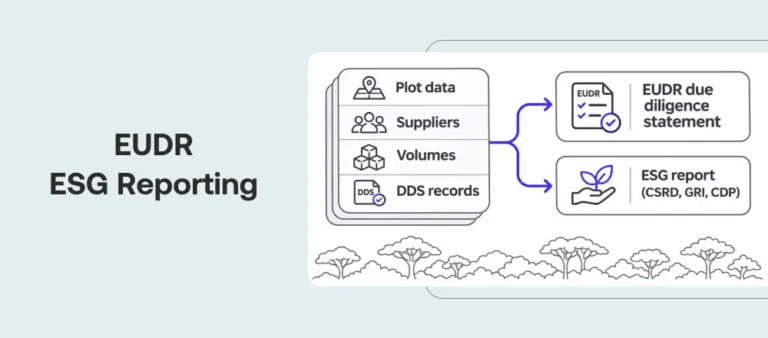
It can. The supplier origin and deforestation evidence gathered for the EUDR also supports sustainability and ESG disclosures, so keep it in one place.
You may also like:
Choosing EUDR software before 30 December 2026?

See how iEUDR takes you from supplier data to a submitted, validated DDS in one platform.
Subscribe to our Newsletter
About iCustoms
iCustoms is an all-in-one solution helping businesses automate customs processes more efficiently. With AI-powered and machine-learning capabilities, iCustoms is designed to streamline your all customs procedures in a few minutes, cut additional costs and save time.
No time for a SOAP API project?
iEUDR connects to the EU Information System for you and submits DDS in bulk.