

AES Ireland: Guide to Automated Export System, Declarations, AES Messages and Destin8 for UK Ports
-
 Freya Jane
- Director of Customer's Success
Ireland’s Automated Export System, known as AES, is the national electronic platform administered by Revenue for submitting export declarations for all goods leaving the European Union through Irish ports and airports. AES replaced the previous Automated Entry Processing (AEP) system on 21 March 2023 and is now the only legally valid method for submitting Irish export declarations.
This guide covers everything you need to know about AES Ireland: how it works, what changed from AEP, the declaration types available, the message flows required to confirm goods’ exit from the EU, and how iCustoms software automates the entire AES filing process, including the unique cross-border workflow for Irish exporters shipping goods to Great Britain via UK port systems including Destin8.
What Is AES Ireland?
AES Ireland is Revenue’s digital customs system for all goods being exported from Ireland to destinations outside the European Union. Under EU law, any goods leaving the EU require an export declaration submitted to the national customs authority of the EU member state from which the goods depart. In Ireland, that authority is Revenue, and AES is the system through which all export declarations must be submitted.
AES processes two categories of declaration. First, export declarations, which cover goods being permanently exported from the EU. Second, re-export declarations, which cover goods that were previously imported into the EU under a customs procedure and are now being sent back outside the EU.
AES operates under the EU’s Union Customs Code (UCC) framework and uses the EU Customs Data Model (EUCDM) as its data structure. This means AES declarations follow a standardised EU format, making Ireland’s export procedure fully aligned with those of other EU member states. Irish exporters trading with EU-based businesses in other member states do not file AES declarations for those movements. AES only applies to goods leaving the EU entirely.
Ireland’s export value reached €197 billion in 2023, according to the Central Statistics Office (CSO). The pharmaceutical, medical device, and technology sectors account for the majority of this figure. AES is the declaration system through which all of these exported goods are formally cleared by Irish customs.
AES and AEP: What Changed and Key Transition Dates
Before AES, Irish export declarations were submitted through the Automated Entry Processing (AEP) system and, for summary declarations, through the eManifest System. Both of these legacy systems are now closed and cannot be used for new export declarations.
The transition timeline is as follows. AES went live on 21 March 2023, from which date all new export declarations were required to be submitted through AES. The AEP system closed for new export declarations on 22 May 2023. As of 4 September 2023, it became no longer possible to amend export declarations that had been submitted to AEP before its closure. From that date onwards, any amendments to legacy AEP declarations required direct contact with the relevant Revenue export office rather than electronic amendment.
Businesses that were using AEP for their export declarations needed to migrate to AES-compatible software and familiarise themselves with the new AES dataset and declaration structure. AES introduced a new data model, new declaration types, and a new set of exit confirmation messages that did not exist under AEP.
| AES Key Date | Event |
| 21 March 2023 | AES goes live. New export declarations must be submitted through AES from this date. |
| 22 May 2023 | AEP closes for new export declarations. AEP can no longer be used to submit new declarations. |
| 4 September 2023 | AEP amendment window closes. Amendments to AEP declarations must now go through Revenue directly. |
| Ongoing | AES continues to be updated by Revenue with new business rules. Check Revenue’s AES Trader Guide for the latest updates. |
Want to learn more about Automated Import Systems?
AES Declaration Types: Normal, Pre-Lodged, Simplified and Supplementary
AES Ireland supports four types of export declaration. Choosing the correct declaration type depends on the nature of your goods, the export procedure you are using, and your operational workflow at the time of export.
- A normal export declaration is the standard declaration submitted at the time the goods are presented to customs at the exit point. This is the most common declaration type for regular exporters. The declaration data is submitted when the goods arrive at the port or airport, and customs validation happens in real time before the goods are loaded.
- A pre-lodged export declaration is submitted in advance of the goods arriving at the customs office. Under AES, exporters have up to 30 days before the goods need to arrive at customs to file their export declaration. This is beneficial for complex shipments or where early customs validation is operationally useful. A C2 notification is required when the goods are subsequently presented to customs, linking the pre-lodged declaration to the physical goods.
- A simplified declaration allows certain authorised exporters to submit a declaration at the time of export with reduced data requirements. A supplementary declaration must then be submitted within a defined period after export to provide the full required dataset. This procedure requires authorisation from Revenue in advance.
- A supplementary declaration is the follow-up declaration submitted after a simplified declaration to provide the complete export data. It is submitted electronically through AES after the goods have already left the EU.
AES Required Documents for Irish Export Declarations
The following documents and data are typically required to complete an AES export declaration in Ireland. The exact requirements depend on the goods, their value, destination, and any applicable export licences or restrictions.
- Commercial invoice showing the exporter’s and consignee’s details, full goods description, quantity, and customs value.
- Packing list detailing the number and type of packages, gross weight, and net weight of each item.
- Transport document: the bill of lading for sea freight, the airway bill for air freight, or the CMR consignment note for road freight.
- EORI number of the exporter. All exporters must have a valid Economic Operators Registration and Identification (EORI) number issued by Revenue.
- Commodity codes (HS codes) for all goods. Each product line must be classified under the Harmonised System tariff schedule.
- Export licence or permit where applicable, for example for controlled goods (dual-use items, weapons, certain chemicals).
- Excise movement reference for excise goods moving under EMCS (Excise Movement Control System).
- Statistical value of goods for Intrastat reporting purposes where the goods were previously released for free circulation within the EU.
AES Message Types: IE507, IE590, C2, and A3 Explained
AES uses a structured set of electronic messages to confirm the movement of goods from the point of export declaration to the point of physical departure from the EU. Understanding these messages is essential for both exporters and the carriers who move the goods.
IE507: Arrival at Exit
The IE507 message, formally known as the Arrival at Exit notification, is filed by the person presenting the goods at the exit point, typically the exporter, their agent, or the terminal operator. This message tells Revenue that the goods covered by a specific AES export declaration have arrived at the customs office of exit and are ready for physical departure.
The IE507 requires the Movement Reference Number (MRN) of the existing AES export declaration. Filing this message triggers Revenue’s validation of the goods’ exit status and must be completed before the carrier can receive confirmation that the goods are released for loading.
For pre-lodged declarations, the C2 notification serves a similar function to the IE507 in linking the pre-lodged declaration to the goods’ physical arrival at the exit point.
IE590: Exit Notification
The IE590 message, formally known as the Exit Notification, is filed by the carrier at the exit point once the goods have physically left the European Union. This message closes the AES export procedure for those goods and provides Revenue with confirmation that the declared goods have exited EU customs territory.
The IE590 is a carrier obligation. Ferry operators, airlines, and shipping lines are responsible for filing this message after their vessel or aircraft departs. For road freight crossing a land border, the exit confirmation procedure follows a different path.
The IE590 requires the MRN of the export declaration and confirmation of the exit point, vehicle or vessel details, and the date and time of departure.
C2 Notification: Pre-Lodged Declaration Arrival
When an exporter has submitted a pre-lodged AES declaration, a C2 notification is required when the goods are physically presented to customs at the exit point. The C2 links the pre-lodged declaration (which was submitted up to 30 days in advance) to the specific physical goods now at the port or airport. Think of C2 as the signal that ‘the goods I declared earlier are now here’.
A3 Notification: Re-Export from Temporary Storage
When goods that were placed in temporary storage at an Irish port or customs facility are subsequently re-exported, an A3 notification must be submitted. This message tells Revenue that goods previously held in temporary storage are now being exported from the EU and links the re-export movement to the original temporary storage declaration.
ERVS: The Revenue Export Release Verification Service for Carriers
ERVS stands for the Export Release Verification Service. It is an API (Application Programming Interface) provided by Revenue that allows carriers, port operators, and logistics systems to check the customs status of export declarations in real time. ERVS is used primarily at Irish sea and air exits to confirm that goods have been properly declared and released before they are loaded.
ERVS performs three main functions. The verify release function checks whether a given MRN is valid and has a status of ‘Released’, meaning customs has approved the goods for export. Without a ‘Released’ status, the carrier should not load the goods. The confirm arrival function allows the carrier or terminal operator to notify Revenue that the goods covered by the MRN have arrived at the exit point, effectively filing the IE507 in an automated way. The confirm departure function allows the carrier to notify Revenue that the goods have departed, effectively filing the IE590.
For software providers building integrations with Irish customs systems, the ERVS API is the primary connection point for automating carrier-side AES message flows. iCustoms supports Revenue API connectivity, enabling freight forwarders and carriers to automate the IE507 and IE590 filing process within their existing operational workflows.
EMCS and AES: Exporting Excise Goods from Ireland
The Excise Movement Control System (EMCS) is the EU’s electronic system for controlling the movement of excise goods, including alcohol, tobacco, and energy products, while they are suspended from excise duty. When excise goods are exported from Ireland, the AES export declaration and the EMCS movement document must be linked to confirm that the goods have left the EU under both the customs and excise frameworks.
AES includes an improved EMCS interface that allows the export declaration and the EMCS electronic administrative document (e-AD) to be coordinated within a single workflow. When goods exported under EMCS leave the EU and the IE590 exit notification is filed, this also triggers the completion of the EMCS movement, releasing the excise duty suspension.
This is particularly relevant for Irish whiskey, spirits, and pharmaceutical exporters, for whom EMCS-linked export declarations are a regular part of operations. iCustoms supports EMCS-linked AES declarations, enabling these businesses to manage both their customs and excise export obligations within a single platform.
AES Ireland to UK: The Destin8 Cross-Border Export Workflow
When Irish exporters ship goods to Great Britain via RoRo ferry, they are navigating two separate customs systems in a single movement: Revenue Ireland’s AES for the Irish export side, and HMRC’s CDS together with GVMS and, at relevant ports, Destin8 on the UK arrival side. This cross-system coordination is one of the most operationally complex aspects of Ireland-to-UK trade since Brexit.
Destin8 is a Port Community System (PCS) used at several UK ports to manage cargo tracking, customs status notifications, and logistics coordination between port operators, freight forwarders, shipping lines, and HMRC. At ports where Destin8 is the PCS, import declarations and cargo arrival events are processed through the Destin8 network.
Step-by-Step: The Ireland-to-UK AES Export Workflow
- The Irish exporter or their customs agent submits an AES export declaration to Revenue, either as a normal declaration when the goods arrive at the port or as a pre-lodged declaration up to 30 days in advance. Revenue validates the declaration and issues an MRN.
- When the goods arrive at the Irish exit point (Dublin Port, Rosslare Europort, Cork Port, or similar), the IE507 Arrival at Exit message is filed using the MRN, notifying Revenue that the goods are present and ready for departure.
- The ferry carrier uses the ERVS API to confirm that the MRN is in ‘Released’ status before loading the goods onto the ferry. Without this confirmation, the carrier cannot lawfully accept the goods for transport.
- The ferry departs Irish waters. The carrier files the IE590 Exit Notification to Revenue, confirming the goods have left EU customs territory. This closes the Irish AES export procedure.
- Before the ferry arrives at the UK port, the UK importer or their agent must have a pre-lodged UK import declaration on HMRC’s Customs Declaration Service (CDS) and a GVMS (Goods Vehicle Movement Service) reference. GVMS links the UK import declaration to the road vehicle or trailer carrying the goods.
- The driver presents the GVMS reference at the UK port gate. The GVMS system validates the reference and confirms that a matching UK import declaration exists.
- At ports using Destin8 as their Port Community System, the cargo arrival event is registered in Destin8. Freight forwarders and port agents in the Destin8 network receive automated notifications about cargo arrival, customs clearance status, and any Revenue or HMRC queries relating to the shipment.
- HMRC processes the UK import declaration on CDS. Once cleared, the goods are released for onward movement within Great Britain.
Automating the AES-to-Destin8 Data Flow with iCustoms
iCustoms is the only customs software provider with demonstrated expertise in both the Irish AES export workflow and the UK CDS import and GVMS environment. This dual capability allows iCustoms to serve businesses managing Ireland-to-UK freight as a single end-to-end platform rather than requiring two separate software systems for the two sides of the same movement.
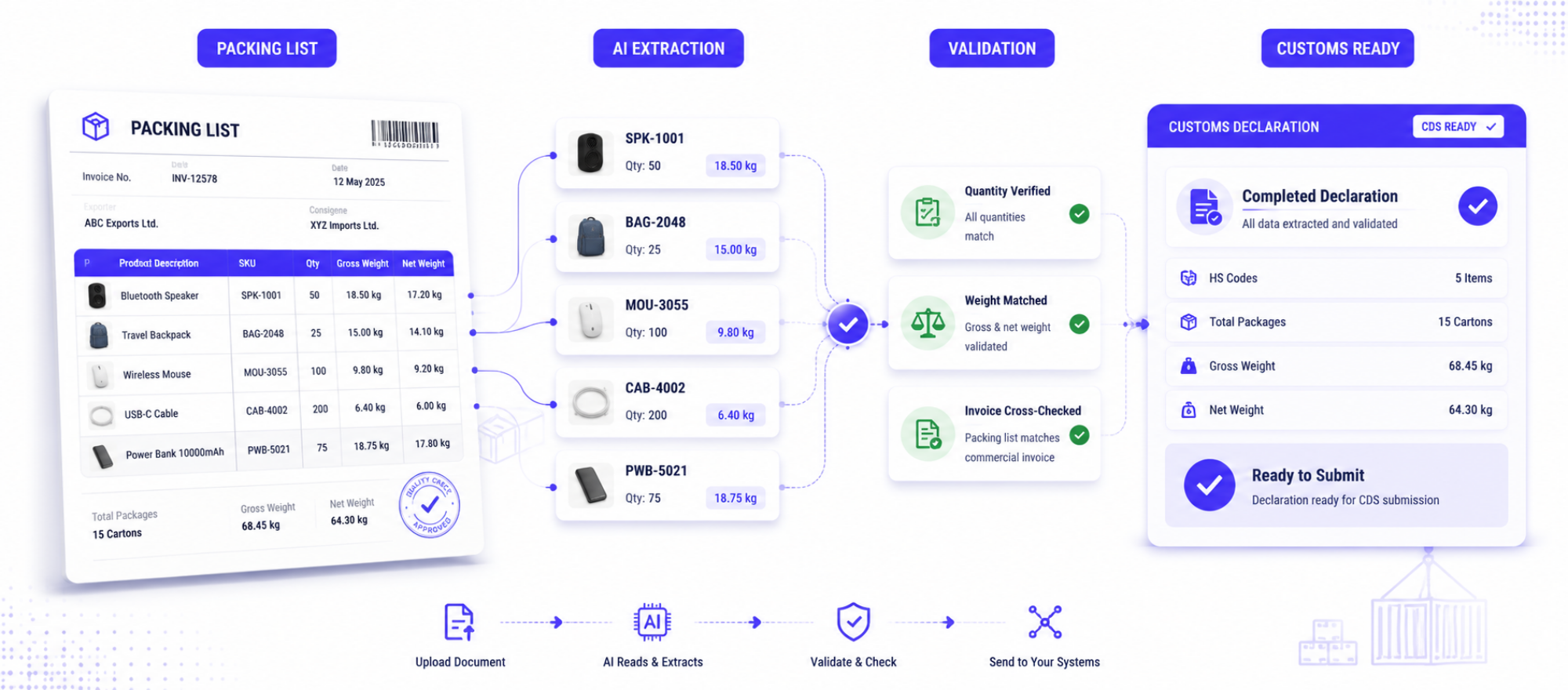
- On the Irish side, iCustoms automates AES declaration preparation using intelligent document processing (IDP), which reads commercial invoices, packing lists, and shipping documents to auto-populate the AES declaration fields. The platform manages MRN tracking, IE507 and IE590 message monitoring, and ERVS status checks.
- On the UK side, iCustoms handles CDS import declarations and understands the GVMS pre-notification requirements for RoRo ferry arrivals. This means the MRN from the Irish AES declaration can be referenced in the UK import workflow without manual re-entry.
- For freight forwarders and customs agents handling Ireland-to-UK movements at scale, iCustoms can automate the data handoff between AES and the UK import process, significantly reducing the manual coordination work that currently causes errors and delays.
If your business ships goods from Ireland to Great Britain and you want to automate both the AES export declaration and the UK CDS import declaration in a single workflow, talk to the iCustoms team about our Ireland-to-UK cross-border automation capability.
How to Register for AES Ireland and Get Started
Setting up for AES Ireland involves three prerequisites: EORI registration, access to AES-compatible software, and familiarity with the AES Trader Guide published by Revenue. The following steps cover the full registration and setup process.
- Register for an EORI number with Revenue. All businesses exporting goods from Ireland require an Economic Operators Registration and Identification (EORI) number. If your business already has a Tax Registration Number (TRN) with Revenue, you can apply for an EORI number by completing the eRegistration form on Revenue Online Service (ROS). EORI numbers in Ireland begin with the prefix ‘IE’. The EORI number is your business’s unique identifier across all EU customs systems.
- Register as a direct trader with Revenue’s AES system if you intend to submit declarations yourself (without using a customs agent or broker). Direct trader registration requires completion of the AES trader setup on ROS and acceptance of the AES terms of use.
- Choose AES-compatible software. Manual AES submission is possible through Revenue’s online portal for low volumes, but any business submitting more than a handful of declarations per month will find dedicated AES software significantly faster and less error-prone. iCustoms supports AES declaration submission, MRN tracking, IE507 and IE590 monitoring, and ERVS integration. A free trial is available.
- Read the Revenue AES Trader Guide. Revenue publishes a comprehensive AES Trader Guide covering declaration requirements, message types, procedure codes, and business rules. Reading this guide before your first AES submission will prevent the most common filing errors.
- Classify your goods correctly. Every item in an AES declaration requires a commodity code (HS code). Incorrect classification is one of the most common causes of AES declaration rejections. iCustoms iClassification uses AI to suggest the correct commodity code based on your product description, reducing classification time and error rates.
- Submit your first AES declaration. Once your EORI is confirmed, your software is set up, and your goods are classified, you are ready to submit your first AES declaration. For new AES users, iCustoms iWiz provides a guided, step-by-step declaration wizard that walks you through each required field.
AES Trader Guide: Key Rules for Irish Exporters
Revenue’s official AES Trader Guide is the primary reference document for all Irish exporters. The following summary covers the key rules that affect most businesses. For complete details, consult the official guide available on revenue.ie.
- Pre-lodgement window: Under AES, exporters can submit their export declaration up to 30 days before the goods need to be presented to customs. This pre-lodgement window is considerably more flexible than under AEP and allows exporters to prepare and validate declarations well in advance of their shipment.
- Declaration validity: A pre-lodged AES declaration remains valid for 30 days from the date of acceptance. If the goods are not presented to customs within this period, the declaration will invalidate and must be resubmitted.
- Amendment rules: Amendments to an accepted AES declaration are possible before the goods have been released for exit. Once the IE507 Arrival at Exit has been filed, certain amendment types are restricted. Revenue’s AES Business Rules document specifies which data fields can be amended at each stage of the declaration lifecycle.
- Invalidation: An accepted export declaration can be invalidated by the declarant before the goods have been released. If the export no longer proceeds, the declaration must be formally invalidated rather than simply abandoned.
- Exit results: After the IE590 Exit Notification is filed by the carrier, Revenue issues an ‘Arrival at Customs Office of Exit’ result and a ‘Results of Exit’ message to the exporter’s or agent’s system. These messages confirm that the export procedure has been completed and the goods have legally left the EU.
- MRN tracking: Every AES declaration is assigned an MRN (Movement Reference Number) upon acceptance. The MRN must be provided to the carrier and used for all subsequent messages in the declaration lifecycle, including IE507, IE590, ERVS checks, and any EMCS linkage.
AES Software for Ireland: Choosing the Right Provider
Choosing AES-compatible software is the most important practical decision for any Irish business that submits its own export declarations. The right software should eliminate manual data entry, prevent common declaration errors, and provide MRN tracking through to the confirmed exit of goods.
| Feature | Why It Matters for AES |
| Revenue-approved AES connectivity | The software must be certified to submit declarations directly to Revenue’s AES system. Confirm this before purchasing. |
| Intelligent Document Processing (IDP) | IDP reads commercial invoices and shipping documents to auto-populate AES declaration fields, eliminating manual data entry. iCustoms uses IDP as a core feature. |
| AI commodity code classification | Correct HS code assignment is essential for AES compliance. AI classification tools suggest codes based on product description, reducing classification errors. |
| IE507 and IE590 message tracking | The software should automate or facilitate the filing of IE507 Arrival at Exit and IE590 Exit Notification messages, not just the initial export declaration. |
| ERVS integration for carriers | Carriers and logistics operators need ERVS API connectivity to automate release verification and exit confirmation. iCustoms supports Revenue API integration. |
| UK CDS compatibility (for Ireland-to-UK traders) | If you ship to Great Britain, the software should also support UK CDS import declarations and GVMS pre-notifications to enable a single-platform cross-border workflow. |
| EMCS integration for excise goods | If you export alcohol, tobacco, or energy products, the software should support EMCS linkage within the AES declaration workflow. |
| Free trial availability | A free trial allows you to assess the software’s interface and workflow before committing. iCustoms offers a free trial with no sales call required. |
Export Declaration Software Ireland
Businesses searching for export declaration software Ireland solutions need platforms that do more than simply submit export declarations. Modern export software should automate AES filing workflows, reduce manual data entry, track MRNs in real time, and integrate directly with Revenue systems.
For Irish exporters handling regular shipments outside the European Union, export declaration software Ireland platforms help improve declaration accuracy, reduce customs delays, and streamline communication between exporters, freight forwarders, carriers, and customs authorities.
Customs Declaration Software for Exporters Ireland
Choosing the right customs declaration software for exporters Ireland businesses can rely on is increasingly important as customs compliance requirements continue to evolve after Brexit and under the Union Customs Code framework. Exporters need systems that support AES declarations, IE507 and IE590 message handling, ERVS connectivity, commodity code classification, and automated customs workflows.
Software that combines declaration preparation, customs validation, and shipment tracking in a single interface reduces operational complexity and improves export processing efficiency.
Automated Customs Declaration Ireland
Automated customs declaration Ireland solutions are helping exporters reduce the operational burden associated with manual customs processing. By using Intelligent Document Processing, API integrations, and AI-driven commodity code classification, businesses can automate the extraction and validation of export data directly from commercial invoices, packing lists, and transport documents.
Automated customs declaration Ireland workflows also help exporters improve filing accuracy, accelerate declaration preparation, and manage growing export volumes without increasing administrative workload.
API Customs Declaration Ireland
API customs declaration Ireland platforms allow exporters, freight forwarders, and logistics providers to connect customs workflows directly with ERP systems, warehouse platforms, carrier systems, and Revenue AES services. API-driven customs integration enables real-time declaration submission, automated MRN tracking, electronic message handling, and faster customs communication across export operations.
For high-volume exporters, API customs declaration Ireland capabilities reduce duplicate data entry and improve end-to-end visibility throughout the export declaration lifecycle.
iCustoms AES Ireland: What the Platform Provides
iCustoms is a Revenue-compatible customs software platform supporting the full AES export declaration workflow for Irish exporters and customs agents. The platform covers every stage of the AES process, from initial declaration preparation through to IE590 exit confirmation.
- iWiz, the guided declaration wizard, walks new AES users through each required field with plain-English explanations, making AES accessible to businesses without dedicated customs expertise.
- iZap handles batch export declaration filing for high-volume operators, reducing the time to file multiple declarations from hours to minutes.
- iClassification uses AI to suggest commodity codes from product descriptions, eliminating the most time-consuming manual classification step.
- Revenue API connectivity enables ERVS-based carrier automation for arrival confirmation and departure notification.
- For businesses exporting to Great Britain, iCustoms also handles UK CDS import declarations and GVMS pre-notifications, providing a single platform for the complete Ireland-to-UK export workflow.
Start your free iCustoms AES trial today. No long-term contract. No customs expertise required. Revenue-compatible AES declarations from day one.
Ready to Automate Your Irish Export Declarations?
iCustoms is Revenue-compatible AES software for Irish exporters, freight forwarders, customs agents, and logistics operators. Whether you are filing your first AES declaration or managing hundreds of export declarations per week, iCustoms provides the tools to make AES compliance faster, more accurate, and less reliant on manual processes.
From guided iWiz declarations for new exporters to iZap batch filing for high-volume operators, from AI commodity code classification to the only cross-border AES-to-UK-CDS workflow automation in the market, iCustoms covers every aspect of the Irish export declaration process.
Start your free iCustoms AES trial today. Revenue-compatible. No customs expertise required. Free trial available at icustoms
Frequently Asked Questions: AES Ireland
What is AES Ireland?
AES Ireland is Revenue's Automated Export System, the national electronic platform for submitting export declarations for all goods leaving the European Union through Irish ports, airports, and land borders. It replaced the Automated Entry Processing (AEP) system on 21 March 2023 and is now the only legally valid method for Irish export declaration submissions.
How is Ireland's AES different from the US AES for EEI filing?
Ireland's AES is administered by Revenue (Irish Tax and Customs) and is required for goods leaving the European Union through Ireland. The US AES is the Census Bureau's Automated Export System, used for Electronic Export Information (EEI) filing under the Foreign Trade Regulations for goods exported from the United States. The two systems are completely separate and unrelated. If you are exporting from Ireland to any non-EU country, you need Ireland's Revenue AES, not the US system.
When did AES replace AEP and what changed for Irish exporters?
AES went live on 21 March 2023. AEP closed for new declarations on 22 May 2023. AES introduced a new EU Customs Data Model (EUCDM) dataset, new declaration types (including pre-lodged and simplified declarations), and new exit confirmation messages (IE507 and IE590). It also introduced an improved EMCS interface and the C2 and A3 notification types, which did not exist under AEP.
What is the difference between a normal and a pre-lodged AES declaration?
A normal AES declaration is submitted when the goods are physically presented at the customs office of exit. A pre-lodged declaration is submitted in advance, up to 30 days before the goods need to be presented. Pre-lodged declarations require a C2 notification when the goods subsequently arrive at the exit point, linking the pre-filed declaration to the physical shipment.
What goods require an AES export declaration from Ireland?
An AES export declaration is required for all goods leaving the EU through Ireland with a customs value above 1,000 euros or a gross weight above 1,000 kilograms. Certain goods below these thresholds may still require declarations depending on their nature (for example, goods subject to export licences, excise goods, or controlled dual-use items). Goods moving within the EU do not require AES declarations
What is ERVS and how does it work for carriers?
ERVS is Revenue's Export Release Verification Service, an API that carriers use to check whether an AES export declaration has been released for loading. Before loading goods onto a ferry or aircraft, the carrier uses ERVS to confirm the MRN is valid and has a 'Released' status. ERVS also allows carriers to file the IE507 arrival notification and the IE590 exit notification electronically, automating the exit confirmation process.
How does AES Ireland connect to UK port systems like Destin8?
When Irish exporters ship goods to Great Britain via RoRo ferry, the Irish AES handles the export declaration and exit confirmation in Ireland. On the UK side, HMRC's Customs Declaration Service (CDS) and the Goods Vehicle Movement Service (GVMS) handle the UK import process. At certain UK ports, Destin8 is the Port Community System that tracks cargo arrivals and customs status for port operators and freight forwarders. The MRN from the Irish AES declaration does not transfer directly to Destin8 but is used by the Irish carrier to confirm exit. A separate UK import declaration on CDS and a GVMS reference are required for the goods to clear UK customs. iCustoms supports both the AES side and the UK CDS/GVMS side within a single platform.
How do I register for AES Ireland?
To register for AES Ireland, you first need an EORI number from Revenue. Apply through Revenue Online Service (ROS) if your business is already registered for tax in Ireland. Once your EORI is confirmed, you can register as a direct AES trader on ROS or engage a customs agent to file declarations on your behalf. For software-assisted AES filing, iCustoms offers registration support and a guided first-declaration walkthrough as part of the free trial.
You may also like:
Simplify AES with iCustoms

Automate tasks, guarantee compliance and ensure data accuracy with our AES software
Subscribe to our Newsletter
About iCustoms
iCustoms is an all-in-one solution helping businesses automate customs processes more efficiently. With AI-powered and machine-learning capabilities, iCustoms is designed to streamline your all customs procedures in a few minutes, cut additional costs and save time.
Simplify AES with iCustoms
Automate tasks, guarantee compliance and ensure data accuracy with our AES software