
EUDR Deadlines Check: What Is Your Role and Which Deadline Applies?
- John Hall
- Customs Specialist at iCustoms.ai
EUDR deadlines depend on two things: your role in the supply chain and the size of your company. Large and medium companies apply the EU Deforestation Regulation from 30 December 2026. Most micro and small companies apply it from 30 June 2027. Micro and small companies placing timber products that were already covered by the EU Timber Regulation keep the earlier date of 30 December 2026.
This guide walks you through a three-step EUDR check to work out your role, your start date and what to do before it.
The Short Answer: EUDR Deadlines by Company Size
| Who | Applies from |
|---|---|
| Large and medium operators and traders | 30 December 2026 |
| Micro and small operators placing timber products already covered by the EU Timber Regulation | 30 December 2026 |
| All other micro and small operators and traders | 30 June 2027 |
| Products added by Delegated Regulation (EU) 2026/2102, such as soluble coffee | 30 December 2027 |
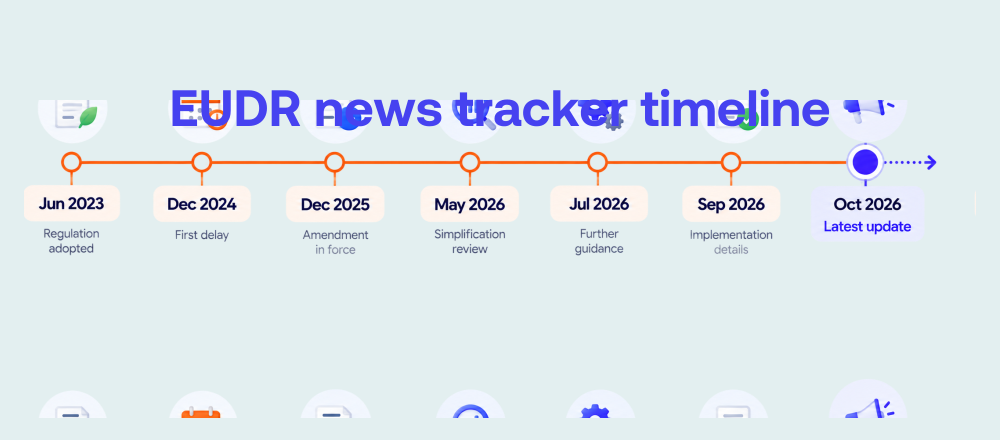
These dates come from Regulation (EU) 2025/2650. The Commission’s May 2026 review proposed no further postponement, so this is the EUDR implementation date to plan around.
EUDR Cutoff Date vs Application Date
Two dates cause most of the confusion, and they mean very different things.
- The EUDR cutoff date is 31 December 2020. It is a reference point for land use. A commodity is only deforestation-free if the land it came from was not deforested after this date. For wood, the forest must also not have been degraded after it.
- The application date is 30 December 2026 or 30 June 2027. It is when your obligations start: due diligence, statements, record keeping and checks by authorities.
So a product you import in 2027 must still trace back to land that has been forest-free since before 2021, which is why supplier data collection should start well ahead of your date.
The Three-Step EUDR Check
- Is your product in scope? If not, the EUDR does not apply to that product.
- What is your role in this transaction? Operator, downstream operator, trader or micro or small primary operator.
- What size is your company? Micro, small, medium or large, under the EU Accounting Directive.
Step 1: Is Your Product in Scope?
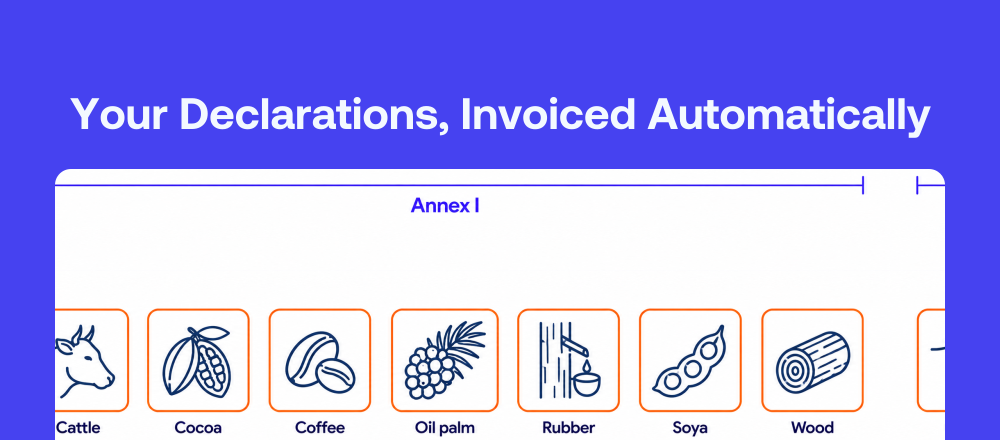
The EUDR covers seven commodities: cattle, cocoa, coffee, oil palm, rubber, soya and wood, plus the products listed in Annex I of the regulation, such as chocolate, palm oil, tyres, paper and wooden furniture. Annex I is organised by HS and CN codes, so the reliable check is your product’s code, not its name.
Some products are outside scope or have left it. Printed products were removed in 2025, and Delegated Regulation (EU) 2026/2102 removed cattle hides, skins and leather, several rubber articles and soya beans for sowing from 18 September 2026. Used and second-hand goods, waste, goods made entirely from recycled material, and products produced before 29 June 2023 are also exempt.
Step 2: Which EUDR Role Are You?
Your role is decided per transaction, not per company. The same business can be an operator for one product and a downstream operator or trader for another.
Upstream operator
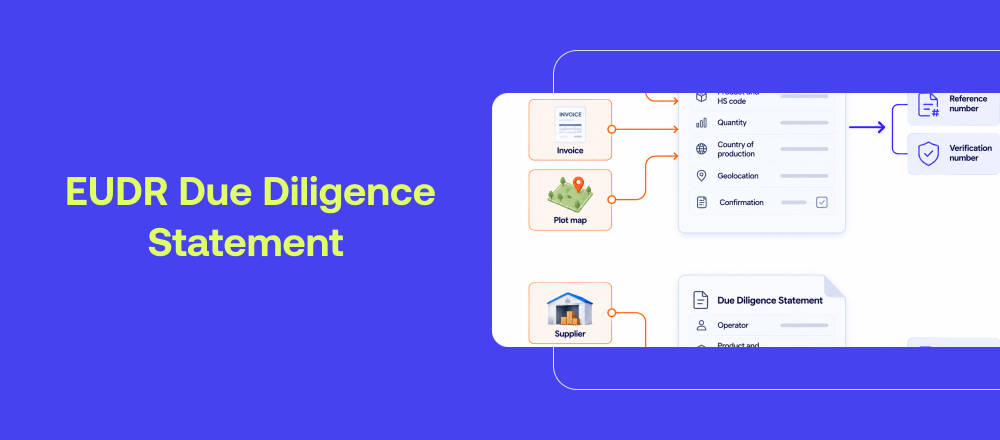
You are an upstream operator, often just called the operator, if you are the first to place a relevant product on the EU market, or you export it from the EU. Importers releasing goods for free circulation are the most common example, along with EU producers placing their own harvest on the market. Operators carry out due diligence, submit a due diligence statement (DDS) before placing or exporting the product, and pass the DDS reference to their direct buyers. An EU company exporting goods it produced or imported itself is the operator for that export too. If a non-EU company imports in its own name, the first EU business that sells the goods on is also an operator.
Upstream micro or small primary operator
This covers farmers, forest owners and other micro or small producers in a low-risk country selling what they grew or harvested themselves. They still carry out due diligence, but file a one-off simplified declaration instead of a DDS per shipment, and may use a postal or cadastral address instead of geolocation.
First downstream operator or trader
This is the first buyer from an upstream operator or micro or small primary operator. As well as the general downstream duties below, it collects the DDS reference number or simplified declaration identifier and keeps it for five years. It does not pass the number on to its own buyers. According to the Commission’s guidance, you do not need to identify yourself: if your supplier sends you a DDS reference, treat yourself as the first downstream operator or trader.
Downstream operator or trader
These are businesses that sell or export products after due diligence has already been done upstream. You are a downstream operator if you turn them into a new product with a different CN or HS code, such as a chocolate maker using cocoa butter bought in the EU, or a roaster roasting green coffee. You are a trader if you sell them on unchanged, such as a distributor, wholesaler or retailer. Neither submits a DDS. Both keep supplier and buyer records for five years and must tell their buyers and the authorities if they learn a product may not comply.
Operator, downstream operator or trader: the quick test
Ask one question: has this exact product already been placed on the EU market by someone else? If no, you are the upstream operator. If yes, and you sell it on with the same product code, you are a trader. If yes, and you turn it into something with a different CN code, you are a downstream operator. If your supplier is the upstream operator, you are also the first downstream operator or trader.
Your role also decides who does the paperwork for others. A non-EU supplier has no EUDR deadline of its own, yet it will be asked for plot data before its EU customer’s date. A forwarder or customs agent never becomes the operator by clearing goods, but it cannot lodge the declaration until the reference arrives.
Step 3: Which Size Category Are You?
The EUDR uses the size categories in the EU Accounting Directive. A company falls into a category if it does not exceed two of the three limits on its balance sheet date.
| Category | Balance sheet total | Net turnover | Employees |
|---|---|---|---|
| Micro | Up to €450,000 | Up to €900,000 | Up to 10 |
| Small | Up to €7.5 million | Up to €15 million | Up to 50 |
| Medium | Up to €25 million | Up to €50 million | Up to 250 |
| Large | Above medium limits | Above medium limits | Above 250 |
Micro, small and medium companies are SMEs. Large downstream operators and traders must also register in the EUDR Information System and, if they learn a product may not comply, check that due diligence was carried out upstream.
Two details catch companies out. Size is tested per legal entity, not per group, so a subsidiary of a large group can still be an SME. And the table shows the maximum small-company limits under Delegated Directive (EU) 2023/2775: some EU countries use lower limits, from €5 million balance sheet and €10 million turnover, so check your national law. If you are close to a boundary, plan for the larger category.
Putting It Together: What You Need to Do and When
| Role and size | Main obligation | From |
|---|---|---|
| Upstream operator, large or medium | Full due diligence and a DDS per product placed or exported | 30 December 2026 |
| Upstream operator, micro or small | Due diligence and DDS (simplified where sourcing is low risk) | 30 June 2027, or 30 December 2026 for timber products already covered by the EU Timber Regulation |
| Upstream micro or small primary operator | Due diligence and a one-off simplified declaration | 30 June 2027 |
| Downstream operator or trader, large | Keep records for five years, register in the Information System, verify upstream due diligence if concerns arise | 30 December 2026 |
| Downstream operator or trader, medium | Collect and keep records for five years | 30 December 2026 |
| Downstream operator or trader, micro or small | Collect and keep records for five years | 30 June 2027 |
| First downstream operator or trader, any size | Also keep the DDS reference number or declaration identifier | Same date as its size category |
What If Your Supplier's Deadline Is Later Than Yours?
Between 30 December 2026 and 30 June 2027, a large buyer may source from an EU micro or small operator whose obligations have not started yet. That supplier may have no DDS reference to send. Record its size category and the date its obligations begin, keep that note with your supplier records, and ask for origin data anyway so the switch in June 2027 is smooth. If you import the goods yourself, your own date applies, whatever the size of your non-EU supplier.
Four Worked Examples
A large German chocolate manufacturer imports cocoa beans from Ghana and also buys cocoa butter from a Dutch processor. For the beans it is the upstream operator and submits a DDS. The Dutch processor is a downstream operator, so it passes on no reference. For chocolate made from that butter, the German company is a downstream operator: it keeps supplier and buyer records and, as a large company, registers in the Information System. Both roles apply from 30 December 2026.
A small Irish furniture retailer imports oak dining tables from Vietnam. It is the first to place them on the EU market, so it is an operator. Wooden furniture was already covered by the EU Timber Regulation, so its start date is 30 December 2026, not June 2027.
A small Italian coffee roaster buys green coffee from an Italian importer and sells roasted coffee to cafés. The importer is the upstream operator and sends its DDS reference. Roasting changes the CN code, so the roaster is a downstream operator, and as the importer’s direct buyer it is also the first downstream operator: it keeps the reference and its supplier and buyer records for five years, with no DDS and no registration, from 30 June 2027.
A freight forwarder in Rotterdam clears palm oil for a client, the operator. From 30 December 2026 the declaration needs the client’s DDS reference, so agreeing how and when it arrives is the priority.
What to Do Next
Upstream operators should map suppliers and start collecting geolocation and legality evidence now. First downstream operators and traders should agree how suppliers will send reference numbers and where they will be kept. Forwarders should agree with clients how references reach them. If your date is June 2027, start supplier data collection anyway; your larger customers will ask for it sooner.
Whatever your role, iEUDR by iCustoms gives you the matching workflow. If you are the operator, suppliers send plot data through their own portal, and iEUDR checks it, creates and validates your DDS, files it with EU TRACES and passes the reference to your forwarder. If you buy from an operator, iEUDR retrieves, verifies and validates the supplier’s DDS and keeps it with your records for the five years the law requires.
Frequently Asked Questions
Has the EUDR been delayed again?
No. After two postponements, the Commission's simplification review in May 2026 confirmed that the application dates of 30 December 2026 and 30 June 2027 stand.
Does the EUDR apply to me if I only buy from EU suppliers?
Yes, if you sell or process those products in the course of business: you are a downstream operator or trader, so you keep supplier and buyer records for five years and, if you are large, register in the Information System. If you buy only for your own use, the EUDR does not apply to you.
Is a medium-sized company an SME under the EUDR?
Yes. SMEs are micro, small and medium companies. Medium companies follow the 30 December 2026 date, but as SMEs, medium downstream operators and traders do not need to register in the EUDR Information System.
You may also like:
Operator, downstream operator or trader?

iEUDR gives each role the right workflow, from submitting a DDS to keeping the references your customers and forwarders ask for.
Subscribe to our Newsletter
About iCustoms
iCustoms is an all-in-one solution helping businesses automate customs processes more efficiently. With AI-powered and machine-learning capabilities, iCustoms is designed to streamline your all customs procedures in a few minutes, cut additional costs and save time.
Is your start date 30 December 2026?
iEUDR collects supplier data, then creates, validates and submits your DDS in time for go-live.