
EUDR HS Codes: Full Annex I Code List and How to Check Your Product
- John Hall
- Customs Specialist at iCustoms.ai
EUDR HS codes are the commodity codes listed in Annex I of the EU Deforestation Regulation. If your product’s code is on that list, and it meets any ‘ex’ condition attached to the code, the product is in scope and needs a due diligence statement (DDS) or a simplified declaration before it is placed on the EU market or exported. If the code is not listed, the EUDR does not apply, even when the product contains cocoa, wood or palm oil.
Annex I covers seven commodities: cattle, cocoa, coffee, oil palm, rubber, soya and wood. It was last changed by Delegated Regulation (EU) 2026/2102, in force since 18 September 2026, which removed some codes and adds others from 30 December 2027.
HS, CN and TARIC Codes: What Is the Difference?
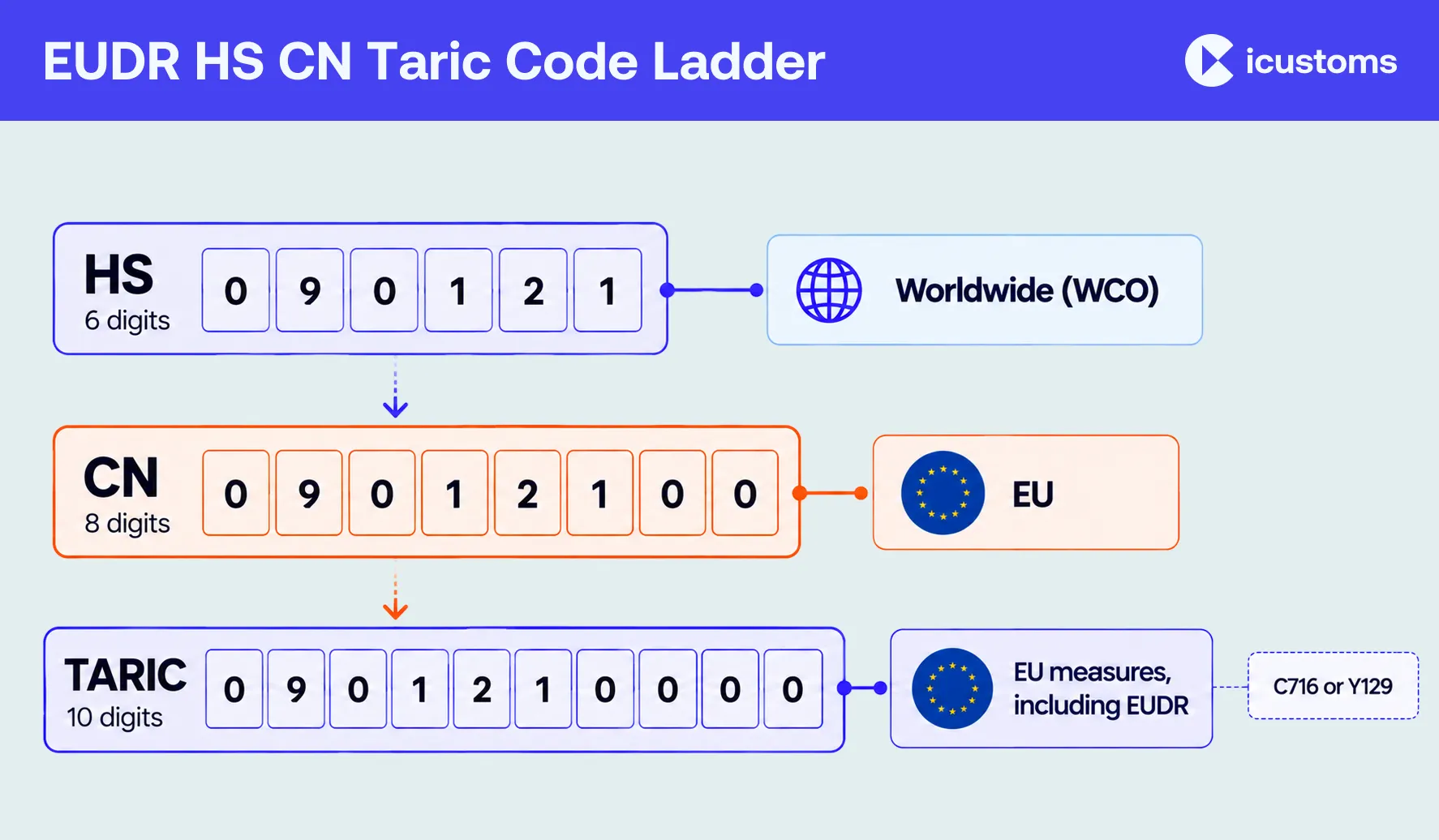
Annex I lists products mostly by HS heading or subheading, but EU customs works at CN and TARIC level, so you need all three.
| Code | Digits | Set by | Role in the EUDR |
|---|---|---|---|
| HS (Harmonized System) | 6 | World Customs Organization, used by over 200 countries | Annex I is written at HS level (4 or 6 digits) |
| CN (Combined Nomenclature) | 8 | The EU | Annex I names some products at 8 digits, such as soya beans 1201 90 00 |
| TARIC | 10 | The EU, with all trade measures attached | Shows the EUDR condition and the document codes, such as C716 or Y129, for each line |
Your supplier may quote a six-digit HS code from its own country. Always confirm the eight-digit CN code that will appear on the EU customs declaration, because ‘ex’ conditions and 2026 changes often sit below the six-digit level.
What Is a Customs Chapter and Why Does It Matter for the EUDR?
Every traded product has a customs code, and the first two digits are its chapter. Chapters group related products: chapter 09 covers coffee and tea, chapter 18 cocoa, chapter 44 wood and chapter 48 paper and paperboard. The next digits narrow it down to a heading (4 digits), a subheading (6 digits) and, in the EU, an 8-digit CN code. Annex I of the EUDR names products by these codes, so a chapter tells you where to look, but only the full code shows whether your product is in scope.
How to Check if Your HS Code Is in EUDR Scope
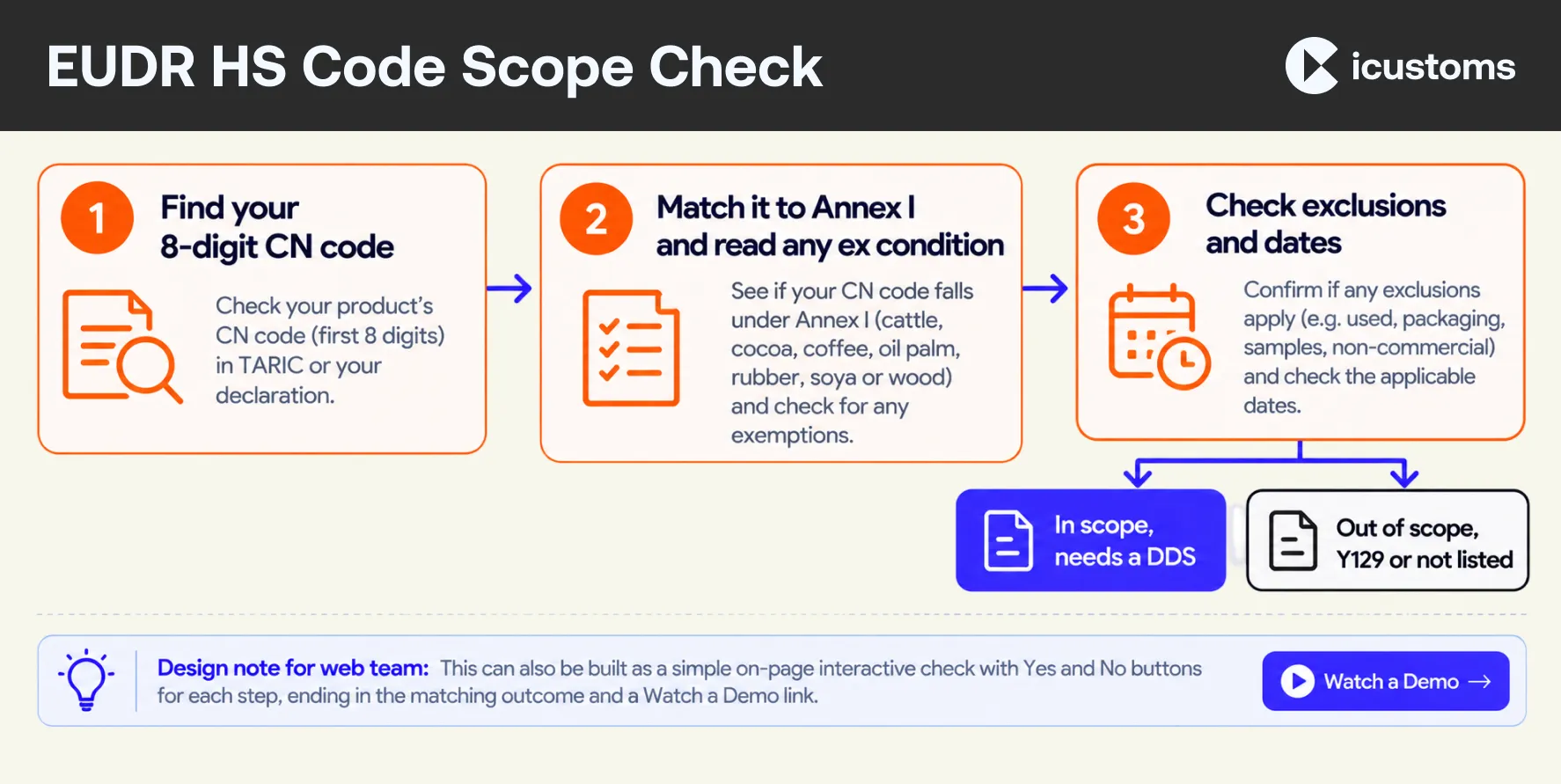
A reliable EUDR HS code check takes three steps.
- Find the eight-digit CN code for each product, from your customs declarations, your tariff classification or a binding tariff information (BTI) decision.
- Match it against Annex I at four, six and eight digits. If the entry starts with ‘ex’, read the condition, such as ‘made using oil palm’ or ‘of wood’.
- Check exclusions and dates. Packaging, samples, used goods, waste and products made before 29 June 2023 are outside scope or exempt, and some codes only join on 30 December 2027.
EUDR HS Code List by Commodity (2026)
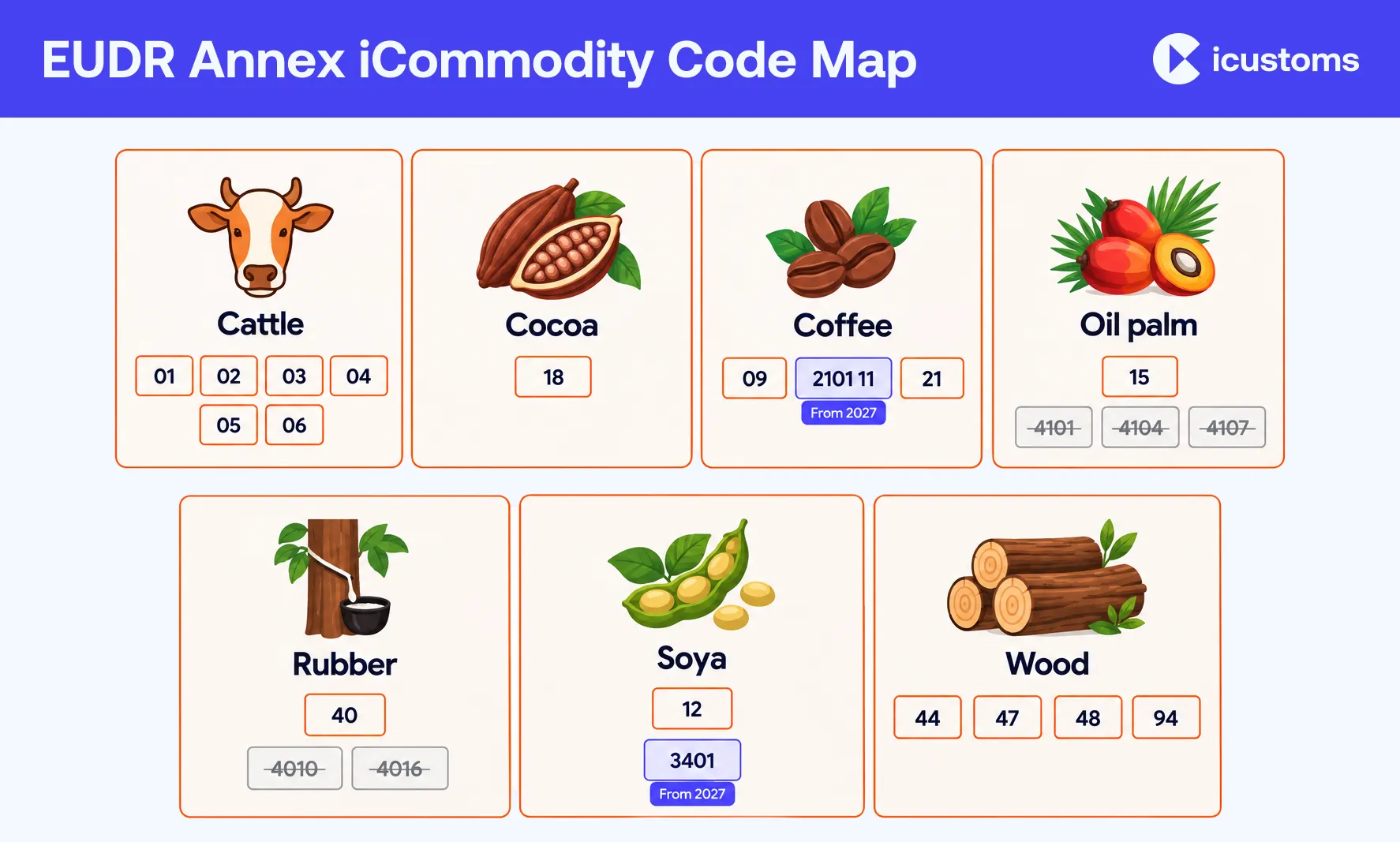
This is the Annex I list as it stands after Delegated Regulation (EU) 2026/2102. ‘Ex’ means only part of the heading is covered.
| Commodity | HS codes in scope | Changed in 2026 |
|---|---|---|
| Cattle | Live cattle, genus Bos (ex 0102); fresh, chilled and frozen beef (0201, 0202); edible offal (ex 0206 10, ex 0206 22, ex 0206 29); prepared or preserved beef (ex 1602 50) | Hides, skins and leather (ex 4101, ex 4104, ex 4107) removed; frozen tongues (ex 0206 21) join in 2027 |
| Cocoa | Beans (1801); shells, husks and skins (1802); paste (1803); butter (1804); powder (1805); chocolate and food containing cocoa (1806) | Waste under the Waste Framework Directive excluded from 1802 |
| Coffee | Coffee, roasted or not, decaffeinated or not; husks and skins (0901) | Soluble coffee and extracts (2101 11) join in 2027 |
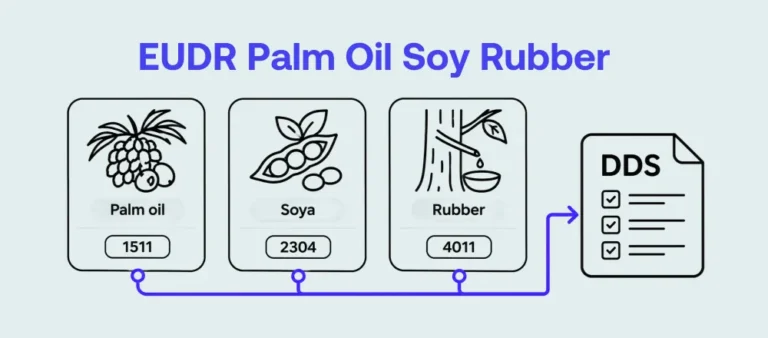
| Oil palm | Palm nuts and kernels (1207 10); palm oil (1511); palm kernel oil (ex 1513); oilcake (2306 60); glycerol (ex 2905 45); palmitic and stearic acids (ex 2915); industrial fatty acids and fatty alcohols (ex 3823) | Many derivatives join in 2027 (see below) |
| Rubber | Natural rubber (ex 4001); compounded and unvulcanised rubber (ex 4005, ex 4006); thread and cord (ex 4007); plates and sheets (ex 4008); new tyres (ex 4011); tyre treads (ex 4012 90 30); inner tubes (ex 4013); apparel and gloves (ex 4015); hard rubber (ex 4017) | Belts (ex 4010), other vulcanised articles (ex 4016) and retreaded or used tyres removed |
| Soya | Soya beans other than for sowing (1201 90 00); flour and meal (1208 10); oil (1507); oilcake (2304) | Soya beans for sowing removed |
| Wood | Wood and articles of wood (chapter 44, 4401 to 4421); pulp (ex chapter 47); paper and paperboard (ex chapter 48); wooden seats (ex 9401); wooden furniture (ex 9403); prefabricated wooden buildings (ex 9406 10) | Aircraft and motor vehicle seats removed; bamboo, rattan and similar materials excluded |
Printed books, newspapers and other chapter 49 products left Annex I with the 2025 amendment. From 30 December 2027, these codes also join: soluble coffee (2101 11 00), frozen cattle tongues (ex 0206 21 00), and palm oil derivatives including modified palm oils (ex 1516 20, ex 1518 00), crude glycerol (ex 1520 00), further fatty alcohols, acids and amines (ex 2905, ex 2915, ex 2916, ex 2921, ex 2923, ex 2924), soaps (ex 3401), chemical preparations (ex 3824 99) and polyethers (ex 3907 29), each only when made using oil palm.
Always confirm the full wording in the consolidated Annex I on EUR-Lex and Delegated Regulation (EU) 2026/2102. For a plain-language view by commodity, see our EUDR commodities list.
What Does 'Ex' Mean in Annex I?
An ‘ex’ before a code means only some products under that heading are covered. The condition is in the product description, so two goods with the same code can be treated differently.
- ex 3401 (soap, from 2027): in scope only when made using oil palm. A soap made from olive or coconut oil is not.
- ex 9401 (seats): in scope only for seats of wood. A metal-framed chair is not covered.
- ex 4001 (natural rubber): covers rubber from Hevea brasiliensis, not other natural gums under the same heading. Synthetic rubber is never in scope.
- ex 0102 (live animals): cattle of the genus Bos only, so buffalo and bison are out.
When goods fall under an ‘ex’ code but outside its condition, the declarant uses TARIC code Y129 to show that the EUDR does not apply. Keep the evidence, such as an ingredient specification, in case customs asks.
When Processing Changes the HS Code
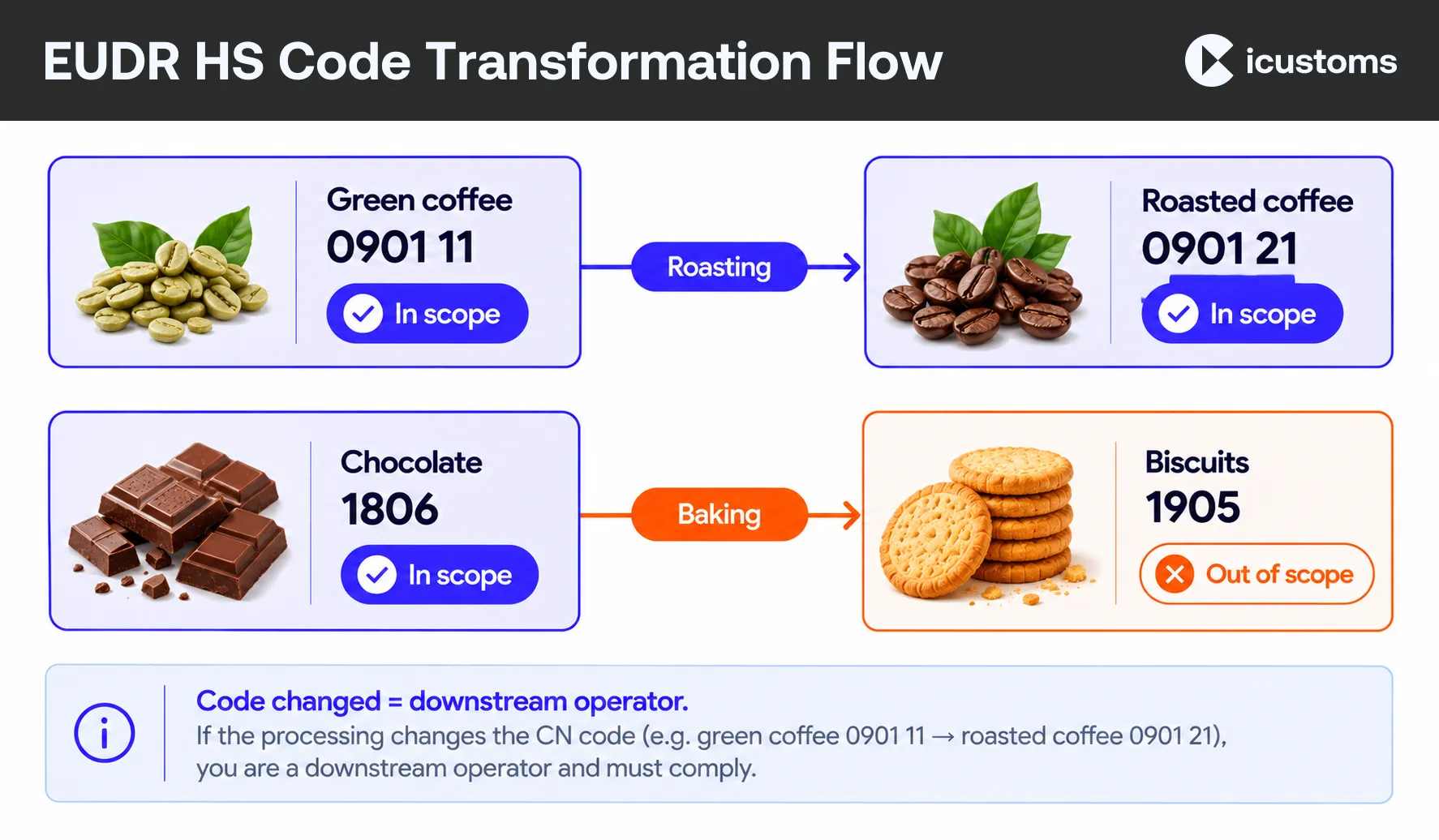
Processing a covered product often moves it to a new code. The European Commission’s EUDR FAQ explains that a company which changes the HS or CN code of a relevant product acts as a downstream operator, while one that resells without a code change acts as a trader. This HS code transformation decides both your role and whether your output stays in scope.
| Processing step | Code change | Result |
|---|---|---|
| Roasting green coffee | 0901 11 to 0901 21 | Still in scope; the roaster acts as a downstream operator |
| Making paper from pulp | 4703 to 4802 | Still in scope; the paper mill acts as a downstream operator |
| Turning paper into notebooks | 4802 to 4820 | Still in scope while sold as paper products |
| Grinding cocoa beans into chocolate | 1801 to 1806 | Still in scope |
| Baking biscuits with chocolate | 1806 to 1905 | Out of scope: 1905 is not in Annex I |
Whatever your role, keep the DDS references for the inputs you bought. Our EUDR role and deadline check explains what each role must do and when.
Three Worked Examples
Cocoa beans, CN 1801 00 00. A Belgian chocolate maker imports raw beans from a cooperative in Ghana. Heading 1801 is listed in full, with no ‘ex’, so every consignment needs a DDS reference declared under C716, as explained in our EUDR due diligence statement guide.
Wooden furniture. A UK retailer ships oak dining tables (9403 60) and metal-framed office chairs (9401 71) to stores in Ireland. The tables are in scope as wooden furniture. The chairs fall under ex 9401 but are not of wood, so they are declared with Y129.
Paper. A German distributor imports copier paper (4802 56) to sell, and receives machine parts packed in cartons (4819 10). The copier paper is in scope. The cartons protect other goods, so they are packaging and outside scope. Empty cartons bought as stock would be in scope.
What to Do When Classification Is Unclear
If you are not sure of the right CN code, apply for binding tariff information (BTI) from the customs authority of an EU country. A BTI decision is binding on customs authorities across the EU and on you, usually for three years, and it settles the code your EUDR check rests on. Until then, record your reasoning, ask your customs broker, and avoid relying on a supplier’s six-digit code alone. The European Commission’s BTI page explains how to apply.
Why Manual Code Checks Break at Scale
Checking ten products by hand is easy. Checking a catalogue of several thousand lines is where errors creep in: suppliers quote codes from different tariffs, ‘ex’ conditions need composition data, the 2026 update changed several lines, and a product moved to the wrong code can stop a shipment at the border or leave an obligation unmet.
How iEUDR by iCustoms Checks Codes and Connects Suppliers
iEUDR by iCustoms is AI-powered, cloud-based EUDR compliance software that takes you from a code check to a customs-ready reference. Your team stays in control of every classification decision.
- AI product classification: built on iClassification, which supports classification across 32+ countries, iEUDR suggests CN codes and flags in-scope, ‘ex’ and 2027 lines across your catalogue for your team to confirm.
- A ready supplier network: many suppliers are already onboarded in iEUDR. Connect them to your account and start from existing supplier records instead of from zero.
- Supplier portal: new suppliers are checked against official EU TRACES records, then enter products, quantities and production sites. Each is asked for the data its commodity needs.
- Geolocation validation: every production site is checked before the supplier can submit.
- DDS created, validated and verified: iEUDR builds and validates each DDS and submits it, singly or in bulk. Supplier statements are retrieved, verified and validated.
- Customs-ready references: each reference reaches your forwarder before they file, with a five-year audit trail.
Frequently Asked Questions
Which HS codes are covered by the EUDR?
Codes in Annex I for cattle, cocoa, coffee, oil palm, rubber, soya and wood, mainly in chapters 01, 02, 09, 12, 15, 16, 18, 23, 29, 38, 40, 44, 47, 48 and 94. Codes in chapters 21, 34 and 39 join for palm and coffee products on 30 December 2027.
Is there an EUDR HS code checker?
The EU TARIC consultation tool shows whether a CN code carries the EUDR condition. For a whole catalogue, EUDR compliance software such as iEUDR flags in-scope codes in bulk for your team to confirm.
Is chapter 49 still covered by the EUDR?
No. Printed books, newspapers, pictures and other printed products under chapter 49 were removed from Annex I by the 2025 amendment.
Is HS 4819 paper packaging covered?
Cartons and boxes under 4819 are in scope when placed on the market as products in their own right. When they are used to support, protect or carry another product, they are packaging and outside scope.
Does a change of CN code change my EUDR role?
Yes. According to the Commission's FAQ, changing the HS or CN code of a relevant product makes you a downstream operator. Reselling without a code change makes you a trader.
Are synthetic rubber products in scope?
No. The EUDR covers natural rubber only. Products made entirely of synthetic rubber fall outside scope, even under a listed heading.
You may also like:
Is your product code on the EUDR list?

iEUDR’s AI classification flags in-scope CN codes across your catalogue, for your team to confirm.
Subscribe to our Newsletter
About iCustoms
iCustoms is an all-in-one solution helping businesses automate customs processes more efficiently. With AI-powered and machine-learning capabilities, iCustoms is designed to streamline your all customs procedures in a few minutes, cut additional costs and save time.
Your codes are in scope. Are your suppliers ready?
Connect suppliers already onboarded in iEUDR and collect the rest through one supplier portal.