

ENS for Road Transport UK: The Haulier's Complete Guide to S&S GB Declarations
- John Hall
- Customs Specialist at iCustoms.ai
For accompanied road freight moving into Great Britain, the haulage company is legally responsible for lodging the S&S GB Entry Summary Declaration before the vehicle arrives.
That is the headline rule every transport manager needs. The exact deadline depends on how you cross: 1 hour before arrival through the Channel Tunnel, and 2 hours before arrival on an accompanied RoRo ferry.
This is the haulier’s operational guide to ENS for road transport into the UK: who files, the deadlines that apply to your crossing, how the declaration links to GVMS, what you need to get set up, and the mistakes that leave trucks stuck at check-in. For the wider picture, see our S&S GB ENS pillar guide.
Who files the ENS on a road movement into the UK?
The legal duty sits with the carrier, and for road that carrier is defined by how the goods travel. Based on HMRC’s guidance, the responsible party is:
| Road Movement Type | Who Is Responsible for the ENS |
|---|---|
| Accompanied RoRo (driver travels with the vehicle) | The haulage company |
| Unaccompanied RoRo (trailer shipped without a tractor unit) | The ferry operator |
| Road via the Channel Tunnel (Eurotunnel) | The haulage company |
A haulier can appoint a freight forwarder, customs agent or software provider to file on their behalf, but the legal responsibility stays with the carrier. If both a haulier and a third party file for the same load, customs can use both declarations or reject the duplicate, so agree in advance who files. See who is responsible for filing the ENS for the detail.
Accompanied vs unaccompanied: the distinction that decides who files
This one distinction changes the whole obligation, so it is worth being clear.
- Accompanied: the driver and unit travel with the trailer on the ferry or through the tunnel. The haulage company is the carrier and files the ENS.
- Unaccompanied: the trailer is dropped and shipped alone on a RoRo ferry. The ferry operator is the carrier and files the ENS.
If you run a mix of accompanied and unaccompanied work, your filing responsibility switches load by load. Our RoRo and accompanied freight guide covers the ferry side in full.
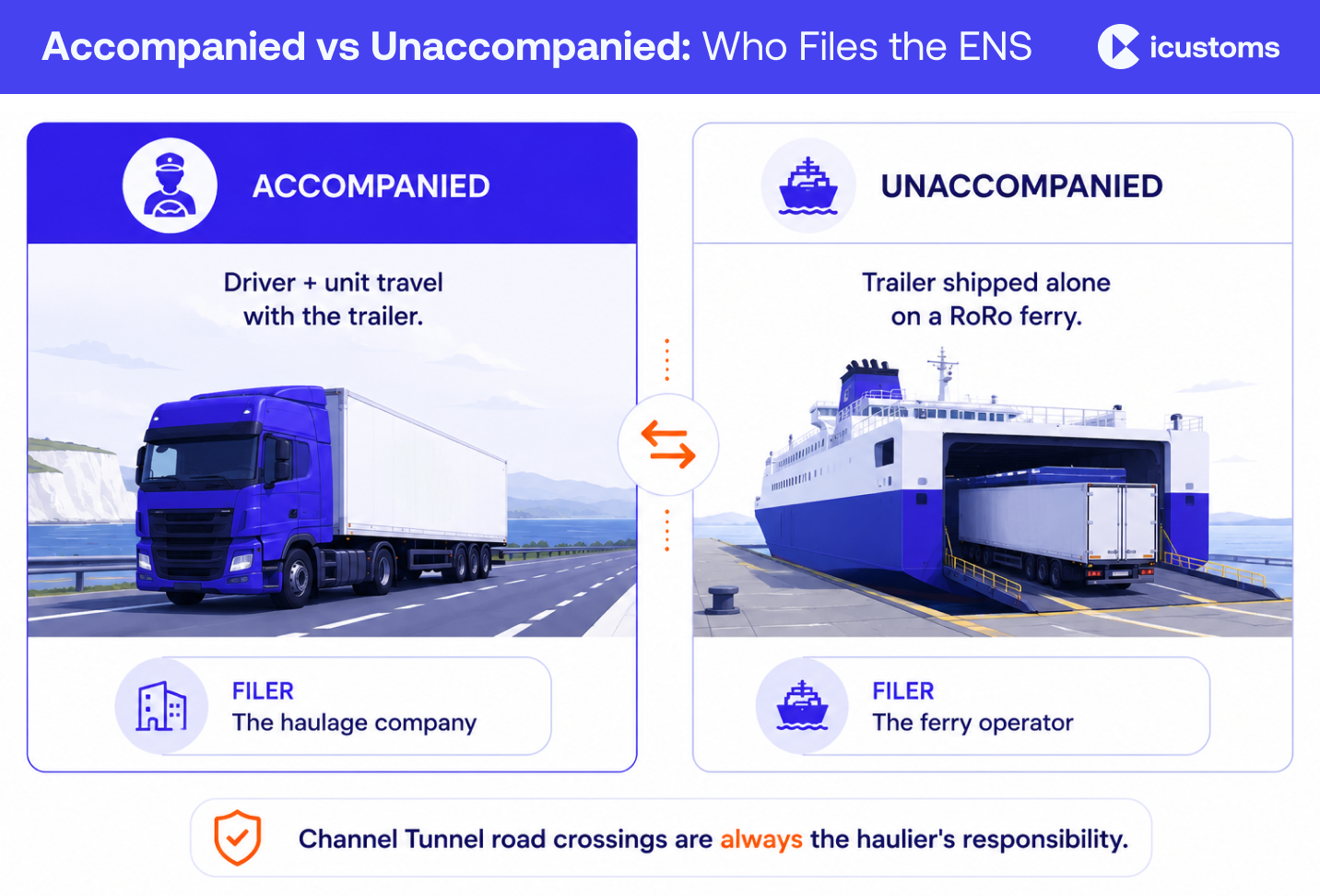
ENS deadlines for road freight (ferry vs Channel Tunnel)
For road hauliers, the deadline depends on the crossing, not the truck:
| Road Crossing | ENS Deadline (Minimum) |
|---|---|
| Channel Tunnel (Eurotunnel) | At least 1 hour before arrival at the Eurotunnel terminal |
| Accompanied RoRo ferry | At least 2 hours before arrival |
| Unaccompanied RoRo ferry | At least 2 hours before arrival (filed by the ferry operator) |
These are legal minimums, and you can file up to 200 days in advance. In practice, file to the operator’s earlier cut-off so there is time to fix a rejection. The full mode table is in our ENS deadlines by transport mode guide.
ENS and GVMS: how the MRN fits the goods movement reference
Most road freight enters Great Britain through ports that use the Goods Vehicle Movement Service (GVMS). You create a Goods Movement Reference (GMR) that ties your customs references to the vehicle so it can board and cross.
For imports into Great Britain, including the ENS movement reference number in the GMR is optional, but many hauliers add it to keep every reference in one place. For movements into Northern Ireland it is required, and doing so lets your arrival and presentation notifications be submitted automatically. Either way, the ENS must still be lodged and accepted, and the MRN issued, before you reach check-in.
What a haulier needs to file S&S GB
Before you can submit a road ENS through S&S GB, you need three things in place:
- A GB EORI number. The party lodging the declaration must hold one.
- S&S GB enrolment. You must enrol with the S&S GB service before filing through software.
- A way to submit. S&S GB has no online form, so you need compatible software, a community system provider, or an agent who files for you.
Many haulage firms choose to file through software or an agent because the volume of movements makes a manual route impractical, especially when accompanied and unaccompanied loads carry different obligations.
The road ENS process, step by step
- Confirm who files. For accompanied loads, that is you as the haulier; for unaccompanied, the ferry operator.
- Gather the data. Collect the consignment details from the trader or forwarder: goods description, parties, EORIs, package and weight data, and the routing.
- Lodge the ENS. Submit through S&S GB ahead of the crossing cut-off. The system validates the declaration.
- Get the MRN. On acceptance, S&S GB issues a movement reference number as your proof of a valid declaration.
- Build the GMR. Create your Goods Movement Reference and, if you choose, add the ENS MRN to it.
- Cross. Present at check-in with a valid GMR so the vehicle can board and clear the border.
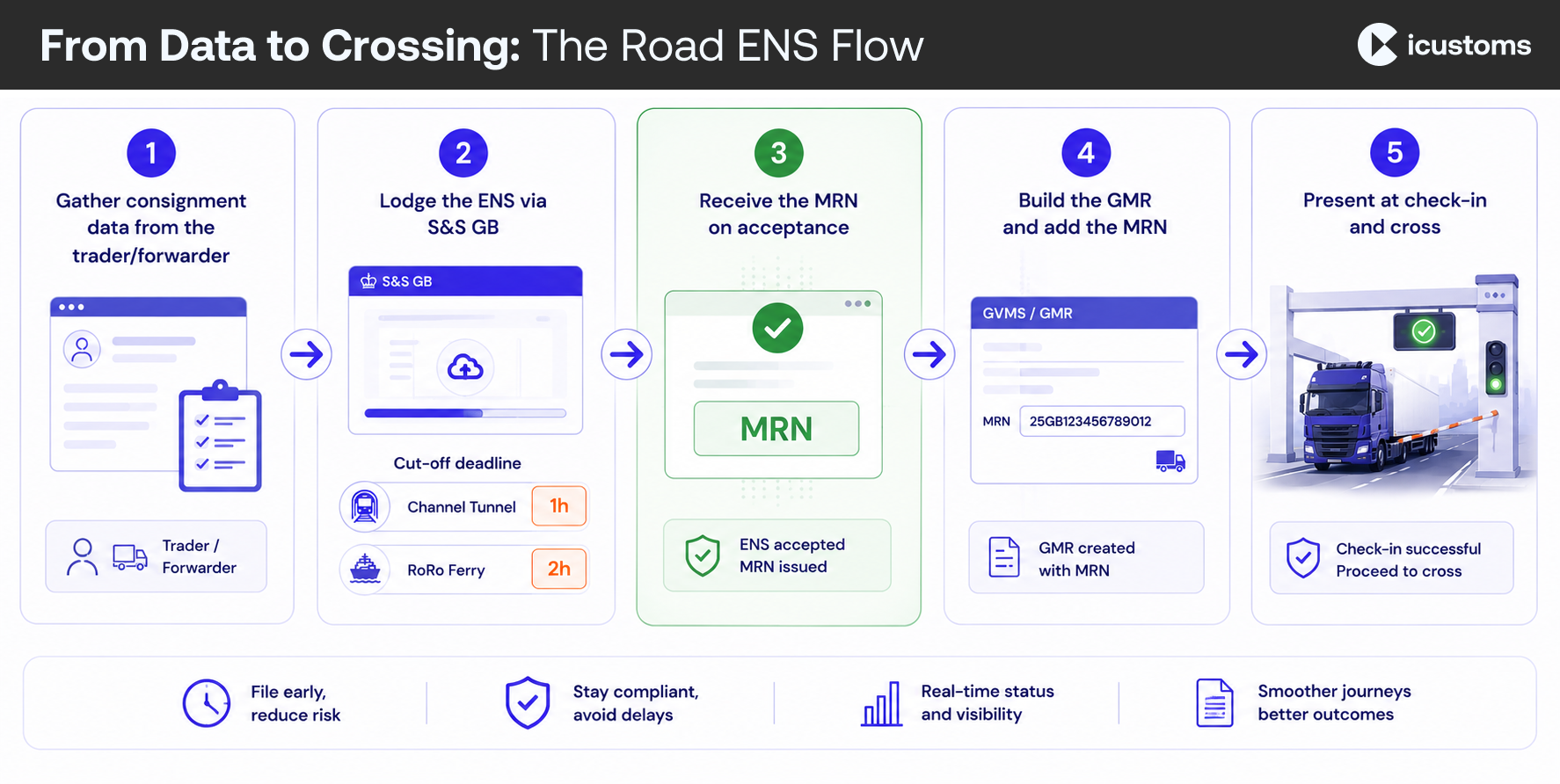
Do empty trailers need an ENS?
Often, no. Empty trailers, containers and packaging moved under a transport contract can usually be declared by conduct, and goods declared orally or by conduct are on HMRC’s list of movements that do not need an entry summary declaration. This matters for hauliers repositioning empty equipment across the border, as it removes a filing step. Always confirm the movement genuinely qualifies, because as soon as the trailer is loaded, the ENS obligation returns. The full exemption list sits in HMRC’s guidance.
The data you need, and where it comes from
A haulier rarely generates the consignment data; you receive it. The ENS needs the consignor and consignee, their EORIs where held, a clear goods description, package count and gross weight, and the routing and port of entry. That data comes from the trader or forwarder, usually off the commercial invoice, packing list and transport document.
Because the carrier carries the legal duty but the trader supplies the facts, the weak point is the handover. A vague goods description or a missing EORI passed to you late is what turns into a rejected declaration at the worst moment. Set a clear data cut-off with your customers that sits comfortably before the crossing cut-off.
Common ENS mistakes hauliers make
- Treating the HMRC minimum as the deadline instead of the operator’s earlier cut-off, leaving no time to fix a rejection.
- Confusing accompanied and unaccompanied, so nobody files, or two parties file the same load.
- Relying on trader data that is vague or incomplete, which bounces the declaration.
- Turning up at check-in without a valid MRN in hand.
- No out-of-hours cover to amend a crossing time when a ferry is delayed.
Delays, diversions and amendments
Road and RoRo work is exposed to weather and industrial action, so HMRC allows some tolerance. If a routing is delayed by more than 2 hours beyond the scheduled arrival, no amendment is needed as long as the vehicle travels on the same routing, with the same carrier, after the original scheduled departure, and leaves the declared port no later than 12 hours after the original scheduled sailing.
Otherwise, you can amend a declaration at any time until the goods arrive, even after the time limit has passed, provided the original was lodged on time. This is why out-of-hours amendment cover matters for road operators.
How iENS helps hauliers
Road ENS is a volume and timing problem. iENS from iCustoms reads the consignment documents, extracts and validates the data, and files through S&S GB before the cut-off, returning the MRN ready for your GMR. That means fewer rejections, fewer trucks held at check-in, and less time chasing missing data. See how it works on the iENS Entry Summary Declaration page.
Frequently Asked Questions
Who files the ENS for road freight into the UK?
For accompanied road freight, the haulage company files the S&S GB ENS. For unaccompanied RoRo, the ferry operator files it. A haulier can appoint an agent, but the legal responsibility stays with the carrier.
Do hauliers need to file S&S GB declarations?
Yes, for accompanied road movements into Great Britain. The haulier is the carrier and must ensure a valid ENS is lodged before arrival.
What is the ENS deadline for road transport?
One hour before arrival at the Eurotunnel terminal for Channel Tunnel crossings, and 2 hours before arrival for accompanied RoRo ferries. You can file up to 200 days in advance.
What is the difference between accompanied and unaccompanied for ENS?
Accompanied means the driver travels with the trailer, so the haulier files. Unaccompanied means the trailer is shipped alone, so the ferry operator files.
Do I need GVMS as well as an ENS?
Usually yes for road. You create a Goods Movement Reference in GVMS to cross. Adding the ENS MRN to the GMR is optional for Great Britain and required for Northern Ireland.
You may also like:
Struggling to Extract, Catagorise & Validate Your Documents?

Capture & Upload Data in Seconds with AI & Machine Learning
Subscribe to our Newsletter
About iCustoms
iCustoms is an all-in-one solution helping businesses automate customs processes more efficiently. With AI-powered and machine-learning capabilities, iCustoms is designed to streamline your all customs procedures in a few minutes, cut additional costs and save time.
Struggling to Extract, Catagorise & Validate Your Documents?
Capture & Upload Data in Seconds with AI & Machine Learning