

ENS Deadlines by Transport Mode: Complete UK & EU Timing Guide
- John Hall
- Customs Specialist at iCustoms.ai
The ENS deadline is the latest point at which an Entry Summary Declaration can be lodged, and it depends on how the goods travel.
The declaration must always be submitted before the goods arrive, with minimum time limits ranging from 24 hours before loading for deep-sea containers to 1 hour before arrival for road traffic through the Channel Tunnel. You can submit up to 200 days in advance.
This reference guide sets out the exact ENS deadline by transport mode for UK imports through S&S GB, explains how the EU handles the same timings under ICS2, and covers the practical points that catch operators out: amendments, disruption and missed deadlines. The figures below follow HMRC’s published time limits.
ENS deadlines by transport mode (UK S&S GB)
For imports into Great Britain, the minimum timing requirement for lodging the Entry Summary Declaration is:
| Transport / Shipping Service | Minimum ENS Submission Timing |
|---|---|
| Maritime containerised cargo | At least 24 hours before loading at the port of departure |
| Maritime bulk or break-bulk cargo | At least 4 hours before arrival |
| RoRo – accompanied freight | At least 2 hours before arrival |
| RoRo – unaccompanied freight | At least 2 hours before arrival |
| Short sea journeys | At least 2 hours before arrival |
| Short-haul flights (under 4 hours) | At the time of actual take-off |
| Long-haul flights (4 hours or more) | At least 4 hours before arrival |
| Short rail journey (under 2 hours) | At least 1 hour before arrival |
| Long rail journey (over 2 hours) | At least 2 hours before arrival |
| Road (Channel Tunnel) | At least 1 hour before arrival at the Eurotunnel terminal |
These are minimum time limits. Filing earlier is always allowed, and for high-risk or complex consignments it is sensible.
Before loading vs before arrival: what the deadline is measured from
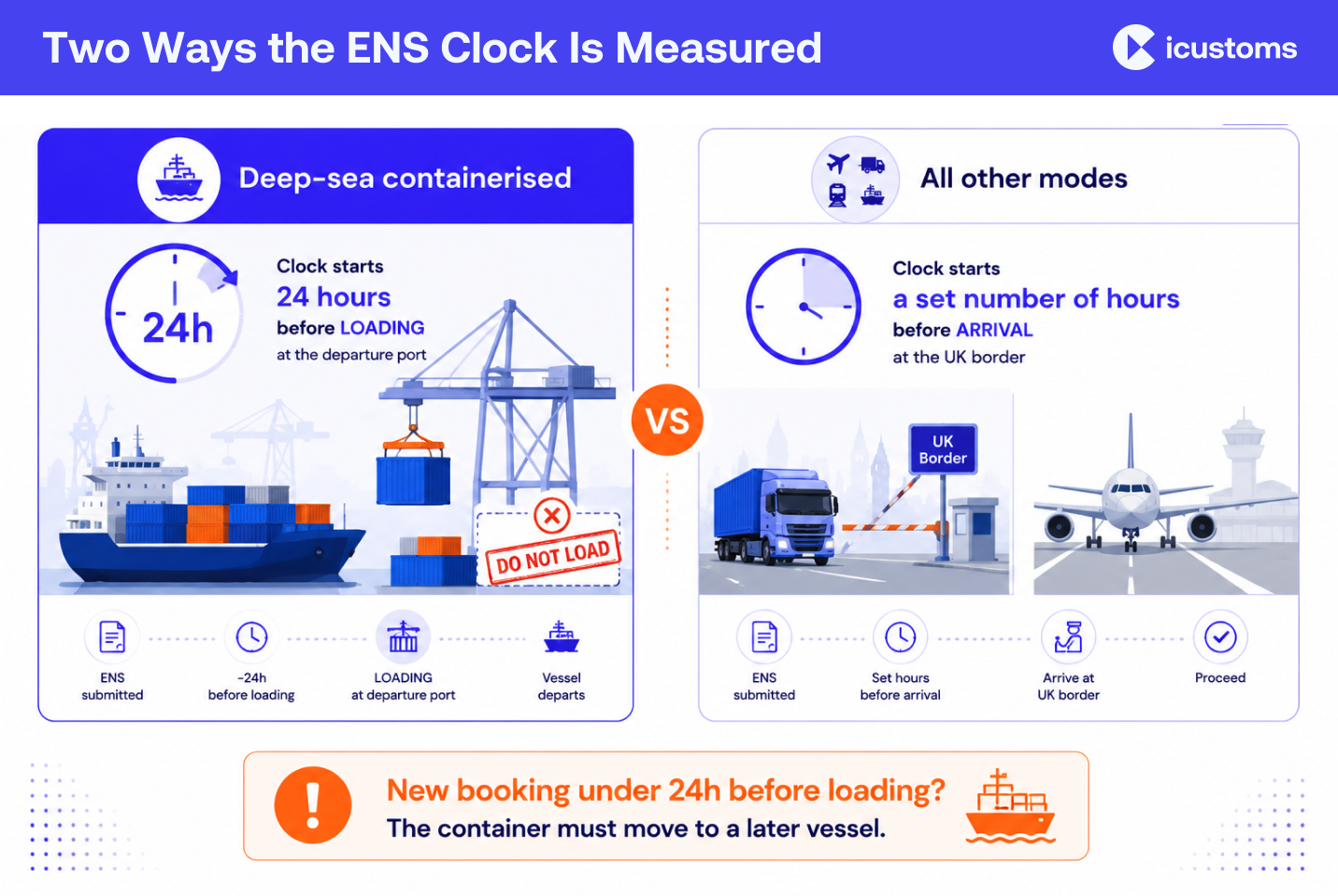
Most modes are measured against arrival at the UK border. Deep-sea containerised maritime cargo is the exception: its deadline is measured against loading at the foreign port of departure, not arrival. This is because customs can issue a “do not load” instruction for containers before they are put on the vessel.
The practical effect is significant. For a container booking made less than 24 hours before loading, the carrier must move the cargo to a later vessel so the 24-hour rule can be met. The declaration cannot simply be filed late.
What counts as a short sea journey
Short sea journeys into Great Britain, which use the 2-hour rule, include routes from the English Channel and the Atlantic coast of Europe up to and including Algeciras, plus Norway, Ireland, the Faroe Islands, Iceland, and ports on the Baltic Sea and the North Sea. Both containerised and non-containerised cargo on these routes follow the 2-hour deadline.
ENS cut-off vs the legal deadline
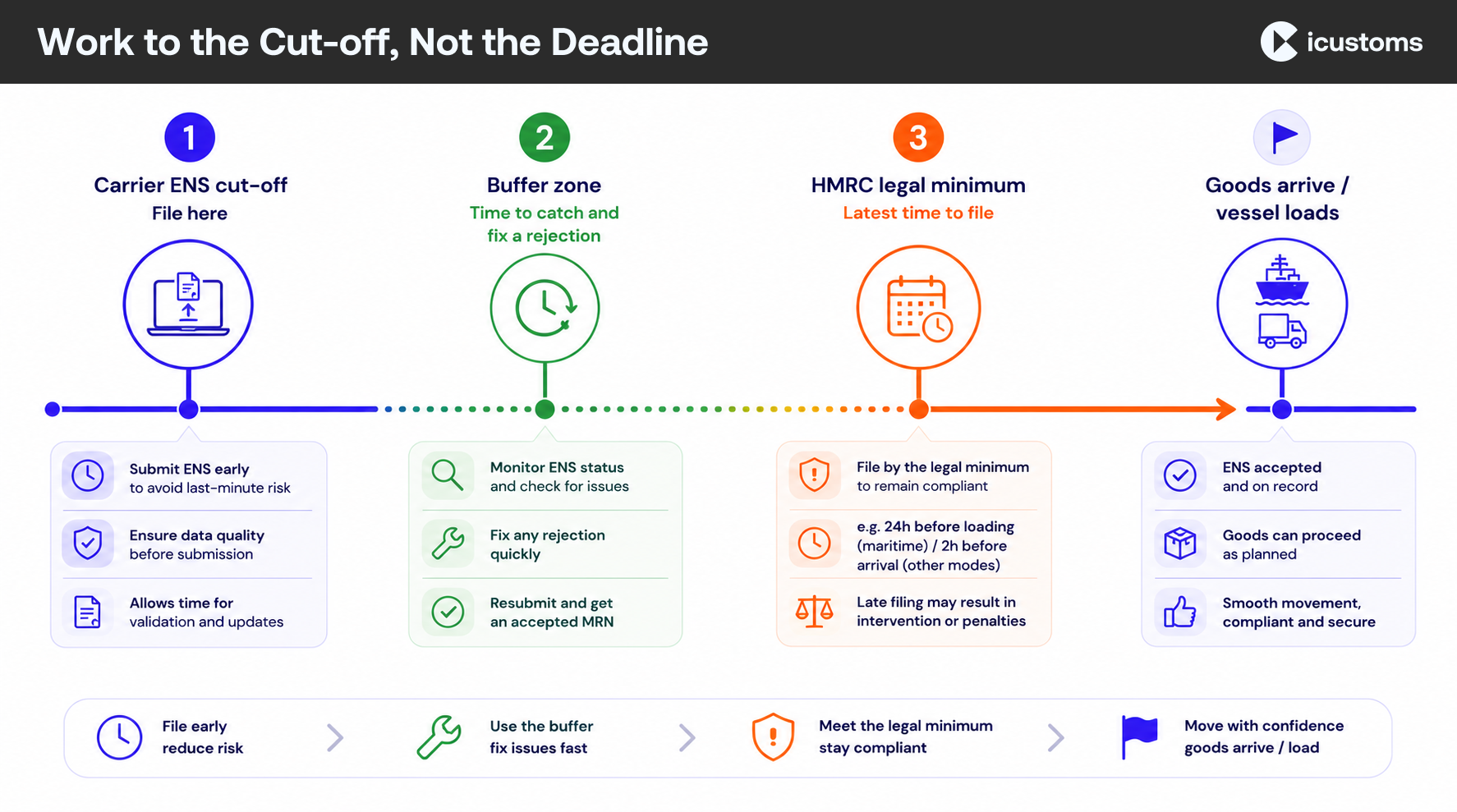
The legal deadline is the HMRC minimum. In practice, carriers set an earlier ENS cut-off so they have time to gather data, file, and handle any rejection before the legal limit. Always work to the carrier’s cut-off, not the HMRC minimum, and build in a buffer for corrections.
EU ICS2 deadlines: how the EU compares
Goods entering the EU are declared through ICS2, and the EU applies the same mode-based pre-arrival time limits, because both the UK and the EU inherited them from the Union Customs Code. So the sea, air, rail, road and RoRo figures above are a reliable guide for EU movements too.
There is one important addition on the EU side. For air cargo, ICS2 also requires a pre-loading advance data set to be filed before the goods are loaded onto the aircraft, on top of the pre-arrival declaration. If you move air freight into the EU, treat pre-loading as a separate, earlier obligation and confirm the current ICS2 requirement for your route.
Can you amend or submit an ENS late?
You can amend an ENS at any time until the goods arrive, even after the mode’s time limit has passed, but the original declaration must still be submitted on time.
The amendment overwrites the original and must contain all of its data plus the change. You cannot amend the person lodging the declaration or their representative; that needs a new declaration.
Two allowances help with real-world disruption:
- RoRo and road delays: if a routing is delayed by more than 2 hours beyond the scheduled arrival, no amendment is needed provided the vehicle travels on the same routing, with the same carrier, after the original scheduled departure, and leaves the declared port no more than 12 hours after the original scheduled sailing.
- Diversions: if goods are diverted and no declaration has been lodged, submit as soon as the decision is made and no later than 2 hours before arrival.
Declarations cannot be cancelled. If you decide not to ship, you simply take no action.
What happens if you miss the ENS deadline
Missing the deadline has consequences before the goods even move. For deep-sea containerised cargo, customs can issue a “do not load” message (an IE351 advanced intervention) so the container is not put on the vessel. For other modes, goods can be held at the border for further checks. Late, missing or inaccurate declarations can also attract penalties under the Customs Safety and Security (Penalty) Regulations 2019. Our complete ENS guide covers the compliance detail.
Who is responsible for meeting the ENS deadline?
The legal duty to file on time sits with the carrier, but which party that is depends on the mode:
- Sea: the shipping company that issued the bill of lading.
- Air: the airline that issued the air waybill.
- Rail: the rail freight operator hauling the train.
- RoRo accompanied and road via Eurotunnel: the haulage company.
- RoRo unaccompanied: the ferry operator.
A carrier can appoint a freight forwarder or agent to file on their behalf, but the legal responsibility to meet the deadline stays with the carrier. See who is responsible for filing the ENS for the full picture.
Practical tips to hit every ENS deadline
- Work to the carrier’s cut-off, not the HMRC minimum. The cut-off is earlier and leaves room to fix a rejection.
- Front-load deep-sea. Because the clock runs from loading, not arrival, prepare container declarations days ahead, not hours.
- Validate before you file. Most missed deadlines are really data problems: a missing EORI or vague goods description bounces the declaration and burns the buffer.
- Confirm the route early for short sea and RoRo. File with the intended routing and amend if it changes; amendments are allowed up to arrival.
- Agree out-of-hours cover. For RoRo and road, make sure whoever files can amend crossing times outside office hours.
How iENS keeps declarations ahead of the deadline
Deadlines are a data problem. The declaration is only as fast as the moment your team has clean, complete data to file. iENS from iCustoms reads the shipping documents, extracts and validates the data, and files through S&S GB or ICS2 well before the cut-off, so a missing field does not become a missed vessel. See how it works on the iENS Entry Summary Declaration page.
Frequently Asked Questions
What is the ENS deadline for sea freight?
For deep-sea containerised cargo, the ENS must be lodged at least 24 hours before loading at the port of departure. Bulk or break bulk cargo is at least 4 hours before arrival, and short sea journeys are at least 2 hours before arrival.
What is the ENS deadline for air cargo?
For short-haul flights under 4 hours, the ENS must be lodged by the time of actual take-off. For long-haul flights of 4 hours or more, it is at least 4 hours before arrival. EU ICS2 also requires pre-loading air data before the goods are loaded.
What is the ENS deadline for road and rail?
Road traffic through the Channel Tunnel is at least 1 hour before arrival at the Eurotunnel terminal. Rail is 1 hour before arrival for journeys under 2 hours, and 2 hours before arrival for longer journeys.
How far in advance can I submit an ENS?
You can submit an Entry Summary Declaration up to 200 days before the goods arrive. There is no benefit to leaving it late, and filing early gives room to fix any rejection.
Can I amend an ENS after the deadline?
Yes. Amendments can be made at any time until the goods arrive, even after the time limit, but the original declaration must still have been submitted on time. You cannot cancel a declaration.
You may also like:
Struggling to Extract, Catagorise & Validate Your Documents?

Capture & Upload Data in Seconds with AI & Machine Learning
Subscribe to our Newsletter
About iCustoms
iCustoms is an all-in-one solution helping businesses automate customs processes more efficiently. With AI-powered and machine-learning capabilities, iCustoms is designed to streamline your all customs procedures in a few minutes, cut additional costs and save time.
Struggling to Extract, Catagorise & Validate Your Documents?
Capture & Upload Data in Seconds with AI & Machine Learning