

Smart Compliance for E-Commerce Retailers: Why AI Is Essential
- John Hall
- Customs Specialist at iCustoms.ai
A single wrong code. One missed document. That’s all it takes to delay an order or trigger a costly customs fine.
For e-commerce retailers shipping across borders, compliance isn’t just about documentation; it’s the backbone of fast, smooth delivery. Yet many still rely on manual methods that are slow, error-prone, and outdated.
AI changes the game. From automating customs documents to accurately classifying products, smart compliance tools powered by AI help online sellers move faster, stay compliant, and keep customers happy.
The compliance burden e-commerce retailers face
E-commerce retailers come across many compliance challenges; common ones are:
Manual work: Error-prone and costly
E-commerce businesses work in an environment where a little negligence can lead to shipment holdups, fines, and penalties. Many e-commerce businesses are relying on traditional methods for documentation, HS code classification, tax calculation, and customs declaration form filing.
This is not only time-consuming, but also increases the risk of costly errors. One wrong Harmonised System (HS) code can trigger delays and financial penalties.
Constantly evolving and complicated regulations
From constantly changing tariff codes to different declarations requirements, staying compliant is a challenge for e-commerce businesses.
Every country has its own customs rules, product codes, and paperwork, plus they change all the time. For e-commerce retailers, staying on top of this complexity is the difference between fast, smooth delivery and costly shipping disasters.
Rising customer expectations
Today’s online shoppers don’t care where you ship from; they just want to receive their order fast. But behind the scenes, the customs compliance is the reason for late deliveries.
One small paperwork error can mean days of delay. For modern e-commerce brands, fast and frictionless delivery isn’t just a logistics challenge; it’s a compliance one. Getting documentation right the first time isn’t just good practice; it’s essential for keeping customers satisfied.
Key compliance challenges AI can solve for e-commerce businesses
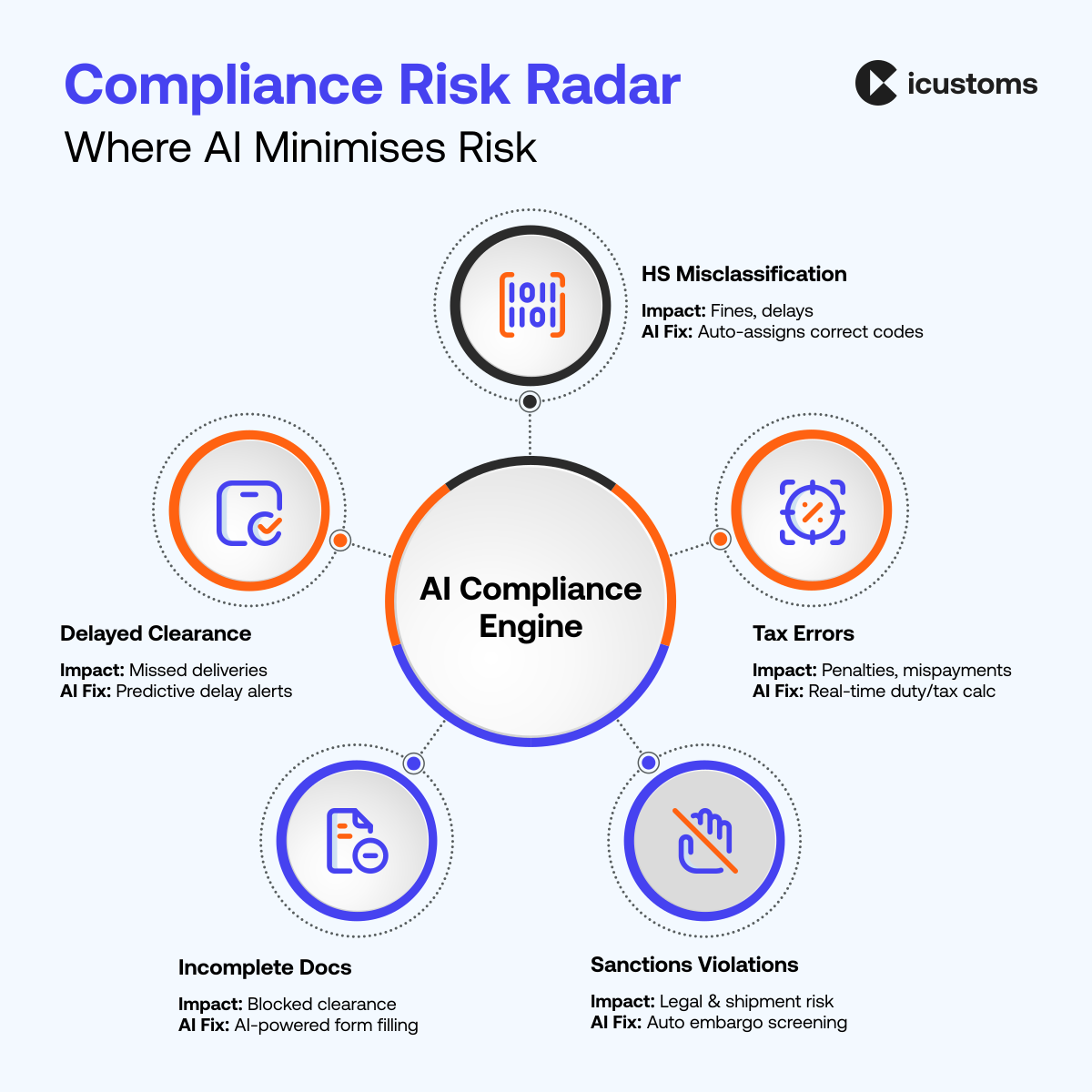
Aside from speeding up the process, AI transforms how compliance is handled entirely. Here are the major challenges AI addresses for e-commerce retailers:
HS code classification
Manually assigning HS codes is highly complex and can lead to serious consequences. These codes determine duties and tax; get it wrong and shipments are fined or flagged.
AI resolves this issue with advanced machine learning models that analyse product descriptions and metadata to accurately assign HS codes. With AI-powered HS codes, tools, retailers can enjoy the less customs hold-ups, fewer misclassification errors, and reduced risk of penalties, which means higher speed and accuracy.
Duty and tax calculation
Duty rates and VAT calculations vary by country, product type, and over time. Miscalculations can lead to unhappy customers or penalties.
Dynamic AI systems tap into live tariff databases from customs authorities to calculate landed costs in real time. With AI, retailers can enjoy transparent pricing at checkout, fewer surprise fees, improved conversion rates, and trust.
Automation of trade/customs documents
Customs require dozens of document types, including packing lists, commercial invoices, certificates, and many more. Processing all the documents manually is error-prone, slow, and costly.
AI technologies such as Intelligent Document Processing (IDP) use natural language processing (NLP) and optical character recognition (OCR) to read, extract, validate and structure document data.
As per Meticulous Research, the global IDP market is set to reach $9.18 billion by 2032.
E-commerce retailers can enjoy lower documentation costs, reduced risk of delays, and faster customs filings, thanks to AI.
Screening and restricted goods detection
Export regulations often prohibit certain items or require added checks. Sanctions lists are constantly updated, making manual screening inadequate.
AI systems automatically cross-check product listings and destinations against global embargo, denied-party, and restricted goods lists. It helps retailers face fewer compliance violations, reduced legal exposure, and reassurance for both buyers and regulators.
Predictive customs delays and risk monitoring
Even compliant shipments can face delays due to port congestion, documentation issues, or sudden rule changes.
Predictive analysis monitors port traffic, historical customs data, and document readiness to estimate clearance timelines and flag high-risk shipments before they are dispatched.
It helps e-commerce retailers reroute shipments, adjust delivery expectations, and avoid costly holdups, promoting proactive decision-making.
Learn more about how AI is beneficial for e-commerce logistics: Click here!
iCustoms’ AI-powered solutions for e-commerce to stay compliant
As a leader in smart customs technology, iCustoms offers several AI-driven tools designed to streamline every compliance hurdle faced by e-commerce retailers.
iClassification: Smart HS code classification engine
Say goodbye to misclassification fines.
iClassification, the advanced AI-driven tool, uses natural language processing and machine learning to automatically assign accurate HS codes for each product based on its description and specifications. The best part is, it gets better and better as you keep using it, reducing errors over time.
iCalculator & iTariff: Real-time tax and duty calculator
Transparency at checkout. Accuracy at the border.
iCustoms tax and duty calculator tool pulls real-time data from global customs sources to calculate exact duties and taxes for each destination, right at checkout. This keeps pricing transparency and builds trust with your buyers.
Intelligent Document Processing (iDP)
Let AI do the paperwork and hand you the insights.
With iCustoms iDP, you don’t have to worry about manually typing data from invoices and shipping documents. This tool scans unstructured documents, extracts data and intelligently fills the customs forms. No more data entry errors, no more wasted time.
iZAP: Instant declaration filing
Compliance in seconds, not hours.
With iCustoms’ AI-powered iZAP, users can skip the lengthy declaration process by simply filling out a short, simplified form. The system then auto-generates a complete, compliant customs declaration, ready in just 2 minutes.
Benefits of AI-powered compliance for e-commerce

| Benefit | Description |
| Speed and scalability | Handles thousands of transactions quickly without increasing staff. |
| Accuracy | Reduces errors in classification and paperwork, avoiding costly delays. |
| Cost efficiency | Cuts manual work, saving time and reducing fines or rejected shipments. |
| Real-time insights | Adapts instantly to changing trade rules with up-to-date compliance data. |
Wrapping up
E-commerce moves fast, and your compliance processes need to keep up. Manual methods can’t handle the complexity, speed, or accuracy that today’s cross-border trade demands.
That’s where AI makes all the difference. It doesn’t just make compliance easier; it makes it smarter. With tools that handle HS codes, taxes, documents, and even risk prediction, AI helps e-commerce retailers avoid delays, reduce costs, and build customer trust.
Frequently Asked Questions
Why is customs compliance more complex for e-commerce retailers than for traditional businesses?
E-commerce retailers face compliance complexity at scale that traditional businesses rarely encounter. Rather than managing a small number of large shipments to known trade partners, online retailers process thousands of small orders shipped to dozens of countries simultaneously. Each destination has its own tariff schedule, declaration requirements, restricted product categories, and VAT rules that change frequently. Managing this breadth of regulatory variation manually is neither practical nor reliable, which is why compliance errors are disproportionately common in cross-border e-commerce.
How do incorrect duty and VAT calculations affect e-commerce customer satisfaction?
When duty and VAT calculations are inaccurate at checkout, customers face unexpected charges upon delivery or, in some cases, refuse to accept parcels because costs exceed what they agreed to pay. Both outcomes damage trust and increase returns. Furthermore, retailers who underquote duties expose themselves to fines from customs authorities for underpayment. Accurate, real-time duty and VAT calculation at checkout removes these surprises for customers and protects retailers from the financial consequences of miscalculation.
How does AI calculate accurate landed costs for cross-border e-commerce orders at checkout?
AI-powered landed cost calculators connect to live tariff databases maintained by customs authorities in each destination country, pulling current duty rates, VAT percentages, and applicable trade agreement preferences in real time. When a customer checks out, the system calculates the full landed cost automatically using the product type, declared value, and destination, presenting a transparent total before payment. This approach eliminates manual tariff lookups and ensures pricing accuracy regardless of how frequently rules change across markets.
How does Intelligent Document Processing help e-commerce retailers handle high volumes of customs paperwork?
E-commerce retailers generate commercial invoices, packing lists, and customs declarations for every cross-border order, meaning document volumes scale directly with sales. Intelligent Document Processing (IDP) uses optical character recognition and natural language processing to read, extract, validate, and structure data from these documents automatically. Instead of staff re-entering information for each shipment, IDP processes thousands of documents rapidly and feeds extracted data directly into customs filing systems, reducing both processing time and the risk of data entry errors.
Why do e-commerce retailers need automated restricted goods and sanctions screening?
E-commerce product catalogues can contain thousands of SKUs, some subject to export restrictions, import prohibitions, or sanctions in certain destination markets. Global embargo and denied-party lists are updated frequently by authorities including the UN, national governments, and regional trade bodies. Manually cross-checking every product listing against each destination's prohibited goods requirements is impractical at scale. Automated AI screening checks product descriptions and shipping destinations against these lists continuously, flagging compliance issues before orders are dispatched and reducing legal exposure significantly.
You may also like:
Simplify Customs with our Powerful Customs Management Software

Automate declarations, track shipments, & ensure compliance.
About iCustoms
iCustoms is an all-in-one solution helping businesses automate customs processes more efficiently. With AI-powered and machine-learning capabilities, iCustoms is designed to streamline your all customs procedures in a few minutes, cut additional costs and save time.
Simplify Customs with our Powerful Customs Management Software
Automate declarations, track shipments, & ensure compliance.