
TSS Portal in 2026: The Changes, New Login and How to Automate Your Declarations
- John Hall
- Customs Specialist at iCustoms.ai
On 20 October 2026, the TSS portal moves to a new platform. From that date, all new goods movements between Great Britain and Northern Ireland must be submitted on the new Trader Support Service, and the current portal will no longer accept them.
Every business that uses TSS is affected: traders, hauliers, customs brokers and agents, freight forwarders, shipping and logistics companies, carriers and parcel operators. Each one needs a new TSS portal login, and each one has a choice to make about how declarations get done from here.
This guide covers what you need to know:
- The Trader Support Service changes in 2026, with the key dates
- What changes with the TSS portal login, and what to do before 20 October
- How to automate TSS portal declarations with iTSS by iCustoms, so your team reviews declarations instead of keying them
New to TSS? Read what the Trader Support Service is first.
Key takeaways
- The new TSS portal goes live on 20 October 2026. HMRC’s new platform, often called TSS 2.0, is operated by Netcompany, stays free and doesn’t change your customs obligations.
- You need a new login. Existing users are migrated automatically, but must pre-enrol from their invitation email, set a new password and confirm their details and permissions.
- The current portal stays open until 30 November 2026 for closing supplementary declarations and accessing data only.
- A new portal still means manual keying. Someone still reads each invoice, keys each field and fixes anything that comes back.
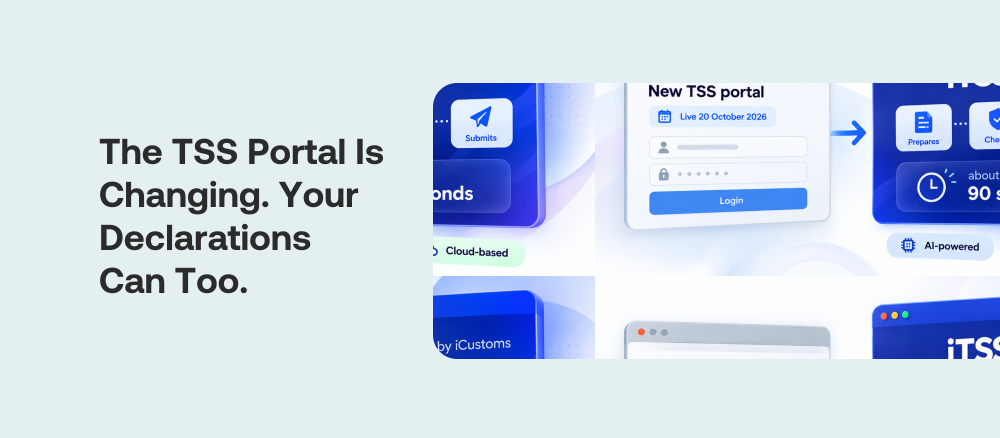
- iTSS automates TSS portal declarations. It is a cloud-based, AI-powered SaaS platform that prepares, checks and submits declarations through TSS in around 90 seconds, while iCustoms runs the platform behind it.
Trader Support Service changes 2026: what you need to know
HMRC’s new Trader Support Service platform, also called the next phase of TSS or TSS 2.0, is operated by Netcompany and hosted on GOV.UK. It has been in private beta since July 2026, with hundreds of declarations already submitted successfully.
The new TSS portal is built on ERMIS, a commercial off-the-shelf customs platform, extended with HMRC’s own front-end screens. In its alpha service assessment, published on 12 October 2026, the Government Digital Service rated the service Green against all 14 points of the Service Standard. The report describes TSS as underpinning most GB to NI freight movements and “critical to maintaining compliant trade flows”. HMRC’s stated aims for the new platform include simpler user journeys, clearer guidance, WCAG 2.2 AA accessibility and more accurate submissions.
Three things stay the same. TSS remains a free, government-funded service for moving goods between Great Britain and Northern Ireland under the Windsor Framework. Customs processes and your legal and regulatory obligations don’t change. And whether you search for it as TSS GB, TSS NI or simply the TSS portal, it is still the same service for GB to NI movements.
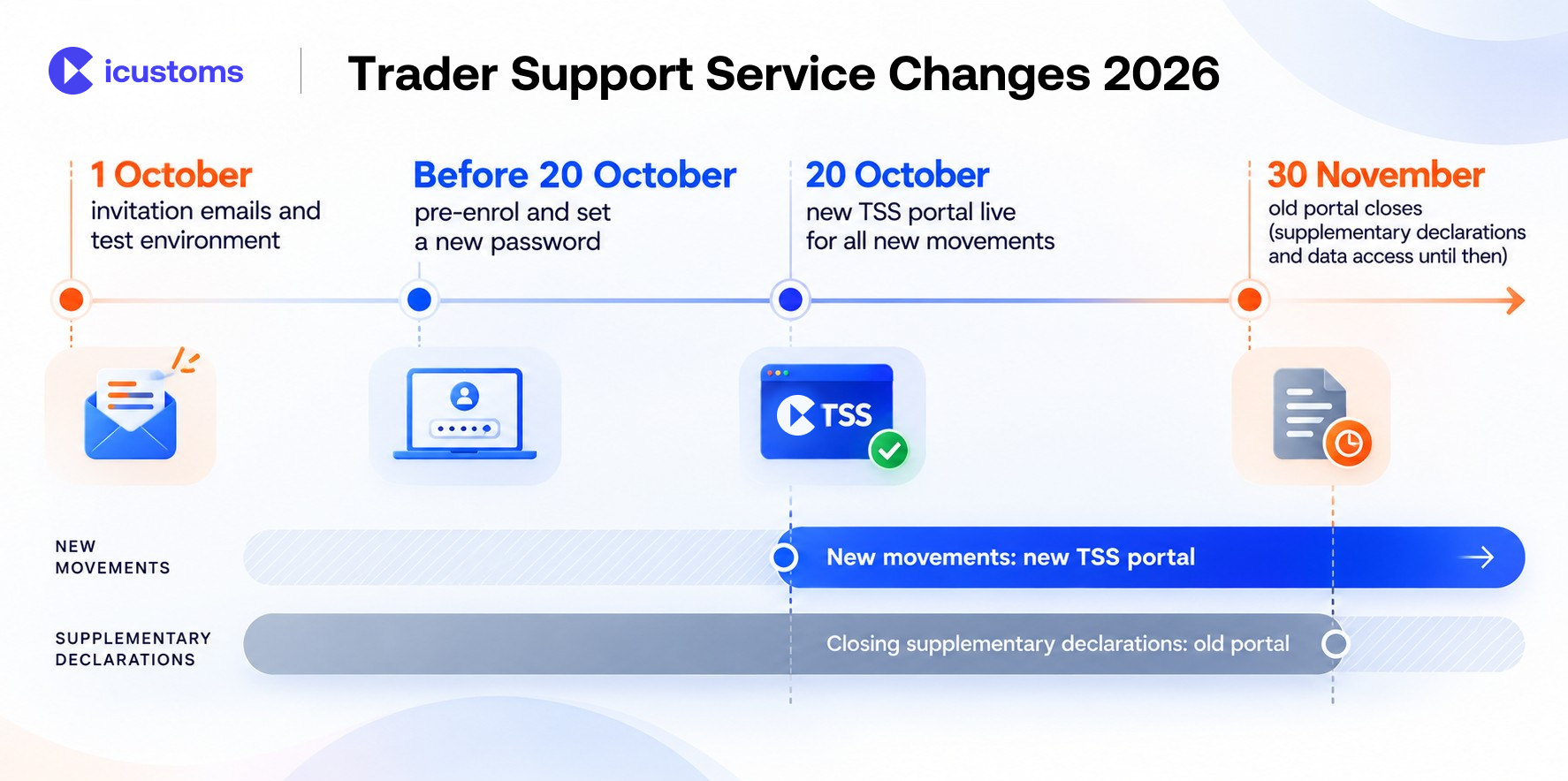
What changes is where and how your team works. HMRC has contacted more than 66,000 registered businesses about the move, and these are the dates that matter:
| Date | What happens | What it means for your team |
|---|---|---|
| From 1 October 2026 | Existing TSS users receive emails with pre-enrolment instructions and access to a test environment | Make sure the invitation reaches the right person, not an old or shared inbox |
| Before 20 October 2026 | Pre-enrol, create a new password and confirm your details and permissions. HMRC says updating a profile takes 5 to 30 minutes, depending on the size of the business | Everyone who files, approves or tracks declarations needs working access from day one |
| 20 October 2026 | The new TSS portal goes live for all users, and all new goods movements must be submitted on it | The current portal shows an error for any arrival date and time on or after 20 October |
| 20 October to 30 November 2026 | The current portal stays open for closing supplementary declarations and accessing data only | You run two portals side by side: new movements on the new platform, open supplementary declarations and other post-movement actions on the old one |
Sources: HMRC, 22 September 2026, GOV.UK Trader Support Service guidance and the TSS transition notice to existing users.
TSS portal login: what changes on 20 October
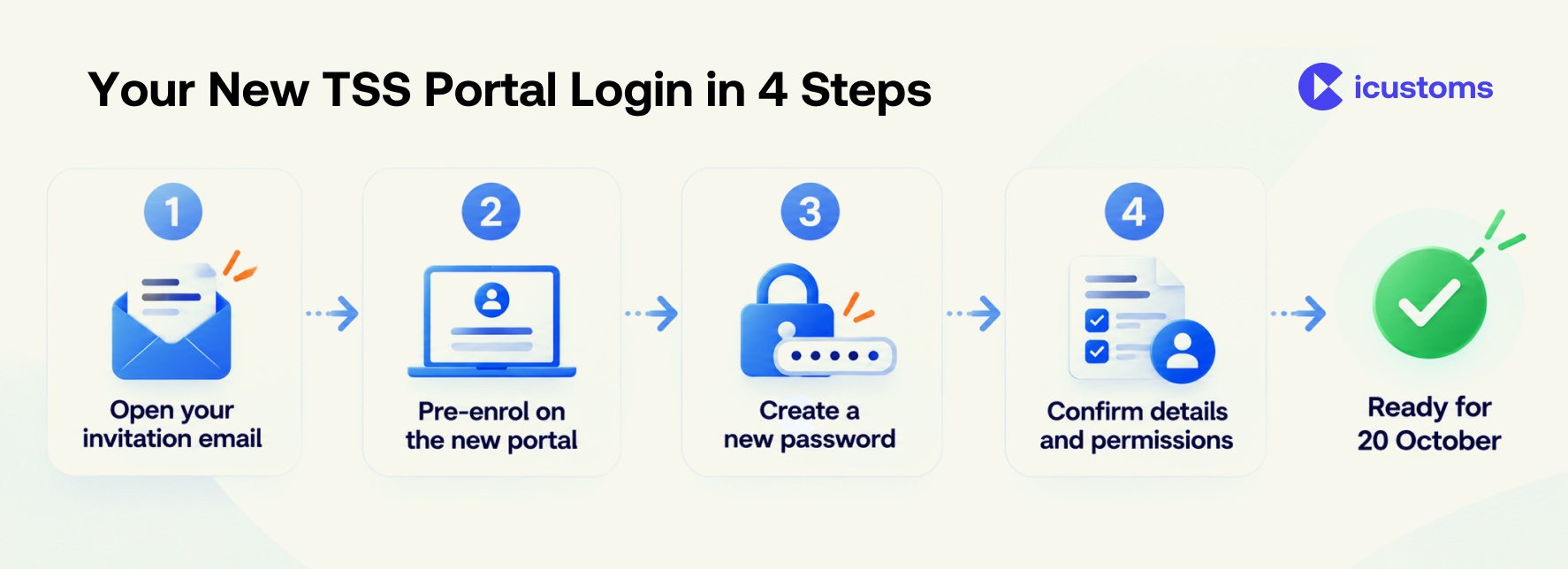
The biggest day-one change for most teams is the TSS login portal itself. If you’re already registered, GOV.UK confirms you’ll be migrated, with no need to register again. You do need to act before 20 October:
- Pre-enrol using the invitation email sent to existing users from 1 October.
- Create a new password for the new platform. Your old login won’t carry over.
- Confirm your details and permissions, including users who have left and anyone who files on your behalf.
- Try the test environment so the new screens aren’t a surprise on go-live day.
- Keep your old login handy until 30 November, for closing supplementary declarations and downloading the records you need.
Looking further ahead, the GDS assessors recommended that HMRC prioritise integration with GOV.UK One Login, so the way you sign in to TSS may evolve again. Keep an eye on GOV.UK guidance for updates.
If your declarations run through iTSS, the day-to-day work of your team stays in one familiar place while the government portal changes behind it. Ask the iCustoms team how your iTSS account connects to the new platform from 20 October.
Join the TSS 2.0 webinar on 15 October 2026
Join iCustoms CEO Adnan Zaheer and Product Director Omar Allybokus to see how AI can make TSS declarations quicker and easier, cut retyping and improve visibility and reporting as the new TSS portal goes live.
Post-webinar version (swap in after 15 October): Missed the live session? Watch the recording (add the recording link) or book a personal iTSS demo.
A new TSS portal still means manual declarations
A new platform changes where you file. It doesn’t change the work behind each declaration. Someone still has to read the commercial invoice, key the parties, find the right commodity code, check weights and values against the documents and fix anything that comes back.
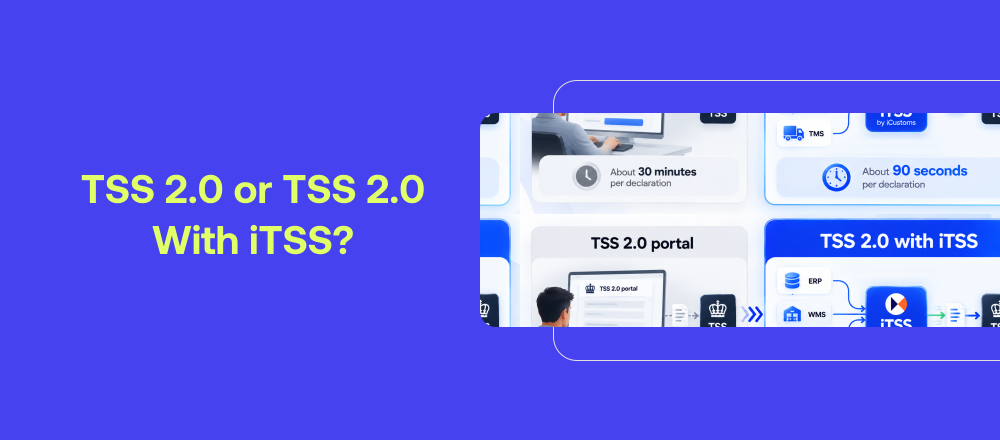
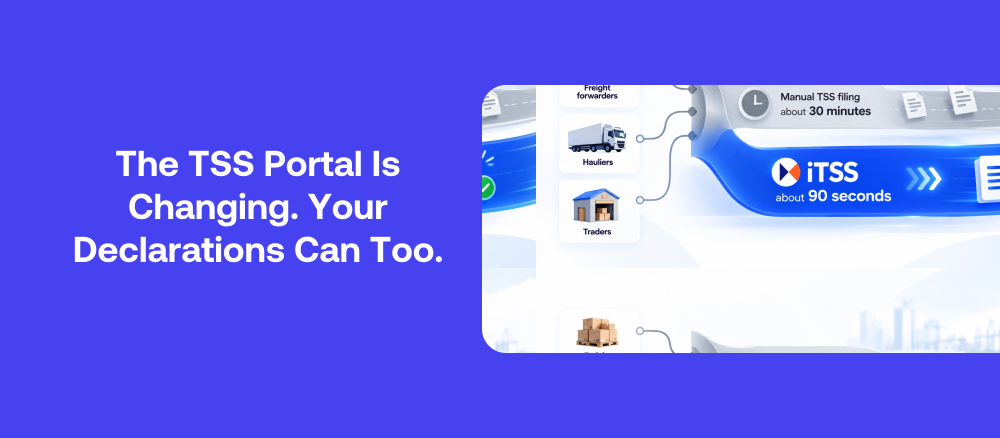
For occasional movements, that’s manageable. As volumes grow, it becomes a people problem. iCustoms benchmarks a manually keyed TSS declaration at around 30 minutes, against around 90 seconds in iTSS. At 200 declarations a month, that is roughly 100 hours of keying versus 5.
HMRC has made more accurate submissions one of the new platform’s aims. iTSS works towards the same goal on your side of the portal, with AI checking every field before it reaches TSS.
That is why the switch is the right moment to automate. New logins, permissions and training are already on the plan, so adding automation now means one change programme instead of two.
How to automate TSS portal declarations
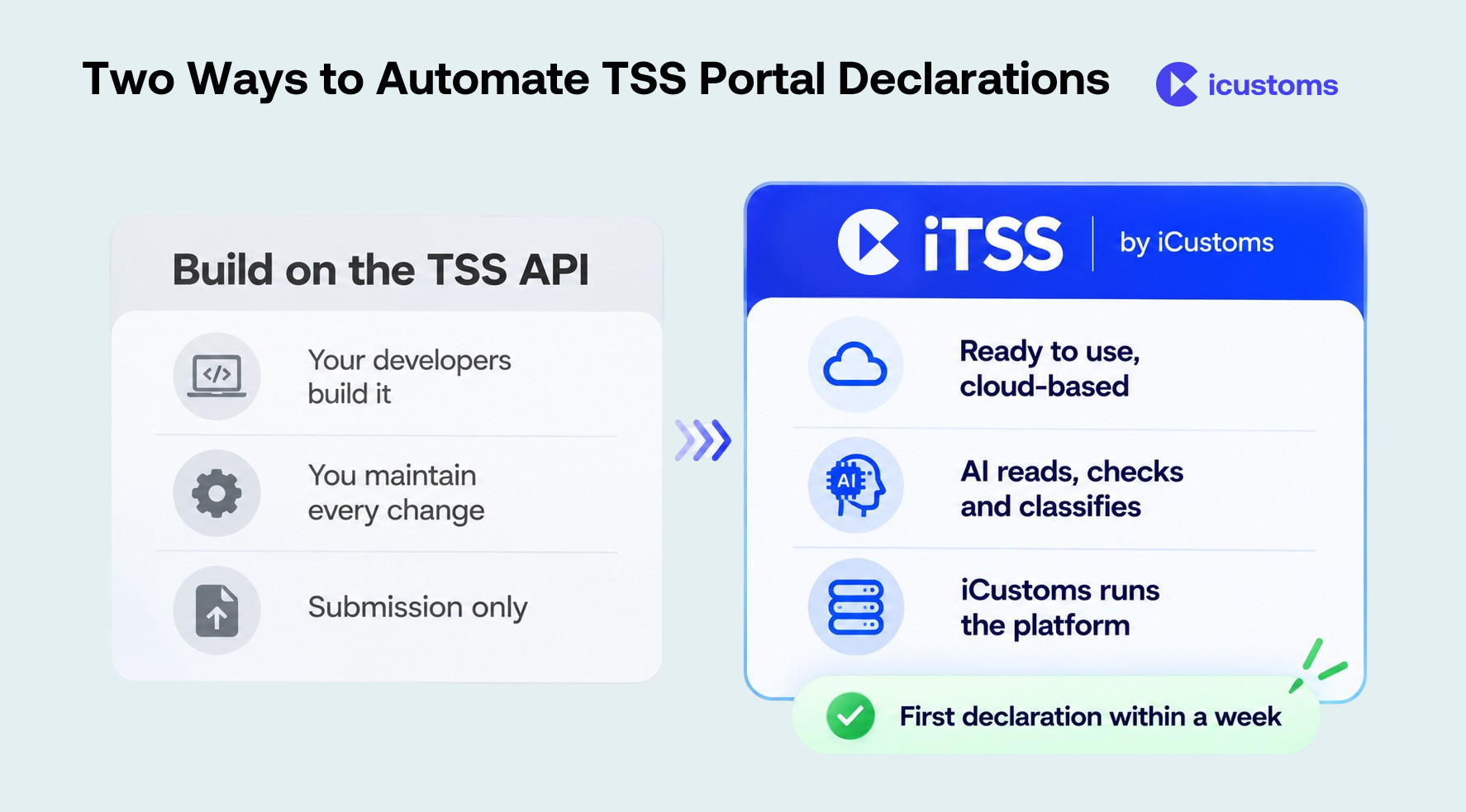
There are two ways to stop keying declarations into the TSS portal by hand.
Build on the TSS API. TSS offers an API that lets your own systems create and submit declarations. It suits businesses with in-house developers and clean system data, but you own the build, the testing and every future change, and the API only handles submission. Reading documents, classifying goods and checking data still need a home. Our TSS API guide explains what it can and can’t do.
Use iTSS, the AI-powered TSS portal app. iTSS is a cloud-based SaaS platform built by iCustoms for GB-NI trade automation. It reads your documents, builds the declaration, suggests commodity codes, checks every field and submits through TSS, with your team approving before anything is sent. There’s nothing to build, host or maintain: iCustoms runs the platform, the AI and the integrations, so your team can focus on getting declarations out quickly.
For the stage-by-stage logic of automation, see how to automate TSS declarations.
Inside iTSS: one declaration from invoice to TSS in around 90 seconds
Here is the complete iTSS workflow for a single shipment, taken from our iTSS workflow video: a commercial invoice from Northline Textiles Ltd to Belfast Apparel Co. for men’s knitted cotton T-shirts worth £12,480.
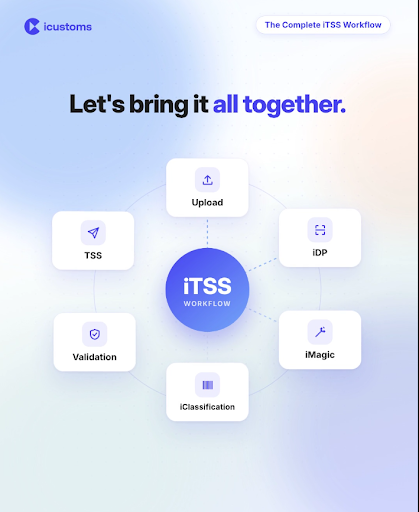
- Shipment data. It starts with your shipment data, here a commercial invoice. It could just as easily be a spreadsheet or data from another system.
- Upload. The invoice PDF is dropped into a new declaration in iTSS.
- iDP extraction. AI pulls out the key details: exporter, consignee, goods and invoice value.
- iMagic. The details are structured into a draft declaration: consignor, consignee, commodity, customs value (£12,480.00), gross mass (860 kg) and origin (GB).
- iClassification. From the goods description, AI suggests HS code 6109.10.00 with a 98% match and shows the nearest alternatives.
- Validation. Built-in checks confirm mandatory fields, the commodity code, value and currency, and weight tolerance. They flag that the origin needs attention against the documents.
- Team review. A team member checks the flagged point, reviews the finished declaration and approves it.
- Submission. The declaration is submitted through TSS in around 90 seconds.
The origin query was caught before submission, when a fix takes moments, and the person in the loop spent their time on one judgement call instead of keying every field. That is zero touch in action: re-keying invoice data, copying codes between systems, cross-checking every field and heading off avoidable rejections are automated behind every TSS declaration. TSS handles the declaration process. iTSS prepares, checks and submits.
What iTSS adds to the TSS portal
| Task | In the TSS portal | With iTSS |
|---|---|---|
| Time per declaration | Manual form-filling, around 30 minutes | Around 90 seconds on average |
| Getting data in | Typed from source documents | iDP, iMagic and CSV uploads fill the declaration from invoices, photos and files |
| Form layout | Several screens | One page with every field, built for keyboard entry |
| HS classification | Left to the trader | AI-assisted classification at up to 99% accuracy |
| Checks before submission | Limited | Every field validated, including Windsor Framework checks |
| Other systems | Data re-keyed elsewhere | 200+ system connections and data mirroring with CDS and Ireland’s AIS and AES |
| Reporting | Limited operational visibility | Real-time dashboards, analytics and a full audit trail |
| Volume | Peaks land on the same people | The same speed at 10 declarations or 10,000 |
GB-NI trade automation for every team on TSS
TSS isn’t only for traders. GOV.UK describes it as a service for anyone moving goods themselves or acting on someone else’s behalf, such as a haulier. iTSS is built for customs agents, traders, carriers and postal operators across every industry.
| If you are a… | Where the time goes today | How iTSS helps |
|---|---|---|
| Trader, importer or retailer | Re-keying commercial invoices and product data, and keeping supplementary declarations up to date | Reads invoices automatically, suggests codes and keeps a full audit trail |
| Haulier or road carrier | Getting safety and security data and movement details right before goods travel, often from incomplete paperwork | Fast capture from documents and checks that show what’s missing before submission |
| Customs broker or agent | Many clients, many document formats and teams working across shifts | The same checks every time, a review step before submission and reporting you can share |
| Freight forwarder, shipping or logistics company | Peaks around sailings and the monthly supplementary cycle, with data spread across systems | Connections to ERP, WMS, carrier APIs and spreadsheets, at the same speed at any volume |
| Postal or parcel operator | High volumes of smaller consignments | CSV and API intake with consistent AI classification |
Is iTSS worth paying for when the TSS portal is free?
TSS is free, and stays free on the new platform. The real comparison is between iTSS and the time your team spends keying, checking and correcting declarations by hand.
- Start with your own numbers. Multiply your monthly declarations by the minutes each one takes, then add the time spent on queries and rejections.
- Compare like for like. iTSS is a paid platform scoped to your declaration volume and priced for businesses of every size. iCustoms reports up to 50% reduction in time and cost, and customers often offset the cost through less admin and fewer duty errors.
- You don’t have to choose one or the other. There’s no need to deregister from TSS. Many businesses keep the TSS portal as a fallback while filing most of their volume through iTSS.
Your TSS portal checklist, before and after 20 October
Before 20 October
- Pre-enrol from your invitation email, create your new password and confirm your details and user permissions.
- Use HMRC’s test environment to get familiar with the new TSS portal.
- List every open supplementary declaration and post-movement action on the current portal, with an owner and a target date well before 30 November.
- Record your baseline: declarations per month, average minutes per declaration and how often submissions come back.
- See iTSS working on your own invoices.
From 20 October to 30 November
- Submit every new movement on the new platform, whether your team keys it or iTSS sends it.
- Close outstanding supplementary declarations and other post-movement actions on the current portal.
- Download the records and reports you need while the current portal is still available for data access.
- Start iTSS on one route or customer, compare it against your baseline, then widen.
Why iTSS is the best alternative to manual filing in the TSS portal
iTSS by iCustoms is built for one job: getting GB-NI declarations through TSS quickly, accurately and with far less manual work. It’s a cloud-based SaaS product powered by the latest AI, so there’s no software to install and nothing to maintain. iCustoms looks after the platform, the AI models, updates and integrations; your team just focuses on getting declarations out.
- Faster filing: around 90 seconds on average, against around 30 minutes keyed by hand
- Higher accuracy: up to 99% with AI-assisted classification and compliance checks
- Less admin: up to 50% reduction in time and cost, with one entry per shipment instead of two
- Connected: 200+ system connections, plus data mirroring with CDS and Ireland’s AIS and AES
- Built to scale: the same speed at 10 declarations or 10,000
- In your control: team review before submission, real-time dashboards and a full audit trail
- Works with TSS: keep the free TSS portal as your fallback, with no need to deregister
- Quick to start: most teams file their first declaration within a week
- Trusted: ISO 27001:2022, ISO 9001:2015 and Cyber Essentials certified, recognised by HMRC and Irish Revenue, and used by businesses such as Morrisons, Lyreco, Kerry Logistics and Nordic Transport Group
The TSS portal is changing on 20 October. The work behind each declaration doesn’t have to stay the same. TSS handles the declaration process. iTSS prepares, checks and submits it, whether you file 10 declarations or 10,000.
Frequently Asked Questions
What is the TSS portal?
The TSS portal is the online service HMRC provides, free of charge, for moving goods between Great Britain and Northern Ireland. It can complete customs and safety and security declarations on your behalf and offers guidance, training and a contact centre. A new version of the portal goes live on 20 October 2026.
How do I log in to the new TSS portal?
Existing users are migrated automatically. Pre-enrol using the invitation email sent from 1 October, create a new password and confirm your details and permissions. The GOV.UK Trader Support Service guidance has the latest instructions.
What are the Trader Support Service changes in 2026?
TSS moves to a new platform operated by Netcompany on 20 October 2026. All new goods movements must be submitted there. The service stays free and your customs obligations don't change.
Can I still use the old TSS portal after 20 October 2026?
Only to finish existing work. You can't create goods movements with an arrival date and time on or after 20 October on the current portal. It stays open until 30 November 2026 for closing supplementary declarations and accessing data only.
What platform is the new TSS portal built on?
The new TSS is built on ERMIS, a commercial off-the-shelf customs platform, with HMRC's own front-end screens on top. It was rated Green against all 14 points of the Service Standard in its GDS alpha assessment, published on 12 October 2026.
Is there a TSS portal app?
HMRC's TSS is a web portal. iTSS by iCustoms is a cloud-based app that works alongside it, using AI to prepare, check and submit TSS declarations in around 90 seconds.
Does TSS have an API?
Yes. The TSS API lets your own systems create and submit declarations, but you build and maintain the connection yourself. iTSS gives you automation without the build.
Do I have to stop using the TSS portal if I use iTSS?
No. TSS stays free and there's no need to deregister. Many businesses keep the TSS portal as a fallback while filing most of their volume through iTSS.
How quickly can my team start with iTSS?
Most teams file their first declaration through iTSS within a week of signing up. Full ERP or WMS integration usually follows in the weeks after.
You may also like:
Ready to Automate Your TSS Declarations?

Automation of GB-to-NI goods movements reduces manual data entry and simplifies declaration preparation.
Subscribe to our Newsletter
About iCustoms
iCustoms is an all-in-one solution helping businesses automate customs processes more efficiently. With AI-powered and machine-learning capabilities, iCustoms is designed to streamline your all customs procedures in a few minutes, cut additional costs and save time.
Getting Ready for the New TSS Portal?
Prepare your team for the TSS 2.0 transition. AI can streamline customs declarations, reduce repetitive work, and improve efficiency.