
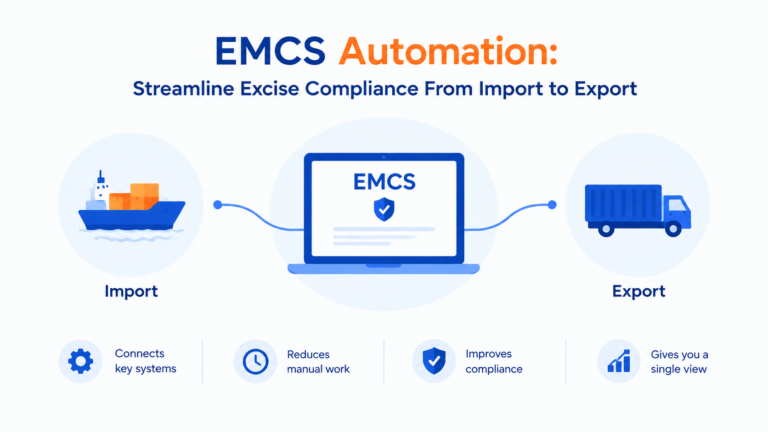
EMCS Automation: Streamline Excise Compliance From Import to Export
- John Hall
- Customs Specialist at iCustoms.ai
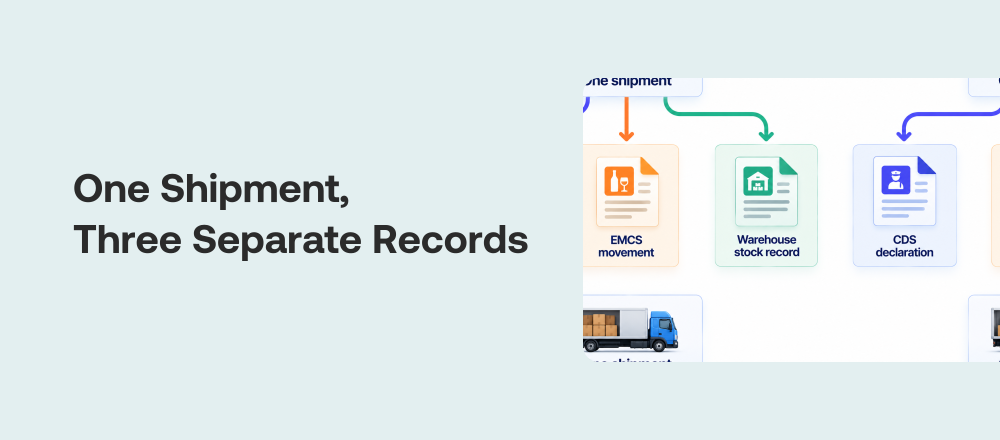
A single duty-suspended shipment travels through five distinct stages between arriving in the UK and leaving it again: a CDS import declaration, an EMCS movement into the warehouse, a warehouse stock record, an outbound EMCS movement, and a CDS export declaration. Without EMCS automation, that journey requires someone to complete largely the same commodity, quantity and party details five times, checking along the way that none of the five copies have quietly drifted from each other.
This guide is the broad view of that journey: what a fragmented version of it actually costs a business, what changes when the five stages are connected instead, and what that connection looks like in practice. The mechanics of each individual stage and the specific ways to connect them are covered in their own guides throughout this series; this one is about the shape of the whole thing and the business case for closing the gaps between the pieces.
What a Fragmented Excise Workflow Actually Costs
None of the five stages above are optional, and none of them are hard to justify individually. What is easy to underestimate is what happens at the seams between them when nothing connects the systems doing each one. A CDS declaration’s commodity and party detail gets retyped to open the eAD. The eAD’s report of receipt gets retyped again to build the warehouse’s own stock record. A warehouse removal gets rebuilt from scratch as a fresh outbound eAD rather than carrying forward data the warehouse already has.
Each of those re-entry points costs staff time that scales with volume, and each is a place a transposed figure or a missed field can sit quietly until a W1 return, a reconciliation, or an HMRC audit finds it. The volume problem is the part that is easiest to miss until it is already a problem.
A manual, re-entry-heavy process does not get proportionally easier as a business grows; it gets proportionally more expensive, because more shipments mean more retyping, more chances for mismatches, and more staff hours spent reconciling records that were never built from the same source in the first place.
The Connected Alternative: How EMCS Automation Links Import to Export
Run as a connected process, the same five stages become one continuous thread of data rather than five independent records. At import, the CDS declaration’s detail carries directly into the eAD, our guide to the EMCS import process covers this handoff in full. Once dispatched, that movement is tracked in real time until it reaches the warehouse, where the report of receipt updates the warehouse’s own stock record automatically rather than through a second manual entry.
When goods are later removed for a transfer or a re-export, that same stock record’s existing detail carries forward into a fresh outbound eAD instead of being rebuilt from nothing. And on export, the ARC that eAD carries is what gets referenced on the CDS export declaration, closing the movement once the departure message confirms the goods have actually left, our guide to the EMCS export process covers that closing sequence in detail.
The difference is not that any individual step becomes dramatically faster. It is that the data underneath all five steps is the same data, entered once and carried forward, rather than five separately typed descriptions of the same shipment that each have to be independently correct and independently kept in sync.
What EMCS Automation Changes in Practice
In practice, EMCS automation changes a specific, recurring set of tasks rather than the compliance obligations themselves:
- Less retyping. Commodity, quantity and party detail entered once carries forward instead of being rebuilt at each stage; our guide to EMCS data mirroring covers what that sharing actually looks like.
- Fewer mismatches found late. Validating data against connected CDS and warehouse records before submission catches errors before they reach a W1 return or an audit, rather than after.
- Status visible without five logins. A centralised view of every ARC, journey and report of receipt answers a status question from one place instead of cross-referencing EMCS, the warehouse system and a spreadsheet.
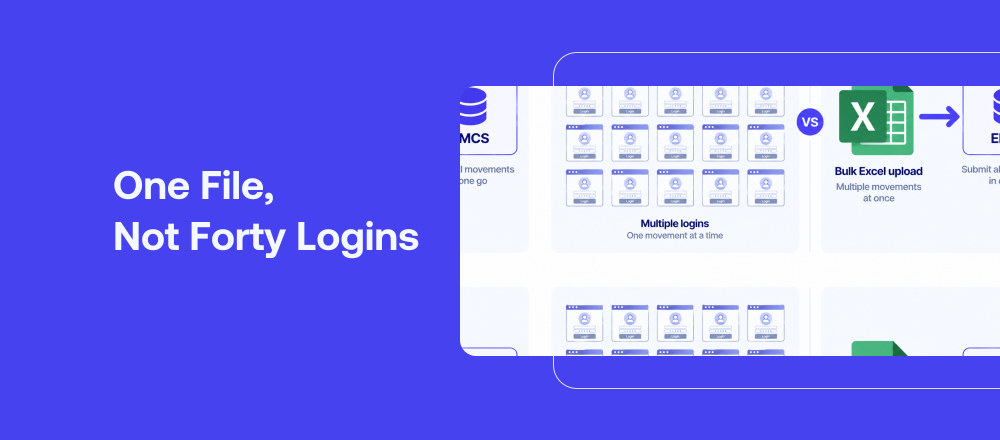
- A workflow that fits the team, not the other way round. API integration, bulk file upload and direct entry are all legitimate ways in, so the method matches the volume and resourcing of the team using it rather than forcing everyone through the same process.
- A record that holds up later. A durable audit trail spanning the full journey, not just the point of initial filing, is what actually helps at reconciliation or audit time.
- Room to grow without growing headcount at the same rate. A connected process that removes repetitive re-entry work absorbs more volume without needing proportionally more people to handle it.
Where iEMCS Fits
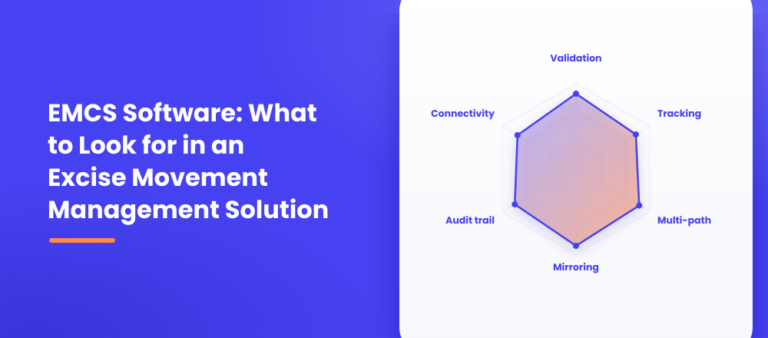
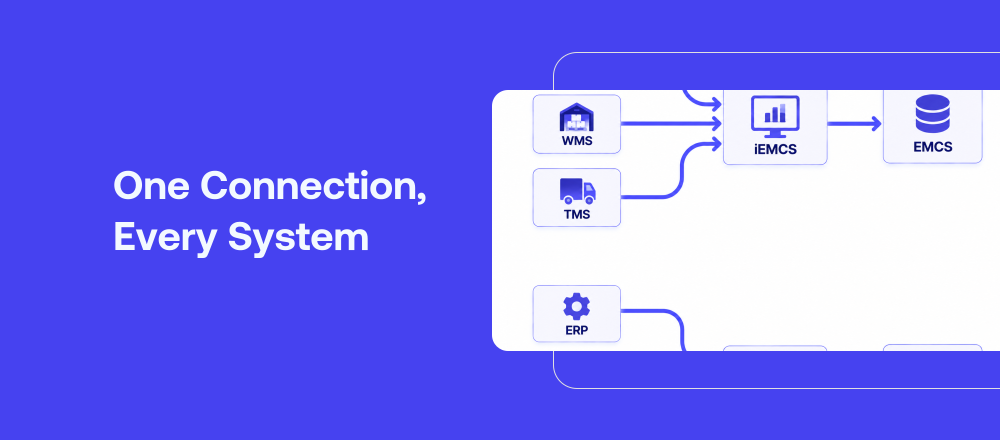
iEMCS is built to be that connective layer across the full journey rather than a tool scoped to any single stage of it. It auto-populates up to 80 percent of an e-AD directly from a CDS import declaration, validates data against CDS and warehouse records before submission, and tracks every ARC, journey and report of receipt centrally. It supports API integration, bulk Excel upload and direct entry as three genuine ways to submit movements, and mirrors data both ways across CDS, EMCS and the warehouse rather than treating each as its own silo.
A full evaluation of those capabilities against a broader checklist is covered in our guide to EMCS software; the summary relevant here is that iEMCS’s own positioning describes handling ten times the volume without ten times the headcount, which is precisely the outcome a connected, automated workflow is meant to produce. On the warehouse side specifically, iWarehouse holds and updates the physical stock record itself, while iEMCS remains the layer generating, validating, tracking and mirroring the movement data between it and CDS.
EMCS Automation in a Real-World Scenario
A mid-size spirits importer runs roughly sixty duty-suspended shipments a month: goods arriving under CDS Procedure 07, moving into a bonded warehouse, and a meaningful share later leaving again as transfers or re-exports. Run manually, that volume means a compliance team retyping shipment detail at every stage, cross-checking EMCS, a warehouse system and a spreadsheet to answer status questions, and spending a disproportionate amount of time each month reconciling records before a W1 return.
None of the sixty shipments individually takes long to process; the cost is cumulative, and it grows every time volume does. Connected end to end, the same sixty shipments carry one shared thread of data from the CDS declaration through to the closed export movement, with validation catching mismatches before submission rather than at audit, and status visible from one dashboard rather than three separate systems.
Common Misconceptions about Customs Automation Work
Automation means removing people from the process. It removes repetitive re-entry and manual reconciliation, not judgment. Someone still decides how a shipment moves; automation changes how much retyping and cross-checking that decision requires.
You have to automate everything at once to see any benefit. Not necessarily. API integration, bulk Excel upload and direct entry can be adopted per workflow, so a business can connect its highest-volume flows first rather than needing a single, all-or-nothing rollout.
Automation is only worth it at very high shipment volumes. The underlying risk, a mismatch sitting unnoticed until an audit finds it, exists at any volume. Higher volume makes the cost of not connecting the process more visible, but it does not create the risk in the first place.
Five Things to Take Away
- A single duty-suspended shipment passes through five distinct stages, import declaration, inbound movement, warehouse receipt, outbound movement and export declaration, each a re-entry point if nothing connects them.
- A fragmented, manual process does not scale evenly; more volume means more retyping and more chances for a mismatch to sit unnoticed until an audit or a W1 return finds it.
- A connected process carries the same shipment data forward through all five stages instead of rebuilding it independently at each one.
- Automation changes retyping, late-caught mismatches, fragmented status checking and reconciliation effort; it does not remove the judgment behind how goods actually move.
- iEMCS’s confirmed capabilities, auto-population, validation, centralised tracking, multiple submission methods and bidirectional mirroring, are built to connect that full import-to-export journey rather than any single stage of it.
Frequently Asked Questions
What does a fragmented, manual excise workflow actually cost a business?
Staff time spent retyping the same shipment detail at each stage, and risk from mismatches that sit unnoticed until a W1 return, a reconciliation or an audit surfaces them. That cost scales with shipment volume rather than staying fixed.
What changes when import-to-export excise compliance is connected end to end?
The same shipment detail, entered once, carries forward through the CDS declaration, the inbound eAD, the warehouse stock record, the outbound eAD and the export declaration, rather than being independently retyped at each stage.
What does EMCS automation change in practice, day to day?
Less retyping, fewer mismatches found late, status visible from one place instead of several systems, a submission method that fits the team using it, and a durable audit trail spanning the full journey rather than just the initial filing.
Does automating excise compliance mean removing people from the process?
No. It removes repetitive manual re-entry and reconciliation work; the decisions about how goods move still sit with the people running the business.
Is automation only worth it at high volumes?
No. The risk of an unnoticed mismatch exists at any volume; higher volume simply makes the cumulative cost of a manual, disconnected process more visible sooner.
You may also like:
Looking to Simplify EMCS Automation?

See how a connected import-to-export workflow can reduce repetitive data entry & keep shipment information aligned across EMCS, CDS & warehouse processes.
Subscribe to our Newsletter
About iCustoms
iCustoms is an all-in-one solution helping businesses automate customs processes more efficiently. With AI-powered and machine-learning capabilities, iCustoms is designed to streamline your all customs procedures in a few minutes, cut additional costs and save time.
See What Automation Actually Removes From Your Team's Day
See how shipment data can flow from import through warehouse movements and export without repeated manual entry.