
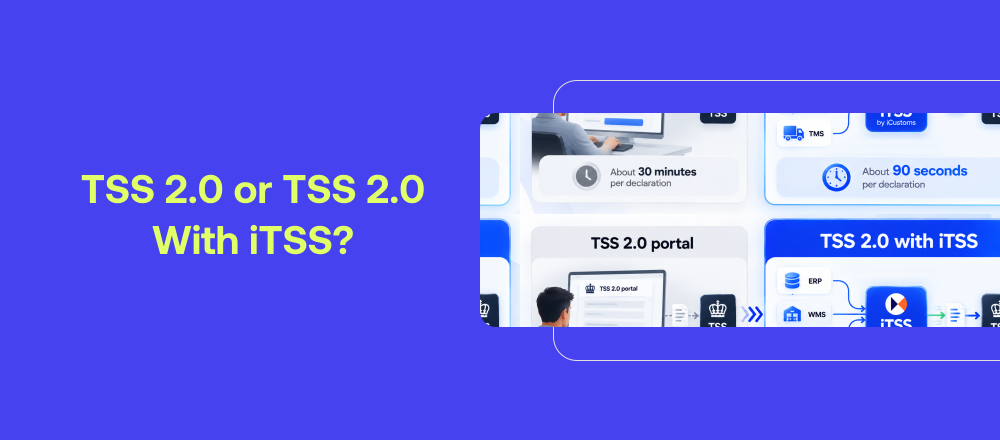
TSS 2.0 vs Customs Software: Which Filing Approach Fits Your Business and Your ERP?
- John Hall
- Customs Specialist at iCustoms.ai
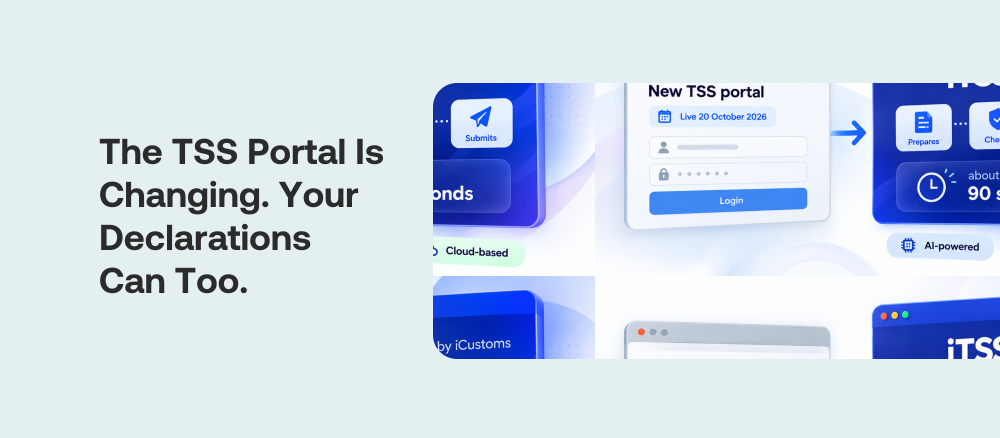
The new Trader Support Service goes live on 20 October 2026, and every business moving goods from Great Britain to Northern Ireland is asking the same question: is the new TSS portal enough on its own, or is it time to add customs software?
The honest answer depends on two things: how many declarations you file, and where your shipment data already lives. If it sits in an ERP, WMS or TMS, the way you file can either reuse that data or make your team type it all again.
This guide compares the two approaches side by side, shows what connecting declarations to your business systems really involves, and helps you decide which fits your operation. Throughout, we use iTSS by iCustoms as the customs software example.
Your data is already in your systems. Stop typing it twice. See iTSS connect to your data.
Key points
- It isn’t either/or. TSS remains the free government service. Customs software like iTSS works with TSS, preparing, checking and submitting declarations for you.
- TSS 2.0 improves the portal. HMRC’s aims include simpler journeys, clearer guidance and more accurate submissions. Your team still keys the data.
- Your ERP is the deciding factor. If shipment data already sits in an ERP, WMS or TMS, customs software can reuse it instead of re-keying it.
- Compare total operating cost, not licence price. TSS is free to use, but manual filing is paid for in people’s time, rework and overtime.
- iTSS connects with 200+ systems, files in around 90 seconds on average and keeps the same speed at 10 declarations or 10,000.
What each approach actually means
TSS 2.0 on its own. You file through HMRC’s new TSS portal, built on the ERMIS platform and operated by Netcompany. It’s free, it supports GB to NI movements under the Windsor Framework, and in its GDS alpha assessment the service was rated Green against all 14 points of the Service Standard. Your team reads each document and keys each declaration into the portal.
TSS 2.0 with customs software. TSS still handles the declaration process. Customs software sits on your side of it, taking data from documents and business systems, building and checking the declaration, then submitting it through TSS. With iTSS, your team reviews and approves rather than keys.
The new portal is a real step forward for the service itself. What it doesn’t change is where your data starts: in invoices, spreadsheets and business systems that the portal can’t read for you.
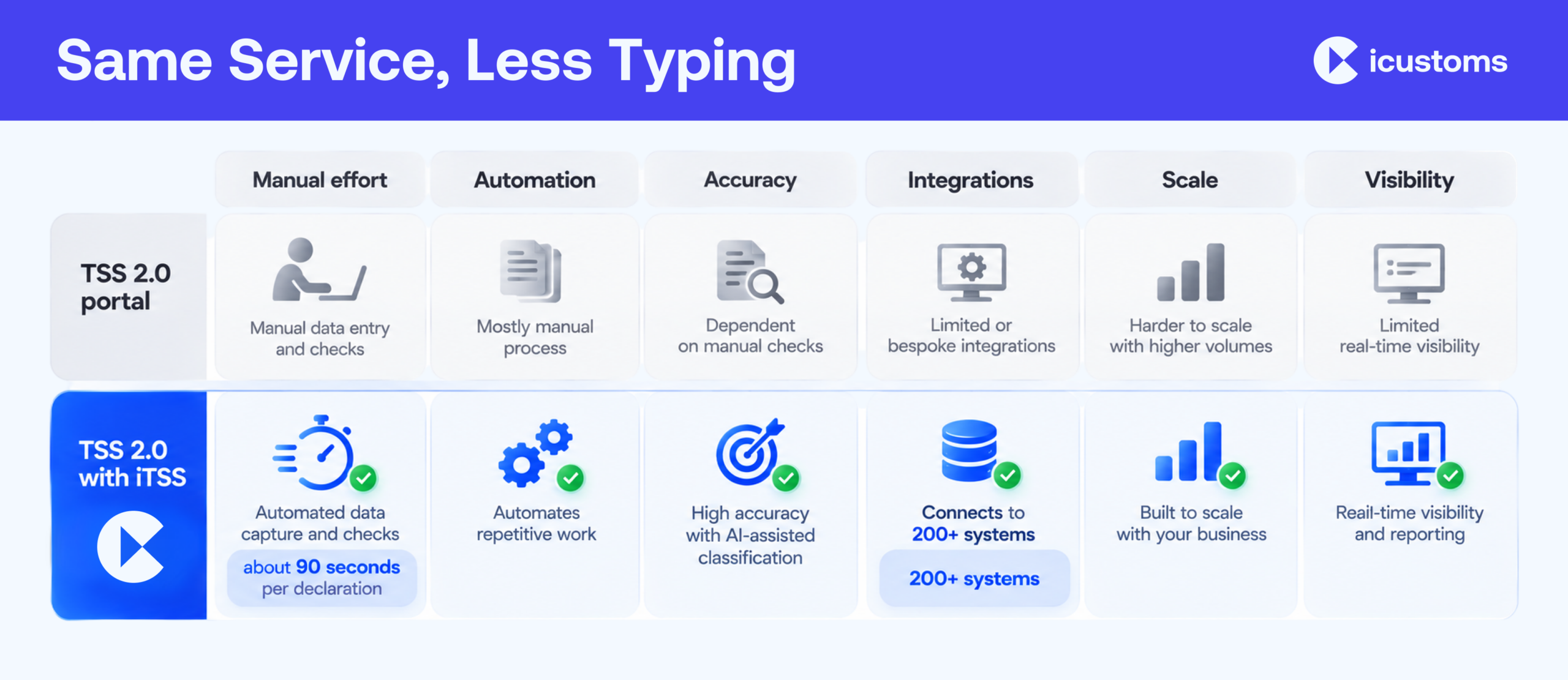
TSS 2.0 vs customs software: side by side
| What matters | TSS 2.0 portal on its own | TSS 2.0 with iTSS |
|---|---|---|
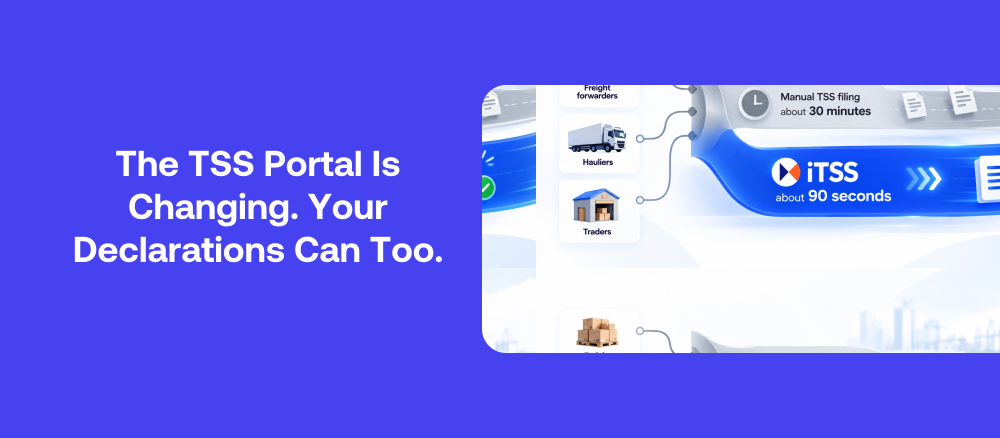
| Manual effort | Every declaration keyed by a person, around 30 minutes each | Around 90 seconds on average, with your team reviewing and approving |
| Automation | Guided journeys inside the portal | AI reads documents, structures the declaration and suggests HS codes |
| Accuracy | Checks within the portal | Every field checked before submission, including Windsor Framework checks, with up to 99% AI-assisted classification accuracy |
| Integrations | Data comes from what your team types | 200+ system connections, plus data mirroring with CDS and Ireland’s AIS and AES |
| Scale | Capacity grows with headcount | The same speed at 10 declarations or 10,000 |
| Visibility | Status checked inside the portal | Real-time dashboards, analytics and a full audit trail |
| Cost | Free to use; paid for in staff time | Paid, scoped to declaration volume; iCustoms reports up to 50% reduction in time and cost |
| TSS access | Your main filing route | Kept as your fallback, with no need to deregister |
iTSS figures are from the iTSS product page. Portal timing is iCustoms’ benchmark for a manually keyed declaration.
TSS ERP integration: what connecting your systems really means
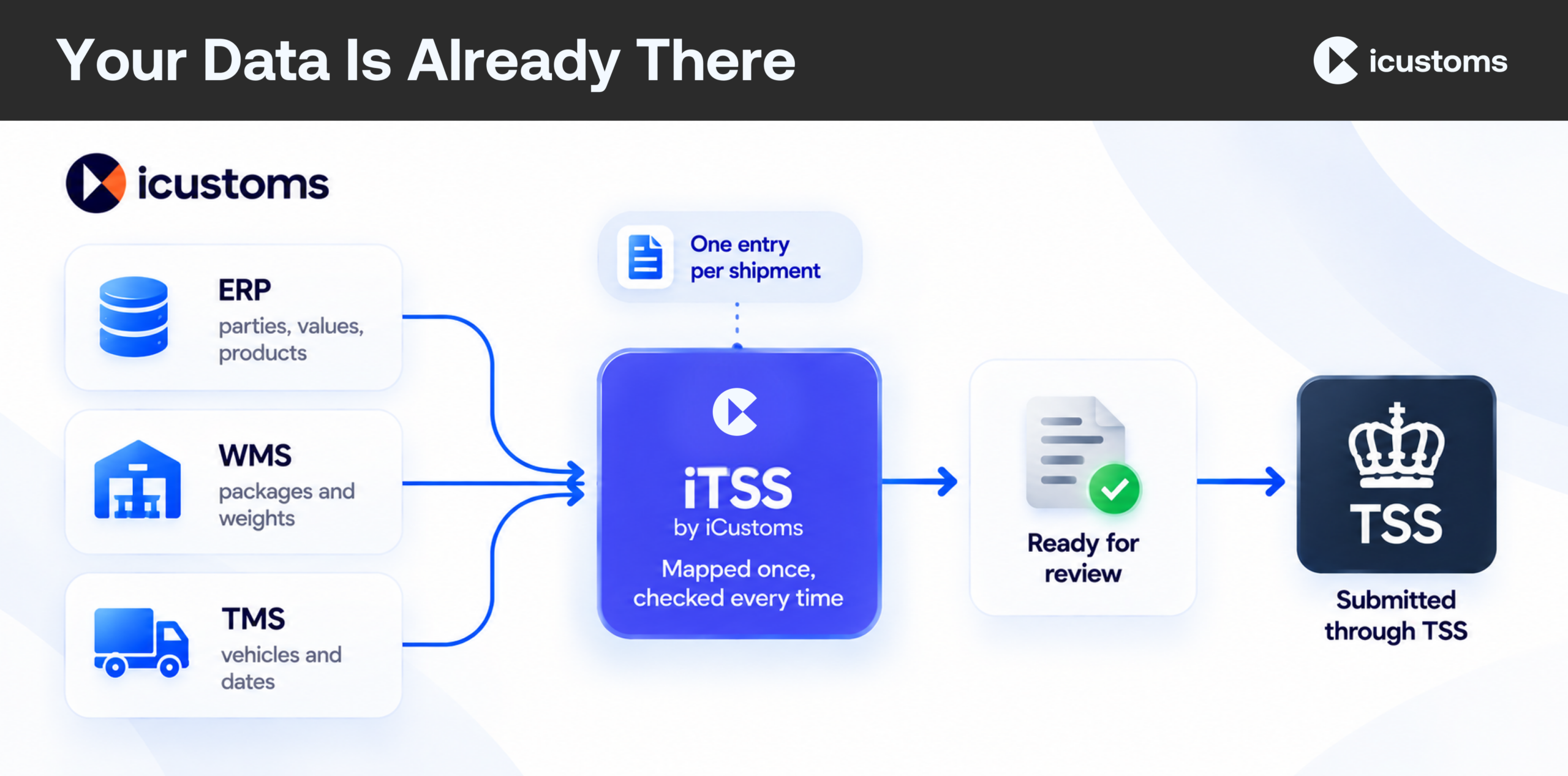
Most of what a declaration needs is already in your business systems. Connecting them to your declaration workflow means that data travels once, instead of being retyped for every shipment.
| Where the data lives | What it already holds | What it feeds in the declaration |
|---|---|---|
| ERP | Customers, suppliers, invoice values, currencies and product master data | Consignor, consignee, customs value and goods descriptions |
| WMS | Packages, quantities and gross weights | Package details and gross mass |
| TMS or carrier systems | Vehicles, routes and movement dates | Movement and transport details</td |
What to expect from a good integration
- Mapping done once. Your system’s fields are matched to declaration fields up front, so every shipment flows the same way.
- Checks before submission. Data from your ERP is validated like any other: commodity codes, values, weights and origin are checked before anything reaches TSS.
- People still in control. Flagged items go to a reviewer, and nothing is submitted without approval.
- A start that doesn’t wait for IT. Uploads of PDFs, photos and CSV files should work from day one, with deeper system connections added after.
How iTSS handles it
iTSS connects with 200+ systems, including ERP, WMS, accounting, e-commerce, CRM, port systems, carrier APIs and spreadsheets, and offers API access for your own platforms. Data mirroring keeps declaration data in sync with CDS and Ireland’s AIS and AES, so you make one entry per shipment instead of two. Most teams file their first declaration within a week of signing up, with full ERP or WMS integration usually following in the weeks after.
Prefer to build the connection yourself? Our TSS API guide explains what that involves, and how to automate TSS declarations walks through the full workflow.
Connect once. File faster every time after.
The real cost of each approach
TSS is free to use, so the comparison isn’t licence against licence. It’s total operating cost.
With the TSS 2.0 portal on its own, your costs are people’s time spent keying and checking, rework when something comes back, overtime around busy sailings and month-end, and new hires as volumes grow.
With iTSS, you pay a subscription scoped to your declaration volume. In return, the keying, cross-checking and code look-ups are automated, so the same team handles more declarations. iCustoms reports up to 50% reduction in time and cost.
To compare fairly, multiply your monthly declarations by the minutes each one takes today, add the time spent on corrections, and set that against an iTSS quote for the same volume.
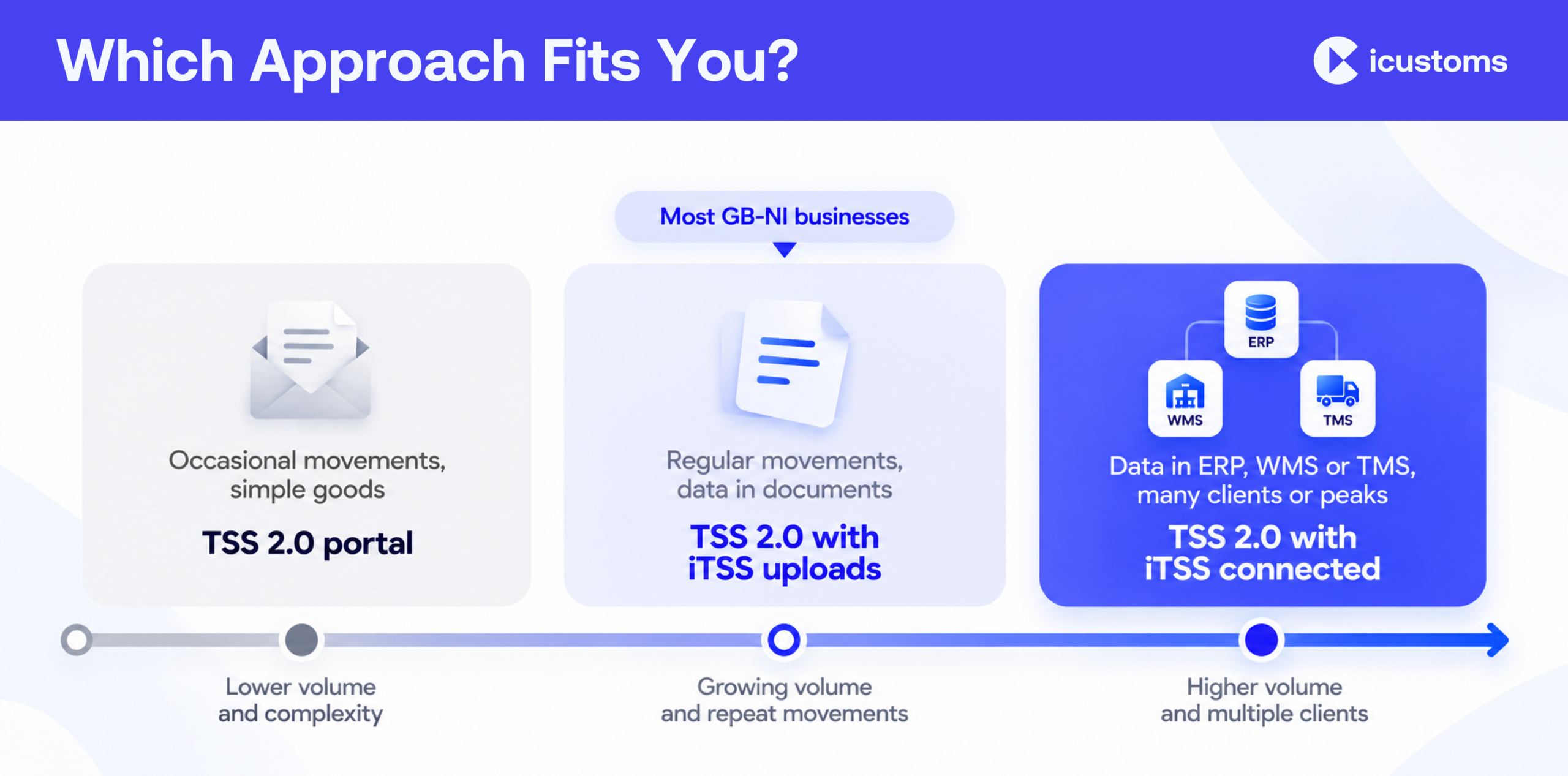
Which filing approach is right for your business?
| Your situation | Best fit |
|---|---|
| A handful of GB to NI movements a month, with simple goods | The TSS 2.0 portal on its own |
| Regular movements, with data in invoices and spreadsheets | TSS 2.0 with iTSS, starting with document and CSV uploads |
| Shipment data in an ERP, WMS or TMS | TSS 2.0 with iTSS, connected to your systems |
| Many clients, formats or peaks, as a forwarder, broker or carrier | TSS 2.0 with iTSS, for the same checks and speed at any volume |
| An in-house development team that wants to own every line of code | A custom build on the TSS API, accepting the build and upkeep |
If you’re moving goods regularly, the switch to TSS 2.0 is the natural time to decide. Your team is learning a new portal anyway. For a step-by-step plan, see our guide to TSS declaration software for freight forwarders, hauliers and traders.
Why businesses add iTSS to TSS 2.0
iTSS by iCustoms is a cloud-based SaaS product powered by the latest AI. There’s nothing to install or maintain: iCustoms runs the platform, the AI, updates and integrations, and your team focuses on getting declarations out.
- Around 90 seconds per declaration on average
- Up to 99% accuracy with AI-assisted classification and compliance checks
- 200+ system connections, with data mirroring to CDS and Ireland’s AIS and AES
- The same speed at 10 declarations or 10,000
- Team review, real-time dashboards and a full audit trail
- Works with TSS, with no need to deregister
- ISO 27001:2022, ISO 9001:2015 and Cyber Essentials certified, and recognised by HMRC and Irish Revenue
TSS handles the declaration process. iTSS prepares, checks and submits it.
Frequently Asked Questions
What is the difference between TSS 2.0 and customs software?
TSS 2.0 is HMRC's free government service for GB to NI declarations, used through its portal. Customs software like iTSS works alongside it, preparing, checking and submitting declarations for you using your documents and business data.
Is TSS 2.0 enough on its own?
For occasional movements with simple goods, often yes. For regular volumes, or when your shipment data already sits in business systems, customs software saves the time spent re-keying.
Can iTSS use data from our ERP, WMS or TMS?
Yes. iTSS connects with 200+ systems, including ERP, WMS, carrier APIs and spreadsheets, and offers API access for your own platforms.
How long does an iTSS ERP integration take?
Most teams file their first declaration within a week using document and CSV uploads. Full ERP or WMS integration usually follows in the weeks after.
Do I still need TSS if I use iTSS?
TSS remains the government service, and there's no need to deregister. Many businesses keep the TSS portal as a fallback while filing most of their volume through iTSS.
Does customs software change my customs obligations?
No. Your obligations stay the same. iTSS helps you meet them faster and more accurately, with your team approving every declaration.
You may also like:
Your ERP Already Has the Data

Connect your ERP, WMS or TMS to iTSS and file GB-to-NI declarations without re-keying a single field.
Subscribe to our Newsletter
About iCustoms
iCustoms is an all-in-one solution helping businesses automate customs processes more efficiently. With AI-powered and machine-learning capabilities, iCustoms is designed to streamline your all customs procedures in a few minutes, cut additional costs and save time.
TSS 2.0 Is Here. Is the Portal Enough?
Keep TSS as your fallback and let iTSS prepare, check and submit declarations in around 90 seconds.