
What Is the Trader Support Service (TSS)? A Complete Guide for GB to NI Trade
- John Hall
- Customs Specialist at iCustoms.ai
The Trader Support Service (TSS) is a free UK government service that helps businesses move goods between Great Britain and Northern Ireland. It can complete customs and safety and security declarations on your behalf, so you do not have to work directly in HMRC systems. TSS also provides training and support for the rules that apply under the Windsor Framework.
If you have just been told you need TSS and have no idea where to start, this guide walks through it from the beginning. No prior customs knowledge is assumed.
What is the Trader Support Service?
TSS is a service funded by the UK government and delivered on behalf of HMRC. It exists for one purpose: to make Northern Ireland trade manageable for businesses that are not customs specialists.
The simplest way to picture it is as a front door. Behind that door sit several government systems that handle customs, safety and security, vehicle movements and transit. Most businesses do not want to learn all of them. TSS gives you one place to enter your information, then passes that information into the right system for you.
Three things are worth fixing in your mind straight away:
- It is free. There is no subscription and no per-declaration fee.
- It is a government service, not a commercial product you buy.
- It handles more than paperwork. The word support is there because the service also provides guidance and training.
What TSS is not
TSS is not a customs authority. It does not decide your duty or approve your goods. It is the layer that helps you submit the right information to the systems that do.
It is also not the same thing as the Customs Declaration Service (CDS). People mix the two up constantly. If you want the full picture on how TSS and CDS relate, we have set that out separately. The short version is that TSS helps you prepare and submit information, and CDS is one of the government systems that receives it.
Why TSS was created
Northern Ireland has a unique position. It is part of the United Kingdom, but under the Windsor Framework it also follows certain EU customs rules for goods. That means a lorry travelling from Manchester to Belfast, entirely within the UK, can still trigger customs and safety and security requirements.
For a business that had never filed a customs declaration before, this was a significant change. Small firms suddenly needed commodity codes, customs values, origin data and safety and security information for routine domestic sales.
TSS was set up to absorb most of that complexity. Rather than expecting every trader to learn HMRC systems, the government built a service that asks plain questions and handles the technical submission behind the scenes.
Who can use TSS?
Registration is open to businesses and representatives involved in Northern Ireland movements. In practice, users tend to fall into these groups:
- Importers bringing goods into Northern Ireland
- Exporters and sellers sending goods from Great Britain
- Freight forwarders acting for multiple clients
- Customs intermediaries and agents
- Carriers and hauliers moving other people’s goods
- Businesses moving their own stock between sites
You will need an EORI number to trade. If you do not have one, that is the first step, not TSS.
How to sign up for the Trader Support Service
Trader Support Service signup is free and takes place on the TSS website, which GOV.UK links to directly. There is nothing to buy and no contract to sign.
Have these ready before you start:
- An EORI number for the business. HMRC issues this, not TSS, so sort it first if you do not have one.
- Company details, including registered address and company number.
- Contact details for whoever will manage declarations day to day.
- A rough picture of what you move, how often and on which routes.
Once you are registered you get access to the TSS portal. That is where declarations are completed, movements are tracked and the guidance material sits.
Trader Support Service login
After sign-up you log in to the portal using the credentials created during registration. If more than one person in your business handles declarations, set each of them up as a separate user rather than sharing one login. It keeps the audit trail clean and makes it obvious who submitted what when a query comes back.
What is a TSS reference, and how do I find my TSS number?
This question comes up constantly, and part of the confusion is that people mean different things by a TSS number. In practice three identifiers matter:
- Your EORI number. This identifies your business to customs and is issued by HMRC.
- Your UKIMS authorisation number, if you hold one. It arrives in your UKIMS approval letter.
- The TSS reference attached to a declaration or movement record. You will find it in the portal next to that record, and it is the reference to quote when you contact support about one specific submission.
If you cannot find a reference, start with the record itself in the portal. TSS support can confirm what applies to your account if it is still unclear.
Which movements does TSS cover?
Most people meet TSS through Great Britain to Northern Ireland movements, and that is the best route to learn first. The service is not limited to it, though. TSS supports:
- Great Britain to Northern Ireland
- Northern Ireland to Great Britain
- Rest of world, excluding the EU, into Northern Ireland
What you need to do varies by route, goods type and how the goods travel. Always start by answering four questions: where are the goods now, where are they going, what are they, and how are they getting there?
Our step-by-step walkthrough of moving goods from Great Britain to Northern Ireland covers the most common route in order, from preparation through to the goods arriving.
Sending parcels from Great Britain to Northern Ireland
Parcels sit under their own arrangements, implemented on 1 May 2025. What applies depends on who is sending and who is receiving.
Where a business sends goods to a private individual for personal use, no customs declaration is needed. Correspondence such as letters, postcards and printed matter falls outside the rules entirely. Some parcel movements from Great Britain into Northern Ireland do still require an entry summary declaration for safety and security purposes.
Business to business parcels and goods sent between private individuals follow different guidance again. Parcel rules have changed more than once, so check the current GOV.UK position for your exact situation rather than relying on what was true last year.
What does TSS actually do?
TSS collects the information a movement needs and routes it to the correct government process. Depending on the movement, that can include:
- Entry summary declarations, which carry safety and security data
- Customs declarations for the goods themselves
- Internal Market Movement Information, used by businesses authorised under the UK Internal Market Scheme
- Simplified declaration processes, including Entry in Declarant’s Records
- Supplementary declarations, which follow a simplified movement
- Full declarations where a simplified route does not apply
- Transit movements
Alongside submission, TSS publishes guidance and training material. For many small businesses that education is as valuable as the declaration function.
Entry in Declarant's Records (EIDR)
EIDR is one of the simplified procedures worth knowing early. It lets you record a movement in your own records at the time it happens and submit the fuller declaration afterwards, with less information needed up front. TSS provides an EIDR route for eligible movements.
The trade-off is real, though. A supplementary declaration still has to follow. EIDR defers the work rather than removing it, so build that follow-up into your process instead of treating the movement as finished.
How TSS connects to CDS, ICS2, GVMS and NCTS
This is where the acronyms pile up. Each system does one job:
- CDS, the Customs Declaration Service, is HMRC’s system for customs declarations.
- ICS2, Import Control System 2, handles safety and security data. It replaced the older ICS, and is used for movements into Northern Ireland from 31 December 2025.
- GVMS, the Goods Vehicle Movement Service, bundles declaration references into a single Goods Movement Reference for roll-on roll-off traffic.
- NCTS, the New Computerised Transit System, manages customs transit.
You do not interact with all four directly. You give TSS the information once, and it feeds the systems the movement requires.
If the relationships still feel abstract, our breakdown of how TSS connects to ICS2, GVMS and NCTS maps them out one by one.
Where the TSS GMR fits
For roll-on roll-off traffic, the carrier needs a Goods Movement Reference before the vehicle can travel. GVMS is what bundles the individual declaration references into that single reference. Inside TSS, the GMR is built from declaration data you have already supplied, which is exactly why those declarations need to be complete before the vehicle reaches the port.
The mechanics of building one, and what goes wrong when a reference is missing, are covered in our guide to TSS and goods movement references.
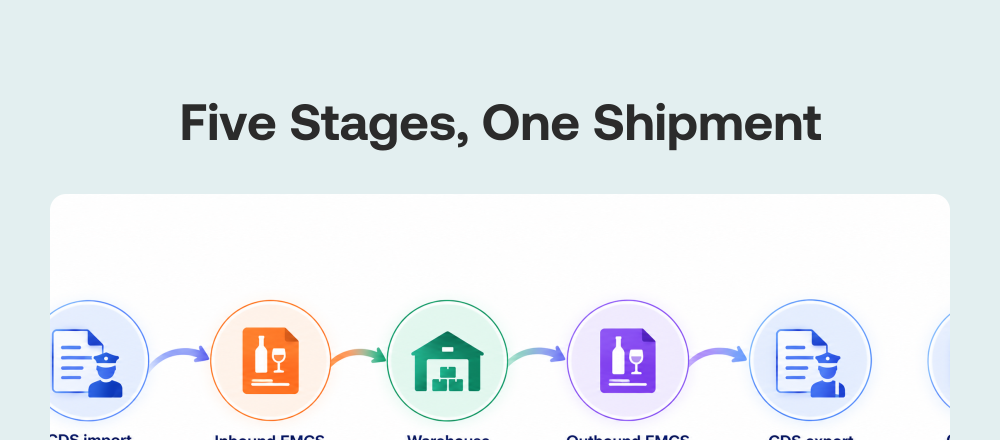
A GB to Northern Ireland movement, step by step
Take a firm in Manchester selling 100 washing machines to a retailer in Belfast. In outline, the movement runs like this:
- Confirm the route. This is Great Britain to Northern Ireland.
- Gather the goods detail: commodity code, description, quantity, weight, value and origin.
- Establish whether the goods are at risk of entering the EU, or not at risk.
- Check whether the UK Internal Market Scheme or another simplification applies.
- Work out which declarations the movement needs.
- Enter the information into TSS.
- TSS submits to the relevant systems.
- Complete any movement reference the carrier needs at the port.
- Customs and safety and security processing take place.
- The goods travel and arrive.
Every movement follows the same shape. Once you have done a handful, the pattern becomes familiar.
What information will TSS ask for?
Have this ready before you begin, and the process is far quicker.
About the parties
EORI number, importer, exporter, declarant and any intermediary acting for you.
About the goods
Commodity code, description, quantity, gross and net weight, value, origin and packaging.
About the customs treatment
Customs procedure, customs value, duty position, any preference or relief claimed, authorisations held and UK Internal Market Scheme status.
About the transport
Mode of transport, carrier, vehicle, route, port and arrival or departure detail.
About safety and security
Consignor, consignee, goods description, transport detail and routing.
One point deserves emphasis. Goods descriptions must be specific enough for customs to identify what is in the consignment. Clothes is too vague. Men’s cotton knitted shirts, size XL is the standard to aim for. Vague descriptions are one of the most common causes of queries and delays.
At risk, not at risk and UKIMS
For Great Britain to Northern Ireland movements, one question shapes the duty position: are the goods at risk of moving on into the EU?
Goods that may go on to the EU are treated as at risk. Goods that meet the relevant conditions can be treated as not at risk.
The UK Internal Market Scheme, usually shortened to UKIMS, is an authorisation for eligible businesses. Where the conditions are met, it allows qualifying goods to be treated as not at risk. Authorised traders can also use Internal Market Movement Information rather than a full declaration for eligible movements, which asks for less data.
Not everything qualifies. Category 1 goods are excluded, and the rules depend on the goods, the trader and the route. Check the current position before you rely on it.
Who needs a UKIMS number?
You need UKIMS if you want to bring goods into Northern Ireland as not at risk using simplified processes, rather than filing full customs declarations every time. It is most relevant to businesses bringing goods in for sale or final use in Northern Ireland.
To qualify you must be established in the UK and satisfy three broad tests: a clean customs and tax compliance record over the past three years, documented procedures and internal controls that track goods from arrival through to end use, and supporting evidence kept for five years and accessible in the UK.
If the goods are processed in Northern Ireland, further conditions apply. These include annual turnover below two million pounds, or processing for approved purposes such as food sale, construction, healthcare, non-profit activity or animal feed.
How do I register for a UKIMS number in Northern Ireland?
You apply online through HMRC. Have ready your EORI number beginning GB or XI, company details, directorship information, company number, incorporation date, annual turnover, premises address and a description of your record-keeping systems and how the goods will be used.
On approval, HMRC sends a letter containing your UKIMS authorisation number. Use that number for goods you move on or after the date you are authorised. It does not apply retrospectively.
Categories of goods: Standard, Category 1 and Category 2
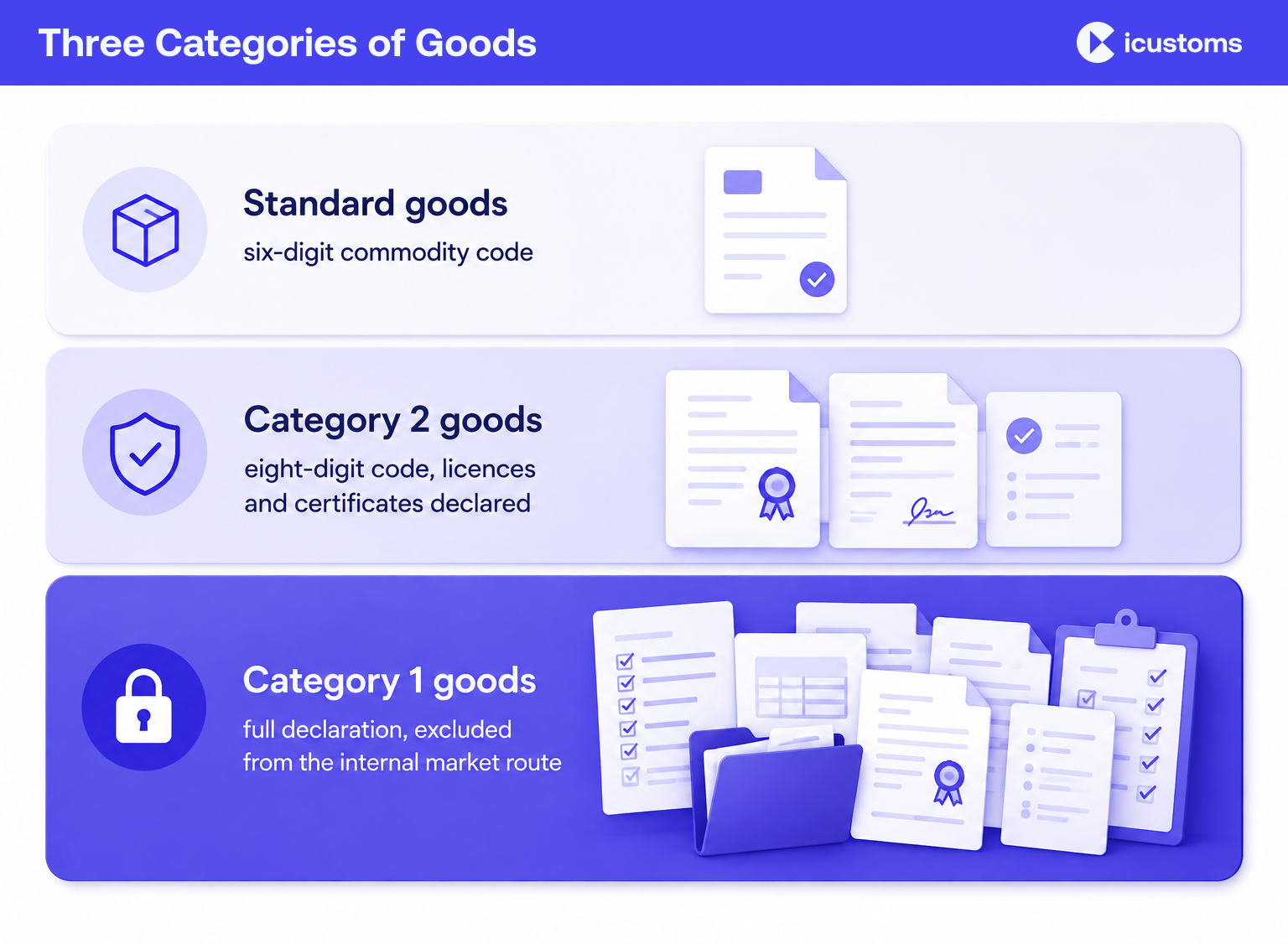
Not all goods are treated the same way. Under the Windsor Framework, goods moving from Great Britain to Northern Ireland fall into categories that decide how much information you supply and which process is open to you.
Standard goods
The lightest-touch category, covering agri-food moving under the Northern Ireland Retail Movement Scheme. Standard goods are declared using a six-digit commodity code.
Category 2 goods
This covers excise products and goods subject to EU import controls. They need an eight-digit commodity code, and any licence or certificate has to be declared. Category 2 goods can still move under the internal market route where the conditions are met.
Category 1 goods
The most restricted group. Category 1 goods cannot move under UKIMS and are excluded from Internal Market Movement Information. Examples include goods subject to trade defence measures, goods under a total ban or prohibition, and cases where the importer is claiming an EU tariff quota. These movements need a full customs declaration.
How do I check the list of controlled goods?
There is no single printed list to memorise. Controlled goods are those needing a licence, certificate or authorisation before they can move, and the category follows from the commodity code. Use the Northern Ireland Online Tariff Tool to check which category your goods fall into and what controls apply. Do that before you book transport, not after the lorry is loaded.
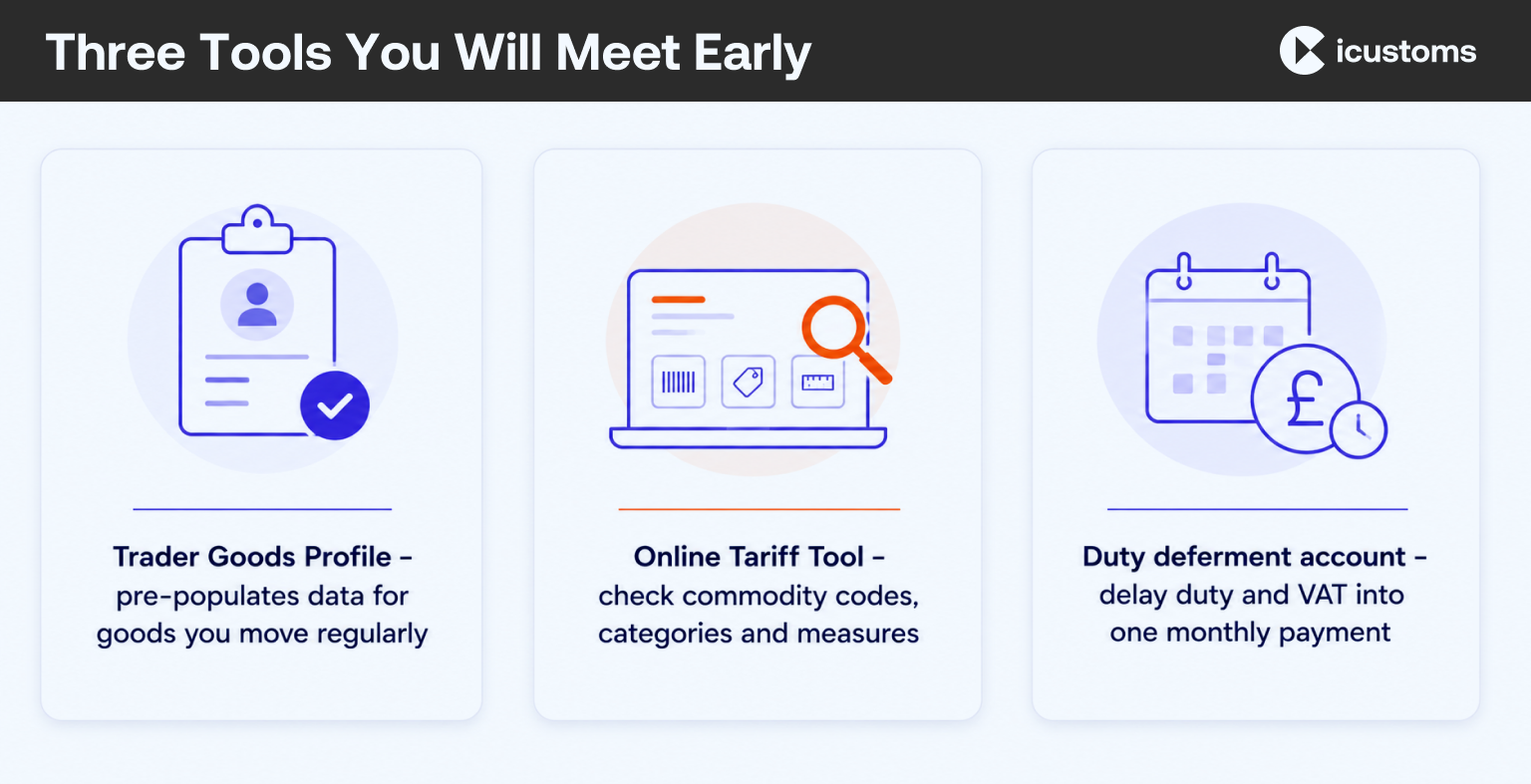
Three tools you will meet early on
Trader Goods Profile (TGP)
The Trader Goods Profile is a record of the goods you regularly move from Great Britain to Northern Ireland. Rather than entering full commodity data every time, the TGP pre-populates certain data elements in your Internal Market Movement Information. You then supply a product reference or a simple goods description alongside the usual commercial information.
HMRC pre-populates the profile from its records of goods you already move, and you reach it through the TSS portal. For repeat movements it removes a lot of duplicated typing.
Online Tariff Tool (OTT)
The Northern Ireland Online Tariff Tool is where you check commodity codes, duty rates, goods category and any measures attached to what you are moving. Getting the commodity code right is the highest-value thing you can do before a declaration, because a large share of downstream problems trace straight back to it.
Duty deferment account
A duty deferment account lets you delay paying most customs and tax charges, replacing payment per consignment with a single monthly Direct Debit. It can cover customs duty, excise duty and import VAT.
On approval, HMRC issues a deferment approval number, often called a duty deferment account number or DAN. You use it to set up the Direct Debit and to quote on declarations. A guarantee from a UK financial institution may be required unless you hold a guarantee waiver. Do not send one unless HMRC asks.
Four misconceptions worth clearing up
TSS costs money
It does not. GOV.UK states plainly that the service is free to use.
TSS replaces CDS
It does not. TSS helps you get information into government systems. CDS is one of those systems.
TSS is manual only
It is not. TSS provides API functionality for programmatic submission, which matters for businesses handling volume.
TSS means you have no responsibilities
The legal responsibility for accurate declarations stays with the trader. TSS submits what you give it. If the data is wrong, the declaration is wrong.
What is changing in 2026?
TSS is moving into a new phase. The next version of the service is being built on a commercial off-the-shelf platform called ERMIS, extended with purpose-built front-end applications.
The service went through a government alpha assessment in April 2026. It received an amber rating and can move to private beta once the flagged points are addressed. The stated aims include simpler user journeys, better accessibility, clearer guidance and more accurate submissions. The service is expected to remain free.
There is a practical lesson here for anyone researching TSS. A lot of the material online was written between 2020 and 2022 and is now out of date. Check current GOV.UK guidance before acting on anything you read, including this guide.
Where TSS fits alongside customs software
Businesses sometimes ask whether TSS removes the need for customs software. The two do different jobs.
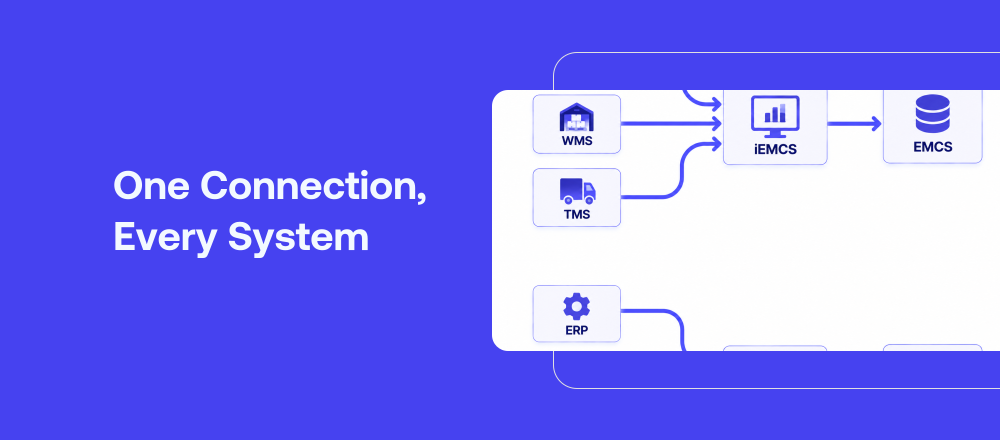
TSS is the government route for Northern Ireland movements. Commercial customs platforms sit around it, connecting business systems such as ERP, WMS and TMS to customs workflows, extracting data from trade documents and validating it before anything is submitted.
For a business filing a handful of declarations a month, TSS on its own is usually enough. For a forwarder handling hundreds, the manual data preparation becomes the bottleneck, and that is the gap commercial tools address.
Frequently Asked Questions
What is TSS in Northern Ireland?
It is the Trader Support Service, a free government service that helps businesses meet customs and safety and security requirements for goods moving to and from Northern Ireland.
How do I sign up for TSS?
Register free on the Trader Support Service website. You will need an EORI number and your company details before you start.
Who needs a UKIMS number?
Businesses that want to move goods into Northern Ireland as not at risk under simplified processes. You must be established in the UK and meet HMRC's compliance and record-keeping conditions.
What are Category 1 goods?
Goods excluded from UKIMS and from Internal Market Movement Information, such as those under trade defence measures, a total ban or prohibition, or where an EU tariff quota is claimed. They need a full customs declaration.
What is a Trader Goods Profile?
A record of goods you regularly move from Great Britain to Northern Ireland. It pre-populates data in your Internal Market Movement Information so you do not re-enter the same commodity detail every time.
Do I need a duty deferment account to use TSS?
Not necessarily. A duty deferment account is for delaying duty and VAT payments into one monthly Direct Debit. Whether you need one depends on your duty position, not on using TSS.
Is the Trader Support Service free?
Yes. GOV.UK confirms the service is free to use. There is no subscription and no charge per declaration.
Do I have to use TSS?
No. Businesses can use other customs software or an intermediary instead. TSS is a free option, not a legal requirement.
Does TSS cover Northern Ireland to Great Britain movements?
Yes. TSS supports Great Britain to Northern Ireland, Northern Ireland to Great Britain, and rest of world excluding the EU into Northern Ireland. The requirements differ by route.
What do I need before registering?
An EORI number and your business details. You will also need goods information for each movement, including commodity codes, values and origin.
You may also like:
Handling High Volume TSS Declarations?

Reduce repetitive data entry with iCustoms TSS automation.
Subscribe to our Newsletter
About iCustoms
iCustoms is an all-in-one solution helping businesses automate customs processes more efficiently. With AI-powered and machine-learning capabilities, iCustoms is designed to streamline your all customs procedures in a few minutes, cut additional costs and save time.
Make Your TSS Workflow More Efficient
Prepare and validate TSS data with less manual work.