
EMCS Software: What to Look for in an Excise Movement Management Solution
- John Hall
- Customs Specialist at iCustoms.ai
Most businesses do not go looking for EMCS software because they woke up wanting new software. They go looking because a spreadsheet-and-portal process that worked at low volume stopped working, and someone has to compare a handful of options against criteria that are not always obvious from a features page. This guide sets out that criteria directly: what an EMCS solution actually needs to do, the questions worth asking any vendor, and how the pieces fit together, integration method, validation, tracking, auditability and connected systems, rather than treating any one of them as the whole evaluation.
The Core Job, and Why It Is Not the Whole Evaluation
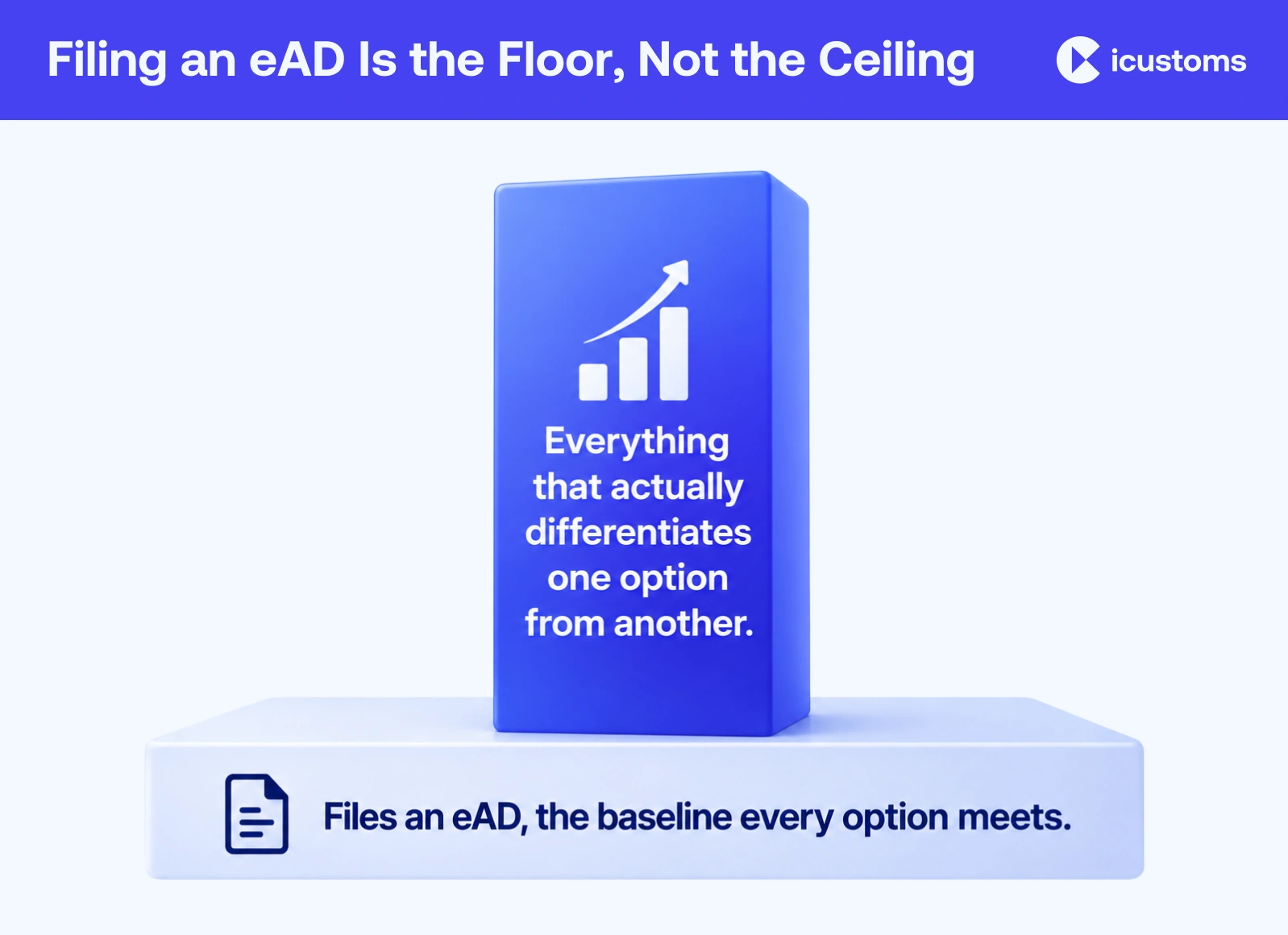
Every EMCS solution has to do one thing at minimum: get an eAD in front of HMRC’s own EMCS system correctly and on time. HMRC’s guidance on registering for and using EMCS explicitly recognises this route, a business “must register and enrol for EMCS even if you choose to use a commercial software package or in-house designed software,” so using software instead of the government’s own portal is an accepted, expected way of working, not a workaround.
Getting an eAD filed is the baseline, not the differentiator. Software that only replicates the portal’s own data entry screen in a nicer interface solves the smallest part of the problem. The real evaluation is in what happens around that filing: whether the data is checked before it is submitted, whether the movement’s status is visible without a separate login, how the software connects to the systems already in use, and whether the record survives being looked at months or years later.
A Capability Checklist
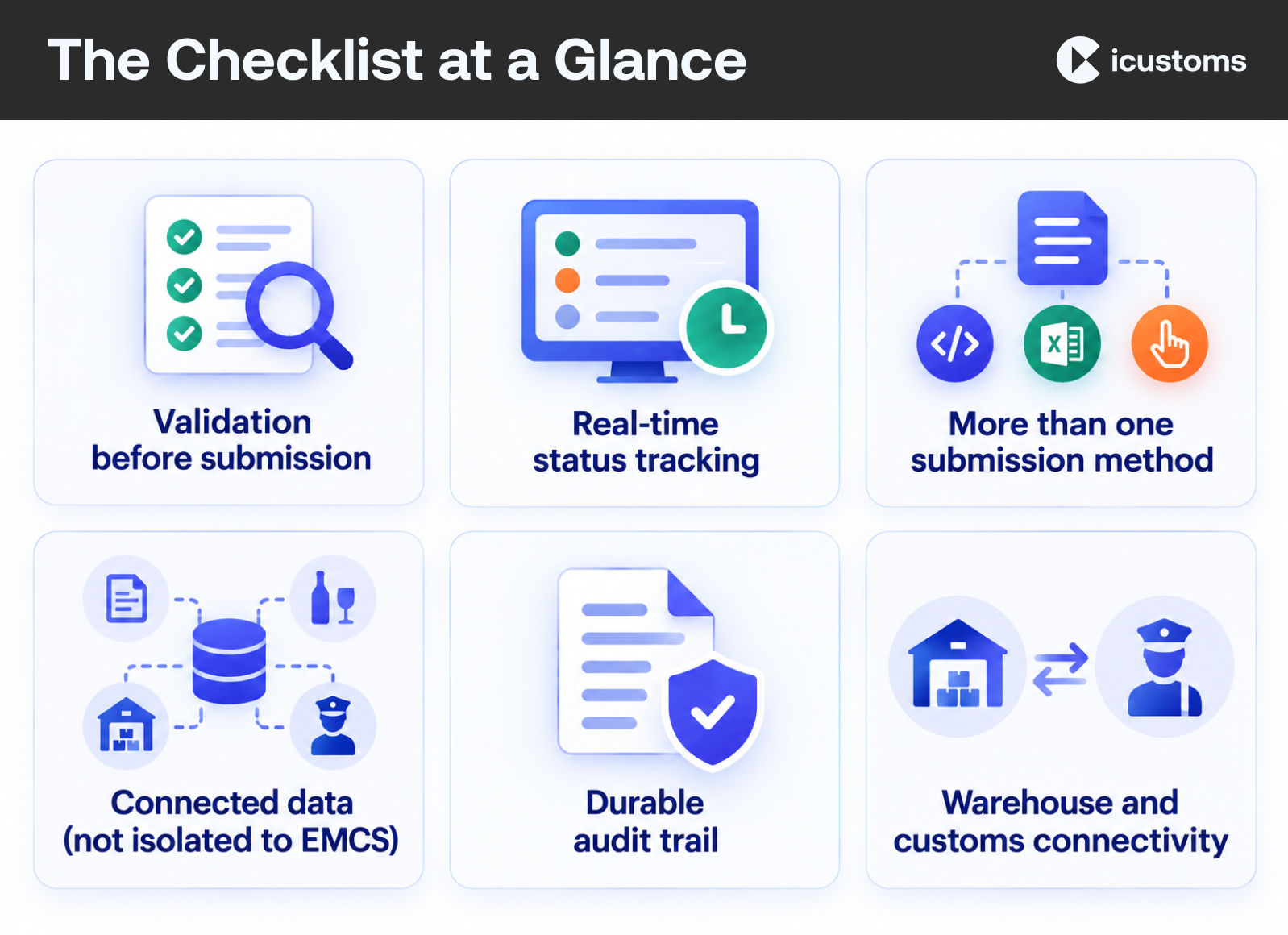
Validation Before Submission
Software that only checks a form is complete, all fields filled in, is not the same as software that checks the data is right. Ask whether a solution validates declaration data against connected records, CDS and warehouse data specifically, and flags mismatches before submission rather than leaving HMRC to reject or query them afterwards.
Real-Time Status Tracking
A movement’s status, has the ARC been issued, has the report of receipt come in, is a question that should be answerable from one place. Look for centralised tracking of the ARC, the journey and the report of receipt, rather than a solution that requires checking EMCS directly for anything beyond initial submission.
More Than One Way to Submit
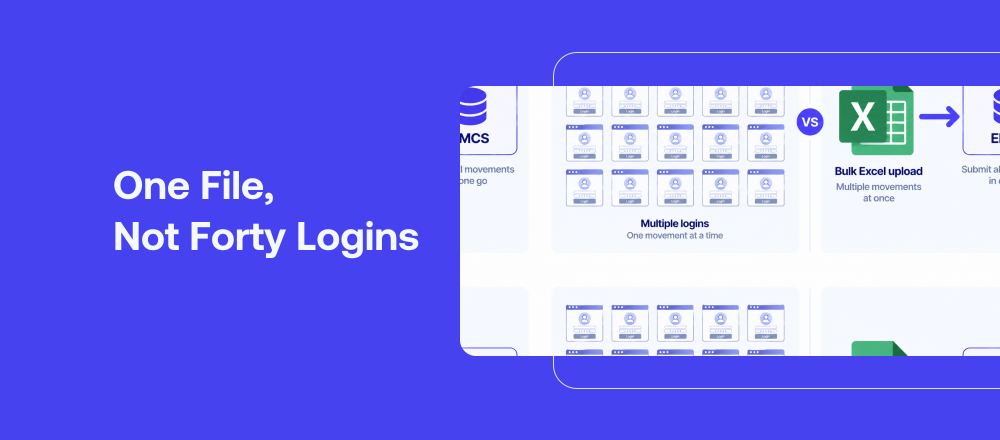
Different teams submit movements differently. A business with an ERP already producing the data wants an API. A back-office team handling batches without engineering support wants a bulk file. Someone filing the occasional single movement wants a simple form. Software that only offers one of these forces every user into the same workflow regardless of fit; our guides to EMCS API integration and EMCS Excel upload cover each path in depth.
Connected, Not Isolated, Data
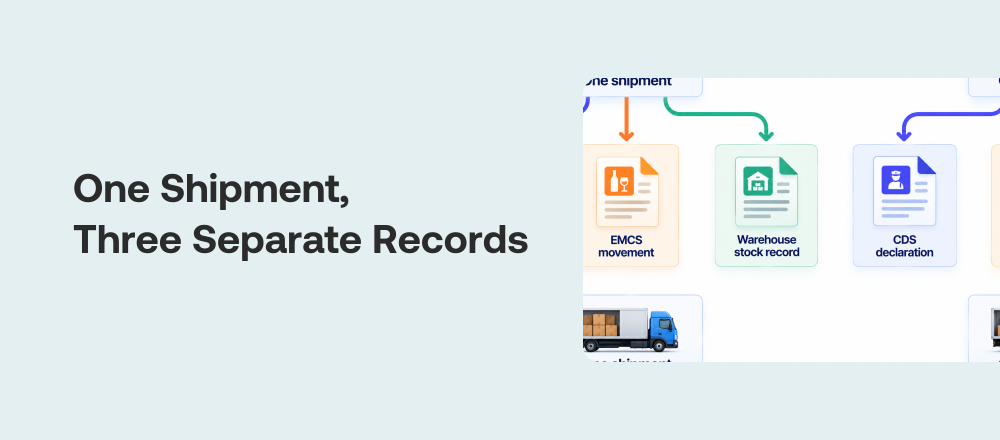
An EMCS solution that only touches EMCS still leaves CDS and warehouse data as separate, independently typed records. Look for data mirroring across the systems a movement actually touches, so a shipment’s detail is entered once and referenced everywhere rather than retyped at each point; our guide to EMCS data mirroring covers why that gap matters.
An Audit Trail That Actually Holds Up
A movement’s record needs to survive being examined later, at a W1 return, an internal reconciliation, or an HMRC audit, not just at the moment it was filed. Ask how long records are retained and whether the audit trail covers the full movement, not just the initial submission.
Genuine Warehouse and Customs Connectivity
Excise movements do not happen in isolation from customs declarations or warehouse stock. Software scoped only to EMCS itself pushes the CDS and warehouse connections back onto the business to manage by hand. Ask specifically how a solution handles the import side, the warehouse side, and the export side, not just the EMCS message itself.
Questions Worth Asking Any EMCS Software Vendor
- Does the software validate data against connected systems before submission, or only check that a form is complete?
- Can I see a movement’s ARC, journey and report of receipt status in the software itself, without a separate login to EMCS?
- What submission methods are supported, API, bulk file, direct entry, and can different teams use different methods for different workflows?
- Does the software mirror data with CDS and warehouse systems, or does EMCS data live in its own silo?
- How long are movement records retained, and is that retention automatic or something we have to manage ourselves?
- Does the platform handle the warehouse and customs sides of a movement, or only the EMCS message itself?
Where iEMCS Fits This Checklist
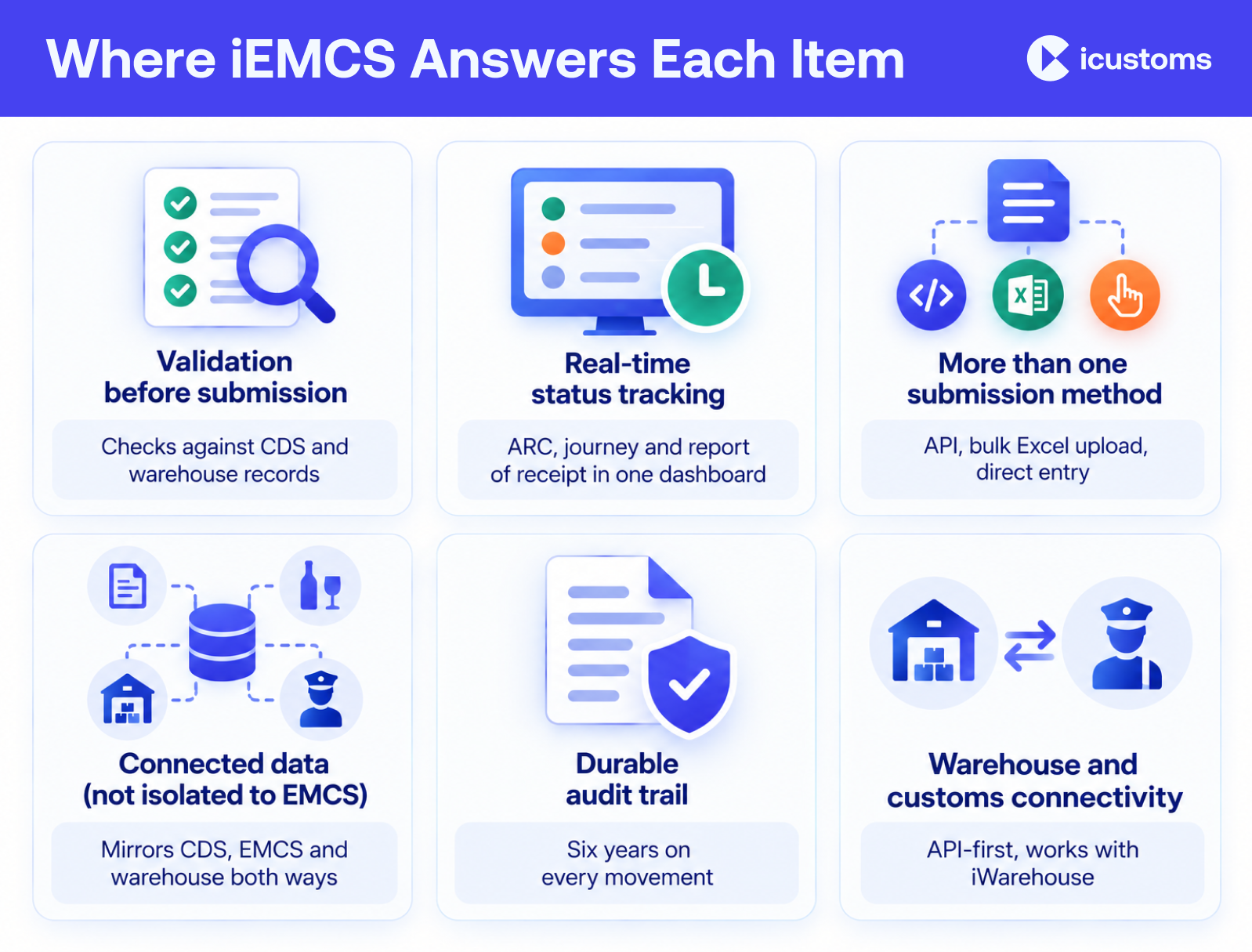
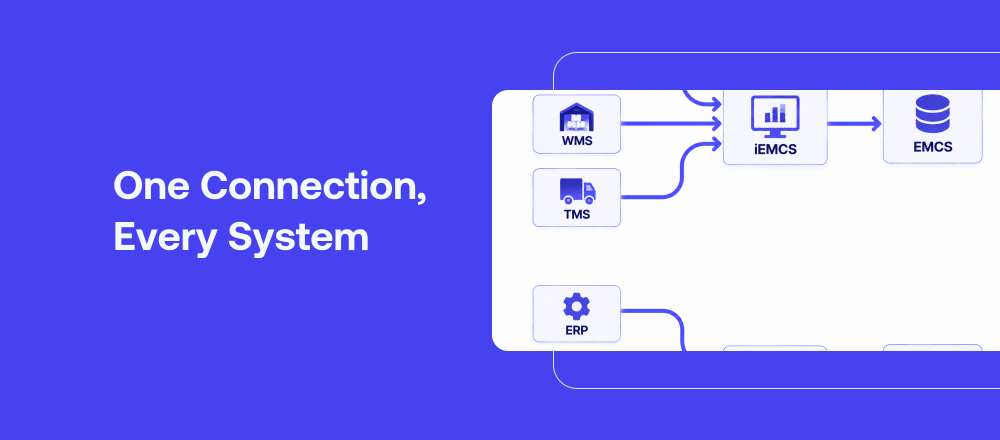
Measured against each of those points, iEMCS’s own product page sets out specific, confirmed answers rather than general claims. On validation, it checks declaration data against CDS and warehouse records and flags mismatches before submission. On tracking, it centralises every ARC, journey time and report of receipt in one dashboard. On submission methods, it offers secure API with real-time confirmations, status updates and ARCs, bulk Excel upload for batch workflows, and direct entry for occasional single movements, letting a business choose the path per workflow rather than committing to one. On connected data, it mirrors information both ways, CDS to EMCS, EMCS to warehouse, and warehouse to EMCS, summarised on its own page as “enter once, mirror everywhere.” On auditability, it keeps a six-year audit trail on every movement. And on connectivity beyond EMCS itself, it is built API-first to connect to an existing ERP, WMS or TMS, and works alongside iWarehouse, which holds the actual stock record on the warehouse side, while iEMCS generates, validates, tracks and mirrors the movement data itself.
A Simple Worked Example
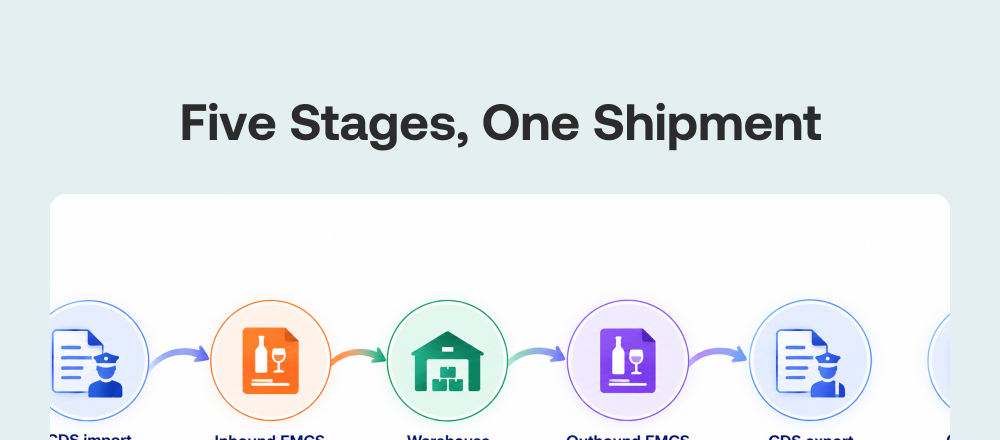
A growing spirits distributor has been filing EMCS movements through the government portal directly, with warehouse stock and CDS declarations tracked separately in a spreadsheet and a warehouse system that do not talk to either EMCS or each other. Running the checklist above against their situation surfaces the actual gaps: no validation before submission, meaning errors are caught by HMRC rather than before filing; no centralised status view, meaning someone checks EMCS, the warehouse system and the spreadsheet separately to answer a single status question; and no data mirroring, meaning the same shipment detail is typed three times with three chances to drift. None of those gaps show up by asking “can this software file an eAD?”, because every option they are comparing can do that much.
Common Myths
Any software that files an eAD is essentially equivalent. Filing an eAD is the baseline every option meets. The real differences are in validation, status tracking, integration flexibility, data mirroring and audit trail depth, none of which are guaranteed just because a solution can submit a movement.
EMCS software just replaces the HMRC portal screen. That is one narrow way to use it. The more useful evaluation question is what happens around the filing, whether data is checked, tracked, connected to other systems and retained properly.
You need an API integration to get real value from EMCS software. Not necessarily. Bulk Excel upload and direct entry are legitimate paths for businesses without engineering resource or with lower, less consistent volume; the right software supports more than one method rather than forcing an API build on every buyer.
Frequently Asked Questions
What should EMCS software actually do beyond filing an eAD?
It should validate data before submission, provide centralised real-time status tracking, offer more than one way to submit movements, mirror data with CDS and warehouse systems, and keep a durable audit trail, rather than only replicating the portal's own filing screen.
What questions should you ask an EMCS software vendor?
Whether it validates against connected systems before submission, whether status is visible without a separate EMCS login, what submission methods it supports, whether it mirrors data with CDS and the warehouse, how long records are retained, and whether it covers the warehouse and customs sides of a movement or only the EMCS message.
Does EMCS software have to connect to CDS and the warehouse, or just EMCS?
It does not have to, but software scoped only to EMCS leaves CDS and warehouse data as separate records that someone has to reconcile by hand. Connected data mirroring is one of the main things worth evaluating for.
Is API integration required to get value from EMCS software?
No. Bulk Excel upload and direct entry are both legitimate submission methods for businesses without engineering resource, and useful EMCS software supports more than one path rather than requiring an API build from every buyer.
How does iEMCS map to a typical evaluation checklist?
It validates data against CDS and warehouse records before submission, centralises ARC, journey and report of receipt tracking, offers API, bulk Excel upload and direct entry as submission methods, mirrors data across CDS, EMCS and the warehouse, and keeps a six-year audit trail on every movement.
You may also like:

Comparing EMCS Software Options?

Work through a capability checklist covering validation, tracking, integration and auditability before you commit to a vendor.
Subscribe to our Newsletter
About iCustoms
iCustoms is an all-in-one solution helping businesses automate customs processes more efficiently. With AI-powered and machine-learning capabilities, iCustoms is designed to streamline your all customs procedures in a few minutes, cut additional costs and save time.
Not Sure Which Questions to Ask a Vendor?
Use the checklist above as a starting point, then see how iEMCS answers each item directly.