
NCTS vs CDS: What's the Difference and When Do You Need Each?
- John Hall
- Customs Specialist at iCustoms.ai
An operations manager once asked why the business needed “another system” for transit when everything was already filed through CDS. The honest answer is that CDS was never filing the transit movements in the first place. It could not, because the two systems are not doing the same job.
NCTS and CDS get treated as competing platforms because both are accessed through the same Government Gateway login and both feel like “the customs system.” They are not alternatives. This guide sets out what each one actually does, why the confusion happens, and when a movement needs one, the other, or both.
NCTS and CDS Are Not Alternatives
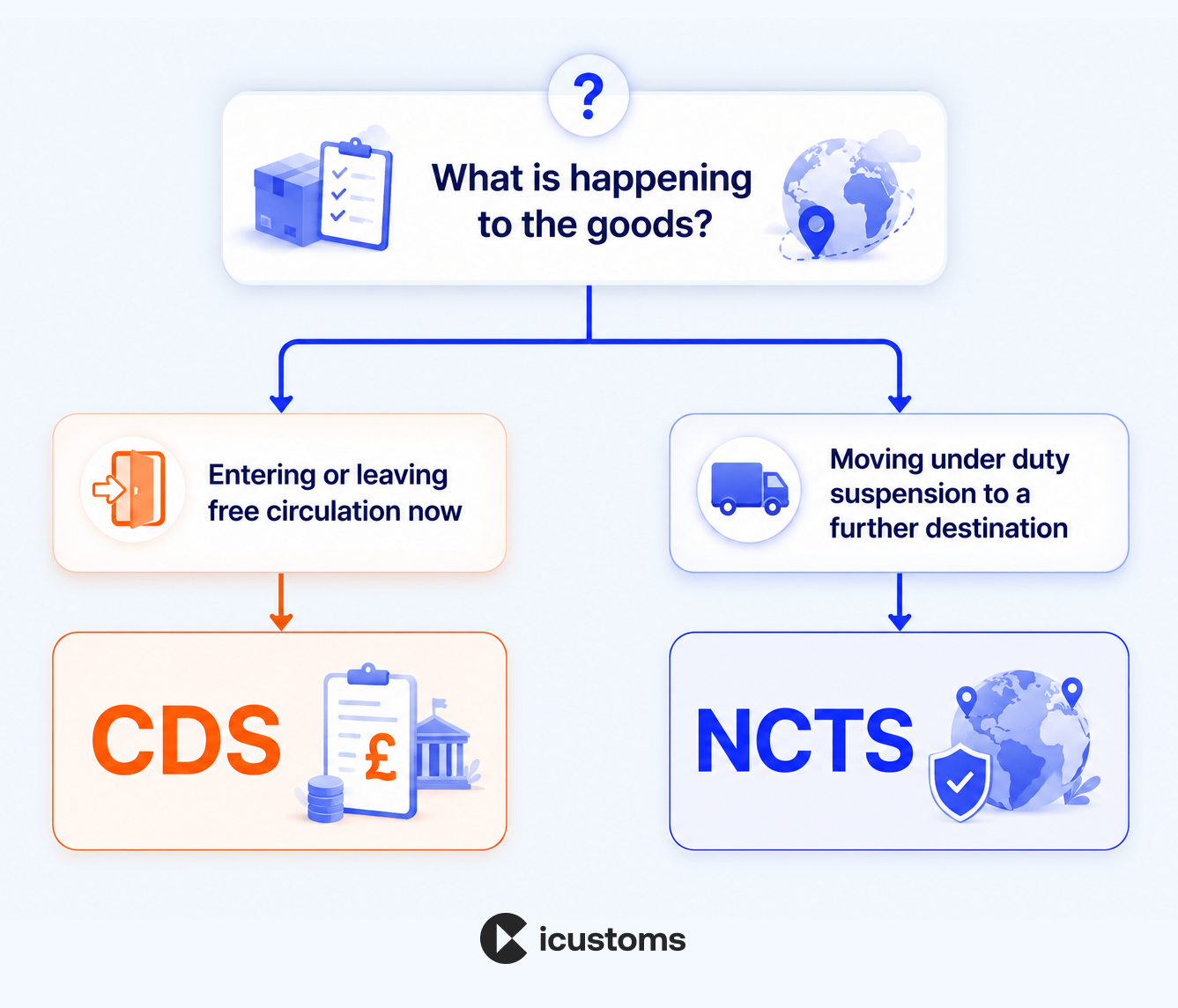
CDS handles import and export declarations, the point at which goods enter or leave free circulation and duty becomes due. NCTS handles transit, the procedure that suspends duty while goods move under a guarantee from an office of departure to an office of destination, often crossing several customs territories on the way.
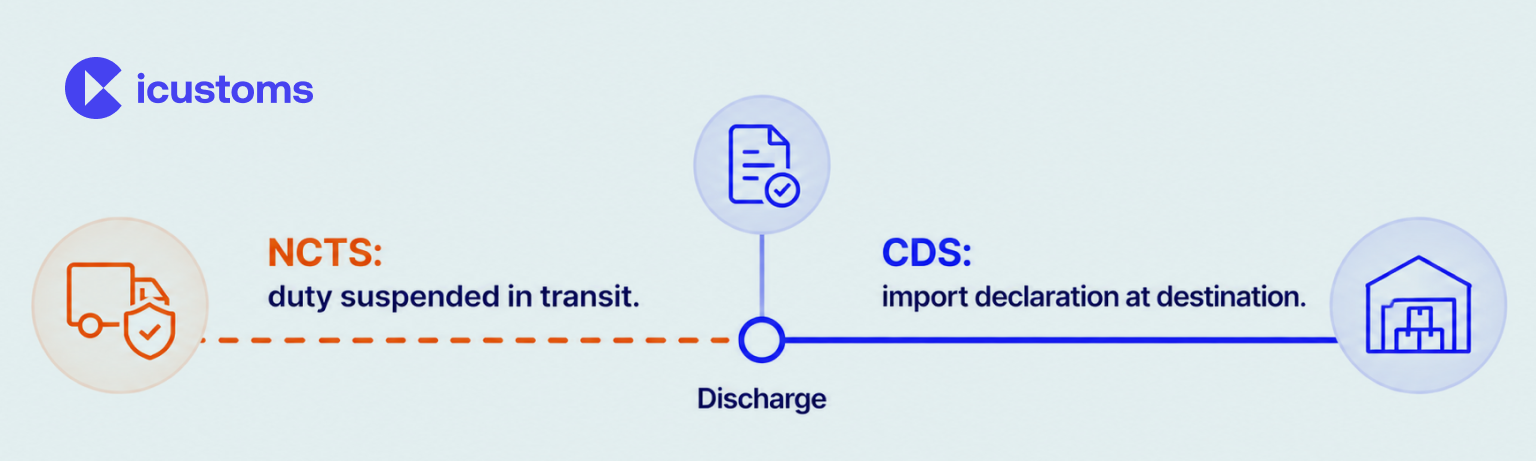
A single shipment can use both, in sequence. Goods can travel under NCTS with duty suspended, and only once the movement is discharged at its destination does an import declaration, made through CDS or the destination country’s equivalent, bring the goods into free circulation.
What CDS Actually Does
The Customs Declaration Service is the UK’s platform for import and export declarations, and it has been the only route since CHIEF was switched off. It uses its own data model, its own procedure codes, and its own financial account structure for duty deferment and postponed VAT accounting. If goods are clearing customs at the point they cross the border, that declaration goes through CDS.
A CDS declaration assumes the goods are ready to be released into free circulation, or ready to leave the UK for good. It asks for the full commercial picture: classification, valuation, origin evidence and the duty or VAT position, because that position is being settled there and then. Nothing about a CDS declaration suspends anything. It resolves the customs position rather than deferring it.
Our full CDS import declarations guide covers the platform in detail.
What NCTS Actually Does
The New Computerised Transit System is the electronic system that runs the transit procedure under the Common Transit Convention. It lets goods move under one declaration and one guarantee across multiple customs offices and territories, with duty suspended until the movement is discharged at the office of destination.
If goods are not clearing customs yet, because they still have distance to travel before reaching their actual destination, that movement runs through NCTS instead of CDS. An NCTS declaration asks for different things: the guarantee reference backing the movement, the consignment and house consignment structure, and the itinerary the goods will follow, because none of that is needed to settle a duty position that has not arisen yet.
Our EU customs transit procedure guide and NCTS Phase 5 guide cover how that procedure and its message flow actually work.
Where the Confusion Comes From
Both systems sit behind the same EORI and the same Government Gateway account, and both produce something that looks like a customs declaration on screen. Teams that only ever import and export directly, without transit involved, never touch NCTS and reasonably assume it is optional. Teams that start moving goods to destinations further afield discover that CDS has no way to suspend duty for a multi-leg movement, because that was never its job.
The naming does not help. “NCTS vs CDS” reads like a choice between two products doing the same job, in the way “NCTS vs TIR” genuinely is a choice between two transit systems. CDS and NCTS are not that. One settles a duty position. The other suspends it. A business does not pick between them any more than it picks between invoicing a customer and shipping the order; both steps happen, for different reasons, often on the same consignment.
When You Need CDS, NCTS, or Both
| Scenario | System needed |
|---|---|
| Importing goods directly into free circulation in the UK | CDS import declaration |
| Exporting goods that clear customs immediately at the border | CDS export declaration |
| Moving goods under duty suspension across the UK, EU or wider Common Transit Convention network | NCTS transit declaration |
| Goods that travel under transit and then enter free circulation at their destination | NCTS to close the movement, then a CDS import declaration, or the destination country’s equivalent |
| Roll-on roll-off movements combining a transit MRN with export or import data | Both: the transit declaration through NCTS, linked into the Goods Movement Reference alongside CDS data |
Where the Two Meet: Roll-on Roll-off Movements
At roll-on roll-off ports operating the pre-lodgement model, the overlap becomes unavoidable rather than occasional. Every reference relating to what is loaded on the trailer, including a transit MRN from NCTS alongside export or import data from CDS, gets linked into a single Goods Movement Reference before the driver can check in. Neither system replaces the other here. The GMR simply needs both to already exist.
This is also where the two-systems problem is most visible operationally. One missing transit declaration among several consignments on the same trailer holds up the whole load at the port, even though the CDS side of the paperwork was filed correctly and on time.
Do You Need Software for Both?
If your business only ever imports and exports without transit, CDS access alone is enough. If your business moves goods under transit at all, and holds a guarantee, you need NCTS capability regardless of how much CDS work you also do. Most forwarders and agents doing cross-border road freight need both, because the two declaration types are legally separate submissions rather than a choice between them.
The practical cost shows up when the two run in disconnected systems. The same consignment, the same commodity codes and often the same guarantee-linked reference get re-entered twice, once for the transit leg and once for the import or export leg, with no shared record of either. A commodity code corrected in one system after a query does not automatically correct in the other, and a team relying on two logins rarely notices until a mismatch causes a rejection on one side or the other.
Frequently Asked Questions
Is NCTS part of CDS?
No. They are separate platforms run for different purposes. CDS handles import and export declarations; NCTS handles transit movements under duty suspension.
Do I need a CDS declaration if I am using NCTS for transit?
Not for the transit leg itself. A CDS declaration becomes relevant once the goods reach their final destination and need to enter free circulation, or if the same shipment also has an export or import element outside the transit movement.
What replaced CHIEF, and is it the same as NCTS?
CHIEF was replaced by the Customs Declaration Service, which handles import and export declarations. NCTS is a separate system for transit and was not affected by the move from CHIEF to CDS.
Can I use CDS for a transit movement?
No. Transit declarations are submitted through NCTS. CDS has no mechanism for suspending duty across a multi-leg movement under a transit guarantee.
Which system handles the Goods Movement Reference, NCTS or CDS?
Neither on its own. The Goods Movement Reference links together whichever declarations apply to the load, which can include a transit MRN from NCTS alongside export or import data from CDS.
Do small businesses need both NCTS and CDS?
Only if they do both kinds of activity. A business that only imports or exports directly needs CDS alone. A business that also moves goods under transit needs NCTS as well, regardless of size.
Is NCTS or CDS used for Northern Ireland movements?
Both can apply depending on the movement. Northern Ireland declarations generally run through CDS, while any transit element of a GB to Northern Ireland or onward EU movement still uses NCTS.
What happens if I only have CDS access and not NCTS?
You will not be able to submit a transit declaration. Any movement that needs duty suspended across a longer route will need NCTS access and a guarantee before it can be released.
You may also like:
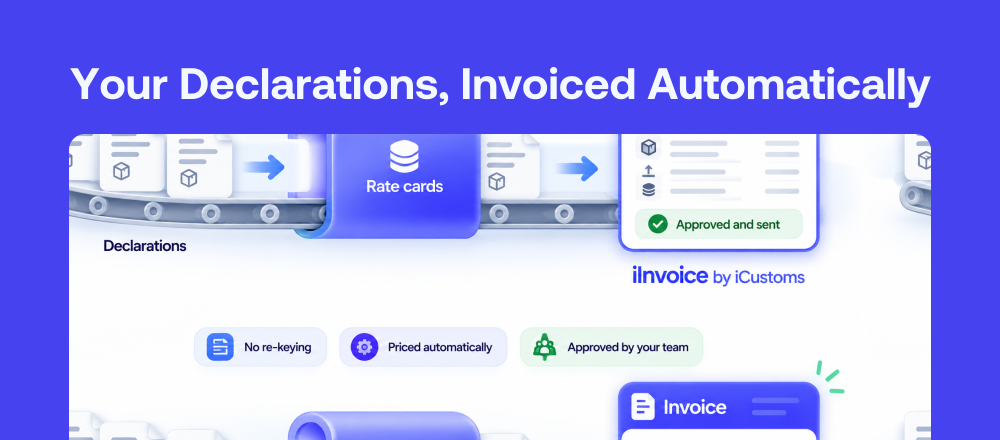
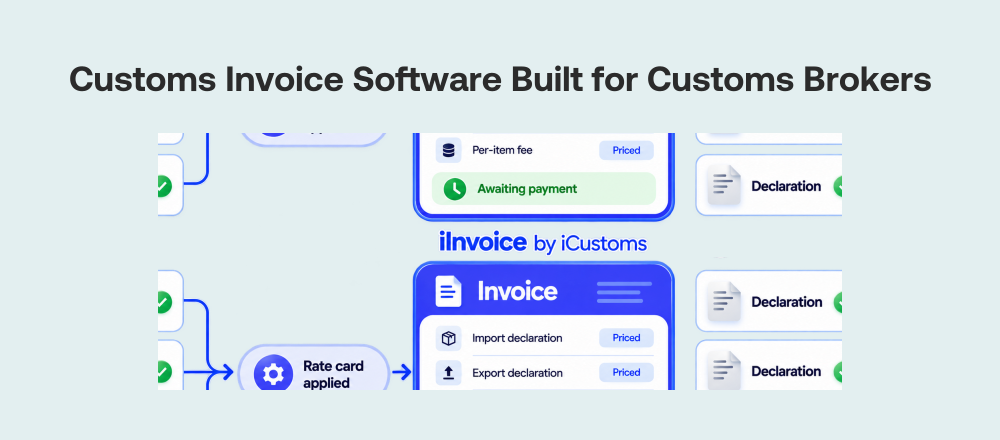
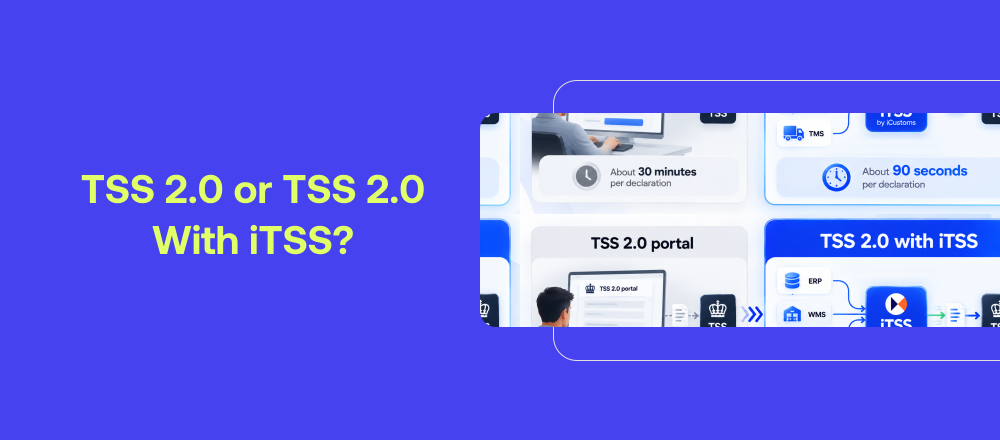
Running CDS and NCTS Through Separate Systems?

iCustoms handles import, export and transit declarations from one platform, so nothing gets re-keyed twice. |
Subscribe to our Newsletter
About iCustoms
iCustoms is an all-in-one solution helping businesses automate customs processes more efficiently. With AI-powered and machine-learning capabilities, iCustoms is designed to streamline your all customs procedures in a few minutes, cut additional costs and save time.
See AI Customs Automation in Action
Turn trade documents into structured data with intelligent automation.