
EU Customs Transit Procedure Explained: A Guide for UK Traders and Agents
- John Hall
- Customs Specialist at iCustoms.ai
A new starter at a forwarding office in Felixstowe once asked a reasonable question. If the goods already cleared customs in the UK, why does a customs post in Poland need to see a document before the trailer can carry on? The answer is that the goods have not cleared customs. They are moving under transit, and the movement is not finished until a customs office at the other end says it is.
That single misunderstanding sits underneath a lot of avoidable delay. Transit is not a formality tacked onto an export. It is its own procedure, with its own rules, its own network of offices and its own financial cover, and it runs independently of whatever happened at the UK border.
This guide sets out what the EU customs transit procedure actually does, how it differs from a normal import or export, and where UK traders and agents most often misread it.
What the EU Customs Transit Procedure Actually Does
Ordinarily, goods crossing into a customs territory need a declaration there and then, and duty becomes payable at that point. Transit exists to avoid that. It lets goods move under a single declaration and a single guarantee from an office of departure to an office of destination, crossing as many customs offices and territories as the route needs, without duty falling due at each one.
Duty is not cancelled. It is suspended and covered by the guarantee until the movement ends. Only then does the destination country’s own import process take over, with its own classification, valuation and duty position.
The point of the procedure is efficiency. Instead of a full customs process at every border a route crosses, there is one control at the start and one at the end, with the goods travelling under a single reference in between.
Common Transit Convention vs Union Transit: The Difference in Plain Terms
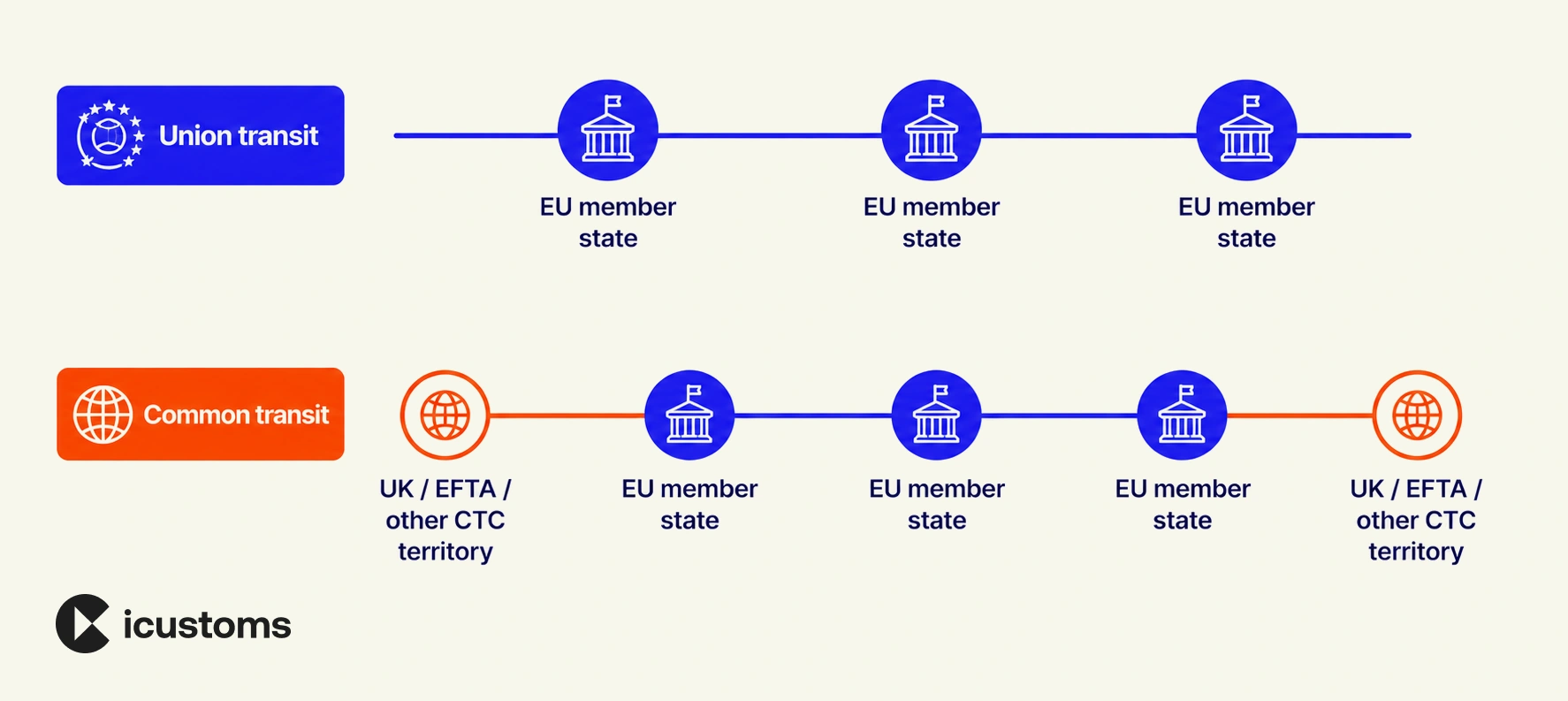
These two terms get used interchangeably, and they should not be. Union transit is the transit procedure under the EU’s own Union Customs Code, used for movements that stay wholly within the customs territory of the EU. Common transit is the wider version created by the Common Transit Convention, which extends the same basic mechanism to contracting parties outside the EU customs territory, including the UK and the EFTA states.
| Aspect | Union transit | Common transit |
|---|---|---|
| Governed by | Union Customs Code | Common Transit Convention |
| Territory | Wholly within the EU customs territory | EU plus non-EU contracting parties (UK, EFTA states and others) |
| Typical UK relevance | Not used for UK movements | The procedure used for all UK to EU and EU to UK transit |
For a UK trader, the practical rule is straightforward: any movement that starts or ends in the UK runs as common transit, because the UK sits outside the EU customs territory but remains a contracting party to the Convention in its own right. For the full list of contracting territories, see our guide to the Common Transit Convention.
The Office Network That Controls a Movement
Office of Departure
This is where the transit declaration is lodged and where the movement is formally authorised to begin. It checks the declaration, the guarantee and the goods description before releasing the movement.
Office of Transit
Not every customs post along a route is an office of transit. The designation applies to specific offices, typically where a movement enters or leaves the customs territory of a contracting party. Where the procedure requires it, the accompanying document is presented there and the crossing is recorded.
Office of Destination
This is where the movement is presented on arrival. It checks the goods against the declaration and, once satisfied, triggers discharge, the step that closes the movement and ends the guarantee’s commitment.
Office of Incident
If something happens outside the plan, a broken seal, a breakdown, an unplanned change of route, it is reported to the office of incident rather than resolved informally at the roadside. Under the current electronic systems, this is a recorded message rather than a handwritten note on a paper document.
Customs Status: Why T1 and T2 Exist
Every movement also carries a customs status, and it decides what happens to the goods at the end. T1 covers non-Union goods, meaning goods that have not been released into free circulation in the EU. T2 covers goods that already hold Union status. Choosing the wrong one does not stop the movement, but it does change the duty position waiting at the other end, so it is worth getting right rather than defaulting to whichever one a template suggests.
The distinction has enough detail behind it to deserve its own explanation. Our T1 document guide covers both statuses, how they are declared and how they affect the movement, in full.
The Guarantee: What Actually Backs the Movement
A transit movement cannot be released without financial cover for the duty and VAT at risk while it travels. In practice, that cover is a comprehensive guarantee, arranged in advance and identified by a guarantee reference number, or in some cases a guarantee waiver that reduces or removes the amount that has to be secured.
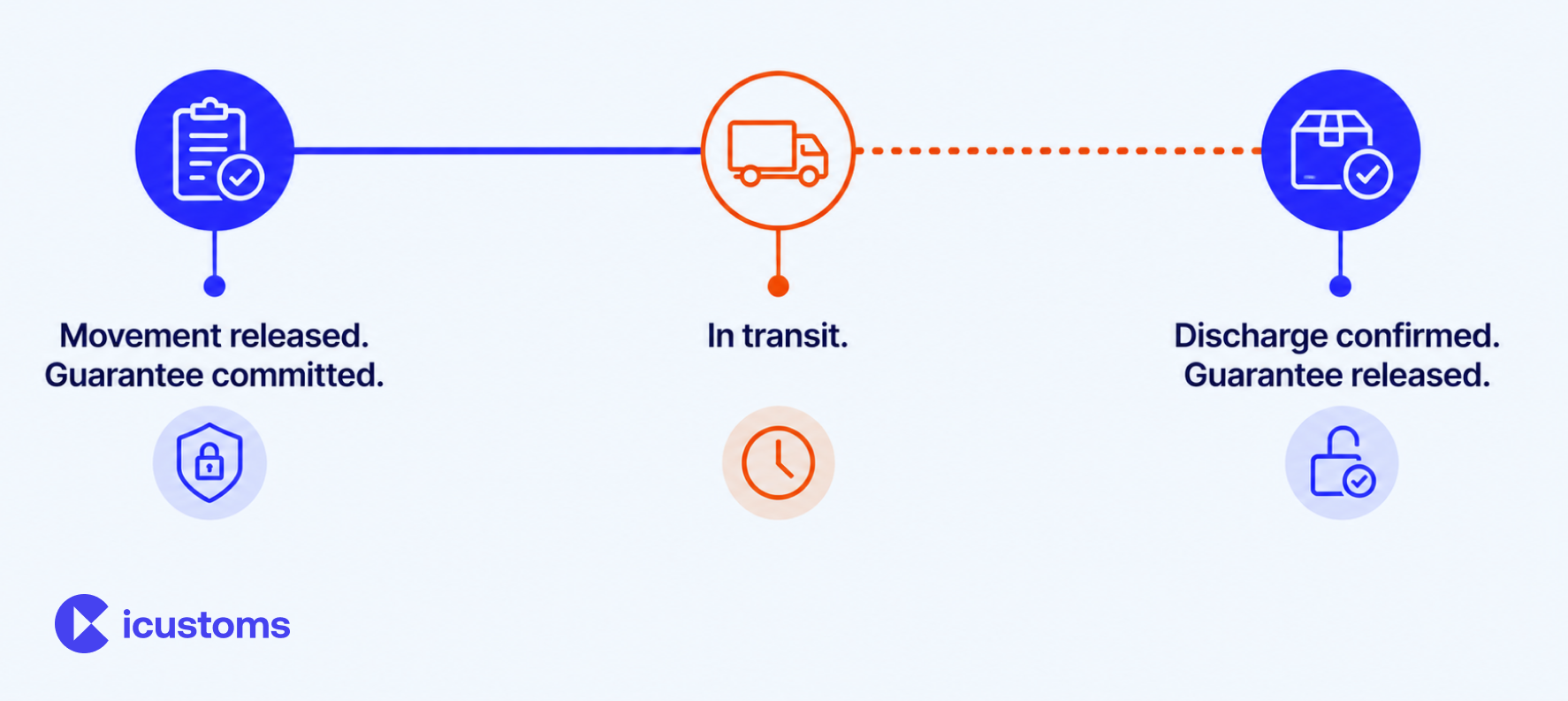
The amount at risk is committed the moment a movement is released, and it is only freed once that movement is confirmed discharged at destination. A guarantee is not a one-off check at booking. It is a balance, and every open movement sits against it until it closes.
This is where cover quietly disappears. A trader running several movements at once can find a guarantee exhausted not because of volume, but because earlier movements arrived weeks ago and were never confirmed discharged, so the amount they committed was never released.
Simplified Procedures: Authorised Consignor and Authorised Consignee
The standard procedure expects goods to be physically presented at the office of departure and the office of destination. Two authorisations change that. Authorised consignor status lets a business start a movement from its own premises, without a customs officer present, provided the required seals and controls are in place. Authorised consignee status does the same at the receiving end, allowing goods to be unloaded and the movement closed at the trader’s own site.
Neither authorisation is automatic. Each has to be applied for and each depends on the trader meeting specific record-keeping and control conditions, separately from broader accreditations such as Authorised Economic Operator status.
What Travels With the Goods
The transit declaration itself is submitted electronically to the customs authority of the office of departure. Once it is accepted and the movement released, a Transit Accompanying Document is issued, carrying the Movement Reference Number as a barcode. That document travels physically with the goods and is presented at any office along the route that needs to see it.
In the UK, this entire exchange runs through the New Computerised Transit System, and the message-by-message detail of what gets sent and received is worth understanding on its own terms if you want to see where a declaration can go wrong. Our NCTS Phase 5 guide walks through that exchange from declaration to discharge.
How a Movement Closes: Discharge
Discharge is the confirmation, issued by the office of destination, that the goods and documents matched and the movement completed correctly. It is the event that ends the customs debt attached to the movement and releases the guarantee amount that had been committed.
Until discharge is confirmed, the movement is still open as far as the guarantee is concerned, whatever has physically happened to the goods. Chasing discharge confirmation is not paperwork tidiness. It is the only way committed cover comes back.
Where the Procedure Trips Up UK Traders
- Treating clearance at the UK border as the end of the process, when the transit obligation runs on until discharge at the office of destination.
- Assuming any customs post can act as an office of transit, when the designation applies to specific offices within the Common Transit Convention network.
- Letting guarantee cover sit committed because nobody confirmed discharge at the other end, then finding a later declaration refused for insufficient cover.
- Applying for authorised consignor or consignee status without checking it actually covers the offices of departure and destination the business uses.
- Assuming a Union transit movement can be used once the route touches a non-EU contracting party, rather than switching to common transit.
- Leaving customs status unresolved because T1 or T2 feels like a checkbox, when it sets the duty position waiting at the destination.
None of these are border problems. They are misunderstandings about what the procedure is actually doing, and every one of them is avoidable before the declaration is ever submitted.
Frequently Asked Questions
What is the EU customs transit procedure?
It is the procedure that lets goods move under a single declaration and a single guarantee across multiple customs offices and territories, with duty suspended until the movement ends at the office of destination.
What is the difference between Union transit and common transit?
Union transit applies to movements that stay wholly within the EU customs territory, under the Union Customs Code. Common transit extends the same mechanism to non-EU contracting parties such as the UK and the EFTA states, under the Common Transit Convention.
Which countries are covered by common transit?
The EU member states as a single territory, the EFTA states, and other contracting parties including the UK. See our full Common Transit Convention countries guide for the complete list.
What is the difference between a T1 and a T2 transit movement?
T1 covers non-Union goods that have not been released into free circulation in the EU. T2 covers goods that already hold Union status. The choice affects the duty position at the end of the movement. Our T1 document guide covers this in detail.
Do I need a guarantee for every transit movement?
Yes, unless a specific guarantee waiver applies. The guarantee covers the duty and VAT at risk while the goods travel, and the committed amount is only released once the movement is confirmed discharged.
What does authorised consignor or consignee status let me do?
It lets a business start or end a transit movement at its own premises rather than at a customs office, provided it holds the authorisation and meets the required controls.
What document travels with the goods during a transit movement?
The Transit Accompanying Document, issued once the office of departure releases the movement. It carries the Movement Reference Number as a barcode and is presented at any office that needs to see it along the route.
When does a transit movement actually end?
When the office of destination confirms discharge, meaning the goods and documents matched on arrival. That is also the point at which the committed guarantee amount is released.
You may also like:
Manually Tracking Guarantees Across Every Movement?

See committed and available cover for every transit movement in one place with iNCTS.
Subscribe to our Newsletter
About iCustoms
iCustoms is an all-in-one solution helping businesses automate customs processes more efficiently. With AI-powered and machine-learning capabilities, iCustoms is designed to streamline your all customs procedures in a few minutes, cut additional costs and save time.
See AI Customs Automation in Action
Turn trade documents into structured data with intelligent automation.