
EUDR News and Updates: Every Amendment, Delegated Act and Guidance Change
- John Hall
- Customs Specialist at iCustoms.ai
The latest EUDR news in short: the EU Deforestation Regulation applies from 30 December 2026 for large and medium companies and from 30 June 2027 for most micro and small ones, and no proposal to change those dates has been made. The product list was updated by Delegated Regulation (EU) 2026/2102, in force since 18 September 2026, and the EUDR Information System has been open for registration and submissions since the end of June 2026.
This page tracks every official EUDR change, newest first, with a plain-English note on who it affects and a link to the official source. New entries are added as soon as changes are published.
EUDR Status at a Glance
| Topic | Current position (27 October 2026) |
|---|---|
| Application dates | 30 December 2026 for large and medium companies; 30 June 2027 for most micro and small companies |
| Further delay | None proposed. The Commission’s May 2026 review confirmed the timetable |
| Open amending proposal | Excluding French Guiana from the EUDR’s territorial scope (September 2026); dates unaffected |
| Legal text | Regulation (EU) 2023/1115, as amended by Regulations (EU) 2024/3234 and 2025/2650 |
| Product scope | Updated by Delegated Regulation (EU) 2026/2102; additions apply from 30 December 2027 |
| Information System | Open for registration, due diligence statements and simplified declarations since late June 2026 |
| Country benchmarking | Implementing Regulation (EU) 2025/1093 applies; no revised list has been published |
EUDR News Timeline 2026: Newest First
October 2026: Smallholder readiness, training and the political picture
A report from the International Institute for Sustainable Development, based on 333 farmers and producer groups in 16 countries, found awareness of the EUDR is high but land documentation, costs and traceability remain barriers. 74% of respondents said stricter rules could push producers towards less regulated markets. Farmers linked to cooperatives or certification programmes reported better support.
The Commission is running online training sessions on the Information System for operators and for micro and small primary operators from 27 October to 26 November 2026. Some member states and the US government continue to ask for further simplification, but no proposal to change the application dates has been made.
What it means for you: plan for 30 December 2026, book a training slot, and start collecting smallholder data through cooperatives or aggregators now.
15 October 2026: Information System rule on competent authorities applies
A provision of Implementing Regulation (EU) 2026/1565 on how statements are assigned to national competent authorities started to apply.
What it means for you: nothing to do. It is a back-office step that prepares authorities for checks from December.
8 October 2026: Germany debates its EUDR implementing law
Germany’s bill on deforestation-free products (Drucksache 21/8278, introduced 30 September) had its first reading in the Bundestag and went to the agriculture committee. It names the Federal Office for Agriculture and Food (BLE) and the federal states as authorities, and sets national penalties, including administrative fines up to €100,000 or, for larger companies, up to 4% of EU-wide turnover.
What it means for you: if you place goods on the German market, expect BLE to be your main contact. Other member states are passing similar laws.
23 September 2026: EUDR TARIC codes updated
The Commission’s customs directorate published Revision 1 of the EUDR TARIC data, aligning customs codes with the 2025 amendment and the new scope. C717 now covers simplified declarations from micro and small primary operators, Y133 was extended to used goods and waste, Y141 stays usable until 29 June 2027, and new codes were added for transitional goods (C718), re-imports and exports by downstream operators (C720, C725, Y188, Y196), samples (Y187), packaging (Y190) and medicinal inputs and marketing material (Y191).
What it means for you: customs agents should update their code lists and declaration templates before 30 December 2026. Our guide to EUDR TARIC document codes explains each one.
18 September 2026: New product scope in force
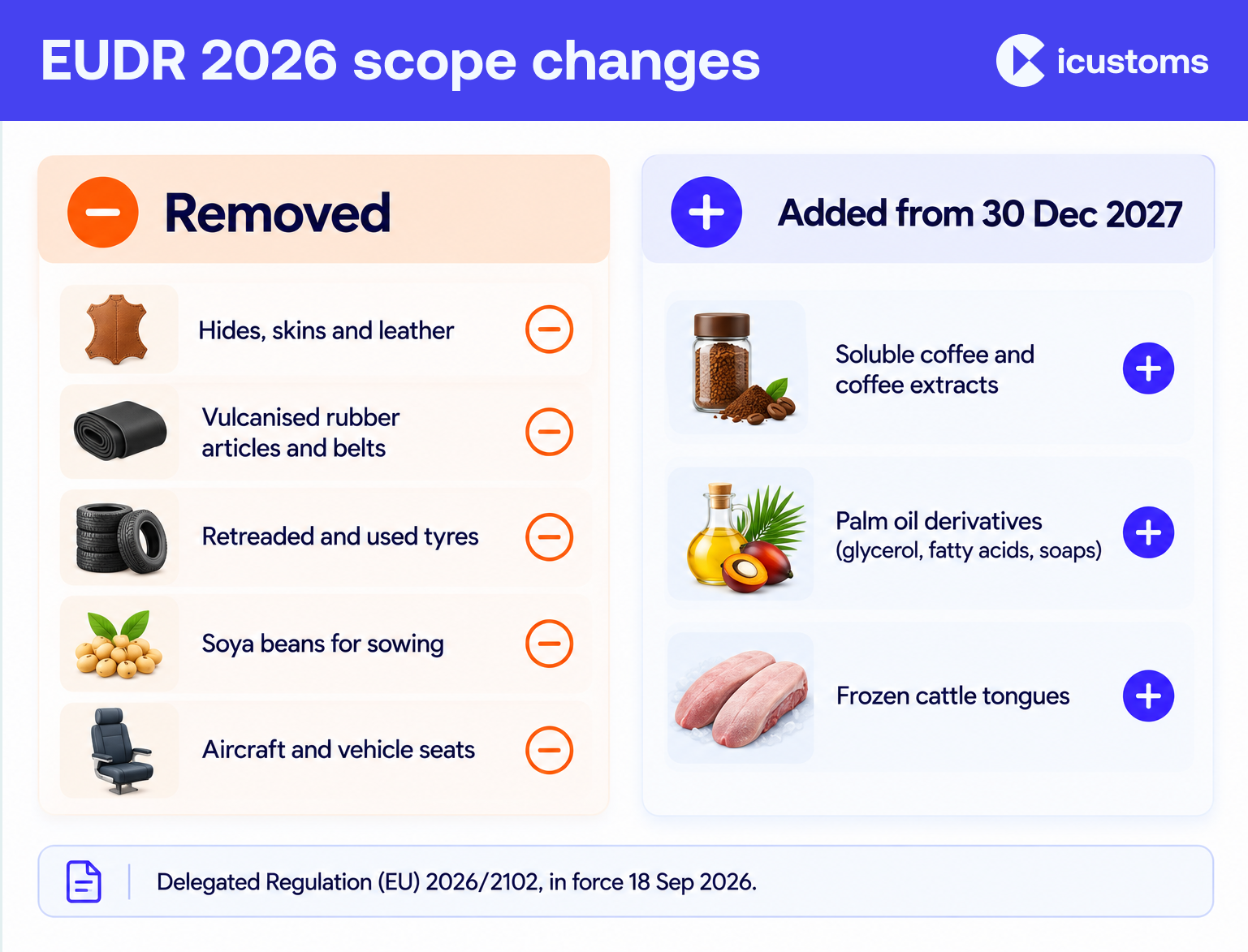
Delegated Regulation (EU) 2026/2102, published in the Official Journal on 17 September 2026, entered into force the following day and rewrites parts of Annex I.
- Removed: cattle hides, skins and leather; conveyor and transmission belts and other vulcanised rubber articles; retreaded and used tyres (only tyre treads remain); soya beans for sowing; aircraft and motor vehicle seats.
- Clarified: bamboo and rattan are not wood; buffalo and bison are not cattle; samples, waste, used goods and certain packaging and marketing materials are excluded.
- Added from 30 December 2027: soluble coffee and other coffee extracts, frozen cattle tongues and palm oil derivatives such as glycerol, fatty acids and soaps.
What it means for you: re-check your CN codes against the new Annex I. Leather and some rubber businesses may now be out of scope, while users of palm oil derivatives have a 2027 deadline.
10 September 2026: Commission proposes excluding French Guiana
As part of a wider package for the EU’s outermost regions (COM(2026) 661), the Commission proposed taking French Guiana out of the EUDR’s territorial scope, citing local food security and planned farmland expansion. Products moving from French Guiana into the rest of the EU would still need a DDS. It follows business feedback gathered at the Commission’s 21 April 2026 dialogue with the outermost regions, and is the only open proposal to amend the regulation.
What it means for you: no change for operators elsewhere, and the application dates are unaffected.
4 September 2026: Information System release 8.2.1
The Commission put release 8.2.1 live on the acceptance and production servers. It adds voluntary grouping of statements and versioning of simplified declarations, in the web interface and the API, plus stronger multi-operator authentication for API users.
What it means for you: API users should retest their connection; operators filing many statements can now group them.
13 July 2026: Delegated act and Information System rules adopted
The Commission adopted the scope delegated act above and Implementing Regulation (EU) 2026/1565. The new rules add the downstream operator and micro or small primary operator categories to the Information System, update the API for high-volume users, let operators group their own statements, set five-year retention in the system and provide contingency reference numbers for outages longer than 60 minutes.
What it means for you: if you plan to submit through the API, build against the updated specifications.
Late June 2026: Information System reopens; UK confirms Northern Ireland position
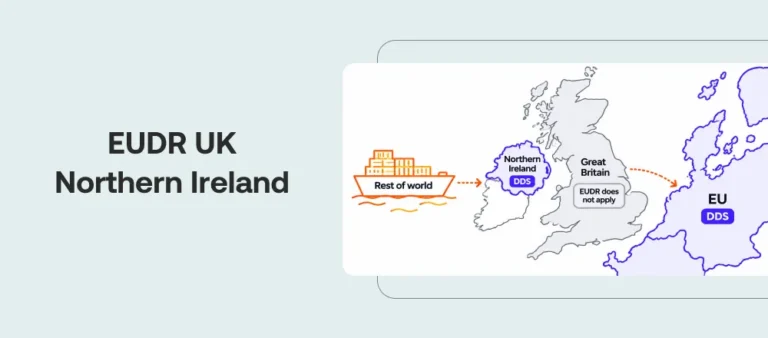
The Information System, run on the Commission’s TRACES platform, reopened for new registrations. The production server accepts statements with legal effect, and the acceptance server remains open for testing. On 23 June, Defra confirmed that the EUDR applies in Northern Ireland under the Windsor Framework, with separate rules for Great Britain to follow after consultation and legislation expected in 2027.
What it means for you: register your EU Login and test a statement on the acceptance server now. Businesses moving goods into Northern Ireland should plan as EU operators.
4 May 2026: Simplification review published
The Commission published its simplification review (COM(2026) 191) with updated guidance and FAQs. Key points: no postponement; downstream operators and traders can meet their record-keeping duty with standard documents such as invoices; a postal address can replace geolocation where it clearly matches the plot.
What it means for you: downstream businesses can usually rely on existing invoices and records rather than new systems.
21 April 2026: Outermost regions raise EUDR concerns with the Commission
At an Implementation Dialogue in Brussels, Executive Vice-President Raffaele Fitto heard from about 20 business and sector organisations from all nine EU outermost regions. Participants called for sector-specific adjustments, including in the wood sector when implementing the EUDR, and stressed the extra costs EU rules place on SMEs and micro enterprises in remote regions. This feedback came before the Commission’s outermost regions package of 10 September 2026.
What it means for you: a signal that the Commission is listening to regional and SME concerns, but no change to the rules or dates
February 2026: Enforcement dry-run findings
Competent authorities from Belgium, France, Germany and the Netherlands, supported by the European Forest Institute, published the second part of their findings from practice inspections in the coffee sector. They will check how due diligence was applied to specific shipments, expect underlying data rather than summaries, and treat certification as support, not proof.
What it means for you: keep shipment-level evidence, not just a policy document.
Earlier EUDR News: 2023 to 2025
26 December 2025: Second amendment in force
Regulation (EU) 2025/2650 set the current dates, created the downstream operator and micro or small primary operator categories, and removed printed products from scope. What it means for you: only the first operator files a DDS; everyone further down keeps records.
22 May 2025: Country benchmarking adopted
Implementing Regulation (EU) 2025/1093 rated countries low, standard or high risk. Belarus, Myanmar, North Korea and Russia are high risk; China, the United States, the UK and EU member states are among those rated low risk. What it means for you: sourcing only from low-risk countries allows simplified due diligence.
December 2024: First delay
Regulation (EU) 2024/3234 postponed application by twelve months. What it means for you: history only; later dates now apply.
29 June 2023: EUDR enters into force
Regulation (EU) 2023/1115 entered into force, replacing the EU Timber Regulation and setting the 31 December 2020 cutoff date. What it means for you: products made before this date are exempt (TARIC code Y132).
What to Watch Next
- French Guiana proposal: its progress through the Parliament and Council.
- National laws: Germany’s bill and other member states’ penalty regimes ahead of application.
- Country benchmarking: the Commission can revise the risk list; no revision has been published.
- Information System: further functions, API updates and the outage arrangements due by 30 December 2026.
- 30 December 2026, 30 June 2027 and 30 December 2027: the three application dates.

What These Updates Mean for Your Business
Since 2025 the obligations further down the supply chain have become simpler, but the core test at the point of entry has not changed. Operators still need plot-level geolocation, legality evidence and a due diligence statement for each relevant product. Downstream operators and traders need a reliable way to keep supplier references. Forwarders and customs agents need those references before they file.
iEUDR by iCustoms brings those steps together: supplier data through a dedicated portal, geolocation validation, AI-assisted CN code classification, DDS creation, validation and submission to EU TRACES, verification and validation of supplier DDS, and reference sharing with your forwarder, with a five-year audit trail. As the rules change, your workflow changes in one place.
Frequently Asked Questions
Has the EUDR been delayed again?
No. As of 27 October 2026, no proposal to change the application dates has been made. They remain 30 December 2026 and 30 June 2027.
Which products were removed from the EUDR in 2026?
Delegated Regulation (EU) 2026/2102 removed cattle hides, skins and leather, several vulcanised rubber articles including conveyor belts, retreaded and used tyres, soya beans for sowing, and aircraft and motor vehicle seats.
When does soluble coffee come under the EUDR?
From 30 December 2027, along with frozen cattle tongues and a range of palm oil derivatives.
Is the EUDR Information System open?
Yes. It reopened at the end of June 2026 for registrations, due diligence statements and simplified declarations, with a separate acceptance environment for testing.
Will the EUDR country risk list change?
It can. The Commission may revise the list under Implementing Regulation (EU) 2025/1093, but no revision has been published. Until then, the current list applies.
How often is this page updated?
We add an entry whenever an official EUDR change is published, usually within two working days, and show the date of the latest update at the top of the page.
You may also like:
Hard to keep up with every EUDR change?

iEUDR keeps product classification, supplier data and DDS submissions in one place, so adjusting to new rules is one update, not ten.
Subscribe to our Newsletter
About iCustoms
iCustoms is an all-in-one solution helping businesses automate customs processes more efficiently. With AI-powered and machine-learning capabilities, iCustoms is designed to streamline your all customs procedures in a few minutes, cut additional costs and save time.
Did the 2026 scope update change your product list?
iEUDR’s AI classification flags in-scope CN codes for your team to confirm, so scope changes show up before shipments do.