
AI Tariff Classification vs. Manual Classification: A Comparative Analysis
- Freya Jane
- Director of Customer's Success
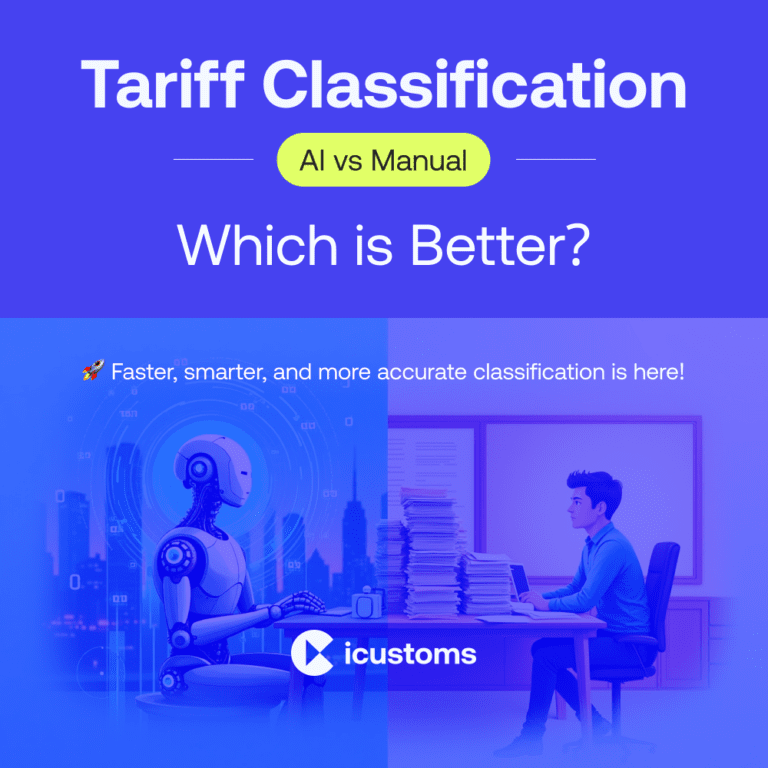
AI Tariff Classification is transforming how importers, exporters, freight forwarders, and customs brokers assign customs tariff classification numbers to traded goods. Traditional manual classification relies on specialist knowledge and extensive research, while AI powered systems use machine learning, Natural Language Processing, and historical customs data to automate the process. This comparison explores the differences between manual classification and AI driven approaches, including accuracy, scalability, compliance, and operational efficiency
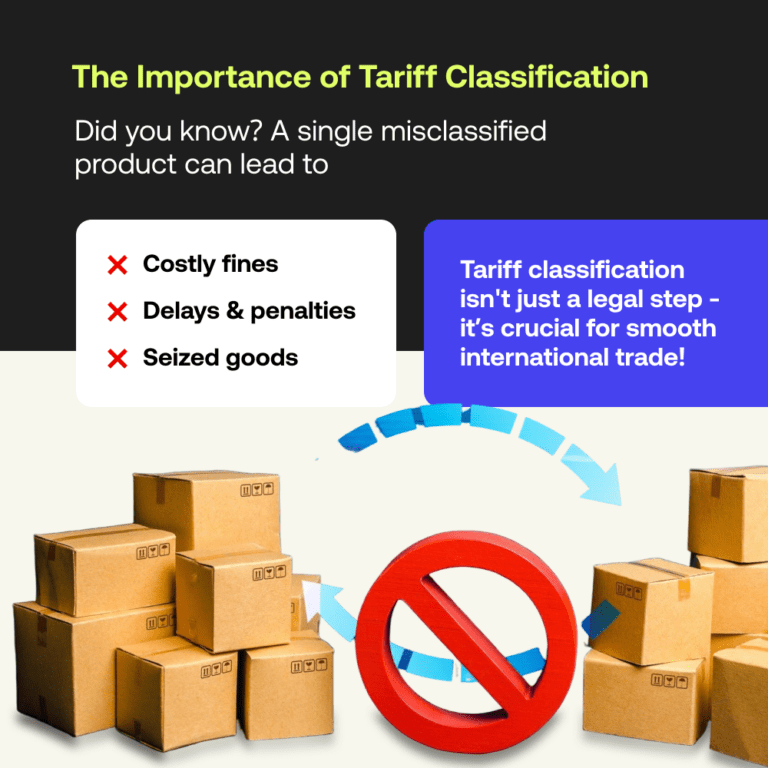
What if a single incorrectly classified product causes your company to face fines, delays, and even goods seizures?
Tariff or goods classification isn’t just a legal formality; it is the foundation of international trade, which ensures goods cross borders smoothly.
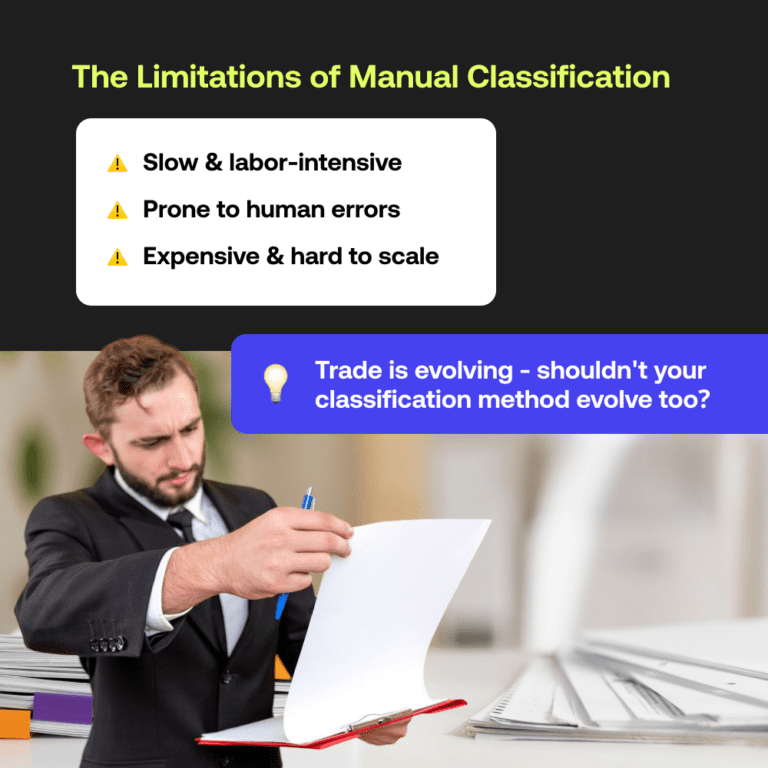
For decades, companies have been using trade compliance specialists to manually categorise goods using the Harmonised System (HS). Despite its effectiveness, this approach is laborious, erratic, and prone to human errors.
However, businesses now have a quicker, more precise, and scalable option thanks to the development of artificial intelligence (AI). AI-powered classification technologies make manual classification seem outdated by processing large datasets, lowering errors, and increasing productivity through automation and machine learning.
So, will AI eventually be used in tariff classification? Let us go through the comparison and look at the factors that lead to business transitions.

Manual tariff classification
In trade compliance, manual tariff classification has been used for a long time. It depends on human expertise to evaluate product descriptions, look up tariff schedules, and identify the appropriate HS codes. To correctly identify products, experts refer to past trade decisions and the General Rules of Interpretation (GRI).
Manual classification can have some benefits, but it also comes with many challenges.
Advantages of manual tariff classification
- Expertise: Skilled experts can interpret unclear or imprecise product descriptions and comprehend the subtleties of intricate regulations.
- Customisation: Humans can adapt to unique situations, such as new products or evolving trade laws, where predefined rules may not apply.
- Accountability: Human classifiers can provide explanations and justifications for their decisions, which is often required in audits or disputes.
Disadvantages of manual classification
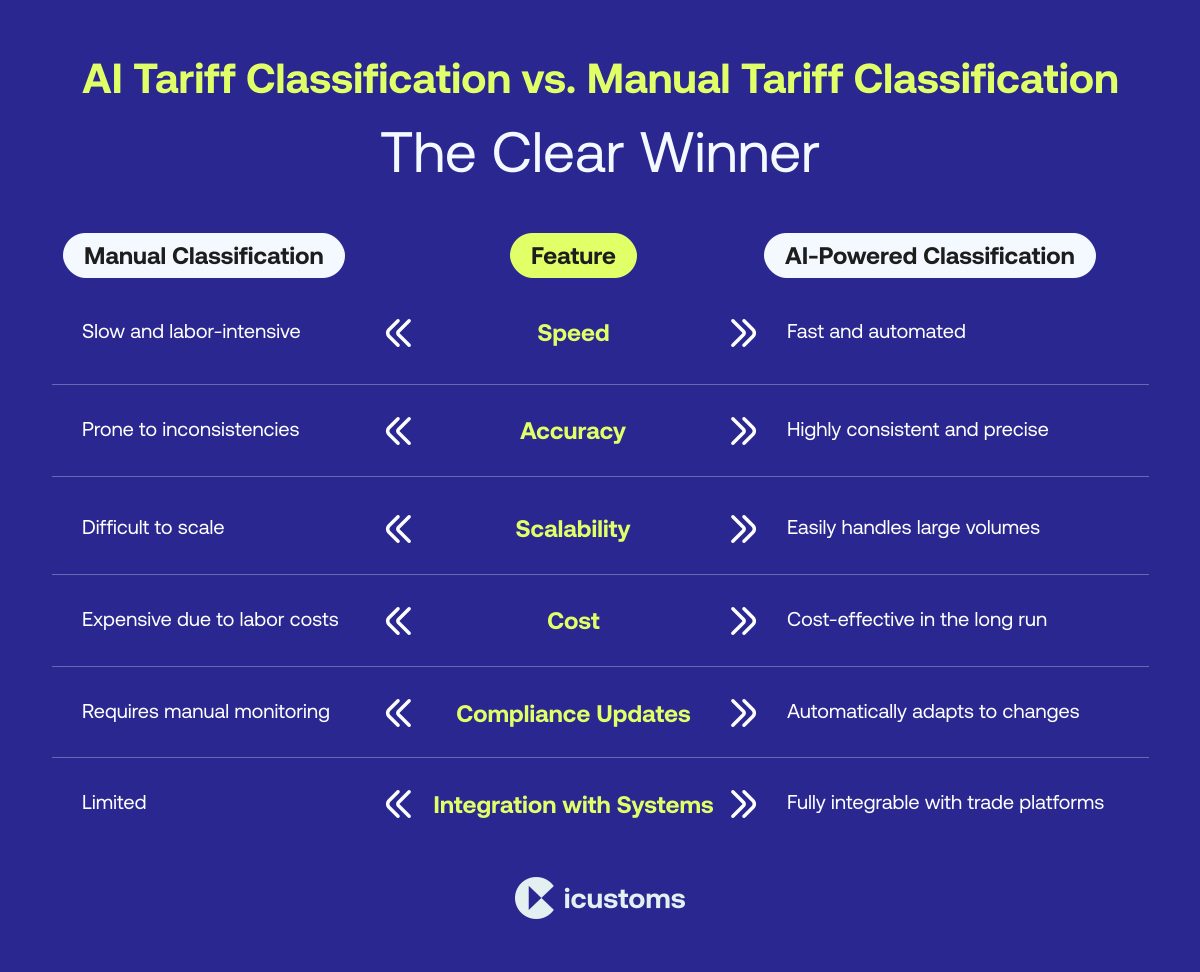
- Time-consuming: Manually assigning HS codes can be a laborious and slow operation, particularly for companies that have big product catalogs.
- Inconsistencies: Human interpretation may vary between different classifiers, leading to inconsistent classifications.
- Scalability problems: Manual product classification grows ineffective and resource-intensive as trade volumes rise.
- Increased costs: Hiring qualified experts for classification can be expensive, particularly when handling intricate or frequent transactions.
What Is Automated Tariff Classification?
Many trade professionals ask, what is automated tariff classification and how it differs from traditional classification methods. Automated tariff classification uses artificial intelligence, machine learning, and customs datasets to analyse product information and recommend the most appropriate customs tariff classification number. Rather than manually reviewing tariff schedules and classification rulings, businesses can automate much of the process while maintaining compliance and consistency.
AI-driven tariff classification automates the assignment of HS codes through the use of large datasets, machine learning algorithms, and Natural Language Processing (NLP). To identify the most accurate tariff codes, these systems examine product descriptions, legal requirements, and previous classification data.
AI classification is more reliable and beneficial than manual classification, but some companies may find it a bit challenging. Below are the potential advantages and disadvantages of AI-powered classification:
How Does AI Classify HS Codes?
Understanding how does ai classify hs codes is important for businesses evaluating customs automation solutions. AI systems analyse product descriptions, technical specifications, historical classification decisions, customs rulings, and tariff schedules. Using Natural Language Processing and machine learning models, the system identifies classification patterns and recommends the most suitable customs tariff classification number with a confidence score.
- Product description analysis
- Historical classification matching
- Customs ruling interpretation
- Pattern recognition across similar products
- Continuous learning from classification outcomes
Advantages of AI classification
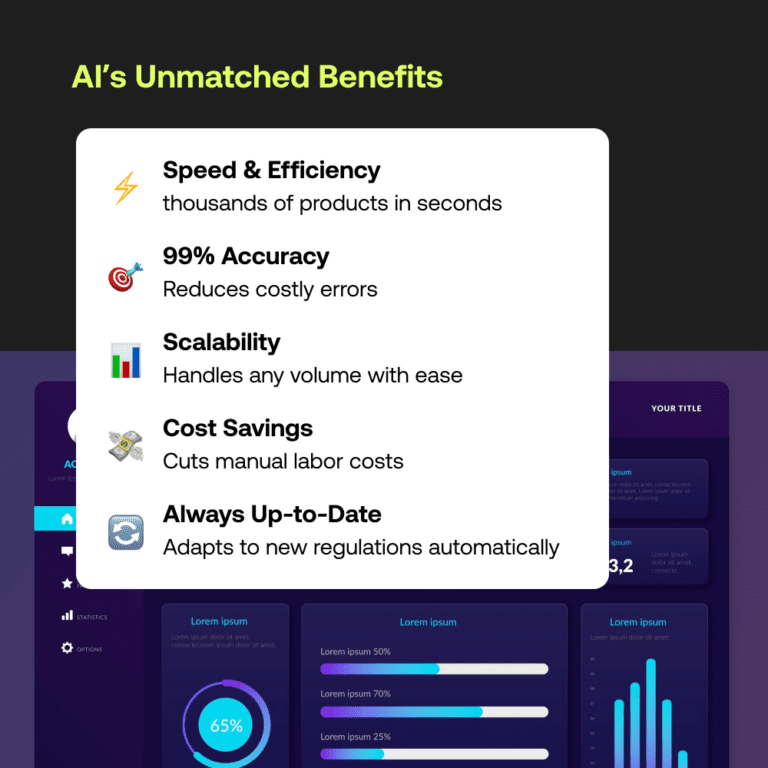
- Speed & efficiency: The time needed for tariff classification can be greatly decreased by using AI, which can classify thousands of items in a matter of seconds. For instance, it can help freight forwarders, importers/exporters, or other businesses that are involved in international trade to save time and improve productivity.
- Increased accuracy: Large datasets are used to train AI systems, guaranteeing 99% accuracy in the classification of the goods. AI reduces classification errors and increases compliance rates by ensuring data precision.
- Scalability: AI tools can classify multiple goods effortlessly. AI-driven classification systems may grow without the need for more human resources, regardless of the volume of items being handled.
- Cost effective: Businesses can cut operating expenses and their need for manual labor by automating classification processes. AI reduces the need to hire classification specialists, which has long-term economic advantages.
- Real-time adaptability: AI-powered systems are always learning and changing in response to past classification trends and new regulation updates. This eliminates the need for laborious manual research and guarantees that businesses stay in compliance with the most recent customs laws.
HS Code Automation Benefits
The growing interest in hs code automation benefits reflects the increasing pressure on businesses to improve customs compliance while reducing operational costs. Automated classification platforms help organisations process larger product catalogues, improve consistency, reduce manual effort, and accelerate customs filing workflows.
- Faster product classification
- Reduced compliance risk
- Improved classification consistency
- Lower operational costs
- Greater scalability
- Better audit readiness
- Faster customs declaration preparation
AI vs. Manual Classification: The Clear Winner
Let iCustoms AI handle your product classification!
Imagine a system that can quickly classify your products, remove costly errors, and stay up to date with changing trade laws without your intervention. This is exactly what iCustoms AI-powered iClassification tool does.
Businesses can rely on AI-driven automation that learns, adapts, and maintains 99% accuracy instead of spending hours manually assigning HS codes. iCustoms scales easily and integrates with your trade systems for a smooth process, regardless of how many shipments you handle.
Conclusion
As global trade regulations become increasingly complex, AI Tariff Classification offers a practical alternative to traditional manual processes. By combining machine learning, customs expertise, and automation, businesses can improve classification accuracy, reduce compliance risks, and scale their customs operations more effectively. Organisations seeking greater efficiency and consistency in customs tariff classification are increasingly adopting AI driven solutions as part of their broader trade compliance strategy.
AI Tariff Classification FAQs:
What is automated tariff classification?
Automated tariff classification uses artificial intelligence to analyse product descriptions, technical specifications, and customs data to recommend the correct customs tariff classification number. This can reduce classification time from hours to seconds while improving consistency.
How does AI classify HS codes?
AI classifies HS codes by analysing product attributes, historical classification decisions, tariff schedules, customs rulings, and trade data. Advanced machine learning models identify patterns and recommend the most appropriate classification with a confidence score.
What are the main benefits of AI Tariff Classification?
AI Tariff Classification helps businesses reduce manual effort, improve classification accuracy, accelerate customs processes, and scale compliance operations. Many organisations can classify thousands of products in the time it would take a specialist to manually review a handful.
Can AI Tariff Classification reduce customs compliance risks?
Yes. Incorrect classifications can result in duty overpayments, underpayments, customs delays, and audit issues. AI helps standardise classification decisions, reducing the risk of costly errors and improving compliance across large product catalogues.
What are the hs code automation benefits for importers and exporters?
Key hs code automation benefits include faster classification, lower operational costs, improved audit readiness, greater consistency across teams, and the ability to process large product volumes without increasing headcount.
How accurate is AI Tariff Classification compared to manual classification?
Modern AI classification platforms trained on customs data, tariff schedules, and historical rulings can achieve accuracy rates above 90 percent in many classification scenarios. Human experts remain important for highly complex, novel, or disputed classifications.
How much time can AI Tariff Classification save?
Manual classification can take several minutes to several hours per product depending on complexity. AI driven systems can analyse and classify products in seconds, enabling customs brokers, freight forwarders, and importers to significantly reduce processing times and improve operational efficiency.
You may also like:
Simplify Customs with our Powerful Customs Management Software

Automate declarations, track shipments, & ensure compliance.
About iCustoms
iCustoms is an all-in-one solution helping businesses automate customs processes more efficiently. With AI-powered and machine-learning capabilities, iCustoms is designed to streamline your all customs procedures in a few minutes, cut additional costs and save time.
Simplify Customs with our Powerful Customs Management Software
Automate declarations, track shipments, & ensure compliance.