
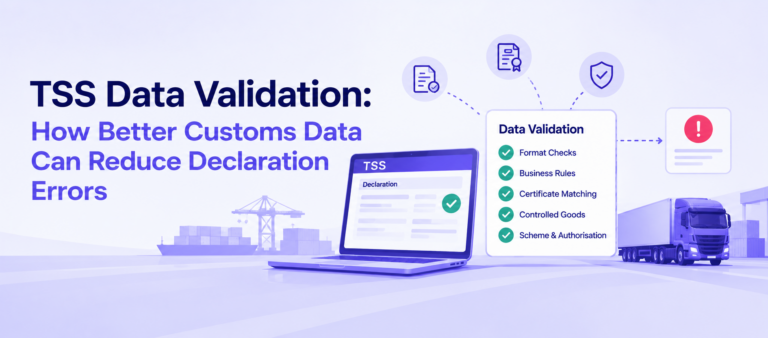
TSS for Licensed and Regulated Goods: Customs Data, Certificates and Controls
- John Hall
- Customs Specialist at iCustoms.ai
Goods are controlled if they’re subject to special health, licensing or environmental rules, and they have to be placed under customs control at the border rather than moved like standard goods. If your goods are shown as restricted on the Northern Ireland Tariff, they need to be entered as controlled goods and accompanied by the full supporting documentation, whether that’s a Home Office licence, a veterinary certificate or a phytosanitary certificate.
This guide covers the main categories of controlled and licensed goods moved through TSS, which certificate or licence typically applies to each, how to check whether your own goods are controlled, and the extra data TSS needs once they are. It doesn’t repeat the entry summary declaration process itself; that’s covered in full in TSS and ENS.
What counts as controlled or licensed goods
Controlled goods need a licence, certificate or authorisation before they can move from Great Britain, or from the rest of the world excluding the EU, into Northern Ireland. They must be presented at the border for pre-clearance or Border Inspection Post controls, and moving them under a standard goods declaration is not an option.
Which category a good falls into follows from its commodity code, not from a general description, which is why checking the code properly matters more here than almost anywhere else in a TSS movement.
Controlled goods categories at a glance
| Category | Typical certificate or licence |
|---|---|
| SPS / agri goods (meat, dairy, live animals, fish, plants, fruit and vegetables) | APHA import licence, phytosanitary certificate, Common Health Entry Document (CHED), CITES permit |
| Chemical goods | UK REACH registration, Prior Informed Consent (PIC) notification, domestic precursor licence |
| Excise goods (tobacco, alcohol, energy products, fuel) | Administrative Reference Code (ARC), electronic Administrative Document (eAD) |
| Fluorinated gases and ozone-depleting substances | Certificate of conformity, verification report |
| Military products | Export Control Joint Unit (ECJU) licence |
| Offensive weapons | Home Office authority or licence |
| Rough diamonds (from outside the EU/RoW excluding EU) | Kimberley Process Certificate |
How to determine if your goods need a licence
Start from the commodity code, then let the Northern Ireland Online Tariff Tool tell you what applies to it, rather than guessing from the category alone.
- Identify the commodity code for your goods using GOV.UK’s tool for finding commodity codes.
- Look up that code on the Northern Ireland Online Tariff, selecting the correct country of origin for the goods.
- Read the measures shown against the code, and the conditions attached to each one; a condition asking for a certificate, licence or other document is what makes the goods controlled.
- Check the footnotes on the commodity page for further controls, and search again if an ingredient, component or the goods’ origin could bring in extra rules of its own.
- Use the tariff duty calculator on the same page to check whether duty applies. This is a separate question from whether the goods are controlled, and it’s covered in more detail in TSS and Customs Duty.
Carry what you find, national additional codes, tax type, document codes, into the correct TSS declaration field. Which declaration type you’re completing is covered in TSS Declarations Explained.
What TSS needs from you
Controlled goods carry data obligations on top of a standard movement. Where an entry summary declaration is required, information has to be provided at both consignment and item level rather than just at consignment level; the mechanics of entry summary declarations themselves are covered in TSS and ENS, not repeated here.
A few fields are specific to controlled goods in the TSS Portal. Document and status codes identify which certificate or licence applies and its current state; GOV.UK’s Appendix 5A and 5B cover the codes in full. GB to NI domestic movements need ‘NIDOM’ entered as the Goods Domestic Status, and all SPS controlled goods need a Net Mass entered at item level. For products of animal origin or high-risk food of non-animal origin where a CHED isn’t required, such as goods imported for research, the status code XW can be used instead, with ‘Waiver claimed’ entered in the Document Reason field.
What happens if the documentation doesn't match
The information on your declaration has to match the certificate or licence behind it. Health certificates in particular are checked against CERTEX, so a mismatch is not a formatting issue; it’s what gets a movement referred for inspection, and it’s also what causes most of the delays traders see on controlled goods lanes. Attach licences, certificates and other documents upfront rather than waiting to be asked for them.
Beyond delay, moving controlled goods without the right documentation can mean the goods are held or seized at the border, and in the more serious categories, offensive weapons, controlled drugs, CITES-listed species, it can carry fines or prosecution. The category, not the value of the shipment, decides how seriously this is treated.
Common misconceptions
All goods moving to Northern Ireland need a licence. They don’t. Only goods shown as controlled or restricted on the Northern Ireland Tariff need one; most standard goods move without any licence or certificate at all.
The commodity code alone tells you if goods are controlled. Not quite. The code gets you to the right page; it’s the measures and conditions shown against that code on the Online Tariff Tool that actually confirm control status.
One licence covers every controlled category. It doesn’t. SPS goods, chemicals, excise goods, military products and rough diamonds each have their own certificate or licence types, issued by different bodies.
TSS decides whether your goods are controlled. It doesn’t. TSS is where the movement is declared; working out the category and obtaining the right licence or certificate stays with the trader.
How iCustoms simplifies controlled goods compliance
Manually working through the Online Tariff Tool, cross-checking certificate reference numbers, and keeping document and status codes correct across a mix of SPS, chemical and excise movements is where controlled goods compliance usually breaks down. iCustoms is TSS controlled goods software built for exactly that: it matches your commodity code against the current controls, flags the licence or certificate your movement needs before you submit, and checks that the reference numbers on your declaration match what’s on the certificate itself.
If your business already searches for customs software for licensed goods, or is comparing options for TSS controlled goods automation, that’s precisely the gap iCustoms is built to close, so you’re not relying on a person remembering to check the tariff tool for every commodity code.
Frequently Asked Questions
What counts as controlled or licensed goods in TSS?
Goods subject to special health, licensing or environmental controls that must be placed under customs control and presented at the border with full supporting documentation, rather than moved as standard goods.
What licences and certificates do controlled goods need?
It depends on the category: APHA licences, phytosanitary certificates, CHED and CITES permits for SPS and agri goods; REACH registration and PIC notifications for chemicals; an ARC and eAD for excise goods; certificates of conformity for F-gases; and a Kimberley Process Certificate for rough diamonds, among others.
How do I check if my goods need a licence to enter Northern Ireland?
Look up your commodity code on the Northern Ireland Online Tariff Tool and read the measures and conditions shown against it. A condition requiring a certificate, licence or other document means the goods are controlled.
What is the Northern Ireland Online Tariff Tool?
A GOV.UK tool that shows the prohibitions, restrictions, duties and other measures that apply to a specific commodity code moving into Northern Ireland.
What data does TSS need for controlled goods?
Consignment and item-level entry summary declaration data where one is required, plus document and status codes, Net Mass at item level for SPS goods, and NIDOM for GB to NI domestic movements.
Do controlled goods need an entry summary declaration?
Often, yes, and with more detail than standard goods; the full rules for who needs one and when are covered in TSS and ENS.
What happens if my certificate doesn't match my declaration?
A mismatch, particularly on health certificates checked against CERTEX, is likely to get the movement referred for inspection, which causes delay even where the underlying paperwork is otherwise in order.
What are document and status codes in a TSS declaration?
Codes that identify which certificate or licence applies to a movement and its current status; GOV.UK's Appendix 5A and 5B set out the full list.
What's the penalty for moving controlled goods without a licence?
It varies by category, from goods being held or seized at the border to fines, and in the most serious categories, prosecution.
How does iCustoms help with TSS controlled goods compliance?
iCustoms checks your commodity code against the categories and licence requirements that apply, flags missing or mismatched certificate references before submission, and keeps the document and status codes attached to the declaration rather than tracked separately.
You may also like:
Moving Controlled or Licensed Goods to NI?

iCustoms flags the licences and certificates your movement needs, before you submit.
Subscribe to our Newsletter
About iCustoms
iCustoms is an all-in-one solution helping businesses automate customs processes more efficiently. With AI-powered and machine-learning capabilities, iCustoms is designed to streamline your all customs procedures in a few minutes, cut additional costs and save time.
Stop Checking the Tariff Tool by Hand
iCustoms matches your commodity code to the licences, certificates and codes it needs.