
Do You Need a Phytosanitary Certificate? UK Plant Export Guide
- John Hall
- Customs Specialist at iCustoms.ai
If you export plants, seeds, cut flowers or wood from the UK, the short answer is usually yes. A phytosanitary certificate is the official document that confirms your plants are free from regulated pests and diseases and meet the destination country’s plant health rules. Since Brexit, most regulated plants leaving Great Britain for the EU now need one, where before they did not.
This guide answers the question directly: what a phytosanitary certificate is, which goods need one, who issues it, how to apply, and what it costs. Because the rules turn on what you are sending and where it is going, we set each part out clearly.
What is a phytosanitary certificate?
A phytosanitary certificate is an official plant health document issued under the International Plant Protection Convention (IPPC). It certifies that a consignment of plants or plant products has been inspected and is considered free from quarantine pests, and that it meets the importing country’s requirements. In effect, it is the plant world’s equivalent of a health certificate, and border officials treat it as the primary proof that plants are safe to enter.
The system sits within the World Trade Organization’s SPS Agreement and the international ISPM standards, so the same basic document is recognised worldwide. That shared framework is why an inspection in York can satisfy an importer in Spain or Japan.
Do you need one? Which plants and products require a phytosanitary certificate
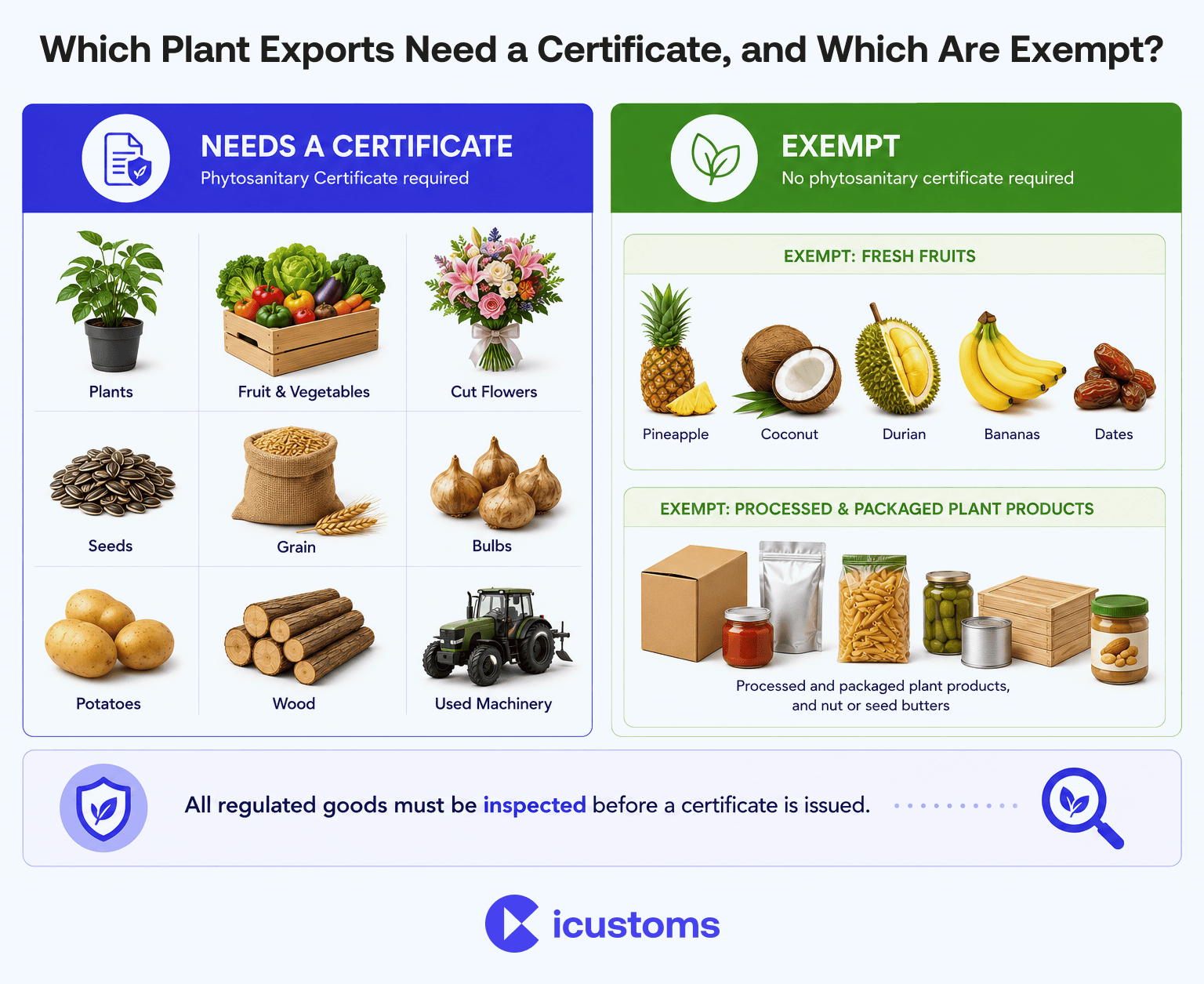
You may need a phytosanitary certificate to export a wide range of regulated plants and plant products. All of these goods must be inspected before a certificate can be issued.
| Goods That May Need a Certificate | Examples |
|---|---|
| Plants | Fruit, vegetables, cut flowers, and other live plants. |
| Seeds and Grain | Sowing seed, cereal grain, and other seeds intended for export. |
| Bulbs and Potatoes | Flower bulbs, ware potatoes, and seed potatoes. |
| Wood and Wood Products | Timber, logs, isolated bark, and other regulated wood products. |
| Used Machinery | Used agricultural or forestry machinery that has been operated in farming or forestry activities. |
The safest first step is to check the destination country’s requirements, because these vary. Contact the plant health authority in the importing country, or check the IPPC country list, before you book an inspection.
Which goods are exempt?
Some products carry a low enough biosecurity risk that they need no certificate at all. You do not need a certificate for these exempt goods:
- Certain fruits: pineapple, coconut, durian, bananas and dates
- Grain, and plant products processed and packaged so they no longer pose a biosecurity risk
- Composite products such as nut and seed butters made from processed fruit or vegetables
If your product is on the exempt list, it moves without plant health controls. However, when in doubt, confirm with your inspector rather than assume, because a wrong call surfaces only at the border.
Plant passport vs phytosanitary certificate: what's the difference?
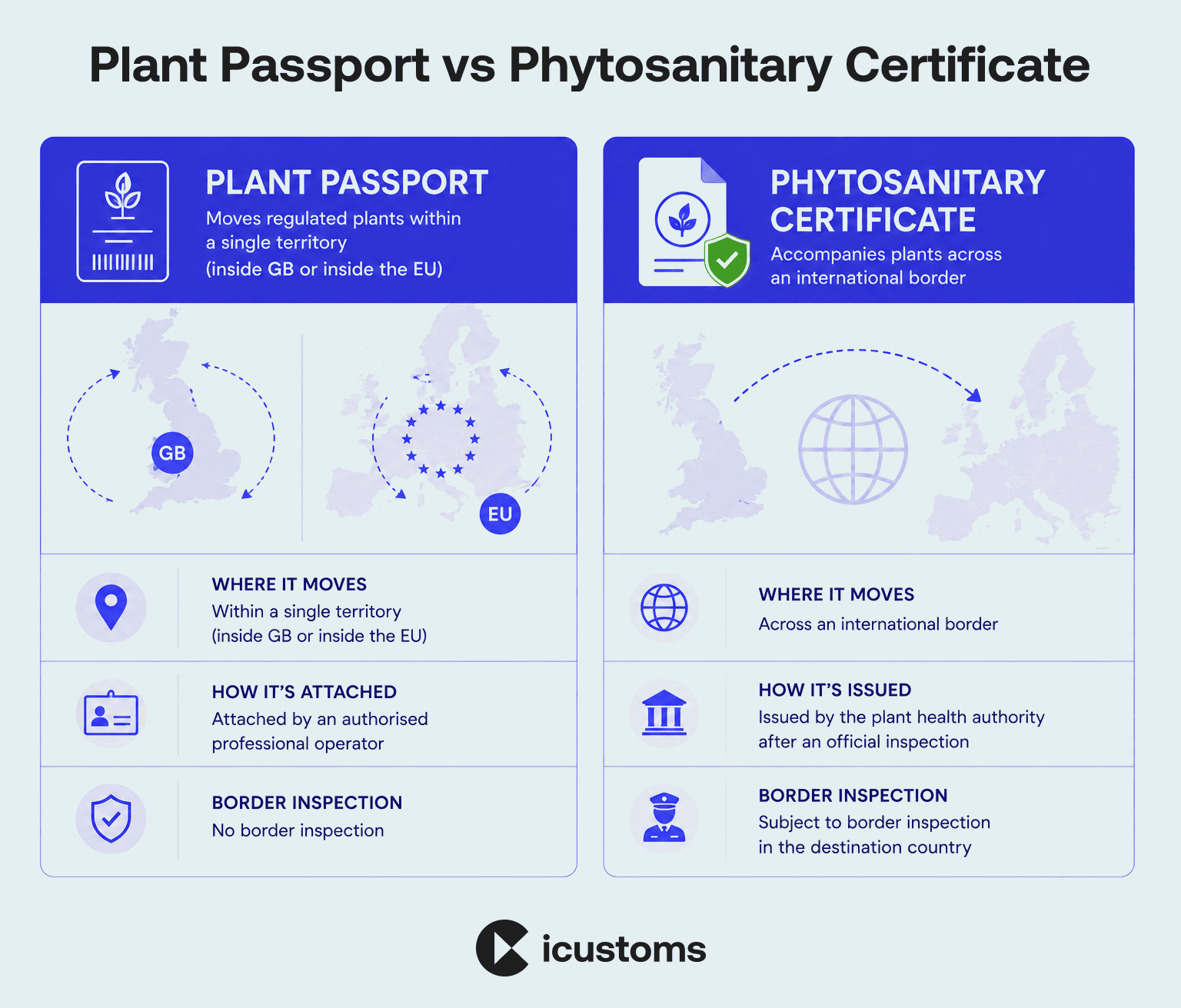
These two documents are often confused, yet they do different jobs. A plant passport moves regulated plants within a single territory, while a phytosanitary certificate accompanies plants across an international border.
| Plant Passport | Phytosanitary Certificate |
|---|---|
| Moves regulated plants within a single territory (inside Great Britain or inside the European Union). | Accompanies plants exported across a border to another country. |
| Attached by an authorised professional operator. | Issued by the national plant health authority following an official inspection. |
| No border inspection is normally required when goods remain within the same territory. | Requires an official inspection before issue. |
Who issues a phytosanitary certificate in the UK?
The UK’s plant health authorities act as the National Plant Protection Organisation and issue certificates after inspection. The authority depends on where the goods leave from.
| Region | UK Plant Health Authority |
|---|---|
| England and Wales | Animal and Plant Health Agency (APHA) |
| Scotland | Science and Advice for Scottish Agriculture (SASA) |
| Northern Ireland | Department of Agriculture, Environment and Rural Affairs (DAERA) |
Whichever authority applies, an official plant health inspector must examine the consignment first. You cannot self-certify, unless you are an approved member of an audited scheme such as PHEATS, which lets eligible traders carry out their own inspections.
How to apply for a phytosanitary certificate, step by step
For exports from England and Wales, the process runs through the online plant export service, and the order matters.
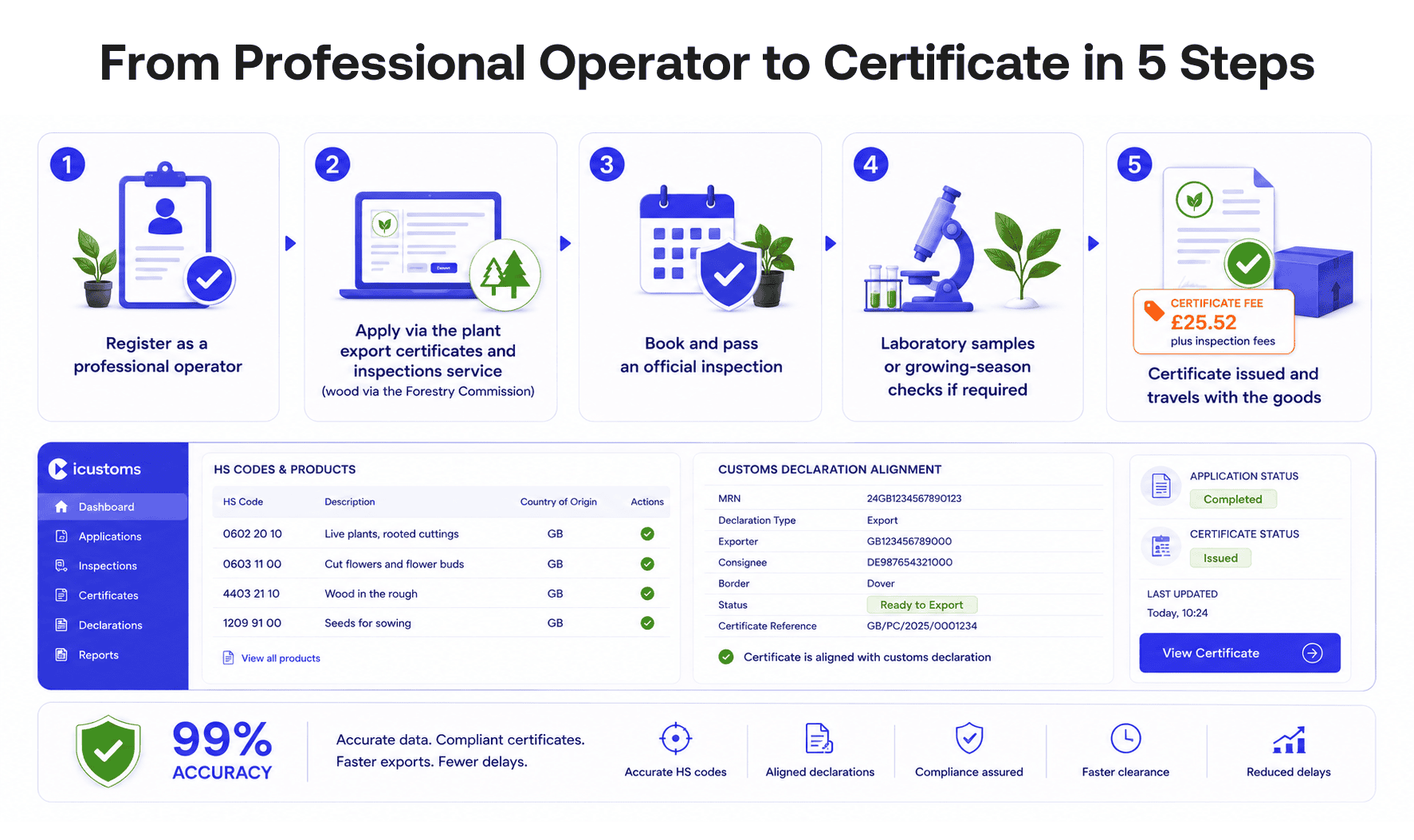
- Register as a professional operator with your plant health authority, if you have not already.
- Apply through the Apply for plant export certificates and inspections service, naming the goods and destination.
- Book an inspection; wood and wood products go through the Forestry Commission’s timber service instead.
- An inspector examines the consignment, and may take laboratory samples or require a growing-season inspection.
- Once satisfied, the authority issues the certificate, which travels with the goods to their destination.
A paper application adds an extra fee, so most exporters apply online. Because inspections must be booked and carried out before issue, you should start the process in good time rather than days before shipping.
How much does a phytosanitary certificate cost?
Fees for England and Wales are set per certificate and per inspection. The figures below are the main charges; Scotland’s fees differ, so contact SASA.
| Item | Fee (England and Wales) |
|---|---|
| Phytosanitary certificate | £25.52 |
| Inspection (first 30 minutes) | £127.60 |
| Each additional 15 minutes of inspection | £63.80 |
| Certificate amendment | £15.76 |
| Laboratory sample examined | £33.56 |
| Paper application (additional charge) | £15.76 |
Smaller exporters may qualify for concessionary rates on the first portion of plant health services in a financial year, for example if certified exports were worth less than a set threshold last year. It is worth checking eligibility before you apply.
Still Juggling Plant Export Paperwork by Hand?
Keep your phytosanitary certificate, HS codes and customs declaration aligned on one platform with iCustoms.
Moving plants from Great Britain to Northern Ireland
Movements to Northern Ireland follow their own route. Plants staying in Northern Ireland can travel under a Northern Ireland Plant Health Label (NIPHL), while goods not remaining there need a certificate, now available as an electronic ePhyto. In both cases the receiver notifies DAERA by submitting a plant health Common Health Entry Document (CHED-PP) on TRACES NT.
Phytosanitary certificates are one check among many
A phytosanitary certificate sits alongside your customs declaration, HS codes and, for animal-origin goods, an Export Health Certificate. When those documents disagree, consignments stop. Officials expect the descriptions, quantities and codes to match across every form, and officials check the CHED-PP raised in TRACES NT against them on arrival.
Why choose iCustoms for plant export compliance?
The certificate itself is a plant health document, but everything around it is a data and customs task. The same consignment needs a correct customs declaration, accurate HS codes and consistent information across every document, and that is where errors creep in.
iCustoms keeps that data story consistent. Its Intelligent Document Processing extracts and verifies information from your trade documents, iTraces validates establishment and TRACES-related codes against the official EU database, and iClassification confirms HS codes across 32 countries and more. As a result, teams cut manual effort by up to 80% and work far faster, with 99% accuracy. Logistics leaders such as Kerry Logistics, Ziegler and Woodside Logistics Group already run their customs operations this way.
The inspection and certification stay with your plant health authority, exactly as the rules require. What iCustoms adds is confidence that the customs and data layer around the certificate, especially for movements involving Northern Ireland, is accurate before anything reaches a border control post.
One Consignment, One Consistent Data Story
See how iCustoms AI keeps your plant export documents aligned from application to border clearance.
Frequently Asked Questions
What is a phytosanitary certificate?
It is an official plant health document, issued under the IPPC framework, confirming that a consignment of plants or plant products has been inspected, is free from regulated pests, and meets the importing country's requirements.
Do I need a phytosanitary certificate to export plants?
Usually yes. Most regulated plants, seeds, cut flowers, bulbs, potatoes, wood and used agricultural machinery need one. Always check the destination country's rules first, as a small list of goods is exempt.
Who issues a phytosanitary certificate in the UK?
APHA issues certificates for England and Wales, SASA for Scotland, and DAERA for Northern Ireland. An official inspector must examine the consignment before the authority issues a certificate.
How do I apply for a phytosanitary certificate?
Register as a professional operator, then apply through the Apply for plant export certificates and inspections service. Book an inspection, and the authority issues the certificate once the goods pass. Wood exports go through the Forestry Commission's timber service.
Which plants require a phytosanitary certificate?
Regulated plants and plant products, including fruit, vegetables, cut flowers, seeds, grain, bulbs, potatoes, wood and used farm or forestry machinery. An inspector must examine each one before issue.
You may also like:
Subscribe to our Newsletter
About iCustoms
iCustoms is an all-in-one solution helping businesses automate customs processes more efficiently. With AI-powered and machine-learning capabilities, iCustoms is designed to streamline your all customs procedures in a few minutes, cut additional costs and save time.
One Mismatch Can Stop Your Plant Export

AI checks every document matches before the border