
EMCS Import Process: How CDS, EMCS and Warehousing Work Together
- John Hall
- Customs Specialist at iCustoms.ai
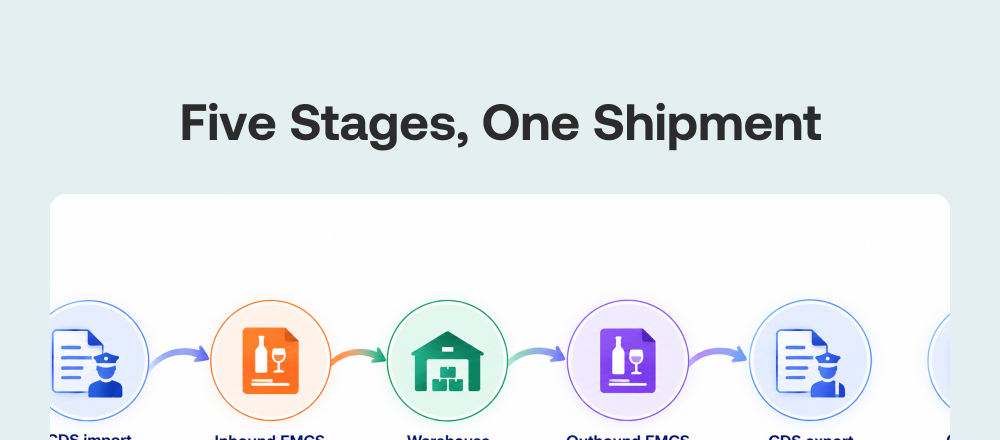
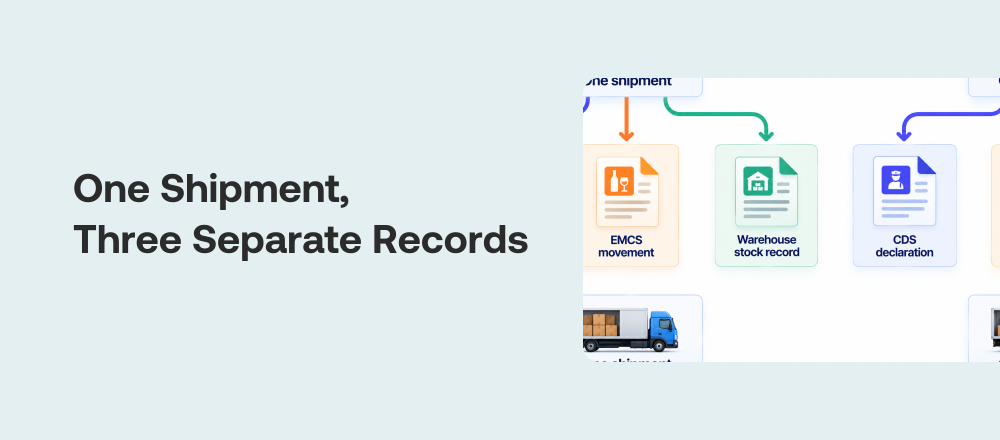
A single container of duty-suspended spirits arriving at Felixstowe from outside the UK touches three separate HMRC systems before it reaches a shelf, and by default none of them share a field with each other. The importer files a customs declaration through CDS. A registered consignor starts a movement in EMCS. A warehousekeeper records the goods into stock. Three systems, three logins, and in most businesses, three sets of data typed in from the same commercial invoice.
None of this is optional, and skipping a step does not mean skipping the paperwork. It means paying duty you did not need to pay, or moving goods you were not authorised to move. This guide traces the actual handoffs: what CDS does, where EMCS picks up, and how the goods land in an excise warehouse with a stock record that matches what HMRC was told.
The Three Systems, and What Each One Actually Owns
Before the handoffs make sense, it helps to be clear about what each system is for, because they are frequently confused with each other.
CDS, the Customs Declaration Service, is where the import itself is declared: what the goods are, where they came from, and whether duty is being paid now or deferred into a warehouse. CDS does not move goods and does not track them once they are in transit. It is a point-in-time declaration.
EMCS, the Excise Movement and Control System, tracks a duty-suspended movement while it is actually happening, from the moment it starts to the moment the receiving warehouse confirms the goods arrived. EMCS does not decide whether duty is owed. It accounts for goods that are moving without duty having been paid yet.
The excise warehouse itself, whether that is a bonded facility at the port or a producer’s own warehouse, is where the goods physically sit and where a stock record has to reconcile with both the CDS declaration and the EMCS movement that brought the goods there. For the fuller picture of what a warehousekeeper is responsible for once goods are on site, see our guide to excise warehouse keepers.
Three systems, three different jobs. The “EMCS import process” is really the sequence of handoffs between them.
Handoff 1: The CDS Import Declaration
The first system to touch the shipment is CDS, and the declaration has to say explicitly that the goods are going into an excise warehouse rather than being released with duty paid at the border.
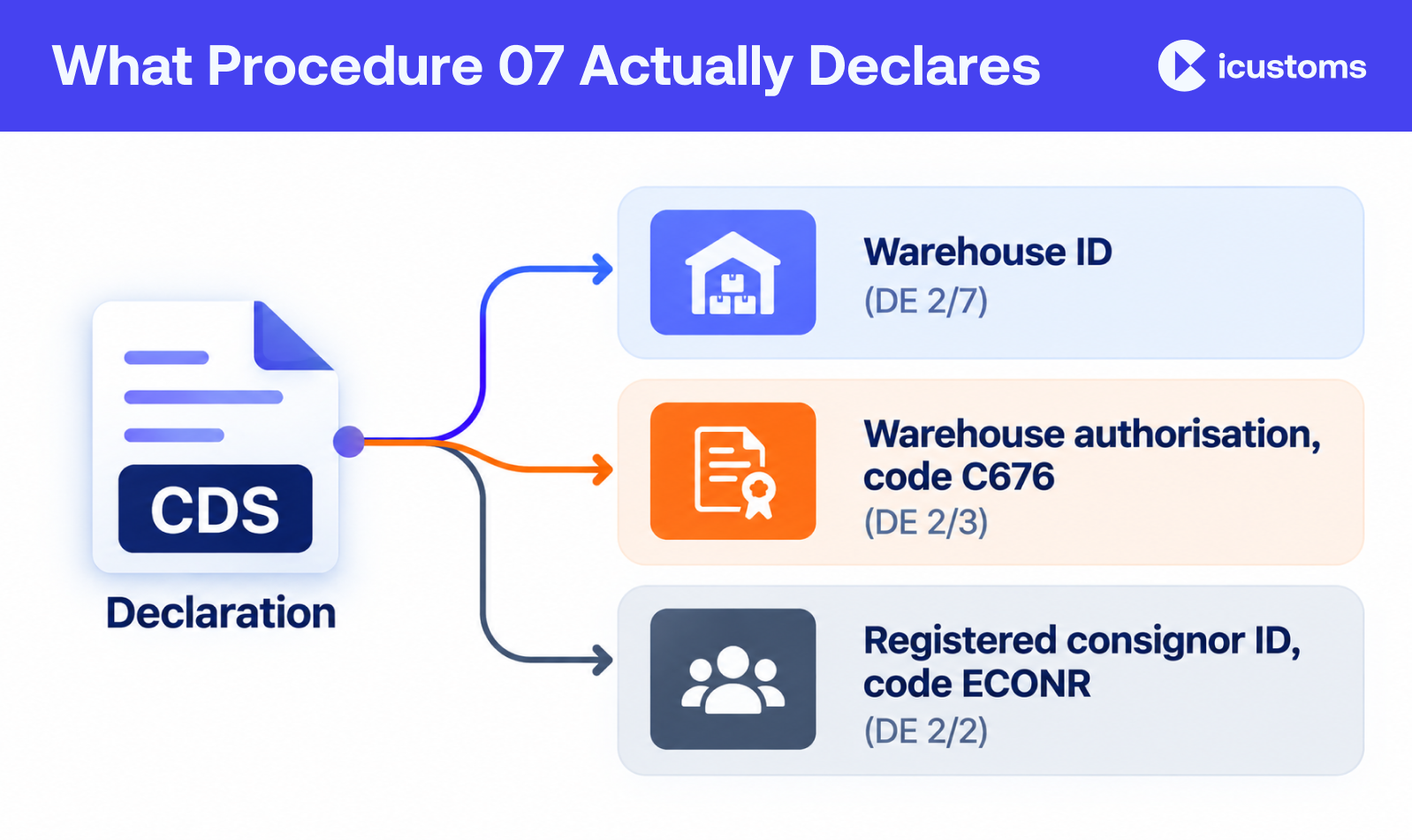
This is CDS Requested Procedure 07: release for free circulation with simultaneous entry to an excise warehouse. In practice, that means the declaration carries the excise warehouse’s own reference (Data Element 2/7), the warehouse’s authorisation under document code C676 (Data Element 2/3), and, critically, the ID of whichever registered consignor is authorised to move the goods on afterwards, entered under code ECONR (Data Element 2/2).
Getting the warehouse ID and the C676 authorisation right is what stops the declaration itself from being rejected. Getting the registered consignor field right is what makes the next step possible at all, and it is the part businesses most often get wrong, because it assumes that approval is already in place before the goods land.
Handoff 2: Only a Registered Consignor Can Start the EMCS Movement
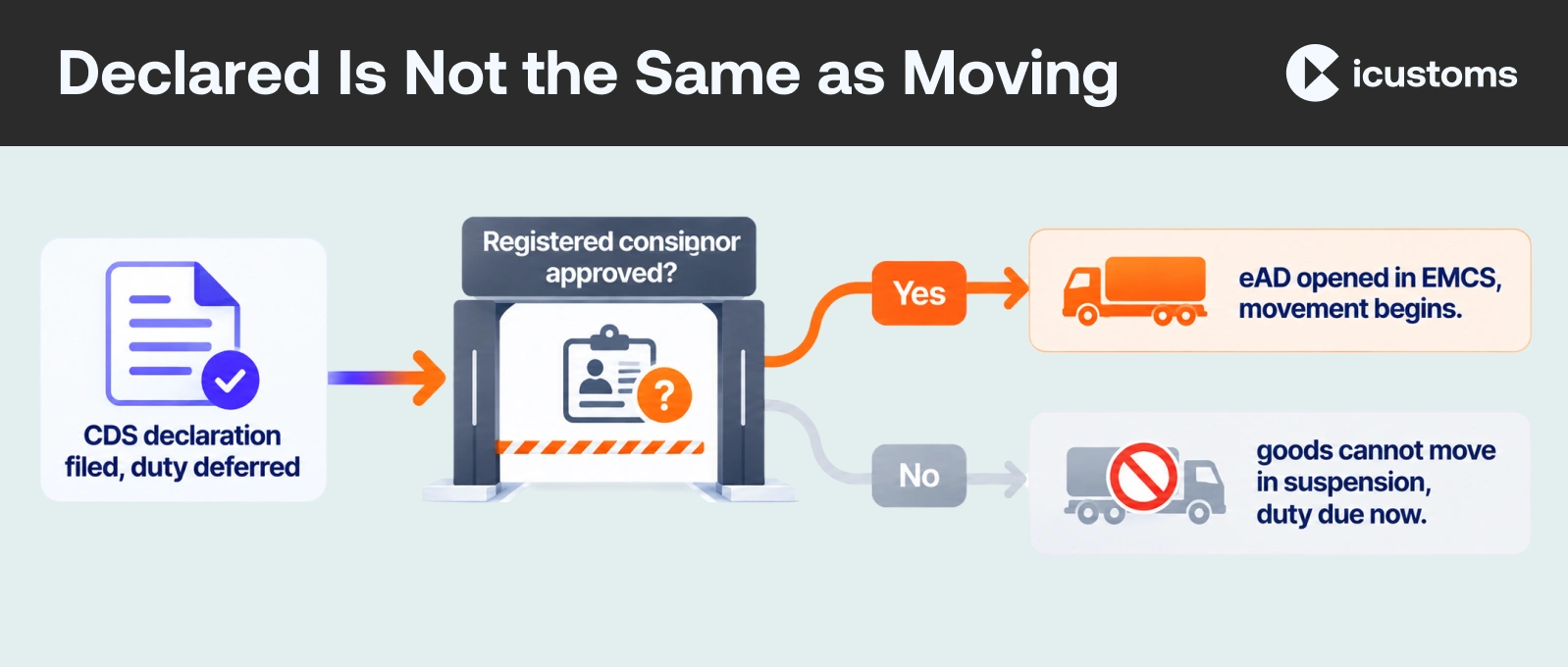
This is the step that catches importers out. A CDS declaration under Procedure 07 defers the duty. On its own, it does not authorise anyone to move the goods anywhere. HMRC’s own guidance is direct about it: goods can only move in excise duty suspension to their destination once a registered consignor has started that movement using EMCS.
Registered consignor status is a separate HMRC approval, applied for on form EX72, and HMRC asks for at least 45 working days to process it, including background checks on financial viability, compliance history and the applicant’s controls against goods disappearing into the illicit market. Import agents, warehousekeepers receiving their own goods, and businesses moving goods on to Northern Ireland can all apply, but the approval has to already be in place before the shipment lands. It is not something that can be arranged at the port.
Once approved, the registered consignor is who opens the eAD, the electronic administrative document, in EMCS. The eAD is what actually authorises the journey from the point of import to the warehouse under duty suspension, and it generates the ARC, the reference both HMRC and the warehouse check the movement against. Our pillar guide on what EMCS is covers the eAD and the ARC in full detail; this article only covers where they sit in the import sequence.
Handoff 3: Receiving the Goods Into the Excise Warehouse
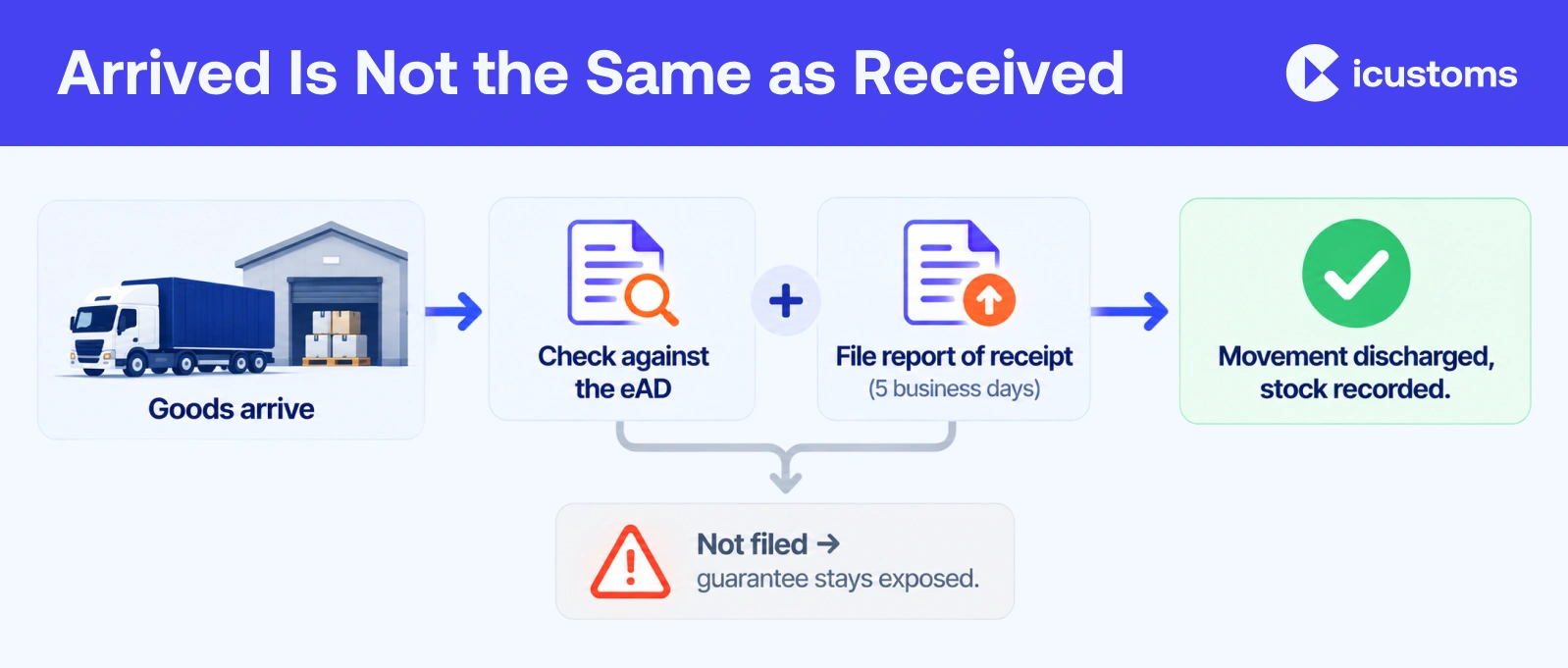
The eAD travels with the goods. When they arrive, the warehousekeeper checks the physical delivery against it, records any shortage or surplus, and submits a report of receipt through EMCS, which HMRC expects within five business days. That report is what discharges the movement and releases the registered consignor’s movement guarantee.
Only once the report of receipt is filed does the stock genuinely exist, in HMRC’s eyes, inside the warehouse. Until then it is still a movement in transit, not warehouse stock, whatever the physical reality on the loading bay.
Where the Same Import Trips Up Businesses Twice
Every step above depends on data that was correct in the very first declaration: the commodity details, the quantity, the warehouse ID. When a business runs CDS, EMCS and its warehouse stock system as three unconnected tools, that same data gets typed in three times, often by up to three different people, and the most common source of a rejected eAD or a mismatched stock record is a simple transcription difference between the CDS declaration and what gets keyed into EMCS afterwards.
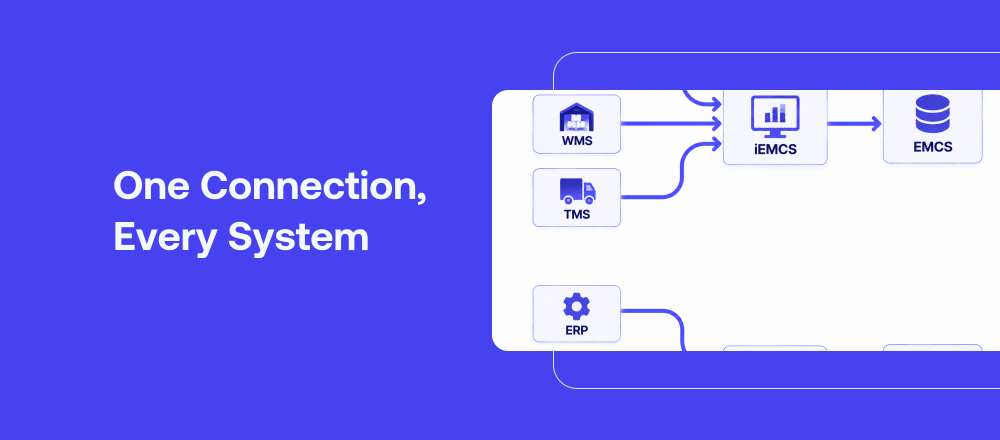
iEMCS sits at exactly that junction, between the CDS declaration and the warehouse, rather than asking anyone to bridge the two by hand. Once registered consignor status is confirmed, it auto-populates up to 80 percent of the e-AD directly from the CDS import declaration, so the warehouse ID, commodity detail and consignor information do not get typed in twice. It validates the movement against both the CDS declaration and the connected warehouse’s own records before the e-AD is submitted, which is what catches a mismatch before HMRC does, and it tracks the ARC, the journey and the report of receipt in real time rather than leaving that to a spreadsheet. Because it mirrors that same data with iWarehouse, the stock record that appears on arrival reflects what was actually declared at import, not a second, separately typed version of it. The mechanics of exactly how that CDS data maps onto the e-AD are covered in full in our CDS to EMCS guide; this article only needed to show where iEMCS sits in the sequence.
A Short Worked Example
A UK drinks importer brings a container of wine into Felixstowe from outside the UK, destined for a bonded warehouse near Milton Keynes. The customs broker files the CDS import declaration under Procedure 07, naming the Milton Keynes warehouse’s C676 authorisation and quoting the importer’s registered consignor ID, arranged with HMRC weeks earlier.
That registered consignor status is what lets the broker open an eAD in EMCS the moment the goods clear at the port, authorising the road movement to Milton Keynes with duty still suspended. When the container arrives, the warehousekeeper checks it against the eAD, records it as received with no discrepancy, and files the report of receipt within the five-day window. Only at that point does the stock appear in the warehouse’s own records as duty-suspended inventory, ready for onward sale or further movement.
Common Misconceptions
A CDS declaration alone moves excise goods into a warehouse. It does not. Procedure 07 defers the duty; a registered consignor still has to open the EMCS movement separately.
Any importer can move their own goods under duty suspension. They cannot, not without registered consignor approval arranged in advance, which takes HMRC around 45 working days to process.
The stock exists in the warehouse as soon as the goods physically arrive. It does not, in HMRC’s terms, until the report of receipt is filed in EMCS and the movement is discharged.
Five Things to Take Away
- An excise import passes through three systems: CDS for the declaration, EMCS for the duty-suspended movement, and the warehouse for the stock record.
- CDS Procedure 07 defers the duty. It does not authorise anyone to move the goods.
- Only a registered consignor, approved separately by HMRC on form EX72, can open the EMCS movement that gets goods from the port to the warehouse in duty suspension.
- The stock only counts as received once the report of receipt is filed in EMCS, within five business days of arrival.
- Most import problems come from the same data being re-typed across all three systems rather than shared between them.
Frequently Asked Questions
What is the EMCS import process?
It is the sequence that takes an excise import from a CDS customs declaration, through a duty-suspended movement tracked in EMCS, to a recorded stock arrival in an excise warehouse.
What is CDS Procedure 07?
The CDS requested procedure for releasing goods for free circulation while placing them simultaneously into an excise warehouse under duty suspension, rather than paying duty at the border.
Do I need a registered consignor for an excise import?
Yes, if the goods are to move from the port to your warehouse in duty suspension rather than with duty paid at import. Only an HMRC-approved registered consignor can start that EMCS movement.
How long does registered consignor approval take?
HMRC asks for at least 45 working days to process an application, so it needs to be arranged well before the shipment is due, not after it has landed.
What happens if the EMCS movement is not discharged?
The registered consignor's movement guarantee stays exposed, so the report of receipt has to be filed within five business days of the goods arriving at the warehouse.
Can the CDS declaration and the EMCS movement use different data?
They should not. A common cause of a rejected eAD or a mismatched stock record is the same shipment being keyed in slightly differently across CDS, EMCS and the warehouse's own stock system.
You may also like:

Running Three Systems for One Excise Import?

iEMCS auto-populates your e-AD from the CDS declaration and mirrors the result with iWarehouse, so nothing gets typed in twice.
Subscribe to our Newsletter
About iCustoms
iCustoms is an all-in-one solution helping businesses automate customs processes more efficiently. With AI-powered and machine-learning capabilities, iCustoms is designed to streamline your all customs procedures in a few minutes, cut additional costs and save time.
Don't Have Registered Consignor Status Yet?
Once you do, iEMCS validates and files the e-AD before HMRC ever sees a mismatch.