
TSS vs CDS: What's the Difference for Northern Ireland Customs?
- John Hall
- Customs Specialist at iCustoms.ai
TSS and CDS are not competing systems. CDS is HMRC’s Customs Declaration Service, the government system that receives and processes customs declarations. TSS is the Trader Support Service, a free service that collects your information and submits it into systems including CDS. One is the destination. The other is the route you take to reach it.
That distinction sounds simple written down. It causes endless confusion in practice, mostly because both names get used as though they were two products you pick between. This guide sorts out what each one actually does, how they connect, and which applies to your movements.
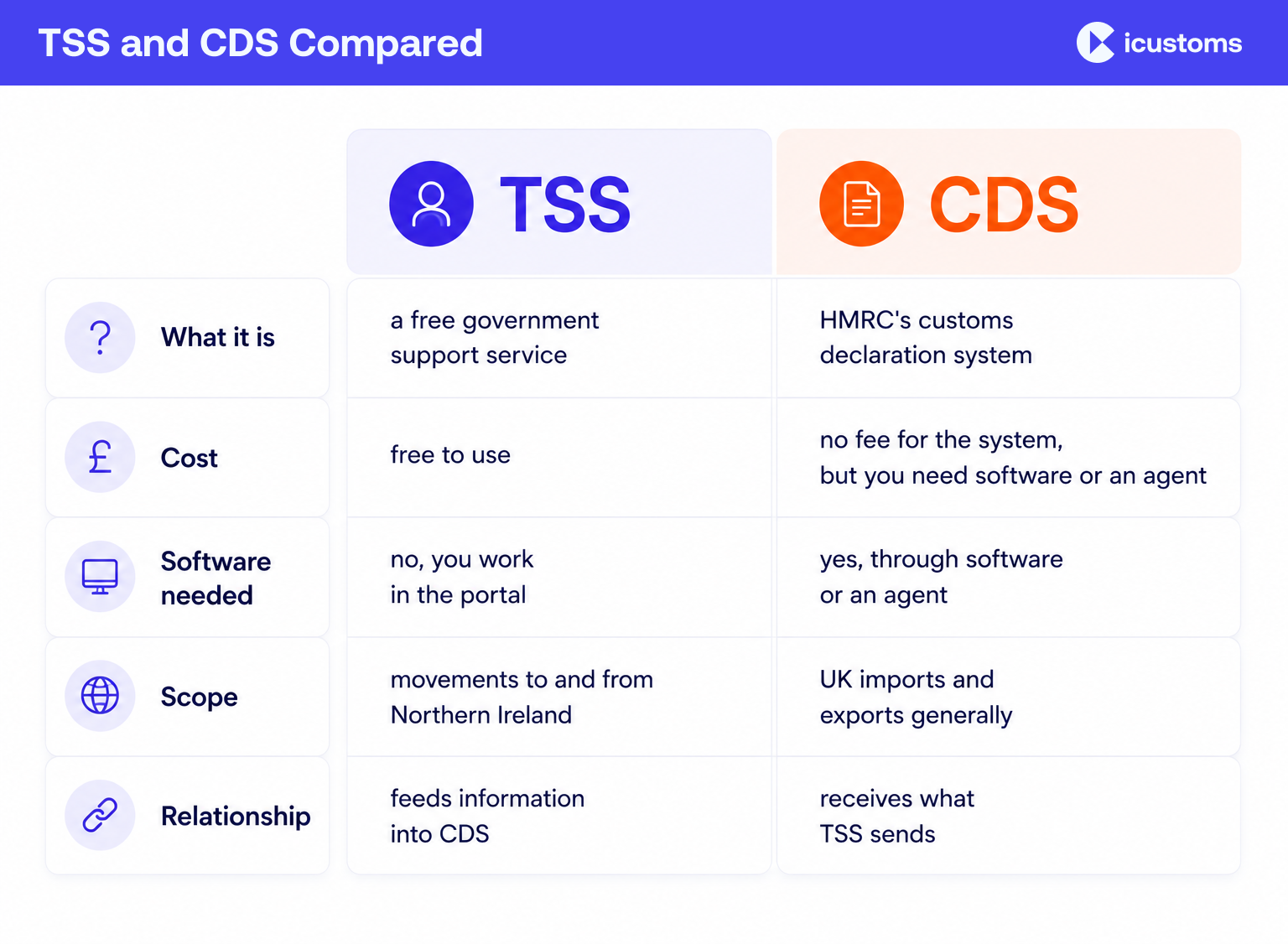
The short answer, side by side
| TSS | CDS | |
|---|---|---|
| What it is | A free government support service | HMRC’s customs declaration system |
| What it does | Collects your information and submits it to the right government systems | Receives, validates and processes customs declarations |
| Who runs it | Delivered on behalf of HMRC | Operated by HMRC |
| Cost | Free to use | No fee for the system itself, but you need software or an intermediary to reach it |
| Scope | Movements to and from Northern Ireland | UK imports and exports generally |
| Software needed | No. You work through the TSS portal | Yes. Declarations reach CDS through customs software or an agent |
| Guidance included | Yes. Training and support are part of the service | No. It is a system, not a support service |
| Relationship | Feeds information into CDS and other systems | Sits downstream, receiving what TSS and other routes send |
What is CDS?
CDS stands for the Customs Declaration Service. It is the system HMRC uses to handle import and export declarations for goods moving into and out of the UK.
It replaced an older system called CHIEF, short for Customs Handling of Import and Export Freight. CHIEF closed on 31 March 2023, with a later end date for Northern Ireland movements, and all businesses had to be declaring through CDS by 30 March 2024. If you still hear people talk about CHIEF, they are describing a system that no longer runs.
Through CDS you can:
- Submit full import and export declarations
- Pre-lodge declarations before goods arrive
- Amend or cancel a declaration
- Upload supporting documents
- Manage duty deferment accounts and cash accounts
- Download statements and view your import duty and VAT position
- Give other people in your business authority to act
There is also a free practice environment called Trader Dress Rehearsal, where you can run declarations without them counting for real. It is worth using before your first live submission.
CDS Northern Ireland movements: what changes
The system does not change for Northern Ireland. The data it expects does. CDS Northern Ireland movements carry Windsor Framework specifics that a straightforward Great Britain import would not: whether the goods are at risk of entering the EU, whether a UK Internal Market Scheme authorisation applies, and which category the commodity code puts the goods in.
That is why Customs Declaration Service Northern Ireland guidance on GOV.UK reads differently from the general import guidance. Same system, different questions, different evidence to hold.
What TSS does that CDS does not
CDS is a system. It processes what it is sent, and it assumes whoever sends it already knows the rules. It does not explain the Windsor Framework to you, and it will not tell you whether your goods are at risk.
TSS was built for the people who need that explanation. It is free, it is aimed squarely at Northern Ireland movements, and the word support in the name is doing real work: guidance and training sit alongside the declaration function. Our overview of what the Trader Support Service is covers the service end to end if you are new to it.
Three differences matter most:
- You do not need to buy customs software to use TSS. You work in the TSS portal.
- TSS asks plainer questions than a raw declaration would, and works out some of the technical detail from your answers.
- TSS covers more than customs. Safety and security information, movement references and transit all run through the same service.
GOV.UK puts it plainly in its own CDS material: if you move goods into Northern Ireland, you can use the Trader Support Service, and it is free to use.
How TSS and CDS work together
Picture a chain rather than a fork in the road.
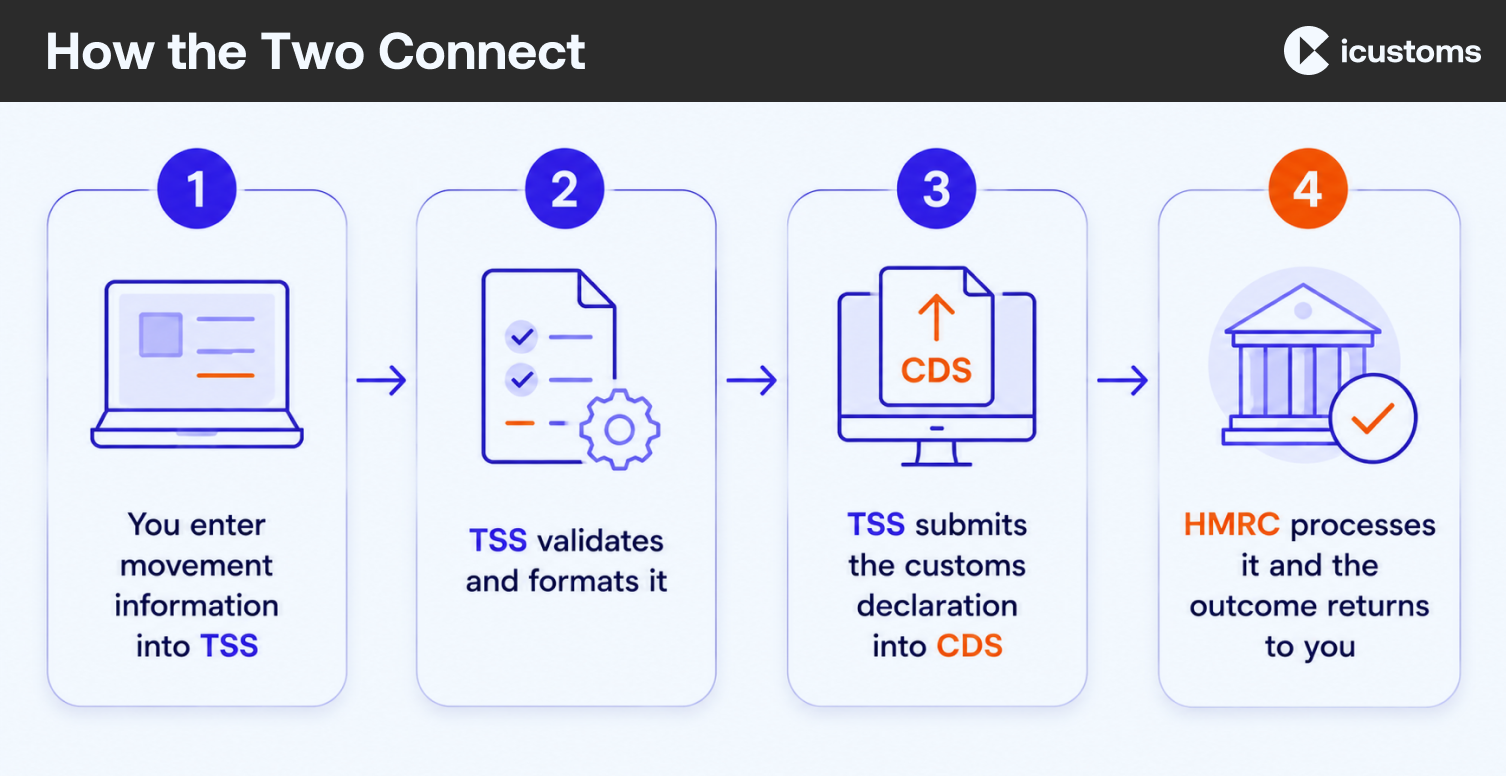
You enter your movement information into TSS. TSS validates and formats it, then submits the customs declaration into CDS. HMRC processes it in CDS. The outcome, whether that is acceptance, a query or a rejection, comes back to you.
So when someone asks whether TSS submits declarations into CDS, the answer is yes. That is a core part of what the service is for. You are still using CDS. You are simply not typing into it directly.
CDS is one of several systems in the chain. Safety and security data goes to ICS2, vehicle movements involve GVMS, and transit runs through NCTS. If you want to see how all of them fit, we have drawn out the Northern Ireland customs system map in a separate guide.
Do you need both?
For most businesses moving goods to Northern Ireland through TSS, the honest answer is that you do not need to set up CDS access separately for those movements. TSS handles the submission.
You will need your own CDS access if any of these apply:
- You move goods between Great Britain and countries other than through the Northern Ireland routes TSS covers
- You want to manage your own duty deferment account, cash account or statements directly
- You act as an intermediary submitting declarations for clients outside the TSS route
- Your movements fall outside what TSS supports
Plenty of businesses end up using both, and there is nothing odd about that. TSS for Northern Ireland movements, CDS access for everything else and for financial administration.
Do I need a CDS subscription to use TSS?
Not for the declarations TSS submits on your behalf. You register with TSS and work there.
You will still want CDS access if you need to see your own duty and VAT statements or run a deferment account. Those live on the CDS side, whoever submitted the declaration.
What you need to use each one
To use TSS
An EORI number and your business details. Registration is free and done on the TSS website.
To subscribe to CDS
More is required here. HMRC asks for:
- An EORI number beginning GB or XI
- Government Gateway sign-in details for the business
- Your Unique Taxpayer Reference
- The business address held on customs records
- Your business start date, and a National Insurance number if you are a sole trader
Access usually arrives within two hours. If HMRC needs to run further checks it can take up to five working days, so do not leave it until the week you need it.
One point catches people out: if you subscribe using an EU country EORI, you need a separate Government Gateway user ID. An EU EORI cannot sit on the same account as a GB one.
What about an XI EORI?
An XI EORI is required if your business is established in Northern Ireland, and you have to meet HMRC’s eligibility criteria to register for one. A GB EORI covers movements between Great Britain and elsewhere, including movements between Great Britain and Northern Ireland.
If you are unsure which you need, check before you subscribe rather than after. Getting the wrong number on a declaration creates work to unpick.
When would you use CDS directly instead of TSS?
There are sensible reasons to go direct.
- Volume. Businesses filing at scale often run their own software into CDS because they want control over the data and the workflow.
- Scope. If most of your movements sit outside Northern Ireland, a single CDS route may be simpler than splitting across two.
- Existing setup. If you already have customs software and processes, adding a second route can create more admin than it saves.
- Financial control. Managing deferment and cash accounts yourself means working in CDS.
Going direct does mean taking on the technical side. CDS expects declarations in a specific structure, and you reach it through purchased customs software or an intermediary rather than typing into a public portal.
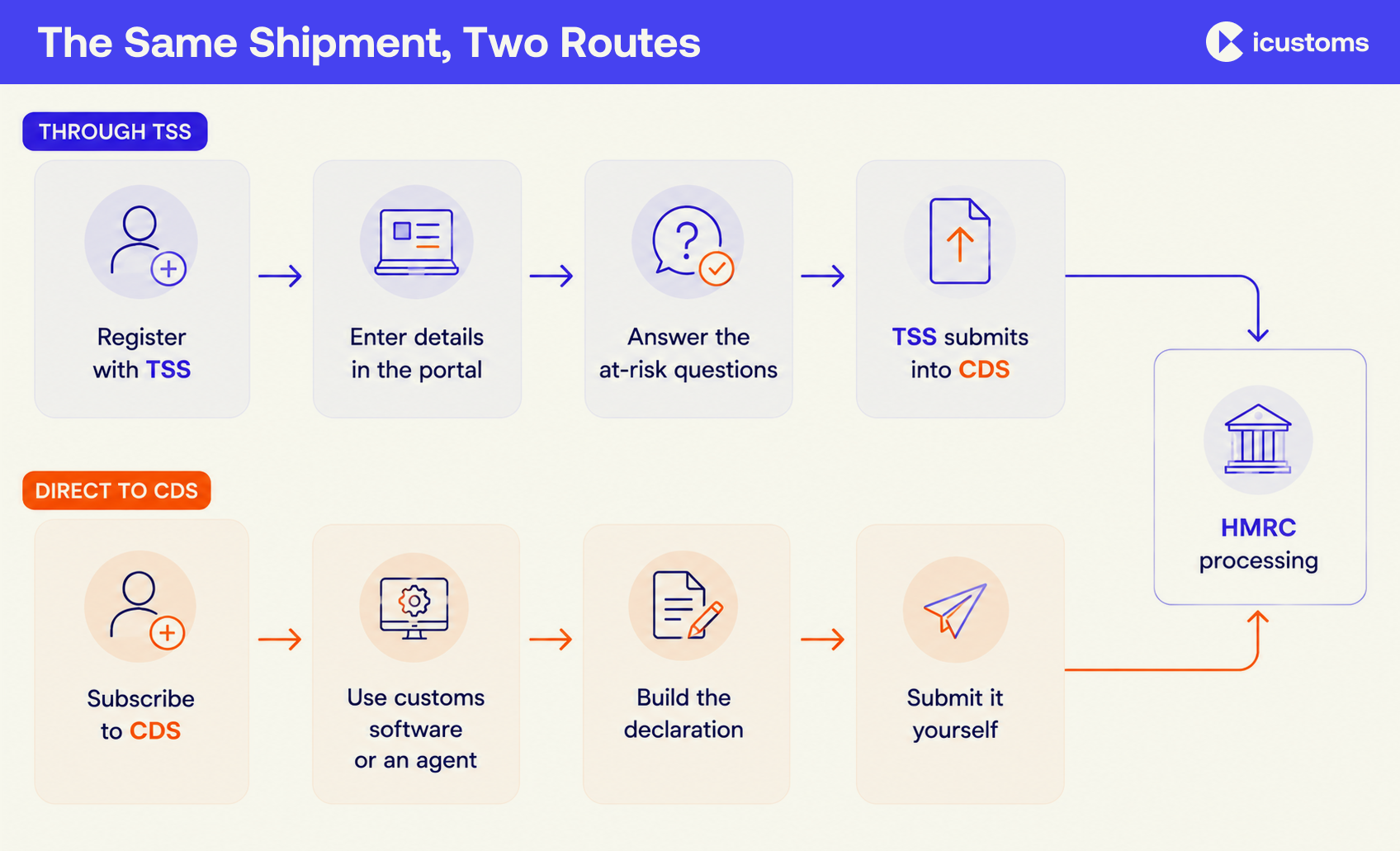
The same movement, two routes
Take a firm in Manchester sending 100 washing machines to a retailer in Belfast. The goods, the lorry and the legal requirements are identical either way. Only the route to CDS changes.
Route one: through TSS
- Register with TSS using your EORI number. No software purchase.
- Enter the movement, goods and party details in the TSS portal.
- Answer the at-risk and scheme questions TSS puts to you in plain terms.
- TSS formats the declaration and submits it into CDS.
- HMRC processes it. The outcome comes back through TSS.
Route two: direct to CDS
- Subscribe to CDS with your EORI, Government Gateway details and UTR.
- Buy or already run customs software, or appoint an intermediary.
- Build the declaration to the structure CDS expects, including the Northern Ireland specifics.
- Submit it yourself through your software.
- Handle the response, and any amendment, in your own system.
Route one asks less of you technically and costs nothing. Route two gives you control of the data and the workflow, and fits businesses that already file at volume or move goods well beyond Northern Ireland.
Neither route removes your responsibility for what the declaration says. The washing machines need the right commodity code either way.
Four mix-ups worth clearing up
TSS replaced CDS
It did not. CDS replaced CHIEF. TSS is a service that sits in front of CDS and other systems, not a replacement for any of them.
Using TSS means you are not using CDS
You are. The declaration still lands in CDS. TSS is how it got there.
CDS is only for Northern Ireland
CDS handles UK imports and exports generally. Northern Ireland movements are one part of what it processes, not the whole of it.
Choosing TSS means giving up responsibility
The trader remains responsible for the accuracy of what is declared. TSS submits the information you provide. If your commodity code or value is wrong, the declaration is wrong, and the liability is yours.
Which one applies to your movement?
Work through these in order.
- Is the movement to or from Northern Ireland? If not, TSS is not the route. You need CDS access through software or an agent.
- Is it a movement type TSS supports? Check the current TSS guidance for your route and goods.
- Do you want to file it yourself in a portal, or through your own software? Portal points to TSS. Software points to CDS.
- Do you need to manage duty deferment, cash accounts or statements? That sits in CDS regardless of how the declaration was submitted.
- Are you acting for clients? Intermediaries usually need CDS access, and may use TSS as well for Northern Ireland work.
Once you know which route applies, the next question is usually which declaration the movement actually needs. We have set out which declarations a movement needs and how the deadlines work.
TSS is moving into a new phase. The next version of the service is being built on a commercial off-the-shelf platform called ERMIS, extended with purpose-built front-end applications.
The service went through a government alpha assessment in April 2026. It received an amber rating and can move to private beta once the flagged points are addressed. The stated aims include simpler user journeys, better accessibility, clearer guidance and more accurate submissions. The service is expected to remain free.
There is a practical lesson here for anyone researching TSS. A lot of the material online was written between 2020 and 2022 and is now out of date. Check current GOV.UK guidance before acting on anything you read, including this guide.
Frequently Asked Questions
Is TSS the same as CDS?
No. CDS is HMRC's customs declaration system. TSS is a free service that collects your information and submits declarations into systems including CDS.
Does TSS submit declarations into CDS?
Yes. That is one of its main functions. You provide the information in TSS and it handles the submission.
Do I still need CDS if I use TSS?
Not for the declarations TSS submits for you. You will still want CDS access to manage duty deferment accounts, cash accounts and statements, or for movements outside the TSS route.
Can I use CDS instead of TSS for Northern Ireland?
Yes. You can file directly through your own customs software or an intermediary. You take on more of the technical work in exchange for more control.
Which system handles GB to NI declarations?
The declaration is processed in CDS. TSS is the free route most businesses use to get it there.
What replaced CHIEF?
CDS. CHIEF closed on 31 March 2023, with a later date for Northern Ireland movements, and all businesses had to move to CDS by 30 March 2024.
Do I need an XI EORI?
You need one if your business is established in Northern Ireland and you meet HMRC's eligibility criteria. A GB EORI covers movements between Great Britain and elsewhere.
How long does CDS access take?
Usually about two hours. It can take up to five working days if HMRC needs to run additional checks.
Is CDS free?
There is no fee for the system, but reaching it requires customs software you buy or an intermediary you pay. TSS is free and needs neither.
You may also like:
Confused About Managing TSS and CDS Together?

Simplify your Northern Ireland customs workflow with iCustoms.
Subscribe to our Newsletter
About iCustoms
iCustoms is an all-in-one solution helping businesses automate customs processes more efficiently. With AI-powered and machine-learning capabilities, iCustoms is designed to streamline your all customs procedures in a few minutes, cut additional costs and save time.
Ready to Simplify Your TSS Customs Workflow?
Manage TSS and CDS data with greater efficiency.