
How to Use TSS for Goods Moving from Great Britain to Northern Ireland
- John Hall
- Customs Specialist at iCustoms.ai
To move goods from Great Britain to Northern Ireland using TSS, you register with the service, enter the movement and goods details, establish whether the goods are at risk of entering the EU, choose the declaration route that applies, and let TSS submit to the relevant government systems. The vehicle then needs a movement reference before it can board.
That is the shape. The detail is where people come unstuck, usually because nobody tells them the order things have to happen in or how far ahead each step needs to be done. This guide runs the TSS GB to NI route from start to finish, in the sequence it actually happens.
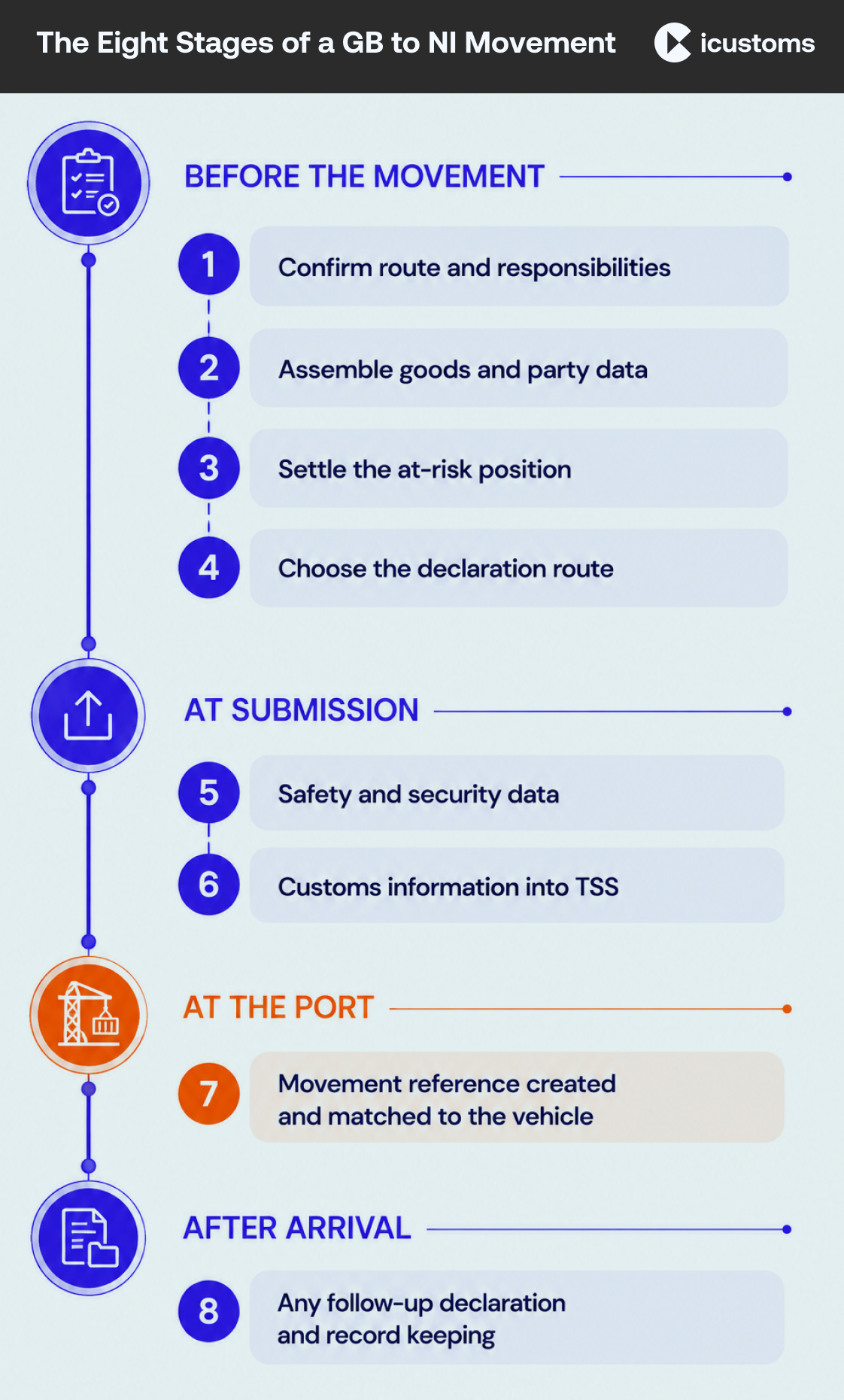
The GB to NI customs process, end to end
BEFORE THE MOVEMENT
1. Confirm route and responsibilities
2. Assemble goods and party data
3. Settle the at-risk position
4. Choose the declaration route
2. Assemble goods and party data
3. Settle the at-risk position
4. Choose the declaration route
↓
AT SUBMISSION
5. Safety and security data
6. Customs information into TSS
6. Customs information into TSS
↓
AT THE PORT
7. Movement reference created and matched to the vehicle
↓
AFTER ARRIVAL
8. Any follow-up declaration and record keeping
The GB to Northern Ireland shipping requirements below apply to business movements of goods. Sending goods to Northern Ireland as a private individual, or as a business sending a parcel to a consumer, follows different arrangements.
Seven of those eight steps happen before the lorry moves. That is the single most useful thing to understand about moving goods from GB to NI: almost all of the work is front-loaded, and the port is where you find out whether you did it properly.
Seven of those eight steps happen before the lorry moves. That is the single most useful thing to understand about moving goods from GB to NI: almost all of the work is front-loaded, and the port is where you find out whether you did it properly.
Who does what
| Step | Usually sits with | Common failure |
|---|---|---|
| Goods and commodity data | Trader or their intermediary | Vague descriptions and unchecked commodity codes |
| At-risk decision | Trader | Assuming not at risk without holding the evidence |
| Customs information | Trader, intermediary, or TSS on their behalf | Submitted too late for the sailing |
| Safety and security data | Carrier, or whoever holds the obligation | Both sides assume the other is doing it |
| Movement reference | Haulier | Vehicle details do not match the reference |
| Follow-up declaration | Trader or intermediary | Forgotten after the goods arrive |
If any of the acronyms in that table are new, our overview of TSS explained for GB to NI trade covers the basics, including registration and what the service costs.

Stage 2: Assemble the goods and party data
Nothing else can proceed until this is right. For each consignment you need:
- EORI number for the business
- Commodity code, and the right number of digits for the goods category
- A specific goods description. Shoes is not a description. Women’s leather ankle boots is.
- Quantity, gross weight, net weight and number of packages
- Value and currency
- Country of origin
- Any licences or certificates the goods require
Commodity code length is not cosmetic. Standard goods are declared with a six-digit commodity code. Category 2 goods, which include excise products and goods subject to EU import controls, need an eight-digit code, and any licence or certificate has to be declared alongside it.
If you move the same products repeatedly, the profile HMRC holds of the goods you already send will pre-populate much of this for you inside the TSS portal. We explain how that profile works, and how to check what is in it, in our guide to the Trader Support Service.
Stage 3: Settle the at risk position
This is the decision that determines whether duty is payable, and it is the one most often made on assumption rather than evidence.
At risk and not at risk goods: what the terms mean
Goods are at risk if they may subsequently move on into the EU. Those goods can attract EU customs duty.
Goods are not at risk when they meet the applicable conditions, which broadly means they are staying in Northern Ireland for sale or final use there and the trader holds the authorisation and evidence to say so.
The phrase not at risk goods is not a self-assessment you can simply assert. It rests on holding a UK Internal Market Scheme authorisation and being able to evidence the end use if HMRC asks.
Do I need UKIMS for every GB to NI movement?
No. You need it to treat goods as not at risk under the simplified route. Without it, movements go through the full declaration process and the duty position is assessed accordingly.
The conditions are substantial and worth knowing before you plan around them. You must be established in the UK, hold a clean customs and tax compliance record over the previous three years, run documented procedures that track goods from arrival through to end use, and keep supporting evidence for five years, accessible in the UK. Where goods are processed in Northern Ireland, further conditions apply, including annual turnover below two million pounds or processing for approved purposes such as food sale, construction, healthcare, non-profit activity or animal feed.
The authorisation number arrives in an approval letter and applies to goods moved on or after the authorisation date. It is not retrospective, so a movement made while the application was pending is not covered by it.
Stage 4: Choose the declaration route
The GB to NI declaration process is not one fixed path. Three broad routes exist, and which one is open to you depends on the goods, your authorisations and how the goods travel.
Internal Market Movement Information
Internal Market Movement Information, usually shortened to IMMI, is the lighter route. It asks for less than a full declaration and is available where all of the following hold:
- The goods are Standard or Category 2 goods
- They are not at risk of entering the EU
- They are already in free circulation
- They are moving by direct transport
- The trader is UKIMS authorised
It cannot be used for Category 1 goods, by traders without the authorisation, or where relief from customs duty is being claimed. Category 1 goods include those subject to trade defence measures, total bans or prohibitions, and cases where an importer is claiming an EU tariff quota.
What you supply for an IMMI includes the EORI number, the UKIMS authorisation number, commodity codes, goods descriptions, values, quantities, origin information, transport details, and any certificates required for Category 2 goods.
Simplified processes, including EIDR Northern Ireland movements
Entry in Declarant’s Records lets you record the movement in your own records as it happens and submit the fuller declaration afterwards, with less information required up front. TSS provides an EIDR route for eligible movements.
Plan for the second half of it. The supplementary declaration still has to follow, and the most common way businesses get into difficulty with simplified processes is treating the movement as finished once the goods arrive.
Full declaration
Where neither of the above applies, the movement needs a full customs declaration with the complete data set. Category 1 goods land here by default.
The declaration types, what each one contains and when each is due are set out in detail in our guide to TSS declaration types.
Stage 5: Safety and security data
Separate obligation, separate system, often a separate party.
An entry summary declaration carries safety and security information about the consignment, and it is required for goods moving from Great Britain to Northern Ireland by air, sea, road or rail. This data goes through ICS2, which replaced the older ICS system for movements into Northern Ireland from 31 December 2025.
Only some parcel movements from Great Britain into Northern Ireland need one, which is a frequent source of confusion for businesses that send both freight and parcels.
Who holds the obligation, what the data set contains and how the timing works are covered in TSS and ENS.
Stage 6: The vehicle and the port
For roll-on roll-off routes that use the Goods Vehicle Movement Service, the haulier needs a movement reference before check-in. It links together the declaration references for everything on the vehicle.
Two hard rules apply at the barrier:
- The vehicle registration, trailer registration and container references must match what is recorded. Vehicles are turned away at check-in if a valid reference cannot be presented or the details do not match.
- Once the vessel departs, the carrier notifies HMRC, the reference moves to embarked status, and the automated customs processes run. That is the point at which you learn whether an inspection is required.
A movement reference cannot be built from declarations that do not exist yet. Late customs data is the most common reason a vehicle misses a sailing.
The mechanics, and what to do when a reference is rejected, are in our guide to GVMS for Northern Ireland movements.
Stage 7: After the goods arrive
Two things remain.
If you used a simplified route, the follow-up declaration is due. Diarise it at the point you make the movement rather than relying on someone noticing later.
Records need keeping. For UKIMS purposes, supporting evidence has to be retained for five years and be accessible in the UK. That is not a filing preference, it is an authorisation condition, and it is what an audit will test.
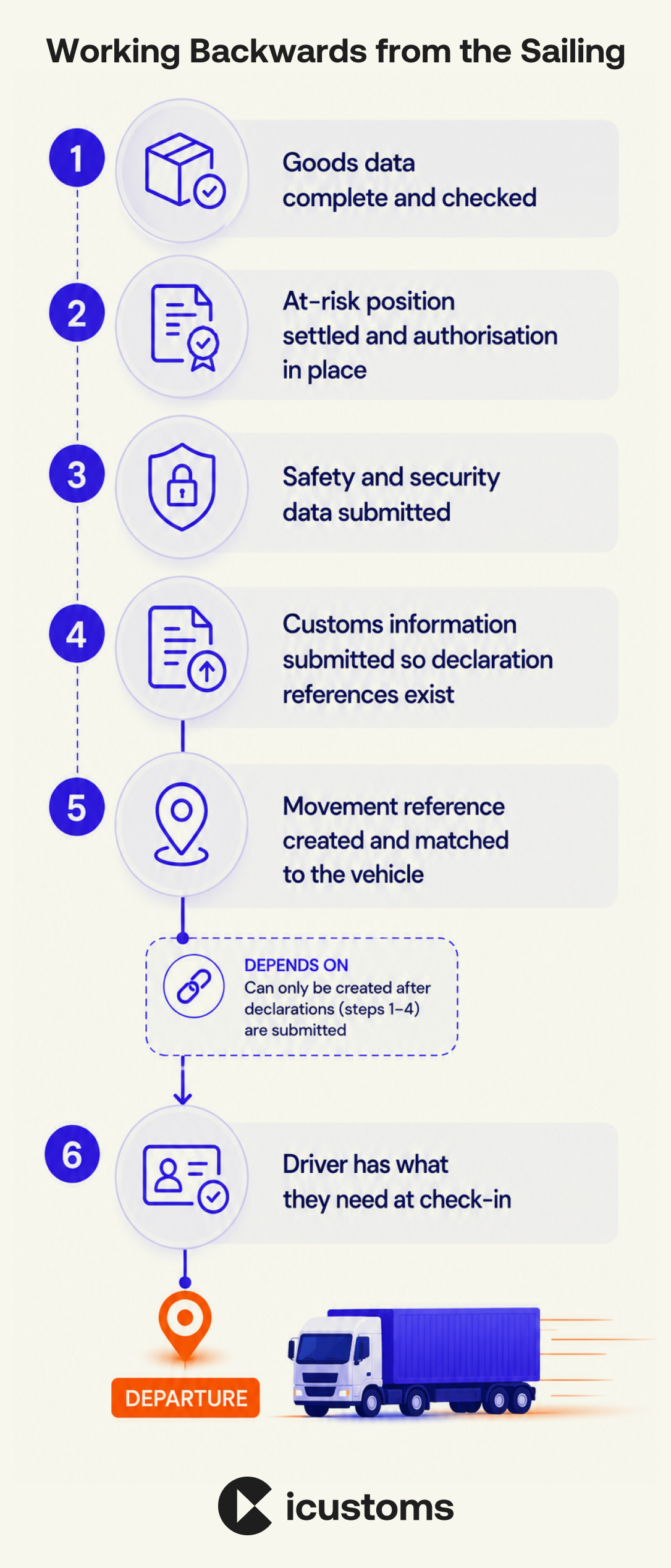
Timing: what has to be true before departure
Work backwards from the sailing.
- Goods data complete and checked. Everything downstream depends on it.
- At-risk position settled and authorisation in place, if you are relying on one.
- Safety and security data submitted, by whoever holds the obligation.
- Customs information submitted so declaration references exist.
- Movement reference created and matched to the actual vehicle and trailer.
- Driver has what they need at check-in.
Steps four and five are the pinch point. The movement reference cannot be built until the declarations exist, and the vehicle cannot board without the reference. Anything that delays the customs data delays the lorry.
Where GB to NI movements go wrong
Five failures account for most problems, and none of them are exotic.
Vague goods descriptions
Clothes, parts, samples, goods. If customs cannot identify what is in the consignment from the description, expect a query.
Commodity codes carried over without checking
Codes change, and the category a code sits in determines how much information you need. A code that was fine last year may not be this year.
Assuming not at risk
Without the authorisation and the evidence, the assumption does not hold. This is the error with the largest financial consequence.
Split responsibility with nobody confirming
Two parties each believing the other submitted the safety and security data is a recurring and entirely avoidable failure.
Mismatched vehicle details
A trailer swapped at the last minute, and nobody updates the reference. The vehicle is turned away.
When the manual version stops working
For a business making a few movements a month, the process above is manageable in a portal. The work is real but the volume is not the problem.
It changes at scale. The pressure points are consistent across freight forwarders, customs agents and in-house logistics teams:
- The same customer and the same products declared over and over, re-keyed each time
- Data arriving as commercial invoices, packing lists and transport documents that somebody has to read and retype
- Business systems such as ERP, WMS and TMS holding the data already, disconnected from the customs workflow
- Exceptions and rejections handled by whoever spots them rather than by a process
- No single view of where each movement stands
None of that changes what the rules require. TSS remains the government route and it remains free. What changes is how the information reaches it, and how much manual effort sits between a supplier’s invoice and a validated set of customs data.
If that is the position you are in, our work on Northern Ireland customs automation covers how document extraction, validation and system integration reduce the re-keying without replacing the government service
Frequently Asked Questions
Do I need a customs declaration to send goods to Northern Ireland?
For most business movements from Great Britain to Northern Ireland, yes, although authorised traders may be able to use Internal Market Movement Information instead of a full declaration. Parcels sent by a business to a private individual for personal use do not need one.
What does not at risk mean for NI goods?
It means the goods meet the applicable conditions to be treated as staying in Northern Ireland rather than moving on into the EU, so EU duty does not apply. It depends on holding UKIMS authorisation and being able to evidence the position.
Do I need UKIMS for every GB to NI movement?
No. You need it to use the not at risk simplified route. Without it, movements follow the full declaration process.
When can I submit an IMMI instead of a full declaration?
When the goods are Standard or Category 2, not at risk, already in free circulation, moving by direct transport, and you hold UKIMS authorisation. Category 1 goods are excluded.
Who is responsible for a GB to NI declaration?
The trader remains responsible for the accuracy of what is declared, even where an intermediary or TSS submits it. Safety and security data is a separate obligation that often sits with the carrier.
What do I need to send goods to Northern Ireland?
An EORI number, TSS registration if you are using the service, complete goods data including a checked commodity code, a settled at-risk position, and whatever declaration the movement requires.
How far in advance does this need to be done?
Far enough that the declarations exist before the movement reference is built, and the reference exists before check-in. In practice that means the goods data needs to be ready well before the vehicle is loaded.
What happens if the trailer changes at the last minute?
The movement reference has to be updated to match. If the vehicle, trailer or container details do not match at check-in, the vehicle is turned away.
Does TSS cost anything for GB to NI movements?
No. GOV.UK confirms the service is free to use.
You may also like:
Moving Goods from Great Britain to Northern Ireland?

Simplify TSS declaration preparation with iCustoms automation.
Subscribe to our Newsletter
About iCustoms
iCustoms is an all-in-one solution helping businesses automate customs processes more efficiently. With AI-powered and machine-learning capabilities, iCustoms is designed to streamline your all customs procedures in a few minutes, cut additional costs and save time.
Make GB to NI Customs Declarations Easier
Prepare customs data faster with fewer manual steps.