
TSS, ICS2, GVMS and NCTS: How the Systems Work Together
- John Hall
- Customs Specialist at iCustoms.ai
Four systems come up constantly in Northern Ireland trade, and they do four different jobs. CDS processes the customs declaration. ICS2 handles safety and security data. GVMS gets the vehicle through the port. NCTS covers goods moving under transit. TSS sits in front of all of them, collecting your information once and sending it where it needs to go.
Nobody explains this to you in order. You meet the acronyms one at a time, usually when something has gone wrong, and they arrive without any sense of how they relate. Think of this as the customs acronyms explained page you wanted on day one: people searching TSS ICS2 GVMS NCTS are almost always trying to build one mental map, not read four separate guides.
The four systems at a glance
| System | What it handles | When it applies | Who usually touches it |
|---|---|---|---|
| CDS | The customs declaration itself: goods, value, duty, procedure | Whenever a customs declaration is required | Trader, intermediary, or TSS on your behalf |
| ICS2 | Safety and security data submitted ahead of the goods | Movements needing an entry summary declaration | Carrier or whoever holds the obligation |
| GVMS | Linking declaration references into one reference for the vehicle | Roll-on roll-off routes that use the service | Haulier and carrier at the port |
| NCTS | Customs transit under the Common Transit Convention | Goods moving under transit rather than being declared at the border | Trader, agent, authorised consignor |
| TSS | Collecting your information and routing it to the systems above | Movements to and from Northern Ireland | Trader, carrier, intermediary |

Where TSS sits in the chain
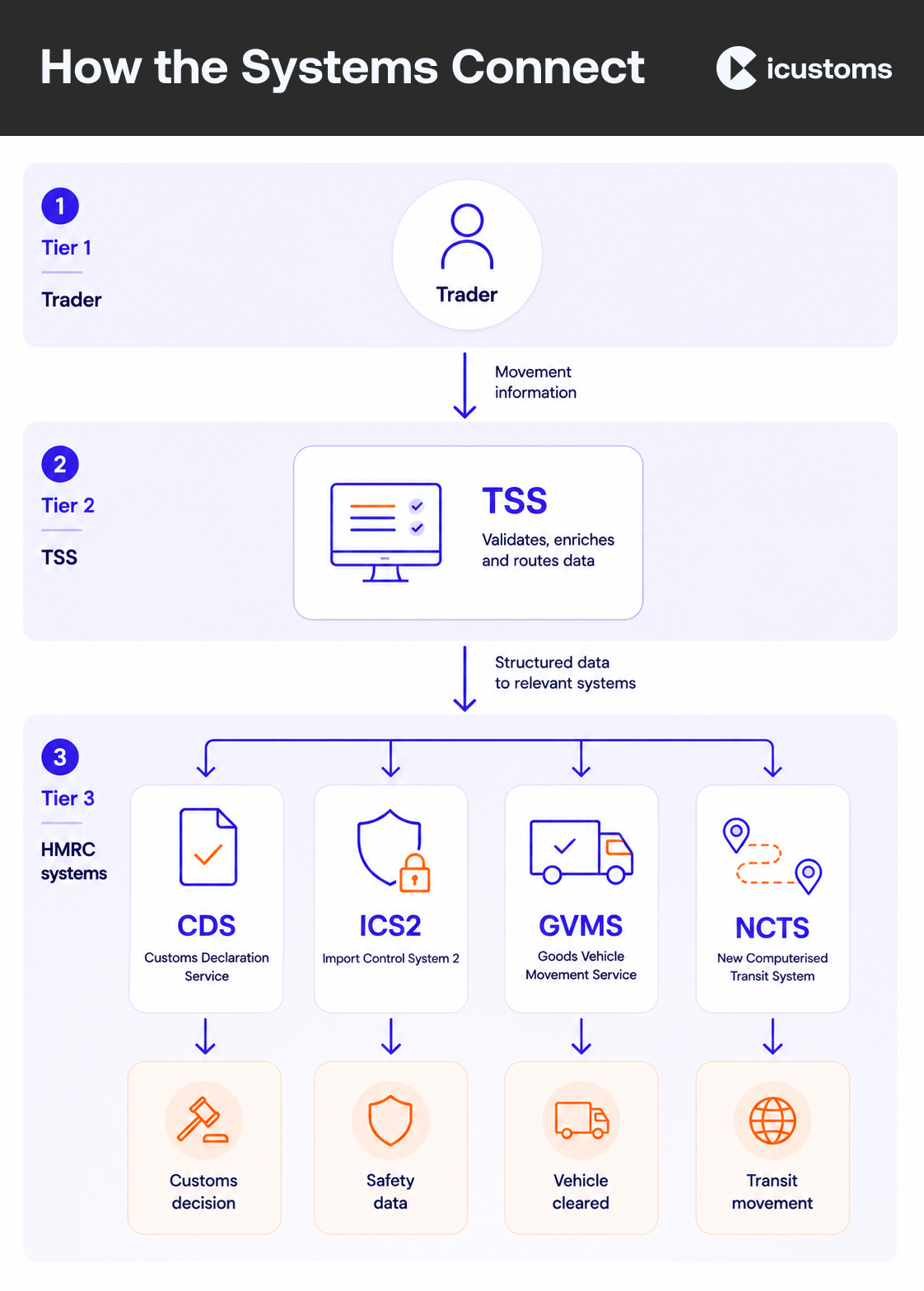
TSS is not a fifth system doing the same job as the other four. It is the layer in front of them.
You give TSS the details of your movement once. It works out which processes apply, formats the information correctly, and submits it to the relevant systems. You are still using CDS, ICS2, GVMS and NCTS. You are just not logging into each one separately.
TRADER
↓
TSS
↓
CDS
↓
Customs
decision
decision
ICS2
↓
Safety
data
data
GVMS
↓
Vehicle
cleared
cleared
NCTS
↓
Transit
movement
movement
The relationship between TSS and CDS in particular trips people up, because both names get used as if you had to choose one. We have set out the difference between TSS and CDS in full, including when you would go direct.
CDS: where the customs declaration lands
CDS stands for the Customs Declaration Service. It is HMRC’s system for import and export declarations, and it replaced the older CHIEF system.
This is where the substantive customs questions get answered. What are the goods, what is the commodity code, what are they worth, where did they come from, what procedure applies, is duty owed. CDS validates the declaration and returns an outcome.
What CDS does not do is explain the rules to you. It processes what it is sent and assumes the sender knows what they are doing.
ICS2: safety and security ahead of the goods
ICS2 is Import Control System 2. It handles safety and security data, which is a separate obligation from the customs declaration and often falls on a different party.
The distinction matters. A customs declaration is about duty and compliance. Safety and security data is about risk: who is sending what, to whom, by which route, so authorities can assess it before the goods arrive. Two different questions, two different systems.
ICS2 replaced the older ICS, and is used for movements into Northern Ireland from 31 December 2025. Entry summary declarations are needed for goods moving by air, sea, road or rail from Great Britain to Northern Ireland, from countries outside the EU into Northern Ireland, and from Great Britain to the EU. Only some parcel movements from Great Britain into Northern Ireland need one.
Who holds the obligation, what data is required and how the timing works are all covered in our guide to entry summary declarations for Northern Ireland.
GVMS: getting the vehicle through the port
GVMS is the Goods Vehicle Movement Service. It solves a practical problem: a single lorry can carry consignments covered by several different declarations, and the port cannot check them all individually while traffic queues behind.
So GVMS bundles them. It links the declaration references for everything on board into one reference, a GMR, or Goods Movement Reference. The haulier presents that at check-in.
Two details are worth knowing before your first movement:
- The vehicle registration, trailer registration and container references have to match what is on the GMR. Vehicles are turned away at check-in if a valid reference cannot be presented or the details do not match.
- Once the vessel departs, the carrier notifies HMRC and the reference moves to embarked status. That is what triggers the automated customs processes, and it is when you find out whether an inspection is required.
GVMS is not a declaration system. It carries no goods data of its own. It points at declarations that already exist, which is exactly why an incomplete declaration becomes a port problem rather than a paperwork problem.
The mechanics of building the reference, and what goes wrong when one is missing, are in our guide to how declarations feed a GMR.
NCTS: moving goods under transit
NCTS is the New Computerised Transit System. It is the one of the four that many businesses never touch, which is partly why it feels the most obscure.
Transit is a customs procedure for moving goods between the UK, the EU and other countries in the Common Transit Convention without completing full import formalities at every border along the way. There are twelve members, including the UK, the EU, Iceland, Norway and Switzerland.
Businesses use transit to:
- Move goods across borders faster
- Reduce the number of full import and export declarations needed
- Delay completing the customs declaration until the goods reach their destination
- Delay paying duty and other charges until that point
Eligible businesses can become an authorised consignor or authorised consignee, which lets them complete transit formalities at their own premises rather than at the border. Otherwise the processes happen at an office of departure or an office of destination.
NCTS Northern Ireland movements
For Northern Ireland movements, NCTS matters when goods are travelling under transit rather than being declared conventionally. If your goods go straight from Great Britain to Northern Ireland and are declared on arrival, transit does not enter the picture.
The route is what usually brings NCTS in. Goods travelling to Northern Ireland through Ireland, or continuing onward into the EU, are far more likely to move under transit than goods on a direct crossing.
Northern Ireland customs systems: how the data connects
The four systems are separate, but they are not describing separate shipments. They are describing the same consignment from four angles, and a surprising amount of the underlying data is shared.
Your EORI number, the commodity code, the consignment details, the parties involved and the transport information turn up again and again. The TSS connected systems each want them in their own format and at their own point in the journey, but the facts underneath do not change.
Part of the awkwardness is historical. The customs systems for NI trade were built at different times, by different teams, for different purposes, and then had to be made to work together after the Windsor Framework arrangements settled. They were never designed as one product.
That is why inconsistency is the most common cause of failure. A commodity code entered one way in the declaration and another way elsewhere, a trailer registration that does not match, a consignee spelled differently across two records: none of these are complicated errors, and all of them stop a movement.
It is also the argument for entering the information once. The value of TSS systems working as an input layer is not that they remove the obligations. It is that one set of inputs cannot contradict itself the way four separate submissions can.
Reading the names: what each acronym actually tells you
- Customs Declaration Service. Declaration is the operative word. This is where the formal statement about the goods is made.
- Import Control System 2. Control, in the sense of risk assessment before arrival, not control in the sense of blocking things.
- Goods Vehicle Movement Service. The clue is vehicle. It is about the lorry, not the cargo paperwork.
- New Computerised Transit System. Transit is the operative word, and transit is a specific procedure rather than a general term for moving goods.
Half the confusion in this area comes from names that describe the technology rather than the job.
Which systems does your movement touch?
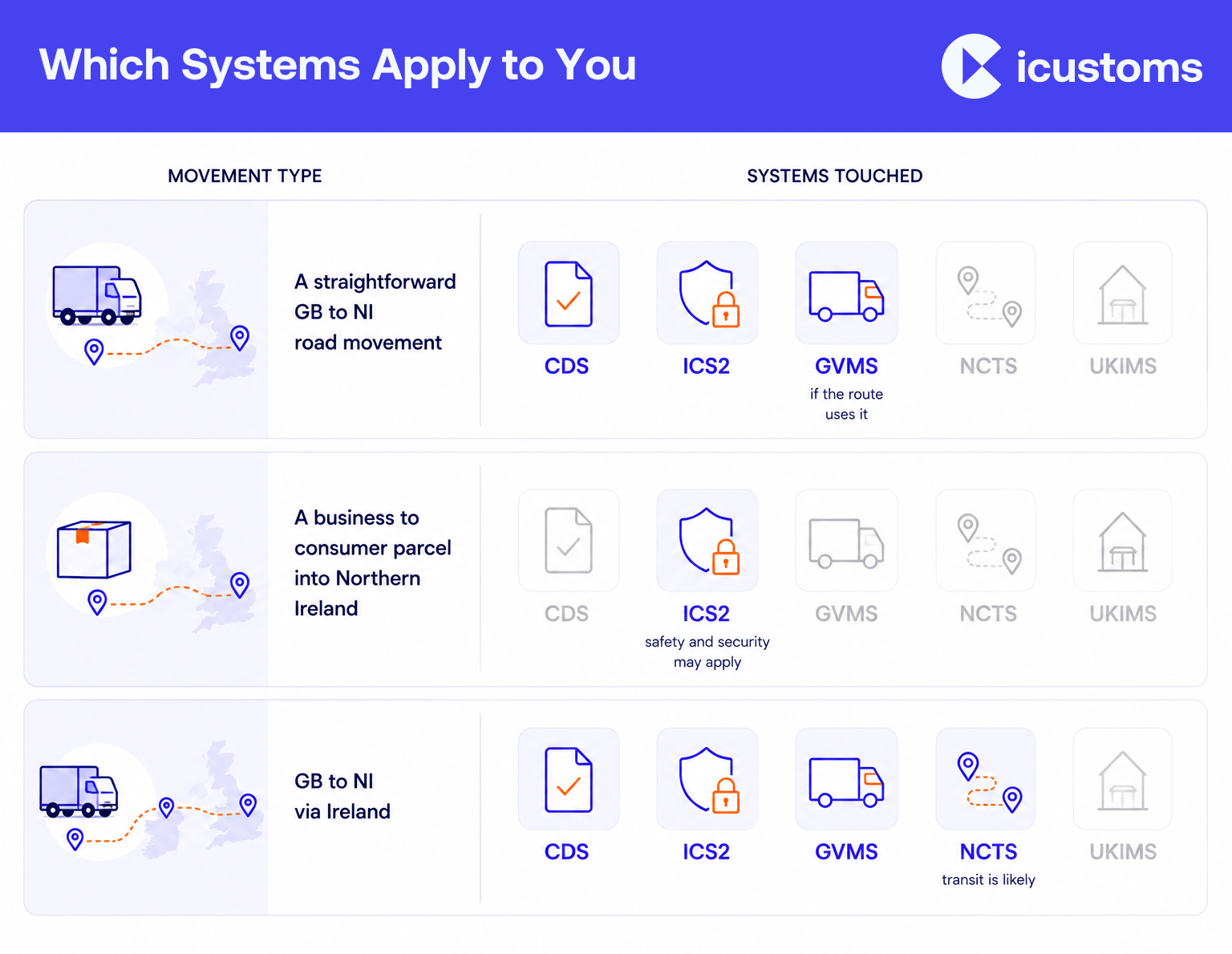
Rather than learning all four, work out which apply to you. Three common shapes:
A straightforward GB to NI road movement
Customs declaration through CDS. Safety and security data through ICS2. A reference through GVMS if the route uses the service. NCTS not involved. TSS can handle the first three from one set of inputs.
A parcel from a business to a private individual in Northern Ireland
No customs declaration needed. Safety and security may apply to some parcel movements. GVMS and NCTS are irrelevant to the sender.
Goods moving from Great Britain to Northern Ireland via Ireland
Now transit is likely, so NCTS comes in. Safety and security obligations still apply. The customs position depends on the route and where the goods are released. This is the shape most likely to need advice rather than a checklist.
For the most common route, step by step, see the GB to NI customs workflow.
Do you need to use all four?
Almost certainly not, and definitely not directly.
Most businesses moving goods from Great Britain to Northern Ireland interact with two or three of these systems, and interact with them through TSS rather than logging in separately. Transit is the exception rather than the rule.
The useful thing is not memorising all four. It is being able to recognise which one a problem belongs to. A rejected declaration is a CDS matter. A vehicle turned away at check-in is a GVMS matter. A safety and security query is an ICS2 matter. Knowing that saves hours of asking the wrong people.
Why the acronyms cause so much trouble
Three reasons, and none of them are your fault.
- The systems are named after what they are technically, not what they do. Nothing in the phrase Goods Vehicle Movement Service tells you it bundles declaration references.
- They overlap in time but not in purpose. Several can apply to one lorry on one day, which makes them feel like alternatives when they are not.
- The guidance changed repeatedly between 2021 and 2026. A lot of older articles describe arrangements that no longer exist, and they still rank well.
If you take one thing from this page, take the shape: one input layer, four destinations, each answering a different question.
Frequently Asked Questions
Which customs systems does TSS connect to?
TSS supports movements involving CDS, ICS2, GVMS and NCTS, depending on what the movement requires.
What is the difference between ICS2 and GVMS?
ICS2 handles safety and security data about the goods before they arrive. GVMS links declaration references together so a vehicle can be cleared through the port. Different data, different purpose, different point in the journey.
What is NCTS used for?
Customs transit. It manages goods moving between the UK, the EU and other Common Transit Convention countries without full import formalities at each border.
Do I need to use all four customs systems?
Most businesses do not. A typical GB to NI road movement involves CDS and ICS2, plus GVMS if the route uses it. Transit is the exception.
Does TSS replace these systems?
No. TSS is the layer that collects your information and submits it into them. The processing still happens in the government systems.
What happens if my GMR does not match the vehicle?
The vehicle is turned away at check-in. The registration, trailer registration and container references have to match what is recorded against the reference.
What does embarked status mean?
Once the vessel departs, the carrier notifies HMRC and the reference moves to embarked. That triggers the automated customs processes and tells you whether an inspection is needed.
Which system does what in Northern Ireland trade?
CDS decides the customs position. ICS2 carries safety and security data. GVMS clears the vehicle. NCTS covers transit. TSS feeds all four.
Is CDS part of ICS2?
No. They are separate systems with separate obligations, and the responsible party is often different for each.
You may also like:
Managing Multiple Customs Systems for Every Movement?

Bring customs data together and reduce repetitive work.
Subscribe to our Newsletter
About iCustoms
iCustoms is an all-in-one solution helping businesses automate customs processes more efficiently. With AI-powered and machine-learning capabilities, iCustoms is designed to streamline your all customs procedures in a few minutes, cut additional costs and save time.
One Set of Trade Data. A Simpler Customs Workflow.
Streamline declarations, safety and security and transit processes.