
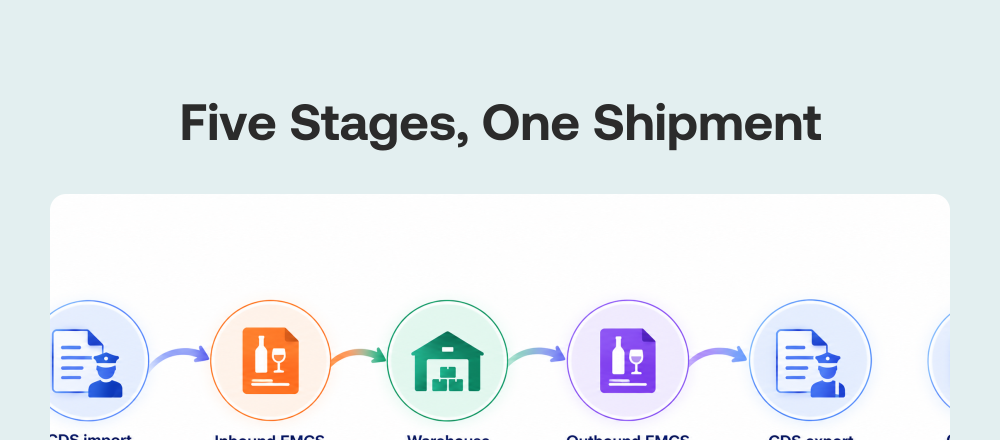
TSS Declarations Explained: ENS, SFD, Supplementary and Full Declarations
- John Hall
- Customs Specialist at iCustoms.ai
A single movement into Northern Ireland involves more than one declaration. An entry summary declaration carries safety and security data before the goods travel. The customs side then follows one of three routes: the TSS Simplified Procedure, which pairs a simplified frontier declaration at the movement with a supplementary declaration afterwards; IMMI, a lighter single submission for authorised traders; or a full frontier declaration carrying the complete data set.
Which route applies depends on your authorisation, your goods and how they travel. This guide walks through the TSS declaration types one by one: what each contains, who submits it and when it is due.
SFD or TSS Simplified Procedure? Both terms are correct and they describe different things. The TSS Simplified Procedure is the route. The Simplified Frontier Declaration, or SFD, is the declaration you submit at step one of that route. The supplementary declaration is step two. People use the names interchangeably and then get confused about how many submissions are involved. There are two. |
The Declarations At a Glance
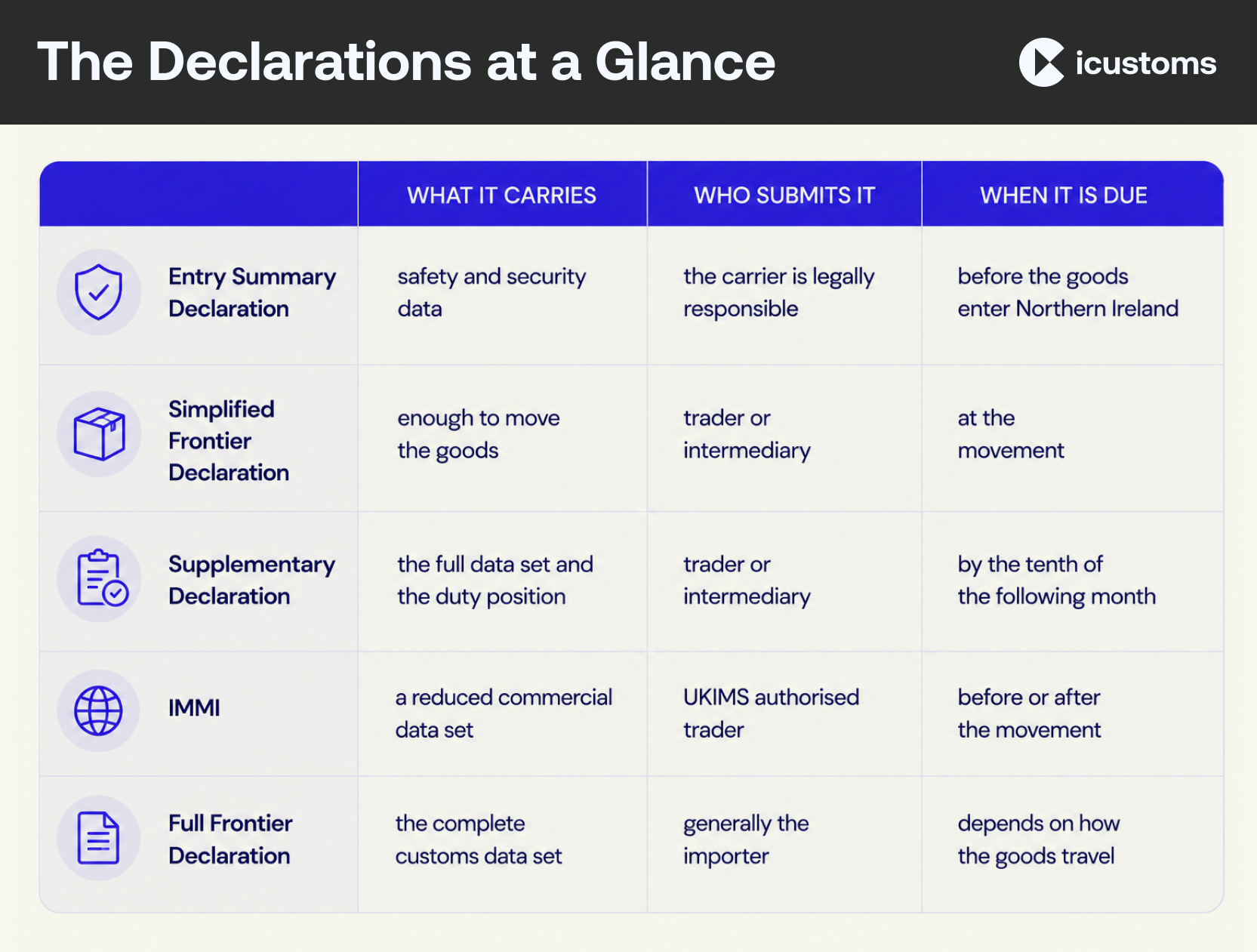
| Declaration | What it carries | Who submits it | When |
|---|---|---|---|
| Entry Summary Declaration | Safety and security data | The carrier holds the legal responsibility | Before the goods enter Northern Ireland |
| Simplified Frontier Declaration | Step one of the TSS Simplified Procedure: enough to move the goods | Trader or intermediary | At the movement |
| Supplementary Declaration | Step two: the full data set and the duty position | Trader or intermediary | By the tenth calendar day of the following month |
| IMMI | A reduced commercial data set, replacing the two-step route | UKIMS authorised trader | Before or after the movement |
| Full Frontier Declaration | The complete customs data set | Generally the importer | Depends on how the goods travel |
Entry Summary Declaration
This one is not a customs declaration at all, which is the first thing to get straight. It carries safety and security information and it exists so authorities can assess risk before goods arrive.
Two facts matter more than the rest. It must be submitted before the goods enter Northern Ireland, and the carrier holds the legal responsibility for submitting it. Traders routinely assume this sits with them, or assume the haulier has it covered without confirming. Both assumptions cause missed sailings.
It also feeds what comes next. Creating the movement reference the vehicle needs at the port is the step that follows the entry summary declaration, and under the TSS Simplified Procedure the data from it is used to build the supplementary declaration later.
The data set, the timing rules and who holds the obligation in less obvious cases are covered in how ICS2 handles NI safety and security data.
The TSS Simplified Procedure: two steps, not one
This is the route many businesses meet first. It splits the customs work into two declarations so the goods are not held up while the full data set is assembled.
Step one: the simplified frontier declaration
The simplified frontier declaration, usually written SFD, carries enough information for the goods to move. The consignment travels on the back of it. Nothing about the duty position is settled at this point, which is exactly why the route works for businesses that cannot assemble the full data set before departure.
Step two: the supplementary declaration
This completes the customs journey. TSS auto-generates it using the data from your entry summary declaration, but auto-generated is not the same as finished. You still have to:
- Confirm the commodity codes
- Provide the full consignment and item data
- Declare whether the goods are at risk of entering the EU or not
- Pay any duty owed, or claim a waiver if you are eligible
That last point is why the supplementary declaration matters. It is where the money is settled.
The deadline that catches people out
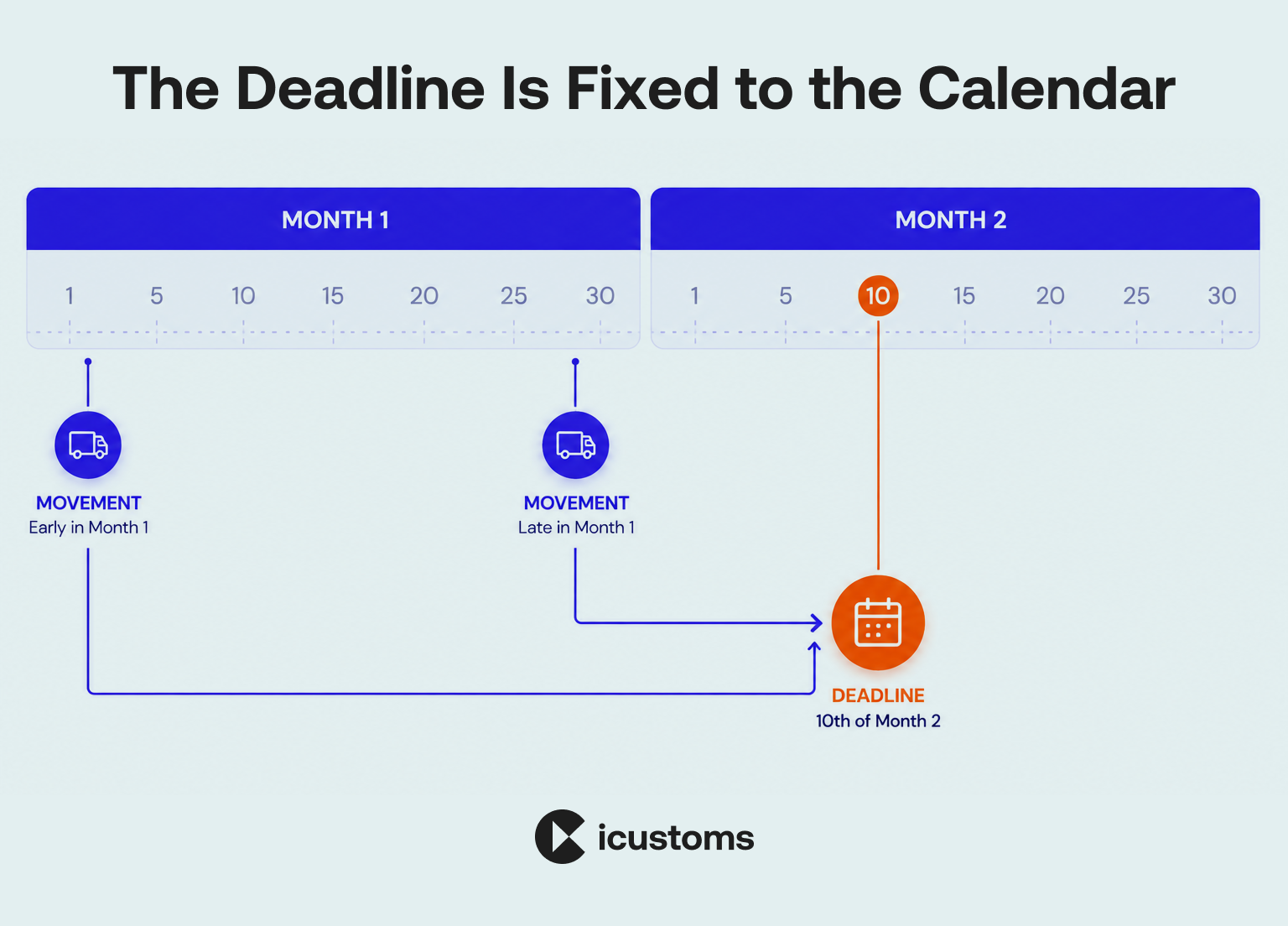
The supplementary declaration must be submitted in TSS by the tenth calendar day of the month following the goods movement.
Read that carefully. It is calendar days, not working days, and it runs from the month of the movement, not from the movement date itself. A consignment that travels on 28 March and one that travels on 2 March share the same deadline of 10 April. The late-March movement gives you under two weeks. The early-March one gives you nearly six.
Businesses that move goods steadily through the month tend to be fine. Businesses with a month-end rush are the ones who end up filing in a hurry.
IMMI: the lighter route
Internal Market Movement Information, almost always shortened to IMMI, is the newer option. It sits under the Simplified Processes for Internal Market Movements, sometimes abbreviated to SPIMM.
Instead of a full customs declaration, you provide commercial information about the goods in a reduced data set. Considerably less is required, and your goods profile in TSS can auto-populate commodity codes for products you move regularly.
Who can use it
Four conditions, all of which have to hold:
- You hold UK Internal Market Scheme authorisation. This is mandatory, not preferable.
- The goods are not at risk of entering the EU.
- The goods are in free circulation in Great Britain before the movement.
- The goods are not Category 1, which rules out anything subject to quotas, anti-dumping duties or prohibitions.
Before or after the movement
IMMI can be submitted pre-movement or post-movement. That flexibility is deliberate, because business models differ. A retailer with settled orders can file ahead. A wholesaler still confirming quantities at the point of loading may prefer to file after.
Converting a supplementary declaration to IMMI
This is the detail most businesses on the older route have not registered.
Where goods arrive in Northern Ireland under the TSS Simplified Procedure and they qualify, the supplementary declaration can be converted to IMMI. The conversion significantly reduces the number of fields you have to complete, and the same deadline applies: the tenth calendar day of the following month.
If you are UKIMS authorised and still completing full supplementary declarations by habit, this is worth an hour of somebody’s time to check.
The practical difference
The TSS Simplified Procedure needs two submissions and ends with a supplementary declaration. IMMI is one submission with fewer fields and no supplementary declaration to follow. Both remain available. Eligibility decides which is open to you.
Full Frontier Declaration
The complete customs data set, submitted for the movement itself rather than split across two steps. It is generally the importer who submits it.
When it applies
- Maritime movements from Great Britain or the rest of the world into inventory-linked ports in Northern Ireland
- Air movements from Great Britain or the rest of the world into inventory-linked airports in Northern Ireland
- Roll-on roll-off movements from Great Britain to Northern Ireland where the trader chooses not to use a simplified procedure
Inventory-linked is the term that trips people up. It refers to ports and airports where the goods are tracked in an inventory system, and it changes the process rather than the goods.
The four-step sequence
- The carrier or haulier submits the safety and security declaration.
- An inventory claim is made in the TSS Portal using the reference numbers.
- The importer submits the full frontier declaration.
- Any duty or charges are paid.
Timing varies by journey type. There is no single deadline that covers every route, so check the position for the specific movement rather than assuming the rule you learned on a different lane still applies.
How the declarations connect
SAFETY AND SECURITY
Entry Summary Declaration
(before the goods travel)
↓
CUSTOMS: CHOOSE ONE ROUTE
↓
SFD then
Supplementary
Supplementary
(two steps)
↓
Supplementary
by 10th of
next month
Supplementary
by 10th of
next month
IMMI
single submission
↓
Nothing
further
required
Nothing
further
required
Full Frontier
Declaration
Declaration
↓
Duty paid
at the
movement
Duty paid
at the
movement

Which TSS declaration do I need?
Work down this list and stop at the first answer that fits.
- Are the goods entering Northern Ireland? An entry summary declaration is required. Confirm who is submitting it.
- Are you UKIMS authorised, are the goods not at risk, in free circulation and not Category 1? IMMI is open to you and is the lightest route.
- Not UKIMS authorised, or the goods do not qualify? The TSS Simplified Procedure splits the work, with the supplementary declaration due by the tenth of the following month.
- Moving through an inventory-linked port or airport, or choosing not to use a simplified route? A full frontier declaration applies.
The full movement sequence, including where each of these sits relative to loading and departure, is set out in our guide to using TSS for GB to NI movements.
Three movements, three routes
The TSS declaration process looks different depending on who you are. Three realistic examples.
A retailer moving own-brand stock weekly
UKIMS authorised, goods staying in Northern Ireland for sale, nothing on the Category 1 list, everything in free circulation before it moves. This business qualifies for IMMI and files pre-movement, because the orders are settled before the lorry loads.
One submission per movement. No supplementary declaration. Commodity codes largely auto-populated from the goods profile because the product range barely changes week to week.
A trader without UKIMS moving mixed consignments
No authorisation, so IMMI is closed. The goods travel under the TSS Simplified Procedure, with the entry summary declaration submitted by the carrier beforehand.
The customs work then sits waiting. The supplementary declaration for every movement in a given month is due by the tenth of the next one, and that is where this business feels the pressure: the volume of unfinished declarations builds through the month and lands as one deadline.
Applying for UKIMS would change the shape of this entirely. It is worth modelling before adding headcount.
An importer bringing goods by sea into an inventory-linked port
Route decides this one, not authorisation. Maritime into an inventory-linked port in Northern Ireland means a full frontier declaration regardless of what else is true.
The carrier or haulier submits the safety and security declaration, an inventory claim is made in the TSS Portal using the reference numbers, the importer submits the full frontier declaration, and duty is paid. Four steps, and the inventory claim is the one businesses new to the route tend not to expect.
The deadlines in one place
| Declaration | Deadline | What to watch |
|---|---|---|
| Entry Summary Declaration | Before the goods enter Northern Ireland | The carrier holds the legal responsibility, not the trader |
| Supplementary declaration | Tenth calendar day of the month following the movement | Calendar days, and month-end movements get the shortest window |
| IMMI | Before or after the movement | Post-movement conversions follow the tenth of the following month |
| Full Frontier Declaration | Varies by journey type | No single rule covers every route |
Where declaration work goes wrong
Four patterns, all avoidable.
Treating auto-generated as complete
TSS builds the supplementary declaration from your earlier data. That is a head start, not a finished document. Commodity codes still need confirming and the at-risk position still needs declaring.
Missing the tenth
Usually not because anyone forgot the rule, but because nobody owns the task. The movement feels finished when the goods arrive.
Staying on the heavier route out of habit
UKIMS-authorised businesses still completing full supplementary declarations when a conversion would cut the fields considerably.
Guessing the commodity code
Every declaration type depends on it. Get it wrong and the error propagates through everything downstream, including the duty position.
On that last point, our guide to what data a TSS declaration needs covers source documents, goods descriptions and validating the data before you submit anything.
Businesses filing at volume often move this work off the portal entirely. We cover how the TSS declaration API works and, separately, how declaration automation works in practice.
Frequently Asked Questions
How many declarations does one movement need?
At least two in most cases: an entry summary declaration for safety and security, plus the customs route you are using. The TSS Simplified Procedure adds a second customs step.
When is a supplementary declaration due?
By the tenth calendar day of the month following the goods movement.
What happens if I miss the supplementary declaration deadline?
The customs position for that movement is left incomplete and duty remains unsettled. Contact TSS and file as soon as possible rather than leaving it.
Can I convert a supplementary declaration to IMMI?
Yes, where the goods arrived under the TSS Simplified Procedure and they qualify. The conversion cuts the number of fields substantially and the tenth-of-the-following-month deadline still applies.
Do I submit IMMI before or after the goods move?
Either. It can be submitted pre-movement or post-movement, which is one of its main advantages.
Is a simplified frontier declaration the same as the TSS Simplified Procedure?
No, and the distinction matters. The TSS Simplified Procedure is the route. The simplified frontier declaration is the first of the two declarations within it. The supplementary declaration is the second.
What is an inventory-linked port?
A port or airport where goods are tracked through an inventory system. Maritime and air movements into inventory-linked locations in Northern Ireland need a full frontier declaration.
Who submits the entry summary declaration?
The carrier holds the legal responsibility for submission.
Do I need UKIMS to use IMMI?
Yes. UK Internal Market Scheme authorisation is mandatory for it.
Which declaration is cheapest to run?
IMMI asks for the least information and needs no supplementary declaration afterwards, so it carries the least administrative work for those who qualify.
You may also like:

Managing Different TSS Declaration Types?

Simplify declaration preparation with structured customs data.
Subscribe to our Newsletter
About iCustoms
iCustoms is an all-in-one solution helping businesses automate customs processes more efficiently. With AI-powered and machine-learning capabilities, iCustoms is designed to streamline your all customs procedures in a few minutes, cut additional costs and save time.
Prepare TSS Declarations With Greater Confidence
Validate key information before submitting customs declarations.