
How to Prepare Customs Data for TSS Declarations
- John Hall
- Customs Specialist at iCustoms.ai
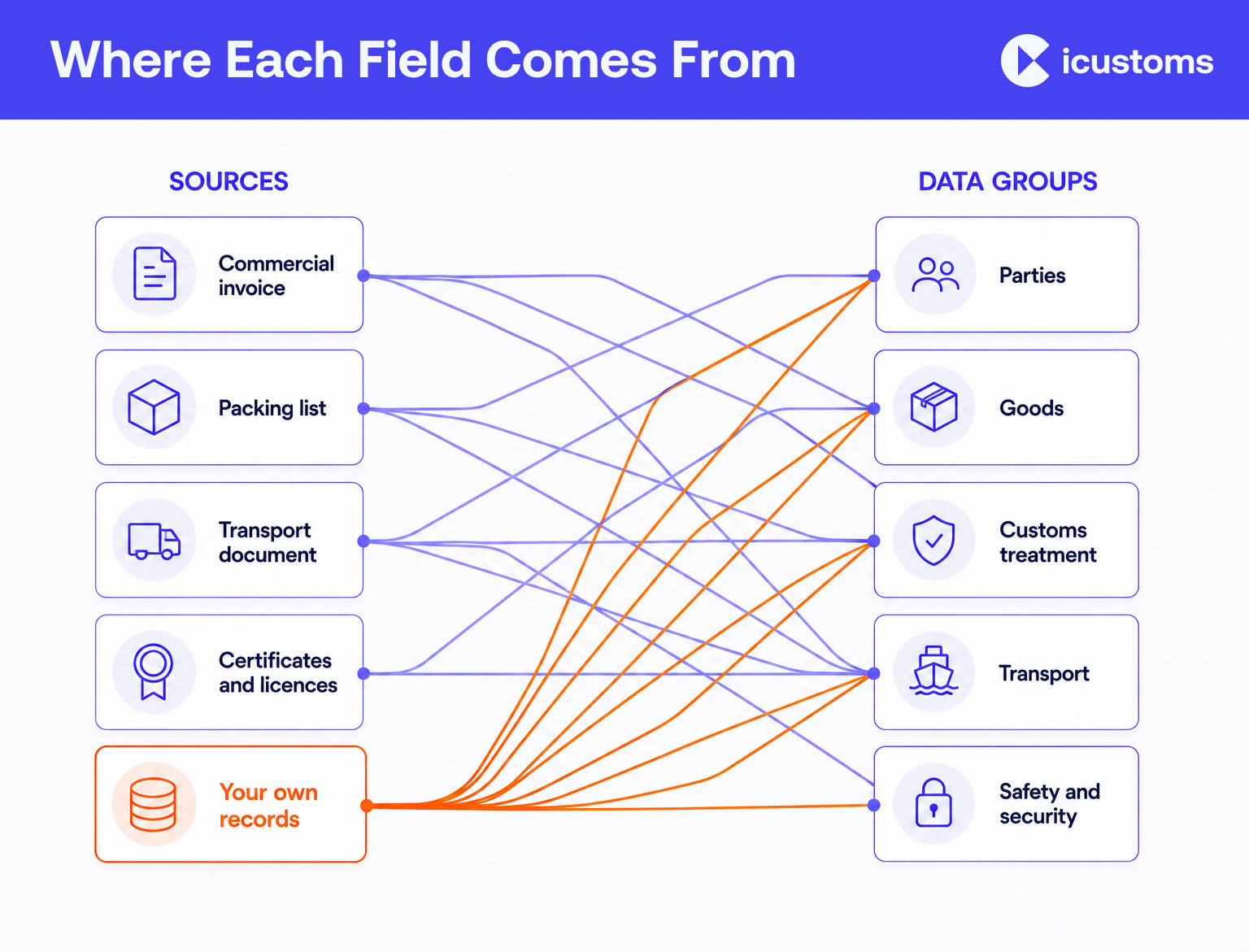
A TSS declaration needs five groups of data: who the parties are, what the goods are, how they are being treated for customs, how they are travelling, and the safety and security detail. Most of it comes from the commercial invoice, the packing list and the transport document. The rest, including the commodity code and your authorisation numbers, comes from your own records, and that is the half people are least prepared for.
This is the groundwork article on customs data preparation. Get the data right and the declaration is mechanical. Get it wrong and everything downstream inherits the problem, which is why almost every rejection traces back to something on this page.
The five groups of TSS customs data
| Group | What it covers | Usual source |
|---|---|---|
| Parties | EORI, importer, exporter, declarant, any intermediary | Your own records |
| Goods | Commodity code, description, quantity, gross and net mass, value, origin, packaging | Commercial invoice and packing list |
| Customs treatment | Procedure, customs value, duty position, preference, reliefs, authorisations, scheme status | Your own records and decisions |
| Transport | Mode, carrier, vehicle, route, port, arrival and departure detail | Transport document and the haulier |
| Safety and security | Consignor, consignee, goods description, transport and routing detail | Shared across the parties |
TSS data requirements differ by declaration type, but those five groups hold across all of them. Notice how much of the content does not come from a document at all. The commodity code, the authorisations, the customs treatment: these live in your records or in a decision somebody has to make. A business that assumes the invoice contains everything will stall on its first declaration.
Start with the source documents
Each document does a specific job. Knowing what each one supplies, and what it never supplies, saves a lot of hunting.
Commercial invoice
Gives you the parties, the goods lines, quantities, unit and total values, the currency and usually the terms of sale.
It will not give you a commodity code, and any description on it was written for the buyer, not for customs. Treat invoice descriptions as a starting point, never as the finished article.
Packing list
Gives you package counts, package types, gross and net mass, and often dimensions. This is your reconciliation document. If the weights on the declaration disagree with the packing list, one of them is wrong.
Transport document
Gives you the carrier, the movement detail, routing and references. For accompanied road freight it is what ties the consignment to a vehicle.
Certificates and licences
Where goods are controlled, the certificate or licence carries reference numbers and quantities that have to be declared. These have to match. Health certificates in particular are checked against CERTEX, so a mismatch between the declaration and the document is not a cosmetic problem.
Your own records
The commodity code, your EORI, your UK Internal Market Scheme authorisation number where you hold one, standing party details, and any procedure or relief you are entitled to use. None of this arrives with the shipment.
How to write a goods description for customs
This deserves its own section because it is the field that causes the most avoidable trouble, and the standard is published rather than a matter of opinion.
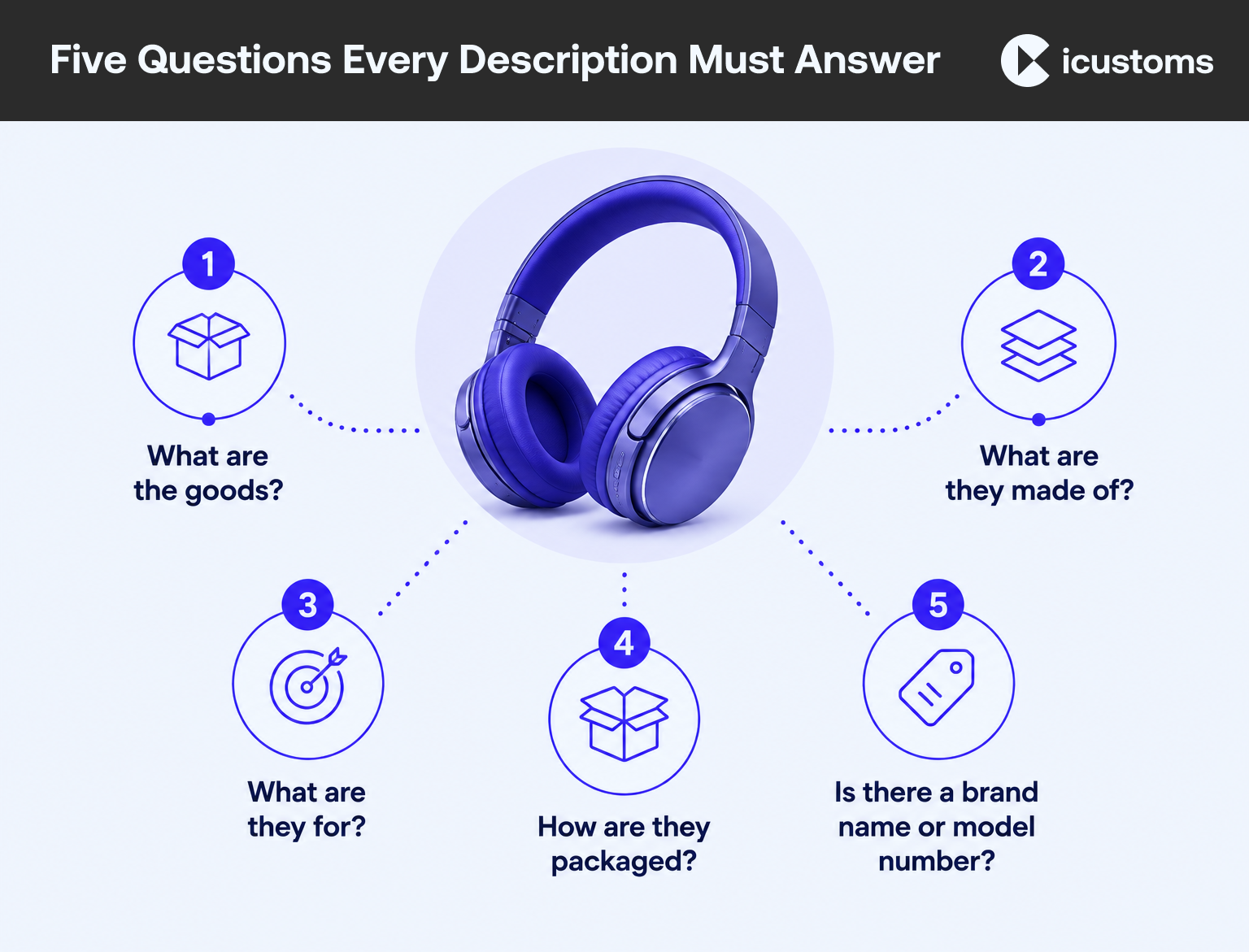
A description must be in plain language and specific enough for authorities to identify, classify and examine the goods. To get there, answer five questions:
- What are the goods?
- What are they made of?
- What are they for?
- How are they packaged?
- Is there a brand name or model number?
Worked examples
| Not acceptable | Acceptable |
|---|---|
| Clothes | Men’s cotton shirts (knitted), size XL |
| Appliances | Fridge-freezer (combined), 249 ltr, white |
| Battery | Lithium batteries for household use, size AAA (packs of 4) |
| Vodka | Vodka (brand name), 1 ltr, ABV 37.5 |
Three extra rules are worth committing to memory. Excise goods need the volume and the container detail. Alcohol needs the strength stated. Where items are grouped, say so in the description.
Generic terms such as goods or gifts cause delays either before or after the movement. Certain prohibited terms will cause an entry summary declaration to be rejected outright at submission.
Write it once, reuse it forever The highest-return thing in this entire article: build a library of approved descriptions, one per product, written to the standard above. Most businesses move the same things repeatedly. Writing each description once and reusing it removes your commonest rejection cause permanently and takes the judgement out of a job that is otherwise done under time pressure. |
Commodity code data
The commodity code drives almost everything else: the duty rate, the goods category, the documents required and the level of detail the declaration needs.
Two practical points.
First, the number of digits depends on the category. Standard goods are declared using a six-digit commodity code. Category 2 goods, which cover excise products and goods subject to EU import controls, need eight digits and any licence or certificate declared alongside. Category 1 goods, which include those subject to trade defence measures, prohibitions or where an EU tariff quota is claimed, sit outside the simplified routes altogether.
Second, once you save the commodity code details, a Tariff Requirements section tells you what those goods actually need. Read it. That is where the document codes you will otherwise omit are listed, and skipping it is the direct cause of a great many cases.
Codes change, so a code that was right last year may not be this year. The tariff tool for checking category and measures is covered in our overview of how the Trader Support Service works, along with the goods profile that can pre-populate codes for products you move regularly.
For businesses with large or changing catalogues, AI-powered commodity classification is the part of the problem worth looking at first, because classification effort scales with the number of distinct products rather than the number of movements.
Trader and movement data
The stable half of the data set, and the half worth setting up properly once.
- EORI number for the business, and the correct one where you hold more than one
- UK Internal Market Scheme authorisation number, where you hold it, used only for movements on or after the authorisation date
- Importer, exporter, declarant and intermediary details, spelled consistently everywhere
- Any procedure or relief authorisations you are entitled to use
- Standing carrier and route detail for lanes you run regularly
Consistency matters more than completeness here. A consignee name spelled two ways across two systems will eventually produce a mismatch nobody can explain.
Consignment level and item level
Customs data sits at two levels, and mixing them up is a common source of confusion for people new to declarations.
Consignment level covers the shipment as a whole: the parties, the transport, the overall totals. Item level covers each distinct goods line within it: its own commodity code, description, quantity, weights, value and origin.
One consignment with fifteen different products has fifteen sets of item data. This is precisely why the effort scales with product variety rather than shipment count, and why a business sending one pallet of mixed goods can have more work than one sending a full load of a single product.
Pre-submission validation: the checklist
Customs data validation before submission is the cheapest quality control available. Work through these before anything is sent.
Completeness
- Every mandatory field for the declaration type in use is populated
- Every goods line has its own code, description, quantity, weights, value and origin
- Certificates and licences are present for controlled goods
Consistency
- Gross mass exceeds net mass
- Package counts match the packing list
- Item values sum to the invoice total
- Party names and identifiers match your records exactly
- The currency stated is the currency on the invoice
Correctness
- The commodity code exists and is current
- The digit count matches the goods category
- The description meets the plain-language standard
- The document codes the Tariff Requirements section calls for are all present
- Origin is the country of origin, not the country of despatch
Authorisation
- Any scheme number quoted is valid for the date of the movement
- Any preference claimed is supported by evidence you actually hold
What each of these fields means in detail is set out in the TSS data guide, which covers every field across all four declaration types and was last updated in June 2026. If you want the failure side of the same picture, why TSS declarations get rejected works through what happens when these checks are skipped.
The declaration data checklist
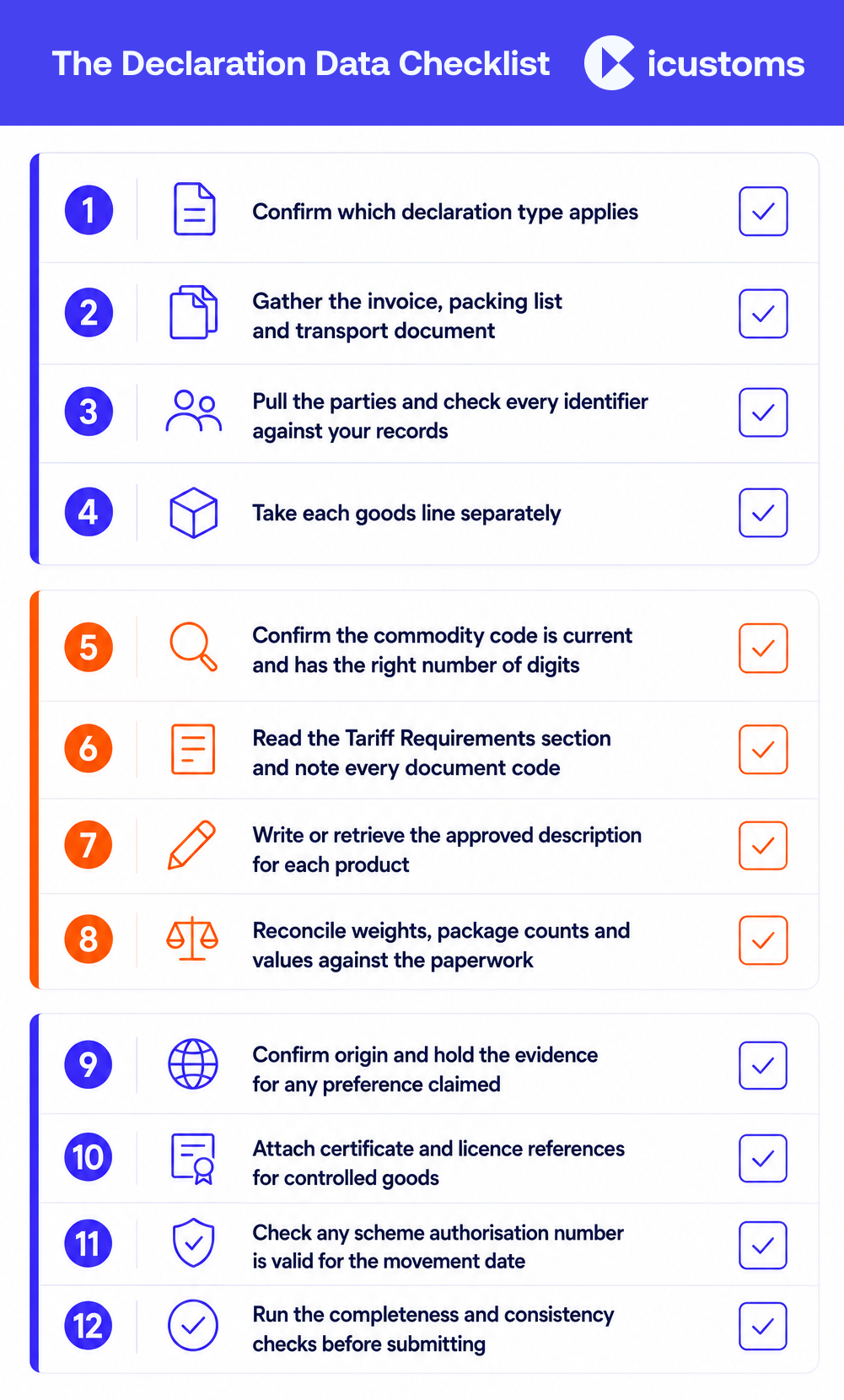
If you take one thing from this article and pin it up, take this. It is the short version of everything above, in the order you should work through it.
- Confirm which declaration type applies. The data set follows from it.
- Gather the invoice, the packing list and the transport document.
- Pull the parties, and check every identifier against your own records.
- Take each goods line separately. Do not merge them.
- Confirm the commodity code is current and has the right number of digits.
- Read the Tariff Requirements section and note every document code it calls for.
- Write or retrieve the approved description for each product.
- Reconcile weights, package counts and values against the paperwork.
- Confirm origin, and hold the evidence for any preference you intend to claim.
- Attach certificate and licence references for controlled goods, and check they match the documents.
- Check any scheme authorisation number is valid for the movement date.
- Run the completeness and consistency checks before you submit anything.
Build the foundations once
Everything above is easier if four things exist.
- A product master. One record per product holding the approved description, the commodity code, the material composition and any certificate requirement. One authoritative source, not three spreadsheets.
- A party record. Importers, exporters, consignees and carriers with their identifiers, spelled once.
- A document standard. What you require from suppliers, in what format, so the same fields appear in the same places.
- A review rhythm. Codes change and products change. A quarterly check is far cheaper than discovering it at a port.
None of this is glamorous and all of it pays back. A business with a good product master can automate; a business without one cannot, whatever software it buys.
Where the data comes from at volume
At a few movements a month, assembling this by hand is fine. The economics change when the same supplier sends forty invoices a month in a layout nobody controls.
That is where extracting data from trade documents earns its place: reading the invoice and packing list, pulling the fields, and handing structured data to the validation step rather than to a person with a keyboard.
Once the data is structured and checked, submitting it is the straightforward part, whether through the portal or by connecting your systems to TSS. Our overview of Northern Ireland customs automation covers how the pieces fit together.
Requirements differ by declaration type, so it is worth knowing which one applies before you assemble anything. We cover simplified and supplementary declarations explained separately, and the safety and security half of the data set in the safety and security data set.
Frequently Asked Questions
What data do I need for a TSS declaration?
Five groups: parties, goods, customs treatment, transport, and safety and security. In practice that means EORI, commodity code, a specific goods description, quantity, gross and net mass, value and currency, country of origin, packaging, transport detail and any certificates for controlled goods.
How do I write a good goods description for customs?
Plain language, specific enough for authorities to identify, classify and examine the goods. Answer what they are, what they are made of, what they are for, how they are packaged, and the brand or model. Clothes fails; men's cotton shirts (knitted), size XL passes.
Which documents do I need for a Northern Ireland declaration?
Commercial invoice, packing list and transport document as a minimum, plus any certificate or licence for controlled goods. Your commodity code and authorisation numbers come from your own records, not from the shipment.
How do I check a commodity code before submitting?
Check it is current, that the digit count matches the goods category, and read the Tariff Requirements section after saving the code. That section lists the documents those goods need.
What is the difference between consignment level and item level?
Consignment level covers the shipment as a whole, including parties and transport. Item level covers each distinct goods line, with its own code, description, quantity, weights, value and origin.
How do I validate customs data before submission?
Check completeness, internal consistency, correctness of codes and descriptions, and that any authorisation or preference claimed is valid and evidenced. Doing this before submission costs minutes; doing it afterwards costs a rejection.
What does a commercial invoice not tell me?
The commodity code, your authorisation numbers, the customs treatment, and usually a description that meets the customs standard. Invoice descriptions are written for the buyer.
How many digits does a commodity code need?
Standard goods are declared at six digits. Category 2 goods need eight, with any licence or certificate declared alongside.
Do the data requirements change by declaration type?
Yes. The TSS data guide covers the fields for entry summary, simplified frontier, supplementary and full frontier declarations, and there is a separate guide for internal market movement data.
What is the single most useful thing I can do?
Build a product master with an approved description and commodity code for each product. It removes the commonest rejection cause and is the precondition for automating anything later.
You may also like:

Spending Too Much Time Preparing TSS Customs Data?

Extract trade information and create structured customs data.
Subscribe to our Newsletter
About iCustoms
iCustoms is an all-in-one solution helping businesses automate customs processes more efficiently. With AI-powered and machine-learning capabilities, iCustoms is designed to streamline your all customs procedures in a few minutes, cut additional costs and save time.
Turn Your Trade Documents Into Customs Data
Capture information automatically for more consistent TSS preparation.