

ENS for Rail Freight UK: What Train Operators and Rail Forwarders Must Know
- John Hall
- Customs Specialist at iCustoms.ai
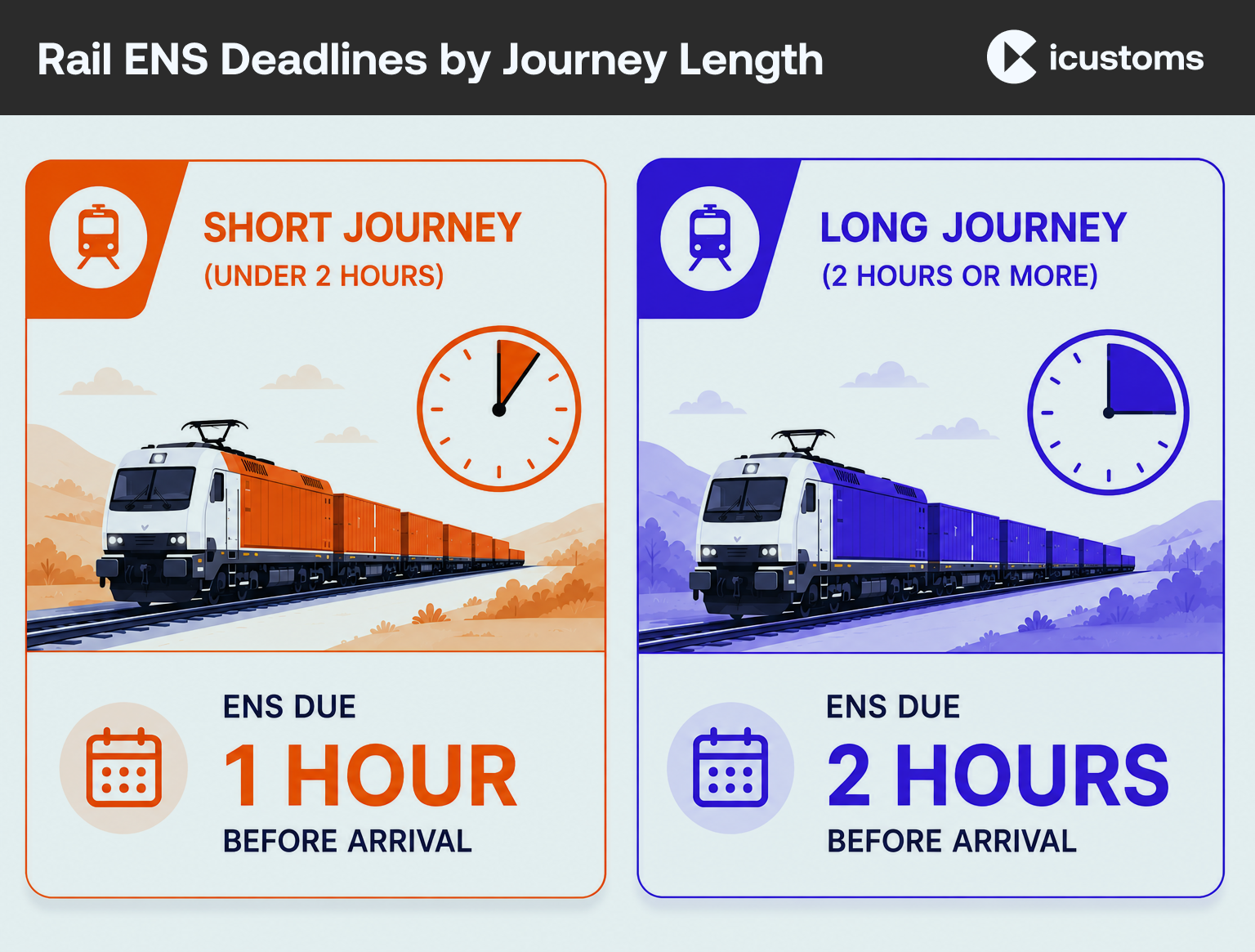
For rail freight into Great Britain, the carrier responsible for the Entry Summary Declaration is the rail freight operator authorised to traction the train through the Channel Tunnel. The deadline is 1 hour before arrival for journeys under 2 hours, and 2 hours before arrival for longer journeys.
Rail is a smaller share of UK-EU freight than road or sea, but the ENS rules still apply in full, and they are specific. This is the rail view for train operators and rail forwarders. For the full cluster, start with our S&S GB ENS pillar guide.
Who files the ENS for rail freight?
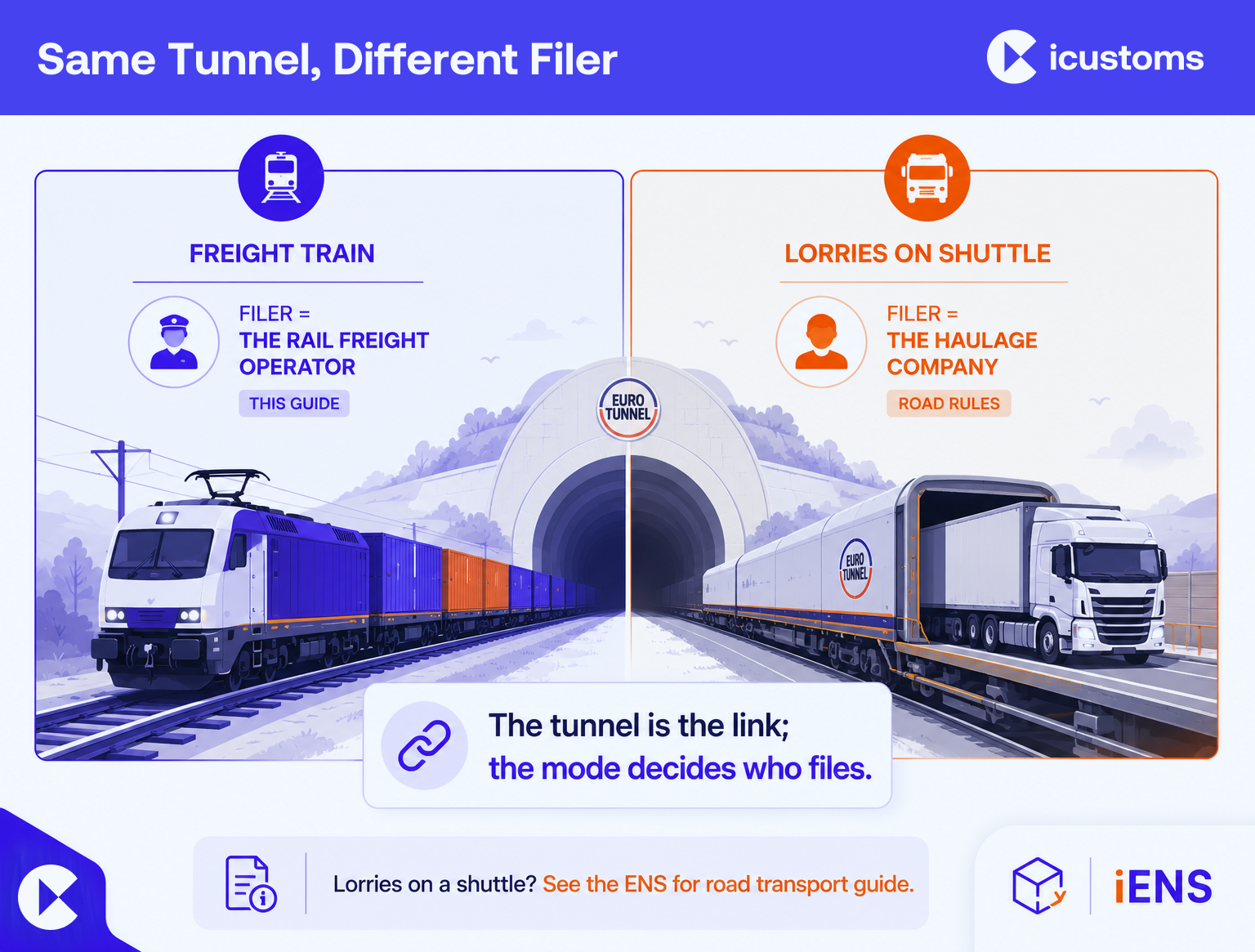
The legal duty sits with the rail freight operator that tractions the train into Great Britain through the Channel Tunnel. In practice, rail forwarders and the traders behind the consignments supply the data, and the operator, or an agent acting for them, lodges the declaration. As with every mode, an agent can file, but the legal responsibility stays with the carrier, and two parties should not file the same consignment. See who did file ENS for the detail.
Rail ENS deadlines
| Rail Journey | ENS Deadline (Minimum) |
|---|---|
| Short rail journey (under 2 hours) | At least 1 hour before arrival |
| Long rail journey (2 hours or more) | At least 2 hours before arrival |
The deadline is tied to journey length, not cargo type. You can file up to 200 days in advance, and in practice you file to the operator’s earlier cut-off. The full mode table is in our ENS deadlines by transport mode guide.
Rail freight and the Channel Tunnel
Rail freight into Great Britain runs through the Channel Tunnel, which is the only fixed rail link to continental Europe. That is why the carrier is defined as the operator authorised to traction the train through the tunnel.
It is worth separating two things that both involve the tunnel. Rail freight, where goods travel by train, is filed by the rail freight operator. Road freight that crosses on the Eurotunnel shuttle, where lorries drive on, is filed by the haulage company and follows the road rules. If your movement is lorries on a shuttle rather than a freight train, see our ENS for road transport guide instead.
What rail forwarders need to provide
A rail forwarder rarely lodges the declaration, but the quality of the data you hand to the operator decides whether it passes. Provide a clear goods description, the consignor and consignee with their EORIs, package and weight data, and the routing. A vague description or a missing EORI is the usual reason a declaration is rejected, so agree a data cut-off with the operator that sits well before the ENS deadline.
After you file: the MRN
Once the declaration passes validation, S&S GB issues a Movement Reference Number as proof of acceptance, and the consignment is risk assessed. You can amend a declaration until the goods arrive if details change, but the original must still have been lodged on time. The ENS is separate from the customs import declaration, so it does not clear the goods for duty and VAT.
How iENS helps rail operators and forwarders
Rail volumes may be lower, but the filing standard is the same, and a rejected declaration still holds a train. iENS from iCustoms reads the consignment data, validates it, and files through S&S GB ahead of the cut-off, returning the MRN and flagging any issue early. See how it works on the iENS.
Frequently Asked Questions
Who files the ENS for rail freight into the UK?
The rail freight operator authorised to traction the train through the Channel Tunnel into Great Britain. Rail forwarders supply the data, and an agent can file, but the operator keeps the legal responsibility.
What is the ENS deadline for rail freight?
One hour before arrival for rail journeys under 2 hours, and 2 hours before arrival for journeys of 2 hours or more. You can file up to 200 days in advance.
Does rail freight into the UK go through the Channel Tunnel?
Yes. The Channel Tunnel is the only fixed rail link to continental Europe, which is why the carrier is defined as the operator tractioning the train through it.
Do rail forwarders need to file the ENS themselves?
Usually not. The rail freight operator is the carrier and files, while the forwarder supplies the consignment data. A forwarder or agent can file on the operator's behalf by agreement, but must hold a GB EORI and be enrolled with S&S GB.
You may also like:
Struggling to Extract, Catagorise & Validate Your Documents?

Capture & Upload Data in Seconds with AI & Machine Learning
Subscribe to our Newsletter
About iCustoms
iCustoms is an all-in-one solution helping businesses automate customs processes more efficiently. With AI-powered and machine-learning capabilities, iCustoms is designed to streamline your all customs procedures in a few minutes, cut additional costs and save time.
Struggling to Extract, Catagorise & Validate Your Documents?
Capture & Upload Data in Seconds with AI & Machine Learning