

Post-Brexit Customs Requirements Ireland: What’s Changed and What to Do
- John Hall
- Customs Specialist at iCustoms.ai
This guide covers post-Brexit customs requirements Ireland traders are dealing with today, not what changed on day one back in 2021. Our Brexit and GB-Ireland trade rules guide already covers the legal mechanics, the Trade and Cooperation Agreement, rules of origin, and the declaration requirement, and our moving goods from Great Britain to Ireland guide covers the operational step-by-step process. This article is the current-state layer on top of both: what’s actually changed since those rules were first introduced, and what traders are still getting wrong now, years into an arrangement that keeps evolving even though the headline rules haven’t.
A Brexit customs Ireland compliance setup built once in 2021 and never revisited is exactly the gap this guide is written to close. This is what post-Brexit Ireland trade actually looks like today: the same core legal framework as 2021, sitting underneath a UK import-control regime and a Northern Ireland arrangement that have both moved substantially since, in ways that a one-time compliance build doesn’t automatically track.
The Rules Haven’t Changed, but the Landscape Around Them Has
The core legal framework behind GB-Ireland trade, the Trade and Cooperation Agreement and the declaration requirement it sits alongside, has been the standing arrangement since 1 January 2021 and hasn’t been rewritten. What has changed is everything built around it: the UK’s own import-control regime for goods coming in from the EU, and the Windsor Framework’s phased rollout for Northern Ireland. Both directly affect Irish businesses trading with Great Britain, and both have moved in stages since 2021 in ways a compliance setup built in the early post-Brexit period may not reflect.
The Border Target Operating Model: What It Means for Irish Exporters to GB
Most Brexit-focused content covers goods moving into Ireland from Great Britain. Less attention goes to the reverse direction, and that’s a gap worth closing, because the UK’s Border Target Operating Model (BTOM) put real, dated requirements on goods moving from Ireland into Great Britain, requirements that didn’t exist in the early post-Brexit period at all.
BTOM rolled out in three dated phases rather than all at once:
- 31 January 2024: Export health certificates and phytosanitary certificates became required for medium-risk animal products, plants, and plant products moving from the EU, including Ireland, into Great Britain.
- 30 April 2024: Full sanitary and phytosanitary checks began, physical, documentary, and identity checks for medium-risk animal and plant products at UK border control posts, alongside a common user charge applied at ports including Dover and the Eurotunnel.
- 31 October 2024: Safety and security declarations became a requirement for imports into Great Britain from the EU, a data requirement that has no equivalent in the Ireland-side declaration this cluster otherwise covers.
For an Irish business that only ever thought about compliance from the import side, goods coming into Ireland from GB, BTOM is the reminder that the export direction carries its own, separately-evolving set of requirements, phased in well after the original 2021 rules and easy to miss if nobody re-checked the export side once the initial post-Brexit setup was in place.
Where the Windsor Framework Stands Now
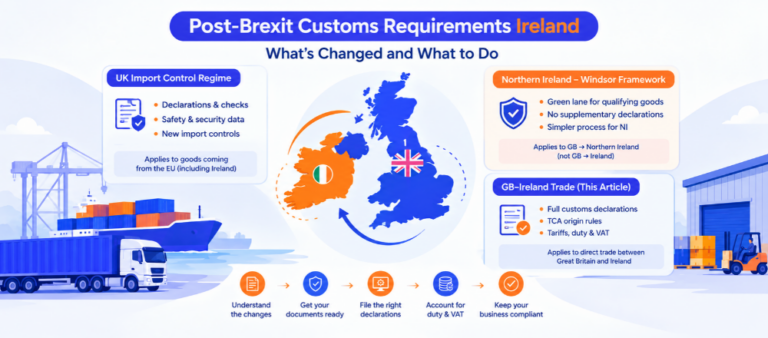
This article doesn’t re-explain Windsor Framework mechanics, our existing Windsor Framework coverage owns that, but its current status matters for anyone tempted to apply Northern Ireland logic to direct GB-Ireland trade, or the reverse. As of its final implementation from 1 May 2025, the Windsor Framework’s green lane arrangement removed the need for supplementary declarations on qualifying goods moving from Great Britain into Northern Ireland, a simplification specific to that route. Direct trade between Great Britain and Ireland was never part of that simplification and still requires the full declaration process this cluster’s other articles cover; the two routes have moved further apart in practice, not closer together, even as Windsor Framework itself has become simpler for the route it actually governs.
The Systems Underneath Have Changed Too
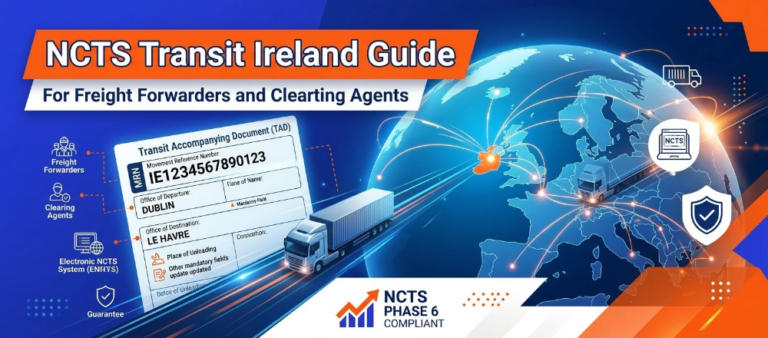
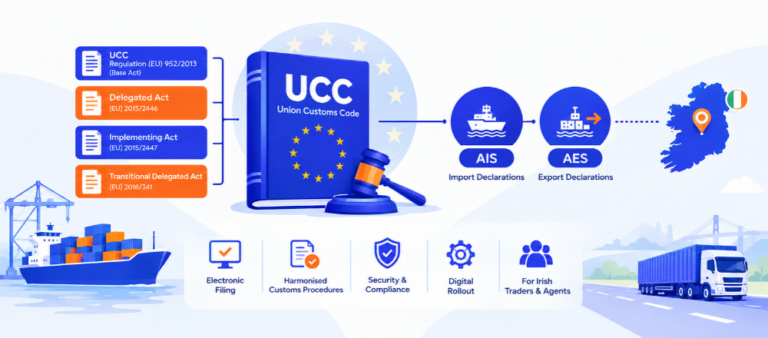
It isn’t just the UK’s import controls and Northern Ireland’s arrangement that have moved since 2021. The Irish-side systems that process the declarations this whole framework depends on, AIS, AES, and NCTS for anything routed through transit, have themselves been rebuilt as part of the EU’s wider Union Customs Code digitalisation programme. NCTS alone has gone through two further phases since the original post-Brexit declaration requirement began, most recently Phase 6, which took effect in September 2025 and made several previously optional data fields mandatory. A business that hasn’t touched its declaration templates or software since the initial 2021 setup isn’t just behind on BTOM and Windsor Framework, it may also be filing against data requirements that Revenue’s own systems moved on from years ago.
GB Ireland Customs 2026: A Quick Compliance Health Check
None of the changes covered above require a full compliance rebuild, but they do warrant checking against, rather than assuming, the current position. A short GB Ireland customs 2026 health check worth running against an existing setup:
- Export paperwork: does it account for BTOM’s certification and safety-and-security requirements, or only for the Ireland-side import declaration?
- Origin evidence: does it reflect current sourcing and manufacturing, or a certificate obtained once and never revisited?
- Route boundaries: is Windsor Framework logic being kept separate from direct GB-Ireland trade, especially now that the two routes look increasingly different in practice?
- Declaration software: is it aligned with current AIS, AES, and NCTS data requirements, including changes like NCTS Phase 6, rather than whatever was accurate when the software was first set up?
- Cost planning: does budgeting account for standing GB-side costs like the common user charge, rather than treating them as one-off surprises?
A setup that answers yes to all five is genuinely current. One that doesn’t is carrying risk that has nothing to do with misunderstanding the original 2021 rules, and everything to do with the landscape around them having moved on without a corresponding review.
Post-Brexit Customs Requirements Ireland Traders Are Still Getting Wrong
The legal misconceptions, things like assuming tariff-free means declaration-free, are covered in our Brexit rules guide. What shows up now, further into the arrangement, tends to be different: not misunderstanding the rules, but compliance setups that haven’t kept pace with how the rules around them have moved.
- Treating 2021 knowledge as current. A compliance process built when the rules first changed doesn’t automatically account for BTOM’s 2024 phases or Windsor Framework’s 2025 rollout; neither existed yet in their current form back then.
- Assuming BTOM is a Great Britain problem, not an Irish one. BTOM’s certification, inspection, and safety-and-security requirements apply to the exporting business’s paperwork just as much as to anything happening at the UK border; treating it as purely the receiving country’s concern leaves the Irish side of the shipment unprepared.
- Confusing Windsor Framework’s simplified green lane with direct GB-Ireland trade. The green lane’s reduced paperwork applies specifically to qualifying Great Britain to Northern Ireland movements. It has no bearing on direct Great Britain to Ireland trade, which still requires the full declaration process regardless of how simple the Northern Ireland route has become.
- Letting origin documentation go stale. A certificate of origin or supplier’s declaration obtained once isn’t necessarily valid indefinitely; origin has to reflect the current sourcing and manufacturing position, not a snapshot from whenever the paperwork was first arranged.
- Not budgeting for GB-side costs as a known, ongoing factor. The common user charge introduced under BTOM is a standing cost of moving qualifying goods through the affected UK ports, not a one-off surprise; treating it as unexpected each time is a planning failure, not a compliance one, but it affects the same shipments.
What This Means Practically
None of this changes what a declaration legally requires or how the step-by-step process works, those are covered elsewhere in this cluster. What it means practically is that a GB-Ireland compliance setup benefits from a periodic review rather than a one-time build: checking whether export-side paperwork accounts for BTOM’s current phase, confirming origin documentation still reflects reality, and keeping the Windsor Framework boundary clear even as that route itself keeps changing shape. This article is deliberately dated content rather than a fixed rules explainer, because that landscape, unlike the underlying TCA framework, has kept moving since 2021 and is likely to keep doing so.
How iAIS and iAES Keep Post-Brexit Compliance Current
A compliance setup built around the 2021 rules doesn’t automatically track what’s changed since, BTOM’s phases, Windsor Framework’s rollout, or which specific data fields a declaration now requires. iAIS and iAES are maintained against current Revenue and UK requirements rather than a fixed understanding of what post-Brexit trade required when the rules first changed, so a declaration filed today reflects today’s requirements, not 2021’s.
Frequently Asked Questions
Have the core post-Brexit customs rules changed since 2021?
No. The Trade and Cooperation Agreement and the declaration requirement for direct GB-Ireland trade have remained the standing arrangement since 1 January 2021. What has changed is the UK’s own import-control regime (BTOM), the Windsor Framework’s rollout for Northern Ireland, and the underlying declaration systems (AIS, AES, NCTS) themselves, none of which alter the core GB-Ireland rules but all of which affect what a current, working compliance setup actually needs to account for.
Do I need to redo my entire compliance setup because of these changes?
Not usually. Most of what’s changed sits around the core rules rather than replacing them, export-side certification under BTOM, Windsor Framework’s simplified Northern Ireland route, and updated data fields under NCTS Phase 6. A review against the current position, rather than a full rebuild, is generally what’s needed, unless that review turns up something that was never set up correctly in the first place.
Does the Border Target Operating Model affect goods moving from Ireland to Great Britain?
Yes. BTOM applies to goods entering Great Britain from the EU, Ireland included, and introduced health certification, physical and documentary checks, and safety and security declaration requirements in phases through 2024.
Does the Windsor Framework’s green lane apply to direct Great Britain to Ireland trade?
No. The green lane’s simplified process applies specifically to qualifying Great Britain to Northern Ireland movements. Direct Great Britain to Ireland trade still requires the full declaration process regardless of Windsor Framework’s own rollout.
Where can I find the legal rules behind GB-Ireland trade, or the step-by-step shipping process?
Our Brexit and GB-Ireland trade rules guide covers the legal framework; our moving goods from Great Britain to Ireland guide covers the operational process shipment by shipment.
How often should a GB-Ireland compliance setup be reviewed?
There’s no fixed official interval, but given how much has changed around the core rules since 2021 (BTOM’s phased rollout, Windsor Framework’s 2025 implementation), a periodic review, rather than a one-time setup, is the more realistic approach for a business trading regularly on this route.
You may also like:
Compliance That Keeps Up With the Rules

iAIS is updated as Revenue’s and the UK’s requirements change, so you’re not relying on a compliance setup from 2021.
Subscribe to our Newsletter
About iCustoms
iCustoms is an all-in-one solution helping businesses automate customs processes more efficiently. With AI-powered and machine-learning capabilities, iCustoms is designed to streamline your all customs procedures in a few minutes, cut additional costs and save time.
One Platform for Both Directions
iAES handles the export-side declaration; iAIS handles the import side. Either way, the data requirements stay current.