
NCTS Transit Ireland Guide: What Freight Forwarders and Clearing Agents Need to Know
- John Hall
- Customs Specialist at iCustoms.ai
This NCTS transit Ireland guide is for the people actually moving the paperwork and the goods, freight forwarders and clearing agents, not for anyone trying to look up a specific NCTS code. If that’s what you need, our NCTS codes guide covers that ground. What this guide covers instead: what actually travels with a transit movement, what changed under NCTS Phase 6, how transit works for goods routed through Great Britain to or from Ireland, and what any of it means for your day-to-day work.
What Is NCTS Transit, and Why Does It Matter for Freight Forwarders?
NCTS, the New Computerised Transit System, is the electronic system that manages transit movements, goods moving under customs control between an office of departure and an office of destination without duty and VAT being paid at every border crossing along the way. It operates under the Common Transit Convention (CTC), the international agreement between the EU, the UK, and a number of EFTA and other partner countries that allows a single transit movement to cross multiple customs territories under one procedure, and under the equivalent Union transit rules for movements that stay entirely within the EU.
For a freight forwarder or clearing agent, the practical value of transit is straightforward: it lets goods move through Ireland, or through other countries en route to or from Ireland, without triggering a full customs declaration and payment at every border. What that requires in return is that the movement is tracked properly from start to finish, which is where NCTS, and the document that travels with the goods, come in.
The NCTS Transit Accompanying Document: What Travels With the Goods
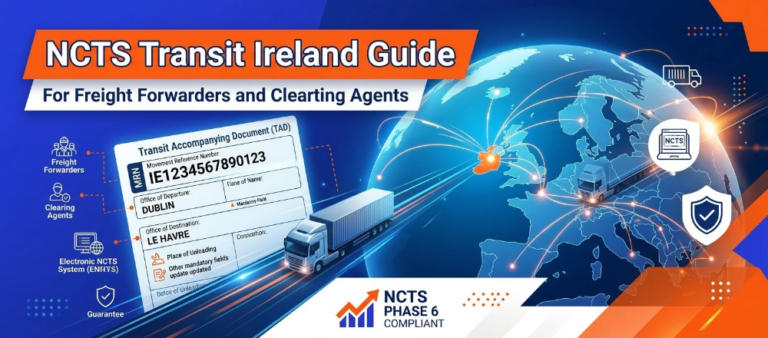
Every NCTS transit movement is represented by a Transit Accompanying Document, generated by the country of departure’s NCTS system once a transit declaration Ireland traders and agents have filed is accepted, and carrying a unique Movement Reference Number (MRN) tied to that specific movement. This NCTS Transit Accompanying Document, and the MRN on it, is what a customs authority or carrier checks against at any point in the journey, at the office of transit, at a border crossing, or at the office of destination, to confirm the movement is a legitimate, still-open transit rather than an untracked load.
A transit movement also needs a guarantee behind it, security covering the duty and VAT that would be due if the goods never actually reached the office of destination. Most freight forwarders and clearing agents operate under a comprehensive guarantee, authorised in advance and referenced on each declaration rather than lodged fresh for every movement, and it’s the guarantee reference fields, not the guarantee itself, that changed under Phase 6.
This is a genuinely distinct piece of the transit process from the classification codes covered in our NCTS codes guide or the T1 document itself, covered in our T1 document guide: the TAD is the physical document that accompanies specific goods on a specific journey, generated fresh for each movement, rather than a reference code or a document type in the abstract.
NCTS Phase 6: What Changed in Ireland
NCTS Phase 6 became effective from 1 September 2025, per Revenue’s own Trader Guide, with Ireland’s updated trader specifications published that same September. It didn’t replace the underlying transit procedure, but it did change what a transit declaration has to contain, and getting this wrong is exactly the kind of thing that produces a rejected declaration rather than a processing delay. The changes freight forwarders and clearing agents are most likely to run into:
- A new “Place of Unloading” data element was added to the declaration.
- Several fields that were previously optional (conditional) became mandatory, including the TIR holder identification number, the Combined Nomenclature code at item level, gross mass at item level, and departure and active border transport means details (vehicle type, ID, and nationality).
- Guarantee reference amount and currency fields, previously more loosely specified, are now required fields.
None of this is something a freight forwarder needs to track field-by-field in Revenue’s own technical specification. What matters practically is that a transit declaration built on an older template, or filed through software that hasn’t been updated for Phase 6, is now more likely to be missing a mandatory field than it would have been under Phase 5. Our NCTS Phase 5 transition guide covers the earlier rollout; this is the update to that story, not a repeat of it.
Moving Goods Between Great Britain and Ireland Under Transit
A significant share of NCTS transit traffic involving Ireland isn’t goods moving in a straight line, it’s goods routed through Great Britain as an intermediate leg, commonly called the UK landbridge: goods moving between Ireland and continental EU countries such as France, Belgium, the Netherlands, or Sweden, physically crossing Great Britain via ports like Holyhead or Liverpool along the way.
That routing layers UK-specific systems on top of NCTS rather than replacing it. The TAD and its MRN are generated by the departure country’s NCTS as usual, but the Great Britain leg also requires the UK’s Goods Vehicle Movement Service (GVMS), which completes the office-of-transit function digitally rather than through a physical stop, and, on the Irish side, a Pre-Boarding Notification created through Ireland’s Customs RoRo service before the ferry crossing. One detail specific to Northern Ireland is worth flagging directly: goods moved under common transit from Great Britain to Ireland where the goods are destined for Northern Ireland are permanently exempt from the UK’s safety and security export requirements, a standing exemption rather than a temporary or transitional one.
What This Means Day to Day for Freight Forwarders and Clearing Agents
None of the above changes the underlying job, but it does change what has to be right before a movement starts. A transit declaration needs the correct, currently-mandatory data fields for Phase 6, not a template carried over from Phase 5. A landbridge movement needs the TAD, the GVMS record, and the Irish PBN lined up as three separate but connected pieces, not just the transit declaration on its own. And knowing where a movement can actually open or close matters operationally, common Irish points of departure, transit, and destination for NCTS movements include Dublin Port, Rosslare Harbour, and Ringaskiddy, though the specific office assigned to a movement depends on the authorisation and route in question rather than being a fixed choice.
This article doesn’t repeat the NCTS code list, the T1 document’s own detail, or the Phase 4-to-5 transition story, our NCTS codes guide, T1 document guide, and NCTS Phase 5 guide own that ground respectively. What it adds is the operational layer sitting on top: the TAD’s role, what actually changed under Phase 6, and how a GB-routed movement fits together.
How iAIS Supports NCTS Transit
Transit declarations carry their own data requirements, separate from a standard AIS or AES filing, and those requirements change when Revenue updates them, as Phase 6 just did. iAIS keeps transit declarations aligned with the current mandatory fields, so a freight forwarder or clearing agent isn’t cross-checking every movement against Revenue’s latest technical specification by hand.
Frequently Asked Questions
What is NCTS transit in Ireland?
It’s the electronic system, used under the Common Transit Convention and Union transit rules, that tracks goods moving under customs control between an office of departure and an office of destination without duty and VAT being collected at every border along the way.
What is a Transit Accompanying Document (TAD)?
It’s the document generated by the country of departure’s NCTS system for a specific transit movement, carrying a unique Movement Reference Number that customs authorities and carriers check at each stage of the journey.
When did NCTS Phase 6 go live in Ireland?
Revenue’s Trader Guide states Phase 6 became effective from 1 September 2025, with Ireland’s updated trader specifications published that same month.
Does the UK landbridge use a different transit system?
No. It uses the same NCTS-generated TAD and MRN as any other transit movement, with the UK’s Goods Vehicle Movement Service and Ireland’s Pre-Boarding Notification layered on for the Great Britain leg specifically.
Where can I find NCTS codes or the T1 document explained?
Our NCTS codes guide and T1 document guide cover those in depth; this guide focuses on the TAD, Phase 6 changes, and GB-routed movements instead.
You may also like:
One Declaration, Tracked From Departure to Discharge

iAIS keeps your transit declarations aligned with the current NCTS message requirements, so a Phase 6 field change doesn’t turn into a rejected declaration.
Subscribe to our Newsletter
About iCustoms
iCustoms is an all-in-one solution helping businesses automate customs processes more efficiently. With AI-powered and machine-learning capabilities, iCustoms is designed to streamline your all customs procedures in a few minutes, cut additional costs and save time.
Phase 6 Fields, Already Built In
iAIS tracks Revenue’s current mandatory-field requirements for NCTS declarations, so the Phase 6 changes are handled in the software rather than caught at rejection.