
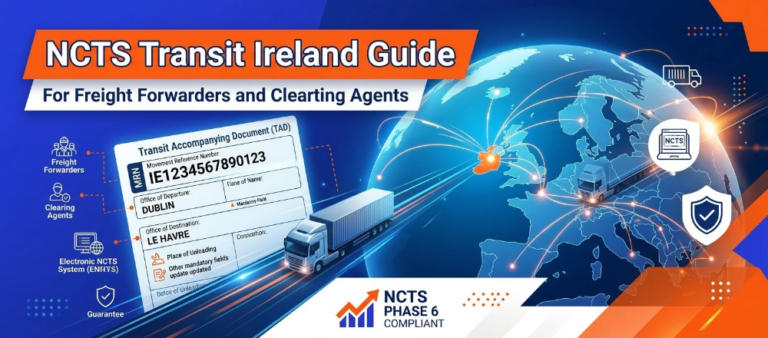
UCC Union Customs Code Ireland Explained: What Irish Traders and Agents Must Know
- John Hall
- Customs Specialist at iCustoms.ai
If you’ve come across the term and want the UCC Union Customs Code Ireland explained in plain language, here it is: the UCC is the single EU regulation that sets the legal rules for how goods move in and out of the European Union, and it is the direct legal reason Irish traders now file import and export declarations electronically through AIS and AES rather than on paper. Every customs procedure this content cluster covers, classification, declarations, penalties, AEO status, Intrastat, sits inside the framework this one piece of legislation establishes.
This guide covers what the UCC actually is, how its supporting legislation fits together, why it’s the legal foundation behind Ireland’s AIS and AES systems, where Ireland currently stands in the EU’s digital rollout of the systems the UCC requires, and what all of this means practically for traders and customs agents working in Ireland.
What Is the Union Customs Code?
The Union Customs Code is Regulation (EU) No 952/2013, applicable across the EU since 1 May 2016. It replaced the older Community Customs Code and consolidated customs law into a single, modernised framework covering how goods are classified, valued, declared, and cleared as they cross the EU’s external border, along with the rules for special procedures, guarantees, and enforcement.
It applies uniformly in every member state, but each country’s customs authority, Revenue in Ireland’s case, administers it nationally through its own systems and processes. Some traders refer to it informally as the EU customs code Ireland businesses operate under, though “Union Customs Code” is its correct legal name and the one used throughout Revenue’s own guidance.
The UCC isn’t a static document. It’s built to be implemented through a set of connected legal instruments and a long-running digital transformation programme, both of which matter more to a working trader or agent than the base regulation’s text alone.
The UCC’s Legal Architecture: Base Act, Delegated Act, and Implementing Act
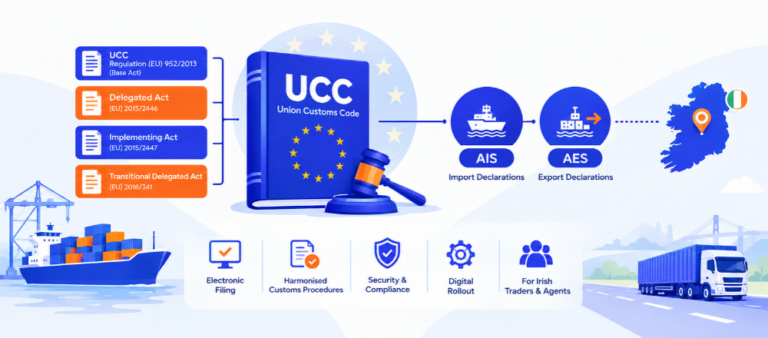
Union Customs Code Ireland legislation, in practice, is a stack of four instruments rather than one:
- The UCC itself (Regulation (EU) 952/2013): the base act setting out the overall legal framework.
- The UCC Delegated Act (Commission Delegated Regulation (EU) 2015/2446): fills in the detailed rules the base act leaves to secondary legislation, criteria for authorisations, valuation detail, and similar technical provisions.
- The UCC Implementing Act (Commission Implementing Regulation (EU) 2015/2447): sets out the procedural detail, data requirements, and formats needed to apply the Code and the Delegated Act consistently.
- The UCC Transitional Delegated Act (Commission Delegated Regulation (EU) 2016/341): governs the rules that apply during the transitional period, while the electronic systems the Code requires are still being built and rolled out, allowing existing paper-based or interim electronic processes to remain valid until a system is ready to replace them.
Any Union customs code reforms since 2016 have generally taken the form of amendments to these four instruments rather than a rewrite of the base Code, which is why UCC legislation is best understood as this evolving stack rather than a single fixed text.
Union Customs Code Ireland Explained: The Legal Foundation Behind AIS and AES
Article 6 of the Union Customs Code requires that all exchanges of information between customs authorities and traders, and between customs authorities themselves, take place using electronic data-processing techniques, not paper. That single requirement is the direct legal basis for why Ireland built and operates AIS (the Automated Import System) and AES (the Automated Export System): they are Revenue’s national implementations of the UCC’s electronic-declaration mandate for imports and exports respectively.
This article won’t re-cover how AIS and AES actually work day to day, our Automated Import System guide and Automated Export System guide cover the mechanics of lodging a declaration in each. What matters here is the relationship: the UCC sets the legal requirement for electronic customs communication across the EU, and AIS and AES are how Ireland meets it. The same logic extends to related requirements the UCC’s implementing legislation sets out for guarantees, special procedures, and Entry/Exit Summary declarations, all of which trace back to this same base framework, even where Ireland’s specific system for handling them (NCTS for transit, ICS2 for pre-arrival safety and security data) has its own name and its own guide.
The UCC Work Programme and Where Ireland Stands
The UCC’s electronic-systems requirement doesn’t switch on all at once. The European Commission manages its rollout through the UCC Work Programme, a formal schedule of the IT systems member states must build nationally or connect to at EU level, set out under a Commission Implementing Decision (originally Decision 2014/255/EU, revised since through Decisions 2016/578/EU and 2019/2151/EU, with the current version adopted as Decision (EU) 2023/2879 in December 2023). That current version targets full operational status for the Work Programme’s electronic systems by 31 December 2025, and publicly available EU reporting on the programme confirms that a number of member states have already indicated they won’t hit that date for every system.
Ireland’s own position is easier to state with some confidence than most, because Revenue reports its national progress directly to the European Commission, and the Commission consolidates every member state’s status into a single tracking document. Based on that European Commission (DG TAXUD) national planning record, most recently updated for Ireland in January 2026, here is where the systems most relevant to Irish traders and agents currently stand:
| UCC system | Ireland status | Note |
|---|---|---|
| National Import Systems (AIS) | Completed | Ireland’s national import declaration system |
| National Export Systems / Trans-European AES | Completed | Both the national and EU-wide export components |
| NCTS Phase 5 | Completed | Transit declarations |
| NCTS Phase 6 | Completed | Ireland’s updated trader specifications published September 2025 |
| ICS2 Release 3 | Completed, with a derogation | Road and rail freight data operated under a Commission-granted derogation to 31 December 2025 |
| Proof of Union Status (PoUS), Phases 1 and 2 | Completed, Phase 2 under derogation | Phase 2 derogation extends to 31 December 2025, tied to delays in national maritime single-window systems EU-wide |
| Centralised Clearance for Import (CCI), Phases 1 and 2 | Completed as a system build | The same record notes no CCI authorisations have actually been issued in Ireland yet, so the system exists but isn’t yet in live use |
| Guarantee Management (GUM) | No additional national system required | Revenue’s own review found Ireland didn’t need to build a separate national component |
Two things are worth taking from this table rather than the individual dates. First, Ireland has largely finished building what the UCC’s Work Programme requires, its remaining open items are narrow (a couple of derogation-covered data flows, and CCI authorisations not yet issued) rather than systems still under construction. Second, “completed” at system level doesn’t always mean “usable by every trader today,” CCI being the clearest example: the infrastructure is built, but no business can actually use centralised clearance in Ireland until Revenue starts issuing authorisations against it. Specific rollout dates and derogation end-dates change as the Commission and Revenue update this record, so treat the table as a snapshot rather than a permanent reference, and check Revenue’s own UCC and eCustoms pages for the current position before relying on a specific date.
What the UCC Means for Irish Traders and Agents Day to Day
For a trader or customs agent, the UCC’s practical effect isn’t the regulation text, it’s a small number of operating realities that follow from it:
Declarations have to be electronic. Paper-based customs declarations for standard import and export movements are not a fallback option under the UCC framework; AIS and AES are the required channels, and the UCC’s transitional rules only permit interim arrangements where the Commission has formally allowed them.
Data requirements are set centrally, not nationally. The specific fields, codes, and formats a declaration must contain come from the UCC’s Implementing Act and its Delegated Act, which is why declaration data requirements look broadly similar across EU member states even though each country runs its own national system.
Authorisations and simplifications sit inside the same legal framework. AEO status, customs warehousing, and other special procedures are all defined and governed by the UCC and its Delegated and Implementing Acts; our AEO status guide covers applying for AEO specifically, and this article deliberately doesn’t repeat that process here.
The framework keeps changing. Because the UCC is implemented through an ongoing Work Programme rather than a single completed rollout, the systems and requirements behind it are still being finished and adjusted, which is one more reason a trader or agent benefits from software that tracks Revenue’s requirements directly rather than relying on a fixed understanding of “how AIS works” formed a year or two ago.
How iAIS Keeps You Aligned With the UCC
The UCC’s requirements reach every declaration an Irish trader or agent files, but almost nobody working a declaration needs to read the regulation itself day to day. iAIS is built to absorb that layer: declaration formats, data requirements, and validation rules stay aligned with what Revenue’s systems expect under the UCC framework, so the legal detail behind a rejected declaration or a changed data field is something the software handles rather than something you have to research from the legislation directly.
Frequently Asked Questions
What does UCC stand for?
Union Customs Code, the EU regulation (Regulation (EU) 952/2013) that sets the legal framework for customs procedures across all EU member states, including Ireland.
What did the UCC replace?
It replaced the older Community Customs Code, consolidating and modernising EU customs law into a single framework built around electronic, rather than paper-based, customs communication.
Is the UCC the same as AIS or AES?
No. The UCC is the EU-wide legal framework; AIS and AES are Ireland’s national electronic systems for import and export declarations, built specifically to meet the UCC’s electronic-communication requirement.
Has the UCC’s digital rollout finished?
Largely, for Ireland. Most of the electronic systems the UCC’s Work Programme requires are marked completed in Ireland, with a small number of components still operating under Commission-granted derogations extending into late 2025. The EU-wide programme as a whole has member states at different stages, so Ireland’s position isn’t necessarily representative of every country.
Where can I read the UCC itself?
The full text of Regulation (EU) 952/2013, along with its Delegated and Implementing Acts, is published on EUR-Lex, the EU’s official legislation portal, and Revenue’s website links to the current versions relevant to Irish traders.
You may also like:
Every AIS and AES Filing, Built on the Same Rulebook

iAIS keeps your declarations aligned with the UCC’s electronic filing requirements automatically, so compliance isn’t something you have to track separately.
Subscribe to our Newsletter
About iCustoms
iCustoms is an all-in-one solution helping businesses automate customs processes more efficiently. With AI-powered and machine-learning capabilities, iCustoms is designed to streamline your all customs procedures in a few minutes, cut additional costs and save time.
One System, Whatever the Underlying Legislation Changes
When Revenue updates a data requirement to match a new UCC provision, iAIS updates with it, so you’re not tracking legislative change and software change separately.