

Customs Agent vs Customs Software Ireland: Which Is Right for Your Business?
- John Hall
- Customs Specialist at iCustoms.ai
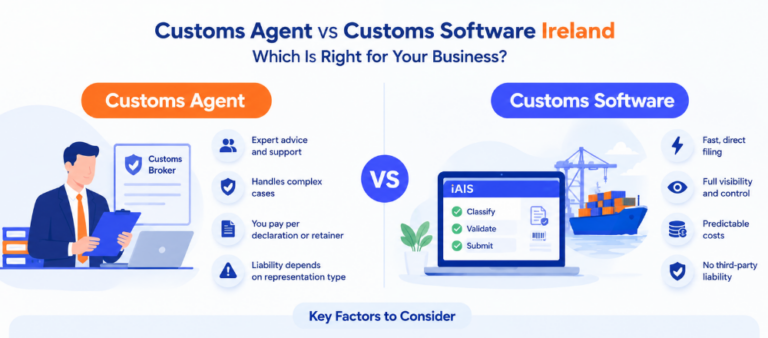
Customs agent vs customs software Ireland is, in practice, a question about who carries the compliance work and who carries the risk that comes with it: a licensed intermediary acting on your behalf, or a platform your own team uses to file directly. Neither option is universally right. This guide compares them properly, on cost structure, control, liability, and scalability, rather than treating it as a foregone conclusion, and covers where each one, and a combination of both, genuinely fits.
What a Customs Agent Actually Does
A customs agent, sometimes called a customs broker, is a third party authorised to lodge customs declarations on a business’s behalf, using either of two legally distinct arrangements under the Union Customs Code (UCC Articles 18 and 19). Under direct representation, the agent acts in the name of, and on behalf of, the business it represents, and the agent isn’t personally liable for the resulting customs debt. Under indirect representation, the agent acts in its own name but on the business’s behalf, which under UCC Article 77(3) makes the agent jointly and severally liable for the customs debt alongside the business itself.
That distinction isn’t a technicality. Which type of representation an agent is operating under determines who Revenue can pursue if a declaration turns out to be wrong, and it’s worth confirming in writing before engaging any customs agent, rather than assuming. A good agent brings classification expertise, an established relationship with Revenue, and the ability to absorb complex, judgment-heavy authorisations (bespoke customs warehousing arrangements, unusual origin situations) that a standard software workflow isn’t built to handle on its own.
What Customs Software Actually Does
Customs software, iAIS for imports and iAES for exports being one example, lets a business file its own AIS and AES declarations directly, using its own EORI number and its own Trader Account Number (TAN) for duty and VAT purposes, rather than routing every declaration through a third-party intermediary. This is, functionally, self-representation: the business is both declarant and importer or exporter in one, which means the direct-versus-indirect representation question, and the liability split that comes with it, doesn’t arise in the first place. The business already carries its own customs debt regardless of who files the paperwork; software doesn’t add a second party into that liability chain.
What software adds instead is consistency and speed at volume: automated data validation against Revenue’s current AIS, AES, and NCTS requirements, AI-assisted commodity classification, and a declaration history a compliance team can see and audit directly, rather than relying on an agent’s own records. It’s built for businesses that want that control in-house, not for replacing expertise the software doesn’t have an equivalent for.
Customs Agent vs Customs Software Ireland: The Full Comparison
| Factor | Customs Agent | Customs Software |
|---|---|---|
| Who files | A licensed third party, under direct or indirect representation | Your own team, as declarant, using your own EORI and TAN |
| Cost structure | Per-declaration or retainer fees, often with disbursement charges on top; our customs agent fees guide covers this in depth | Subscription or per-declaration software pricing, generally more predictable at volume |
| Liability | Depends on representation type; indirect representation makes the agent jointly liable, direct representation doesn’t | No third-party liability layer; the business carries its own customs debt either way |
| Control and visibility | Limited to what the agent reports back; declaration history sits with the agent | Full, direct visibility into every declaration and its status |
| Speed at volume | Bound by the agent’s own capacity and working hours | Scales with shipment volume without proportionally more staff time |
| Consistency | Depends on the individual agent’s process and attention | Automated validation applies the same checks to every declaration |
| Best suited for | Low volume, highly complex or bespoke authorisations, no in-house customs resource | Regular volume, businesses wanting in-house control and audit trail, AI-assisted classification |
This is a genuinely different comparison from choosing between software products, our top 5 customs declarations softwares guide covers that decision; this one is about whether a third party or your own team does the filing at all.
When a Customs Agent Still Makes Sense
A customs agent earns its fee in situations software isn’t designed to replace: genuinely bespoke authorisations (an unusual customs warehousing setup, a one-off special procedure), very low or irregular shipment volume where building in-house capability isn’t worth it, or a business that simply doesn’t want to hold any part of the declaration process itself. An experienced agent’s judgment on an ambiguous classification or origin question, backed by an established Revenue relationship, isn’t something a standard software workflow substitutes for.
When Customs Software Is the Better Fit
Software tends to win out once volume, consistency, or control become the priority: businesses filing declarations regularly, businesses that want their own compliance history rather than relying on an agent’s records, and businesses where a single misclassification or missed data field, repeated across dozens of shipments, is a bigger risk than the cost of building in-house filing capability. It’s also the more predictable cost structure at scale, since software pricing doesn’t move with agent capacity the way per-declaration agent fees can. For a growing number of businesses, the decision to replace customs broker with software Ireland companies like iCustoms provide isn’t about losing expertise, it’s about bringing routine, high-volume filing in-house while keeping an agent relationship, or none at all, for the cases that genuinely need one.
A Quick Decision Framework
Rather than treating this as one all-or-nothing choice, it helps to run through a short set of questions against your own shipment profile:
- How regular is your volume? Occasional or seasonal shipments lean toward an agent; steady, ongoing volume leans toward software.
- How complex are your authorisations? Bespoke customs warehousing, unusual origin situations, or special procedures lean toward an agent’s judgment; standard commercial imports and exports are well within what software handles directly.
- Do you want the declaration history in-house? If audit trail and direct visibility matter to your compliance team, that points toward filing through software rather than relying on an agent’s own records.
- What does representation liability look like today? If you’re currently using an agent, confirm in writing whether it’s direct or indirect representation, since that determines who Revenue can pursue if something goes wrong; filing in-house through software removes that question entirely.
- Could a hybrid setup work? Many businesses run their regular volume through software and keep an agent on hand for the occasional complex movement, rather than picking one model exclusively.
Can You Use Both?
This isn’t strictly either-or. Many customs agents themselves file through software platforms rather than manually, using the same kind of AI-assisted classification and validation tools a self-filing business would use, just on the agent’s side of the relationship instead of the trader’s. A business can also run declarations in-house through software for its regular, straightforward volume while still engaging an agent for the occasional complex or unusual movement. The decision isn’t necessarily software replacing an agent outright; for many businesses it’s about which parts of the process are worth keeping in-house and which aren’t.
How iAIS and iAES Change the Calculation
The traditional case for using a customs agent rested heavily on expertise a business didn’t have in-house and a declaration process too complex to run without a dedicated intermediary. AI-assisted software narrows that gap considerably: iAIS and iAES apply automated classification suggestions, validate declarations against current AIS, AES, and NCTS requirements before submission, and give a compliance team the same kind of declaration history and audit trail an agent would otherwise hold on the business’s behalf. That doesn’t remove every reason to use an agent, the bespoke and judgment-heavy cases covered above still exist, but it does mean the calculation isn’t the same one it was when the only alternative to an agent was a fully manual, in-house paper process.
Frequently Asked Questions
Is it cheaper to use a customs agent or customs software in Ireland?
It depends on volume. Agent fees are typically charged per declaration or as a retainer, which can suit occasional shippers, while software pricing tends to be more predictable and cost-effective at higher, regular volumes. Our customs agent fees guide covers the fee-side detail in depth.
Can I replace a customs broker with software in Ireland?
For regular, straightforward declaration volume, yes, a business can file its own AIS and AES declarations directly using its own EORI and TAN, without a third-party agent in the chain at all. Genuinely bespoke or highly complex authorisations are the cases where a broker’s judgment still adds the most value.
Who is liable if a customs declaration is wrong?
It depends on who files it and how. Under indirect representation, the agent can be held jointly liable for the customs debt alongside the business. Under direct representation, only the business is liable. When a business files its own declarations through software, there’s no third party in the liability chain to begin with, the business carries the customs debt either way.
Is a customs broker alternative Ireland businesses can trust actually viable, or does it require an agent’s expertise?
It’s viable for most regular commercial shipments; AI-assisted classification and validation in modern customs software cover much of what routine declarations require. The remaining cases, bespoke authorisations and unusually complex origin or classification questions, are where agent expertise still matters most.
Do customs agents use software too?
Yes. Many customs agents file declarations through software platforms rather than manually, so choosing software isn’t always about removing an agent from the process, it’s sometimes about which side of the relationship is doing the filing.
You may also like:
See Where Your Declarations Actually Stand

iAIS gives you the direct visibility a third-party agent relationship often can’t.
Subscribe to our Newsletter
About iCustoms
iCustoms is an all-in-one solution helping businesses automate customs processes more efficiently. With AI-powered and machine-learning capabilities, iCustoms is designed to streamline your all customs procedures in a few minutes, cut additional costs and save time.
Classification and Validation, Built Into the Filing Step
iAIS checks declarations against current Revenue requirements before submission, not after a rejection.