
Ireland Customs Penalties: What They Are and How to Avoid Them
- John Hall
- Customs Specialist at iCustoms.ai
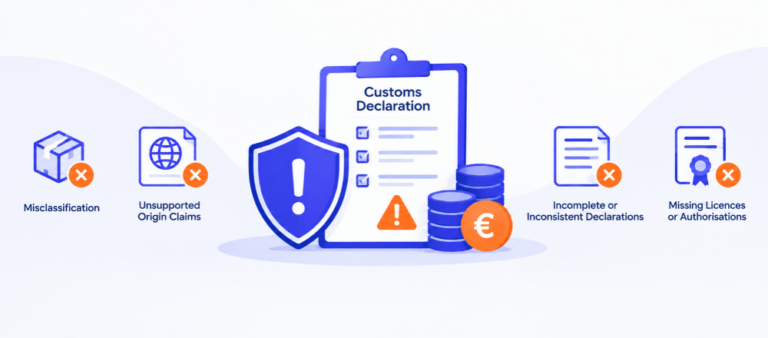
Customs penalties Ireland traders run into almost always trace back to the same handful of root causes: a misclassified product, an unsupported origin claim, an incomplete declaration, or a documentation gap that surfaces during a Revenue review. None of these causes is exotic, and none of them is unavoidable, which is exactly why understanding what actually triggers a penalty matters more than reacting to one after the fact.
This guide covers what a customs penalty in Ireland actually is, how Revenue’s audit and review process works, the difference between a refund situation and a penalty situation, and the practical steps to avoid customs penalties Ireland businesses most commonly run into, so a compliant business never has to find out the hard way.
What Triggers a Customs Penalty in Ireland?
A customs penalty isn’t usually the result of a single dramatic error. It’s more often the outcome of a declaration, or a pattern of declarations, that doesn’t hold up once it’s reviewed. Revenue’s Audit and Examination Programme (AEP) is the mechanism behind that review: a structured, ongoing programme of post-clearance checks that looks at declarations after release, not just at the point of filing, specifically to catch the kind of discrepancy that a quick, in-the-moment check wouldn’t necessarily surface.
A declaration can also raise a flag before release, resulting in a NOT_RELEASED status rather than a straightforward release. Our Ireland customs clearance process guide covers the full AIS declaration status lifecycle in detail; the point relevant here is that a NOT_RELEASED outcome, if the underlying issue isn’t resolved satisfactorily, is one of the more direct routes from a single declaration into a penalty conversation, since it means Revenue has already identified something worth stopping the shipment over.
Common Customs Violations That Lead to Penalties
Customs violations penalties in Ireland tend to cluster around a small set of recurring issues rather than a long, unpredictable list:
- Misclassification. Using the wrong commodity code, whether through carelessness or a genuine ambiguity resolved incorrectly, misstates the duty and VAT owed. Our commodity codes Ireland guide covers how to classify and verify a code correctly; this article treats a wrong code specifically as a penalty trigger, not a classification how-to.
- Unsupported origin claims. Claiming preferential tariff treatment under the TCA or another origin-based arrangement without the proof of origin to back it up is treated as a compliance failure, not a rounding error. Our Brexit and GB-Ireland trade rules guide covers the origin-evidence standard this is measured against.
- Incomplete or inconsistent declarations. Missing fields, mismatched values between the declaration and its supporting documents, or a declared value that doesn’t reconcile with the invoice are all patterns Revenue’s review process is specifically designed to catch.
- Non-compliance with licensing or restricted-goods rules. Importing or exporting goods that need a specific licence or authorisation without holding one is treated as a substantive compliance breach, not a paperwork oversight.
What Happens During an Audit and Examination Programme Review
An AEP review can be triggered by risk-based selection, a pattern across a business’s declaration history, or, in some cases, purely at random as part of Revenue’s ongoing compliance monitoring. Once selected, the review examines the declaration and its supporting documentation, invoice, origin evidence, classification basis, against what was actually declared. Where the review confirms the declaration was accurate, nothing further happens. Where it finds a genuine discrepancy, the outcome depends on the nature and pattern of the issue: an isolated, clearly unintentional error is treated differently from a repeated pattern that suggests a systemic gap in how a business classifies or documents its trade.
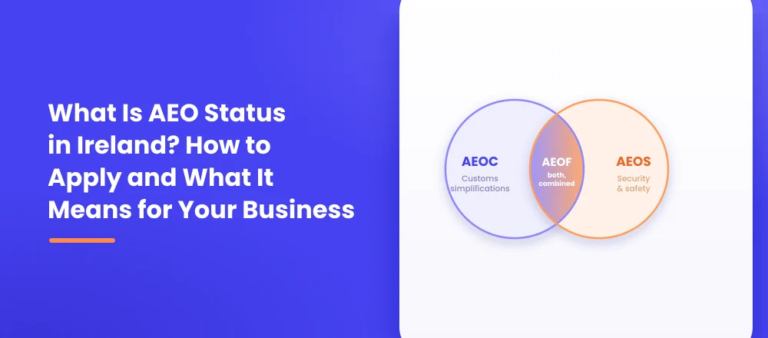
For most businesses, the practical difference between an isolated error and a systemic pattern comes down to whether the same mistake shows up once in a hundred declarations or repeatedly across a supplier, a product line, or a specific trade lane. Revenue’s review process is well placed to spot the second kind, since it looks across a business’s declaration history rather than at a single filing in isolation, which is exactly why a single uncorrected classification error rarely stays a single error for long once it’s built into how a business files every shipment for that product. A business holding Authorised Economic Operator (AEO) status can, in practice, see reduced audit frequency as a recognition of its compliance track record; our dedicated AEO guide covers what that status is and how to apply for it in full.
Refunds vs Penalties: Two Different Outcomes From the Same Kind of Error
Not every discrepancy found in a declaration leads to a penalty. Where a business has overpaid duty, because of a classification that turns out to be too conservative, or a preferential rate that was available but not claimed, the correction runs through a refund process instead, under one of a defined set of legal-basis codes tied to the Union Customs Code’s provisions on repayment and remission of duty. Where the same kind of review instead finds an underpayment, or a claim that wasn’t properly supported, the correction runs the other way, and depending on the pattern and intent involved, that can move from a straightforward correction into penalty territory. The direction of the error, overpaid versus underpaid, and how it’s identified, self-corrected versus found during a Revenue review, both matter to which of these two outcomes actually applies.
Can a Customs Penalty Be Charged to the Customer?
Whether it’s possible to charge a penalty to a customer is ultimately a contractual question, not a customs one: it depends on the terms agreed between the parties, including who was named as importer of record and what the shipping and Incoterms agreement says about liability for compliance failures. A freight forwarder acting purely as an agent, for instance, sits in a different contractual position than an importer of record who made the classification or origin decision that triggered the penalty in the first place, and that difference is usually what a contract dispute over a passed-on penalty actually turns on. This is worth flagging plainly rather than glossing over: this is a legal and contractual matter, and a business facing this situation in practice should get advice from a solicitor or trade compliance specialist rather than relying on a general guide, since the answer genuinely depends on the specific contract in place.
How to Avoid Customs Penalties in Ireland
Revenue Ireland customs fines aren’t handed out for one-off, honestly-made mistakes that get corrected quickly; they build up around patterns that go unaddressed. The practical steps that keep a business out of penalty territory are the same steps covered elsewhere in this cluster, applied consistently rather than occasionally:
- Classify accurately and consistently. The same product should carry the same commodity code across every shipment, not a fresh guess each time.
- Keep origin evidence current and matched to the claim. A preferential rate claimed without the paperwork to support it is exactly the kind of gap an AEP review is built to find.
- Reconcile the declaration against its supporting documents before filing. Invoice, packing list, and declared values should agree with each other every time, not just most of the time.
- Correct errors proactively once found. A self-identified and corrected discrepancy is viewed very differently from the same issue surfacing first during a Revenue review.
- Consider AEO status if audit frequency is a recurring cost. It isn’t a fit for every business, but for one filing at real volume, the reduced audit exposure can be worth the application process.
How iAIS Helps Reduce Penalty Risk
Manually, staying ahead of this means checking classification consistency, verifying origin evidence, and reconciling every declaration against its supporting documents, every time, without the drift that creeps in when the same checks are done slightly differently by different people over time. iCustoms’ iAIS and iAES platforms apply the same validation logic to every declaration, flag a classification or value inconsistency before submission rather than after a review finds it, and keep a consistent record across a business’s full declaration history, the same history an AEP review would otherwise be reconstructing from scratch.
Frequently Asked Questions
What is a customs penalty in Ireland?
It’s Revenue’s response to a confirmed compliance failure on a declaration, such as misclassification, an unsupported origin claim, or an incomplete declaration, identified either at the point of filing or during a later Audit and Examination Programme review.
What is the Audit and Examination Programme (AEP)?
It’s Revenue’s structured post-clearance review programme, examining declarations after release to check that what was declared matches the supporting documentation and the goods actually involved.
Is every discrepancy a penalty?
No. An overpayment discovered through the same kind of review typically runs through a refund process instead; whether an underpayment or unsupported claim becomes a penalty depends on the pattern and nature of the issue.
Can a customs penalty be charged to a customer?
It depends on the contract between the parties, including who is named as importer of record. This is a contractual and legal question that should be confirmed with a solicitor or trade compliance specialist for a specific situation, not answered generally.
Does AEO status help avoid penalties?
It doesn’t remove penalty risk directly, but AEO status is generally associated with reduced audit frequency, since it reflects a business’s recognised compliance track record. Our AEO status guide covers the application process in full.
Where can I find the exact fine amounts for a customs penalty in Ireland?
Specific penalty amounts vary by case and aren’t published as a fixed schedule; confirm current figures directly with Revenue or a trade compliance advisor for a specific situation rather than relying on a general estimate.
How far back can a Revenue review look at past declarations?
An AEP review can examine a business’s declaration history over an extended period, not just the most recent filing, which is part of why a recurring classification or documentation error tends to surface eventually even if individual shipments were never flagged at the time.
Is a customs violation always deliberate?
No. Most customs violations penalties trace back to a genuine classification error, an outdated origin document, or an inconsistent declaration process rather than deliberate misdeclaration, but Revenue’s review process doesn’t distinguish intent from carelessness in the same way a business itself might; both surface as the same kind of discrepancy once reviewed.
You may also like:
Stay Ahead of a Revenue Review

iAIS flags declaration inconsistencies before they become an audit finding.
Subscribe to our Newsletter
About iCustoms
iCustoms is an all-in-one solution helping businesses automate customs processes more efficiently. With AI-powered and machine-learning capabilities, iCustoms is designed to streamline your all customs procedures in a few minutes, cut additional costs and save time.
Fewer Discrepancies, Fewer Audit Flags
iAIS validates classification, origin, and value data against your declaration before it’s filed.