
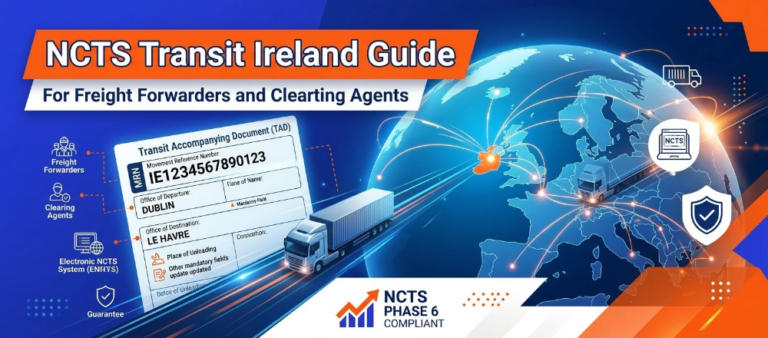
What Is AEO Status in Ireland? How to Apply and What It Means for Your Business
- John Hall
- Customs Specialist at iCustoms.ai
AEO status Ireland what is it, in plain terms: it’s a certification, granted by Revenue under the Union Customs Code, that marks a business as a reliable, secure, compliant participant in international trade, and it comes with real operational benefits once it’s granted. It isn’t a rubber stamp. Qualifying for it means demonstrating, with documented evidence, that a business meets five separate criteria covering everything from customs compliance history to warehouse security, and applying for it means completing a genuinely detailed self-assessment before Revenue ever visits.
This guide covers what AEO status actually is, the three types of authorisation available, the five qualifying criteria behind them, what automatically disqualifies an application, how the application process actually works, and the benefits that make it worth the effort for the right business.
What Is AEO Status in Ireland?
Authorised Economic Operator status is a certification under Article 39 of the Union Customs Code, available to any business involved in the international supply chain, importers, exporters, customs brokers, carriers, freight forwarders, and warehouse operators alike. The conditions and criteria apply to every applicant regardless of size, though Revenue explicitly recognises that how a business demonstrates compliance will vary with its size and the complexity of what it handles; a small importer and a large multinational freight forwarder both qualify against the same criteria, just with different evidence behind each answer. Any authorised economic operator Ireland application is assessed against that same fixed set of criteria, whatever the applicant’s size.
AEOC, AEOS, and AEOF: The Three Types of AEO Authorisation
There are three types of AEO authorisation, and choosing between them depends on what a business actually needs:
- AEOC (Customs Simplifications). Aimed at businesses that want easier access to simplified customs procedures.
- AEOS (Security and Safety). Aimed at businesses focused on supply chain security and safety standards.
- AEOF (Full). The combination of AEOC and AEOS together, not a separate, higher tier so much as both certifications held at once.
Revenue’s own guidance is direct on this point: if a business can meet the qualifying criteria for both, applying for the full AEOF authorisation is recommended, since it carries the complete set of benefits available under either certificate individually and carries broader international standing than holding just one. AEOF isn’t inherently “better” than AEOC or AEOS on its own terms; it’s simply both of them combined, and worth pursuing specifically when a business’s activity and risk profile qualify it for both sets of criteria.
The Five Qualifying Criteria Behind an AEO Application
Every AEO application, regardless of type, is assessed against five blocks of criteria, each tied to a specific article of the Union Customs Code:
| Criterion | UCC Basis | Required For |
|---|---|---|
| Customs compliance record | Article 39(a) | AEOC and AEOS |
| Satisfactory accounting and logistical system | Article 39(b) | AEOC and AEOS |
| Financial solvency | Article 39(c) | AEOC and AEOS |
| Practical standards of competence or professional qualifications | Article 39(d) | AEOC only |
| Appropriate security and safety measures | Article 39(e) | AEOS only |
In practice, these criteria translate into genuinely detailed documentation requirements. The compliance record covers whether customs and taxation breaches have been detected in the last three years and how they were addressed. The accounting and logistical system criterion covers audit trails, IT system access controls, and stock-keeping procedures. Financial solvency requires evidence like audited accounts or a bank reference covering the last three years. Practical competence requires either three years of hands-on customs experience or completed relevant training. Safety and security, assessed only for AEOS and AEOF applicants, covers everything from building perimeter security to how cargo seals are checked and how staff in security-sensitive roles are vetted.
What Automatically Disqualifies an AEO Application?
Before Revenue examines any other criteria, an application is automatically rejected if any of the following apply:
- The applicant has been convicted of a serious criminal offence linked to their economic activity, or is subject to bankruptcy proceedings.
- The applicant’s legal representative in customs matters has been convicted of a serious criminal offence related to a customs-rules infringement connected to their role as representative.
- The application is submitted within three years of a previous AEO certificate being revoked.
None of these are assessed alongside the five main criteria; they’re checked first, and any one of them ends the application before the detailed review even begins.
How to Apply for AEO Status in Ireland
An AEO application Ireland businesses submit runs through Revenue, not a separate EU body, though the underlying criteria and questionnaire are common across all EU member states. The application process runs in a defined sequence:
- Read the EU AEO guidelines. Revenue’s self-assessment questionnaire explicitly references these guidelines throughout, and understanding them before starting the questionnaire makes the rest of the process considerably easier.
- Complete the self-assessment questionnaire and build a documentation folder. The questionnaire covers company information, compliance history, accounting and logistics systems, financial solvency, competence, and, where relevant, security and safety. Responses should cross-reference an organised folder of the actual procedures and evidence behind each answer, since Revenue will expect that documentation to already exist, not be created after the fact.
- Submit the application form and annexes. This goes to Revenue’s AEO Unit in Nenagh, County Tipperary, along with the completed self-assessment questionnaire, via the eAEO EU Trader Portal.
- Respond to Revenue’s follow-up request. Once the application is accepted, a Revenue official will contact the business to request the documented procedures referenced in the questionnaire.
- Host a site visit. A Revenue official visits the business premises to verify the information provided and carry out a physical examination before a final decision is made.
A business that disagrees with a Revenue decision on an AEO application has a right of appeal, the same as with other customs decisions.
Benefits of AEO Status
The benefits split between what each certificate type unlocks individually and what both share:
| Benefit | AEOC | AEOS |
|---|---|---|
| Easier access to simplified customs procedures | Yes | No |
| Advance notification if selected for a customs-legislation control | Yes | No |
| Advance notification if selected for a safety and security control | No | Yes |
| Mutual recognition with third countries | No | Yes |
| Fewer physical and document-based controls | Yes | Yes |
| Priority treatment if selected for control | Yes | Yes |
| Ability to request controls at a specific location | Yes | Yes |
Both certificate types also come with indirect benefits that are harder to quantify but genuinely valuable in practice: recognition as a secure, reliable trading partner, improved relationships with customs and other government authorities, fewer delayed shipments, better supply chain planning, and, for suppliers dealing with an AEO-certified business, lower inspection costs on their side of the relationship too.
How AEO Status Interacts With Your AIS Declarations
Once granted, AEO status isn’t just a certificate sitting in a filing cabinet, it’s referenced directly on declarations. Under AIS, an authorisation type code identifying AEO status has to be valid on the actual date of the declaration and belong to either the declarant or the importer named on it, not simply exist somewhere in the business’s records. A lapsed or misapplied AEO reference on a declaration is a data-quality issue in its own right, separate from whether the underlying AEO certificate is still valid. Our Ireland customs penalties guide covers how AEO status factors into reduced audit frequency in more depth; this article focuses on qualifying for and applying for the status itself.
Common AEO Application Mistakes
- Starting the application before the documentation exists. Revenue expects procedures to already be documented and available for inspection, not written up after the questionnaire is submitted.
- Applying for AEOF without qualifying for both AEOC and AEOS criteria. The combined certificate requires meeting both sets of criteria, not just the more familiar of the two.
- Underestimating the accounting and logistical system requirements. This block covers IT access controls, audit trails, and stock procedures in real operational detail, not just general bookkeeping competence.
- Reapplying too soon after a revocation. An application submitted within three years of a prior AEO certificate revocation is automatically rejected regardless of the applicant’s current standing.
- Treating AEO status as a one-time achievement. The underlying compliance record, systems, and security measures need to stay consistent with what was approved, not drift once the certificate is granted.
Frequently Asked Questions
What is AEO status in Ireland?
It’s a certification under Article 39 of the Union Customs Code, granted by Revenue, recognising a business as compliant, financially solvent, and, where relevant, secure enough in its supply chain to receive reduced customs controls and other trade facilitation benefits.
What’s the difference between AEOC and AEOS?
AEOC covers customs simplifications and is assessed against compliance, accounting systems, financial solvency, and practical competence. AEOS covers security and safety and is assessed against the same compliance, accounting, and financial criteria plus security measures instead of competence.
What is AEOF?
It’s the combined authorisation, AEOC and AEOS held together, rather than a separate, higher-tier certificate. Revenue recommends it where a business qualifies for both, since it carries every benefit available under either certificate.
How long does an AEO application take?
Revenue doesn’t publish a fixed turnaround time; the process includes a documentation review and a physical site visit, so the timeline depends on how complete the initial application and supporting evidence are.
Does AEO status help avoid customs penalties?
Not directly, but it’s generally associated with reduced audit frequency as a reflection of a business’s compliance record. Our Ireland customs penalties guide covers that connection in more detail.
Where do I submit an AEO application in Ireland?
Applications go to Revenue’s AEO Unit in Nenagh, County Tipperary, via the eAEO EU Trader Portal, along with the completed self-assessment questionnaire and supporting documentation.
You may also like:
Is AEO Status Worth Applying For?

iAIS tracks your declaration history, the compliance record any AEO application starts from.
Subscribe to our Newsletter
About iCustoms
iCustoms is an all-in-one solution helping businesses automate customs processes more efficiently. With AI-powered and machine-learning capabilities, iCustoms is designed to streamline your all customs procedures in a few minutes, cut additional costs and save time.
Build Your Compliance Record Before You Need It
iAIS keeps a consistent, auditable declaration history across every AIS and AES filing.