
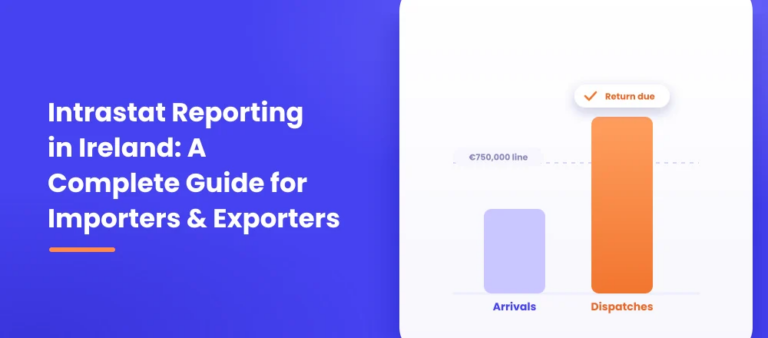
Intrastat Reporting in Ireland: A Complete Guide for Importers & Exporters
- John Hall
- Customs Specialist at iCustoms.ai
Intrastat reporting Ireland software exists because the return itself is a monthly, recurring obligation, not a one-off filing, and doing it manually every month from ERP export data is exactly the kind of repetitive task automation is built for. But before automating anything, it’s worth being clear on what Intrastat actually is, who has to file it, and how it’s different from the AIS and AES declarations covered elsewhere in this guide, since the two get confused more often than the rules justify.
This guide covers the intrastat reporting requirements that actually apply in Ireland today: what Intrastat is, the current filing thresholds, what a return has to contain, how to file it, how it relates to VIES, and what changed for Irish traders once Great Britain left the EU.
What Is Intrastat, and How Is It Different From a Customs Declaration?
Intrastat is a statistical reporting regime, not a customs declaration. It exists to let Ireland’s Central Statistics Office and Revenue track the physical movement of goods between EU member states, movements that, because they cross an internal EU border rather than the EU’s external border, don’t generate an AIS or AES customs declaration at all. That’s the core distinction worth holding onto throughout this guide: AIS and AES exist because goods are crossing into or out of the EU’s customs territory; Intrastat exists precisely because intra-EU movements don’t, and somebody still needs the trade statistics that a customs declaration would otherwise have produced.
Who Has to File an Intrastat Return in Ireland?
Two separate obligations apply here, and they’re often conflated. Every VAT-registered trader engaged in intra-EU trade completes boxes E1 (arrivals) and E2 (dispatches) on their periodic VAT3 return, regardless of the value involved. That’s a baseline reporting obligation tied to VAT registration itself, not to Intrastat directly.
The detailed monthly Intrastat return is a separate, additional obligation that only kicks in once trade volume crosses a threshold. A business only needs to file the full monthly Intrastat return if its annual arrivals from other EU member states exceed the threshold, or, independently, if its annual dispatches to other member states exceed the threshold. These are two separate tests: a business can be over the threshold for dispatches and under it for arrivals, or the other way around, and only the direction that’s actually over the threshold needs the detailed monthly return.
Intrastat Threshold Ireland Businesses Need to Track
As of the current Revenue guidance, the detailed monthly Intrastat return is required where annual arrivals from other EU member states exceed €750,000, or where annual dispatches to other member states exceed €750,000. Because Intrastat thresholds have changed before and can change again, this figure is worth reconfirming directly against Revenue’s own published guidance at the time a business first needs to assess whether it’s over the line, rather than relying on a figure that may have been accurate in an earlier year.
Tracking this isn’t a once-a-year exercise, either. A business that’s comfortably under the threshold in January can cross it by October simply through normal trade growth, and the detailed monthly obligation applies from the point the threshold is crossed, not retroactively from the start of the year. Businesses growing their EU trade volume are better served checking their running annual total periodically rather than assuming a threshold assessment made at the start of the year still holds by the end of it.
What Information Goes Into an Intrastat Return?
A monthly Intrastat return needs, for each movement: the 8-digit Combined Nomenclature commodity code, matching the classification standard covered in our commodity codes Ireland guide; the statistical value of the goods; the net mass or supplementary quantity, depending on the commodity; the partner member state the goods arrived from or were dispatched to; and the nature of the transaction, distinguishing an outright sale from a return, a repair movement, or another non-sale transaction type. Getting the commodity code right matters here just as much as it does on an AIS or AES declaration, since an inconsistent classification distorts the trade statistics Intrastat exists to produce.
How to File: The Return Preparation Facility and Templates
Revenue provides a Return Preparation Facility (RPF) specifically for building an Intrastat return, along with separate arrival and dispatch templates designed to structure the underlying data correctly before it’s submitted. Filing itself happens through Revenue’s online systems, and the practical challenge for most businesses isn’t the filing mechanism, it’s getting monthly data out of an ERP system, SAP being a common example, into the structure the RPF and templates expect, consistently, every single month, without someone manually re-keying figures from one system into another.
Intrastat Ireland filing, once a business is over the threshold, is a monthly obligation rather than a one-off task, and the RPF and templates are the mechanism for it, but they still assume the underlying data, commodity codes, statistical values, partner states, is already correct before it reaches them. Neither the RPF nor the templates validate that a commodity code is right or that a value has been calculated consistently with prior months; that check has to happen upstream, which is where most of the actual compliance risk in monthly Intrastat filing sits.
Intrastat and VIES: Two Different EU Trade Reporting Regimes
Intrastat and VIES reporting are both administered by Revenue’s VIES, Intrastat, and Mutual Assistance (VIMA) unit, and both relate to intra-EU trade, which is exactly why they get confused. They aren’t the same requirement, though. VIES reports the VAT-registered numbers and values of goods sold to customers in other EU member states, and exists to let tax authorities cross-check that VAT is being accounted for correctly across the EU. Intrastat reports the physical movement of goods for statistical purposes, independent of the VAT treatment of the transaction. A business can have obligations under one, both, or neither, depending on its trade volume and pattern, and meeting one doesn’t automatically satisfy the other.
Intrastat Reporting After Brexit: What Changed
Intrastat reporting after Brexit changed in one specific, important way: trade between Ireland and Great Britain no longer falls under Intrastat at all. Since Great Britain left the EU’s customs territory, goods moving between Great Britain and Ireland now require full AIS or AES customs declarations, covered in our moving goods from Great Britain to Ireland guide, rather than an Intrastat return. Intrastat today covers only Ireland’s trade with other EU member states; a business that used to report GB trade through Intrastat before 2021 needs to have shifted that reporting to AIS and AES declarations instead, not carried the old habit forward into a regime that no longer applies to that route.
What Happens If an Intrastat Return Is Missed or Wrong?
Intrastat is a statistical obligation, but that doesn’t make it optional once a business is over the threshold. A missed or persistently inaccurate return is a compliance failure Revenue can and does follow up on, since the underlying trade statistics feed into both Irish and EU-level reporting that depends on completeness. Beyond the compliance exposure itself, a business correcting a backlog of missed or wrong monthly returns all at once, rather than filing accurately each month as it goes, tends to find the correction takes considerably longer than staying current would have, simply because reconstructing several months of commodity codes, values, and partner-state data after the fact is slower than capturing it correctly the first time.
How iCustoms Supports Intrastat Reporting
Manually, staying on top of Intrastat means tracking the running annual threshold for both arrivals and dispatches, pulling consistent commodity codes and statistical values out of whatever ERP system a business runs, and reformatting that data into the RPF or template structure Revenue expects, every month, without a gap or inconsistency creeping in between one month’s filing and the next. iCustoms’ platform keeps commodity classification consistent across every declaration and return a business files, whether that’s an AIS declaration, an AES declaration, or an Intrastat return, so the same product carries the same code everywhere it’s reported rather than being reclassified slightly differently depending on which monthly process happens to be generating it.
Common Intrastat Mistakes
- Treating Intrastat and customs declarations as the same requirement. They serve different purposes and apply to different kinds of movement; a business can have one obligation without the other.
- Missing the VAT3 E1/E2 boxes because Intrastat threshold isn’t met. The VAT3 boxes apply to all VAT-registered traders engaged in intra-EU trade, regardless of whether the detailed monthly return threshold is crossed.
- Assuming last year’s threshold still applies. Confirm the current figure directly with Revenue rather than carrying forward a number that may be out of date.
- Reporting GB trade through Intrastat after Brexit. That trade now runs through AIS and AES declarations instead.
- Inconsistent commodity coding between the Intrastat return and other declarations. The same product should carry the same classification everywhere it’s reported.
Frequently Asked Questions
What is the Intrastat threshold in Ireland?
The detailed monthly return is required where annual arrivals from other EU member states exceed €750,000, or where annual dispatches exceed €750,000, assessed independently for each direction.
Do all VAT-registered businesses need to file Intrastat?
All VAT-registered traders engaged in intra-EU trade complete the E1 and E2 boxes on their VAT3 return regardless of value; only businesses over the threshold need the full detailed monthly Intrastat return.
Is Intrastat the same as a customs declaration?
No. Intrastat is a statistical return covering intra-EU trade, which doesn’t generate a customs declaration. AIS and AES declarations apply to trade crossing the EU’s external border.
Does Intrastat still apply to trade with Great Britain?
No. Since Brexit, Great Britain sits outside the EU’s customs territory, so GB-Ireland trade is declared through AIS and AES instead of reported through Intrastat.
What’s the difference between Intrastat and VIES?
Intrastat reports the physical movement of goods for statistical purposes; VIES reports VAT-registered sales values to other EU member states for VAT cross-checking. They’re related but separate obligations, both handled by Revenue’s VIMA unit.
Can Intrastat reporting be automated from an ERP system like SAP?
Yes, in principle, though the practical work is converting ERP export data into the structure Revenue’s Return Preparation Facility and templates expect, consistently every month, which is where most of the manual effort in Intrastat reporting actually goes.
What happens if a business crosses the Intrastat threshold partway through the year?
The detailed monthly return obligation begins from the point the threshold is actually crossed, not retroactively from the start of the year, which is why tracking the running annual total periodically matters more than checking it once in January.
You may also like:
Still Compiling Intrastat Data by Hand?

iAIS pulls the commodity, value, and partner-country data your Intrastat return needs from data you’ve already declared.
Subscribe to our Newsletter
About iCustoms
iCustoms is an all-in-one solution helping businesses automate customs processes more efficiently. With AI-powered and machine-learning capabilities, iCustoms is designed to streamline your all customs procedures in a few minutes, cut additional costs and save time.
Never Miss a Threshold Change
Get notified when your Intrastat filing obligation changes, without checking Revenue’s guidance manually.