
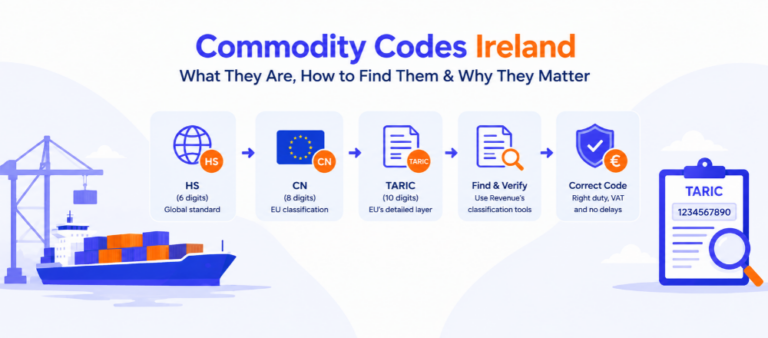
Commodity Codes Ireland: What They Are, How to Find Them & Why They Matter
- John Hall
- Customs Specialist at iCustoms.ai
Commodity codes Ireland what are they, and why does getting one wrong hold up an entire shipment? A commodity code is the number that tells Revenue, and every other customs authority a shipment passes through, exactly what a product is for duty, VAT, and control purposes. Get it right and a declaration processes the way it should. Get it wrong, even by a single digit, and the consequences range from an overpaid duty bill to a held shipment sitting at the border while someone works out what went wrong.
This guide covers what a commodity code actually is, how the HS, CN, and TARIC layers fit together, how to find and verify the right one as an Irish trader, and where Revenue’s Classification Unit and Binding Tariff Information (BTI) fit into getting real certainty rather than a best guess.
Commodity Codes Ireland: What Are They, and Why Does Ireland Use the Same Structure as Everyone Else?
A commodity code is a numeric classification assigned to a product that determines the duty rate, VAT treatment, and any restrictions or licensing requirements that apply to it. It isn’t an Irish invention: the first six digits come from the Harmonised System (HS), a global classification standard maintained by the World Customs Organization and used by more than 200 countries, which is exactly why Ireland, like every other trading nation, starts from the same base structure as everyone else.
From there, the code gets more specific. The EU adds two further digits to build the 8-digit Combined Nomenclature (CN) code, which applies the HS structure specifically within the EU’s own tariff and statistical system. On top of that, a further two digits build the 10-digit TARIC code, the EU’s most granular classification layer, used to capture measures like anti-dumping duties, quotas, and preferential rates that apply to a specific product at a specific time. Every AIS or AES declaration filed through Ireland’s Revenue systems is classified at this full 10-digit TARIC level, not the shorter HS or CN code alone. Our EU TARIC commodity codes guide covers this 10-digit structure and the codes that changed from July 2026 in full detail; this article focuses on how Irish traders actually apply and verify that structure day to day.
HS vs CN vs TARIC: Is a TARIC Code the Same as a Commodity Code?
Not exactly, though the terms get used interchangeably often enough to cause confusion. “Commodity code” is the general umbrella term for the classification number assigned to a product, and TARIC commodity codes are simply the most complete, most specific form that code takes within the EU, Ireland included. The difference between an HS code and a commodity code, in practice, is precision: the 6-digit HS code identifies the general product category and is recognised worldwide, while the full 10-digit TARIC code is what actually gets declared on an AIS import or AES export filing in Ireland, because it’s the level at which EU-specific duty rates and measures are captured.
A harmonised commodity code, in other words, is the same code viewed at different levels of detail depending on which system is reading it: a customs authority outside the EU may only need the 6-digit HS portion, while Revenue and every other EU member state’s system need the full 10 digits to process a declaration correctly.
Why Getting the Commodity Code Right Matters for Irish Importers and Exporters
An incorrect commodity code doesn’t fail quietly. Because the code determines the duty rate and VAT treatment applied to a shipment, a wrong digit can mean paying more duty than the goods actually attract, or just as commonly, underpaying and facing a correction and penalty later once Revenue catches the discrepancy. Beyond the financial exposure, an implausible or inconsistent commodity code is one of the more common reasons a declaration gets flagged for manual review, which holds up release while someone resolves the classification query. None of this is theoretical: it’s the single most common technical error behind avoidable customs delays.
This applies in both directions. An export commodity code has to be just as accurate as an import one, since AES declarations are classified and checked the same way AIS declarations are, and a misclassified export can trigger the same review and delay on the way out that a misclassified import does on the way in. Our VAT on imports guide covers exactly how a duty figure feeds into the VAT calculation once a code is confirmed, and our import duty guide covers duty-rate lookup itself; this article treats the commodity code as the input that determines which rate applies in the first place, not the rate lookup itself. The specific penalty exposure from a sustained or deliberate misclassification is its own topic, covered separately in our guide to customs penalties in Ireland.
How to Find the Right Commodity Code as an Irish Trader
There are three real routes to a commodity code, and they carry different levels of certainty.
The first is a direct database lookup, using the EU’s TARIC consultation database or Revenue’s own tools, searching by product description or keyword to find the matching heading and subheading. This works well for straightforward products but gets harder fast for anything genuinely ambiguous, where two or three headings all seem plausible.
The second, and the one that’s genuinely Ireland-specific rather than shared with UK or generic EU guidance, is contacting Revenue’s Classification Unit directly. If you’re unsure how to classify a product, Revenue’s Classification Unit will provide advice, provided you give them enough to work with: what the product is, what it looks like, what it does or how it’s used, what it’s made of, and any distinguishing features that set it apart from similar goods. It’s worth being clear on what this advice actually is, though: while the Classification Unit makes every effort to give accurate guidance, that advice is not legally binding. It’s a strong starting point, not a guarantee.
The third route, a commodity code checker or AI-driven classification tool, has become the practical default for businesses classifying products at any volume. This is what AI HS code classification Ireland traders increasingly rely on instead of the first two routes alone: an AI commodity code checker works from the same product description Revenue’s Classification Unit would ask for, but validates it against the current TARIC dataset instantly and flags where a classification looks inconsistent with similar products already on file, catching the kind of single-digit error that’s easy to miss manually and expensive to fix after the fact.
Binding Tariff Information (BTI): The Only Legally Certain Classification
If Revenue’s Classification Unit advice isn’t legally binding, what is? Binding Tariff Information (BTI) is the answer: a formal decision, valid across the EU, that legally commits customs authorities, Revenue included, to a specific classification for a specific product for a fixed period. Where a business needs real legal certainty on a classification, because the duty exposure is significant, the product is genuinely ambiguous, or a customs authority has already challenged a previous classification, applying for a BTI decision is the route that actually removes the risk, rather than the informal Classification Unit advice that, however accurate, offers no legal protection if a dispute arises later.
How iAIS Supports Getting Commodity Codes Right the First Time
Manually, getting a commodity code right means describing the product accurately, searching or requesting classification advice, cross-checking the result against the current TARIC dataset, and correctly populating the classification field on the AIS or AES declaration, all without a transcription error creeping in between the classification decision and the filed declaration. HS code classification Ireland traders can rely on shouldn’t depend on one person’s memory of a product classified six months ago. iCustoms’ platform validates the commodity code entered against live TARIC data at the point of filing, flags codes that look inconsistent with the product description provided, and keeps a record of previously used classifications so the same product is coded consistently across every future shipment rather than reclassified from scratch each time.
Common Commodity Code Mistakes
- Using an HS code alone on a declaration. Ireland’s AIS and AES systems require the full 10-digit TARIC code, not the shorter 6-digit HS or 8-digit CN code that might appear in general product literature.
- Treating Classification Unit advice as legally binding. It’s a helpful starting point, but only a BTI decision carries legal certainty.
- Reusing an old code without checking for updates. TARIC measures change, including the structural update that took effect from July 2026; a code that was correct last year isn’t guaranteed to still be correct.
- Under-describing the product when requesting a classification. Vague descriptions produce vague, less reliable classifications, whether the advice comes from Revenue or from classification software.
- Assuming export commodity codes matter less than import ones. AES declarations are classified and checked on the same basis as AIS declarations; the same errors carry the same consequences in either direction.
Frequently Asked Questions
Is a TARIC code the same as a commodity code?
A TARIC code is a specific, fully detailed form of a commodity code: the 10-digit version used for EU declarations, Ireland’s included. “Commodity code” is the general term; TARIC is the most precise layer of it.
What’s the difference between an HS code and a commodity code?
An HS code is the 6-digit global base of a classification, recognised worldwide. A commodity code, in the EU context, usually means the fuller 8-digit CN or 10-digit TARIC version built on top of that HS base, which is what actually gets declared.
How do I find the right commodity code for my product?
Search the EU TARIC database directly, request advice from Revenue’s Classification Unit by describing the product in detail, or use a commodity code checker or AI classification tool that validates the description against current TARIC data.
Is advice from Revenue’s Classification Unit legally binding?
No. It’s a genuine effort to give accurate guidance, but only a Binding Tariff Information (BTI) decision is legally binding on customs authorities.
Where can I find the full list of commodity codes?
The EU’s TARIC database and Combined Nomenclature publications hold the full current code list; Revenue’s Classification Unit and BTI process exist specifically for cases where finding the right entry in that list isn’t straightforward. Intrastat reporting uses its own separate commodity code list requirements, which is a distinct topic from the customs classification covered in this guide.
What happens if I use the wrong commodity code?
Depending on the direction of the error, you either overpay duty unnecessarily or underpay and face a correction and possible penalty once it’s caught, and an implausible code is a common reason a declaration gets held for manual review.
You may also like:
Still Guessing at Commodity Codes?

iAIS validates classification data against current TARIC requirements before you submit.
Subscribe to our Newsletter
About iCustoms
iCustoms is an all-in-one solution helping businesses automate customs processes more efficiently. With AI-powered and machine-learning capabilities, iCustoms is designed to streamline your all customs procedures in a few minutes, cut additional costs and save time.
Get the Digits Right, Every Time
AI-assisted classification checks your commodity code against current TARIC data before you file.