
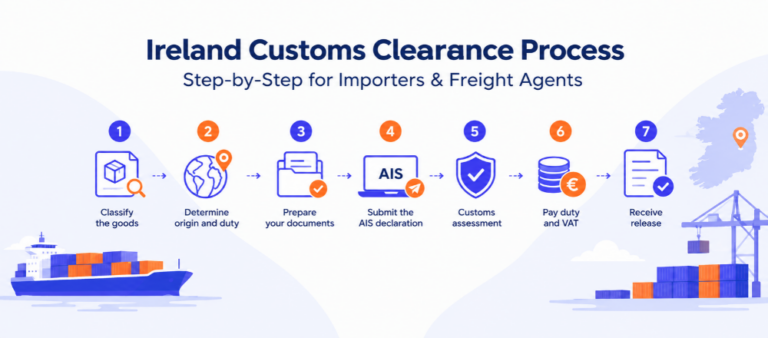
Ireland Customs Clearance Process: Step-by-Step for Importers & Freight Agents
- John Hall
- Customs Specialist at iCustoms.ai
The Ireland customs clearance process follows the same underlying sequence for every shipment entering the country from outside the EU, whether a given declaration clears in minutes or sits under review for days. Knowing that sequence, and specifically what each declaration status actually means once your goods are in it, is the difference between watching a hold resolve itself in the normal course of processing and panicking over something that was never actually a problem.
This guide walks through the full Ireland customs clearance process end to end: classification, origin and duty, documentation, the AIS declaration itself, what happens during Revenue’s assessment, exactly what each status in that assessment means, and where the time in a typical clearance actually goes.
The Ireland Customs Clearance Process at a Glance
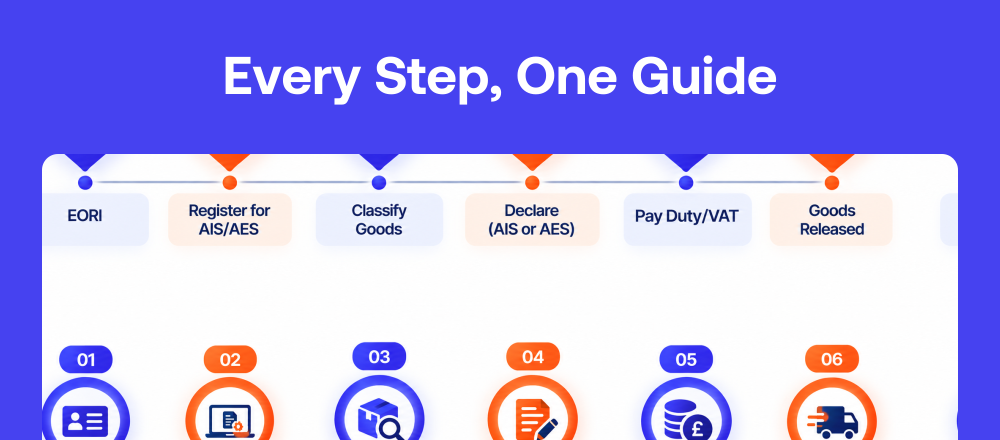
Before the step-by-step detail, it helps to see the whole sequence in one place. The Ireland customs clearance process runs through seven stages: classify the goods, determine origin and duty, prepare supporting documents, submit the AIS declaration, pass through customs assessment, pay any duty and VAT due, and receive release. Most of the guide below is spent on stage five, customs assessment, since that’s where the AIS declaration status a shipment carries actually determines what happens next, and where most of the questions freight forwarders and importers have tend to come from.
Who’s Involved in Clearing a Shipment
Before walking through the sequence itself, it’s worth being clear on who actually does what. The importer, or the freight forwarder or clearing agent filing on their behalf, is responsible for classification, valuation, and the accuracy of everything on the declaration. Revenue’s AIS system is the platform that receives, validates, and assesses that declaration. Revenue’s customs officers are the ones who make the actual risk-based decisions behind Under Control, Under Review, and CERTEX Review statuses when a declaration is flagged rather than passing straight through. Whether the importer files directly or through an agent under direct or indirect representation changes who carries liability if something is wrong, but it doesn’t change the underlying sequence every declaration goes through, which is what the rest of this guide covers.
Step 1: Classify the Goods
Every shipment starts with classification: assigning the correct commodity code to whatever is being imported. This single step determines the duty rate that applies, whether any licences or restrictions apply, and what data has to accompany the rest of the declaration. A wrong or vague commodity code doesn’t just risk the wrong duty amount, it can trigger a Revenue review even when the underlying shipment is completely legitimate. We cover how commodity codes work in Ireland specifically in our commodity codes guide.
Step 2: Determine Origin and Duty
Where the goods actually originate affects whether a tariff applies at all. Goods that qualify as UK or EU origin under the Trade and Cooperation Agreement can move tariff-free, but only with the correct proof of origin attached; origin has to be demonstrated, not assumed from where a shipment happened to ship. Once origin is settled, the applicable duty rate can be calculated against the classified commodity code, which then feeds into the VAT calculation covered later in this process.
Step 3: Prepare Your Documents
Before the declaration is lodged, the core supporting documents need to be ready and consistent with each other: commercial invoice, packing list, transport document, and proof of origin where a preferential rate is being claimed. Missing or inconsistent documentation is one of the most common reasons a declaration ends up under documentary control rather than moving straight through Revenue’s system. Getting this right before submission, rather than assembling it after a hold notice arrives, is worth the discipline.
Step 4: Submit the AIS Declaration
With classification, origin, and documents settled, the declaration itself gets submitted through AIS. Data flows into the correct declaration type, H1 for the standard “release into free circulation” scenario that covers most imports, with goods classified, valued, and matched to the appropriate procedure code. This is the point where accuracy in the earlier steps pays off: a declaration built on the right commodity code and complete documentation moves through assessment far more predictably than one that isn’t.
Step 5: Customs Assessment and Every AIS Declaration Status Explained
Once submitted, Revenue’s system assesses the declaration and moves it through a defined sequence of statuses, the part of the Ireland customs clearance process that generates the most questions. Understanding what each AIS declaration status actually means is the single most useful thing in this entire guide, since most of the anxiety around customs clearance comes from not knowing whether a given status is routine or something that needs action.
- Registered. The declaration has been received and logged in AIS. This is the starting point for every import, not a sign of any issue.
- Accepted. Revenue has validated the declaration data and accepted it for processing. Most declarations that reach this status without further flags move quickly toward release.
- Under Control. The declaration has been flagged for a documentary or physical check. This isn’t automatically a problem: it’s Revenue’s risk-based system doing exactly what it’s designed to do, and most controls resolve once the requested documentation or inspection is complete.
- Under Review. Revenue is examining a specific aspect of the declaration more closely, often related to classification, valuation, or origin evidence, before deciding how to proceed.
- CERTEX Review. The declaration involves goods subject to licensing, certification, or another regulatory control, and that control body’s clearance is being checked before release.
- Awaiting Supplementary. Applicable to simplified declarations, where an additional, more detailed declaration is still due before the process is considered complete.
- Suspended Release. Release has been paused, typically pending resolution of a specific outstanding issue, such as an unresolved control or missing authorisation reference.
- Insufficient Funds. The guarantee or account associated with the declaration doesn’t currently cover the duty or VAT due, and needs to be addressed before release can proceed.
- Released. The declaration has cleared every applicable check and the goods can proceed.
- Not Released. The declaration did not clear, whether due to a failed control, unresolved documentation issue, unpaid duty, or an accepted invalidation. This status requires action, unlike most of the others on this list.
Businesses with Authorised Economic Operator (AEO) status typically see fewer holds during this stage, since AEO status signals a lower-risk trader profile to Revenue’s system. More on that in our AEO status guide.
Step 6: Pay Duty and VAT
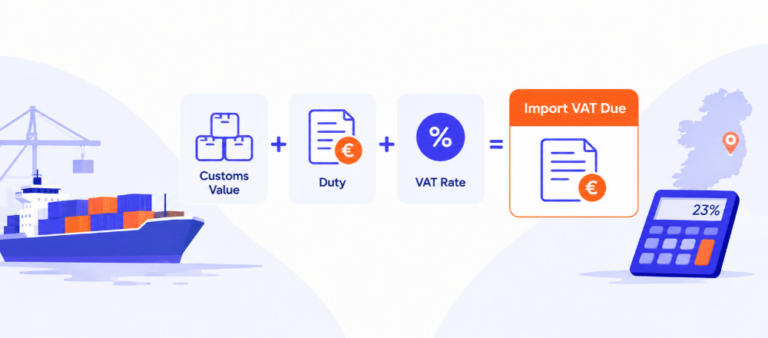
Once a declaration clears assessment, any duty and import VAT due gets calculated and settled, unless Postponed VAT Accounting applies, in which case the VAT is instead declared and reclaimed on the same VAT return rather than paid at the border. We cover the full VAT mechanics, including how PVA interacts with this step, in our VAT on imports Ireland guide; duty specifically is covered in our import duty Ireland guide.
Step 7: Goods Released
Once payment obligations are settled and the declaration carries a Released status, the goods can proceed. For most declarations that don’t get flagged for a control, this entire sequence, from submission to release, takes minutes to hours rather than days.
What Happens If Something Goes Wrong Mid-Process
Even a well-prepared declaration can run into an issue partway through: a document that doesn’t quite match, a classification question, or a licensing check that takes longer than expected. When that happens, the declaration simply sits at whatever status reflects the issue, Under Control, Under Review, or CERTEX Review, until it’s resolved, rather than failing outright. The practical response is almost always the same regardless of which status is showing: respond promptly to whatever Revenue or the relevant control body has requested, keep supporting documentation ready to send immediately rather than assembling it after the fact, and avoid re-submitting a fresh declaration in the meantime, since that usually creates confusion rather than resolving anything. A declaration only moves to Not Released when a control genuinely fails, duty goes unpaid, or an invalidation is accepted, which is a meaningfully smaller set of outcomes than the number of declarations that pass through a temporary hold on their way to Released.
Ireland Customs Clearance Process Timeline: How Long Does It Actually Take?
For declarations that pass straight through without a control, the Ireland customs clearance process is often a matter of minutes to a few hours from submission to release. A documentary or physical control extends that timeline, sometimes by a day or more, depending on what’s being checked and how quickly supporting evidence can be supplied. Tracking your own customs clearance timeline Ireland-wide against these benchmarks is a useful way to spot whether a particular declaration is running normally or genuinely stuck. The single biggest factor within an importer’s control is how complete and accurate the classification and documentation were before submission; the steps above in the right order, done correctly, are what keep a declaration out of Under Control in the first place.
Automated Customs Clearance in Ireland: How Software Speeds This Up
Manually, the Ireland customs clearance process means classifying goods by hand, calculating duty and VAT separately, filling in declaration fields one at a time, checking for errors, and resubmitting when something doesn’t match. Customs clearance automation Ireland-wide works differently: commodity codes are classified automatically, duty and VAT are calculated on the correct basis, and the declaration is validated against Revenue’s requirements before it’s ever submitted, which is exactly the kind of check that keeps avoidable errors from turning into an Under Control status in the first place. iCustoms’ iAIS platform delivers automated customs clearance Ireland businesses can run from one interface, cutting a five-touchpoint manual workflow down to one.
Frequently Asked Questions
What does “Under Control” mean on my declaration?
It means Revenue has flagged the declaration for a documentary or physical check. It isn’t automatically a sign of a problem; it’s part of the normal risk-based assessment process, and most controls resolve once the requested check is complete.
How long does the Ireland customs clearance process take?
Most declarations that aren’t flagged for a control clear within minutes to a few hours. A documentary or physical control can extend that by a day or more, depending on what’s being checked.
What is the Ireland customs clearance process in short?
It’s the sequence every import declaration follows: classify the goods, determine origin and duty, prepare documents, submit the AIS declaration, pass customs assessment, pay any duty and VAT due, and receive release. Assessment is the stage with the most possible statuses, covered in full above.
What happens if my declaration is Not Released?
Not Released means the declaration didn’t clear, due to a failed control, unresolved documentation, unpaid duty, or an accepted invalidation. Unlike most other statuses, this one requires direct action to resolve.
Does having AEO status speed up clearance?
Yes, generally. AEO status signals a lower-risk trader profile to Revenue’s system, which typically results in fewer declarations being flagged for control.
Can I pay VAT later instead of at the point of clearance?
Yes, if Postponed VAT Accounting applies. Instead of paying import VAT at the border, an eligible, authorised importer declares and reclaims the same VAT on their regular VAT return.
What’s the most common reason a declaration gets held up?
Incomplete or inconsistent documentation, most often a mismatch between the commercial invoice, packing list, and the declared classification or origin.
Does this process differ for freight forwarders filing on behalf of clients?
The clearance sequence itself is the same regardless of who files it. What differs is the representation basis, direct or indirect, which affects who carries liability if something in the declaration turns out to be wrong.
You may also like:
How Long Is Clearance Really Taking You?

See where iAIS removes manual steps from every stage of this process.
Subscribe to our Newsletter
About iCustoms
iCustoms is an all-in-one solution helping businesses automate customs processes more efficiently. With AI-powered and machine-learning capabilities, iCustoms is designed to streamline your all customs procedures in a few minutes, cut additional costs and save time.
Submit Without the Manual Entry
iAIS pre-fills and validates your declaration before it reaches Revenue.