

ENS in Shipping Explained: Meaning, Charges and the ENS Number
- John Hall
- Customs Specialist at iCustoms.ai
ENS stands for Entry Summary Declaration.
In shipping, it is the pre-arrival safety and security declaration a carrier must file before your cargo reaches the UK or EU border, so customs can screen the shipment for risk. It is not a customs duty or a tax.
If you have spotted ENS on a freight quote, a booking confirmation or an invoice and wondered what it means, this guide explains the shipping side: what ENS means, why an ENS charge appears on your bill, and what the ENS number is. For the full customs procedure, see our complete ENS filing guide and the S&S GB ENS guide for freight forwarders.
What does ENS mean in shipping?
It is a safety and security declaration lodged with customs before goods arrive. Its job is risk screening, not revenue: customs use the advance cargo data to check for dangerous or prohibited goods before the shipment reaches the border. You will also hear it called a “safety and security declaration”.
ENS shows up in a shipping context because the legal duty to file it sits with the carrier, the shipping line, airline or haulier moving the goods. The declaration must be lodged before arrival, and for deep-sea containerised cargo before the container is even loaded. That is why carriers and freight forwarders build ENS into their booking terms, cut-off times and pricing.
In short, ENS is a compliance step that happens in the background of your shipment. But it affects your timeline and your invoice, which is why it is worth understanding.
Why is there an ENS charge on my shipment?
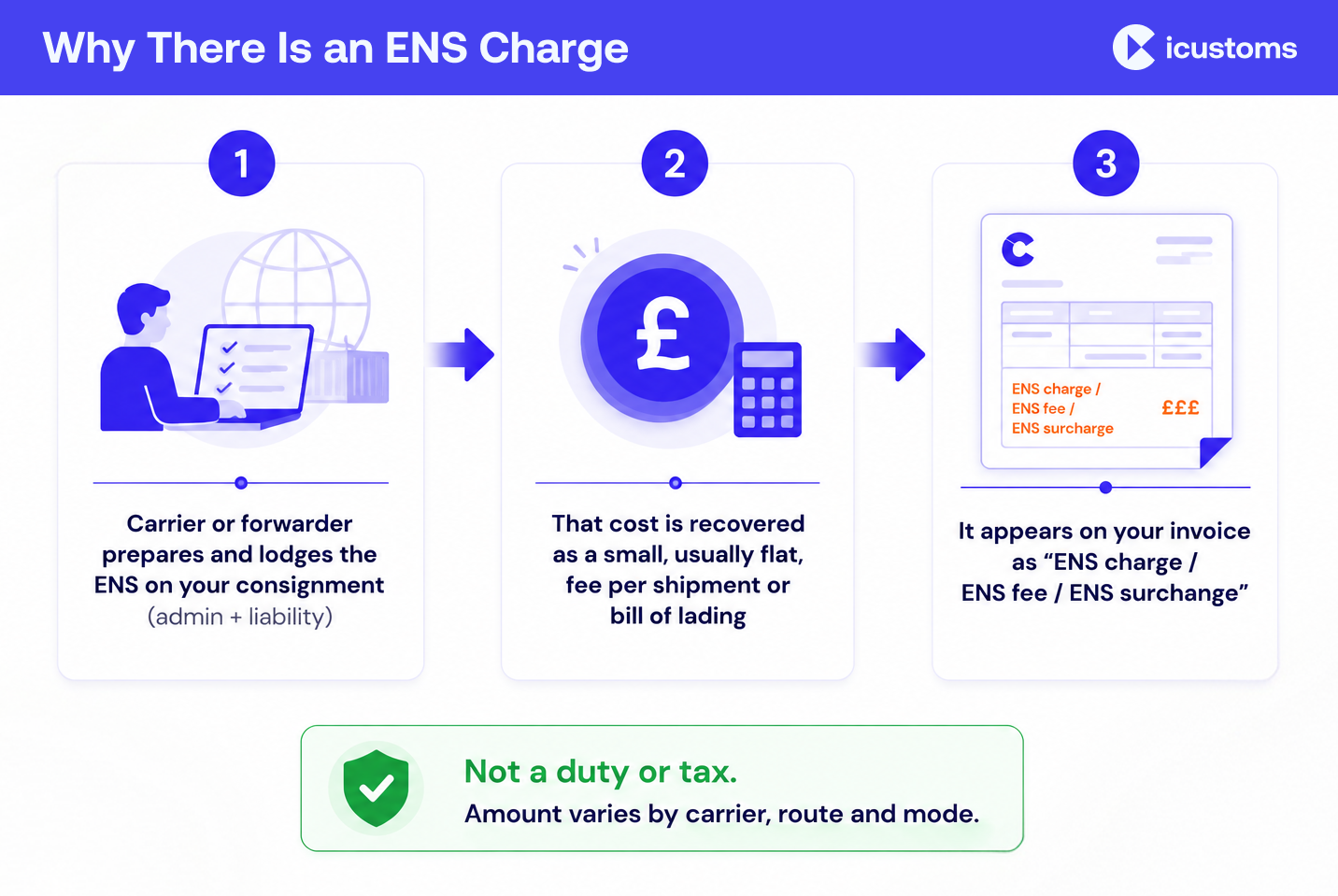
An ENS charge is a fee the carrier or freight forwarder passes on for preparing and lodging the Entry Summary Declaration on your consignment. You may see it labelled as an ENS fee, an ENS surcharge or a safety and security fee.
Filing an ENS is administrative work that has to happen on every qualifying shipment, accurately and on time. The party that files carries the cost and the liability for getting it right, so many recover that through a small, usually flat, charge per consignment or per bill of lading. It is common on ocean freight quotes, and it can appear on road and air movements too.
A few things to keep in mind about the ENS charge:
- It is not a duty or tax. It is a documentation and handling fee for the filing itself.
- The amount varies. It depends on the carrier, the route and the mode, so there is no single standard figure.
- It is per shipment, not per item. It usually applies once per consignment or bill of lading.
If the ENS charge on your quote is unclear, ask your carrier or forwarder to confirm what it covers and whether it applies to your lane.
Who pays the ENS charge?
The ENS charge is normally billed to the party that books the transport, which is often the shipper or the importer, and it is frequently recovered by the freight forwarder as a disbursement. Which side ultimately bears it depends on your agreed terms of sale (your Incoterms). If your contract puts carriage in the seller’s hands, the seller’s costs may include it; if you arrange carriage as the buyer, expect to see it on your side.
What is an ENS number?
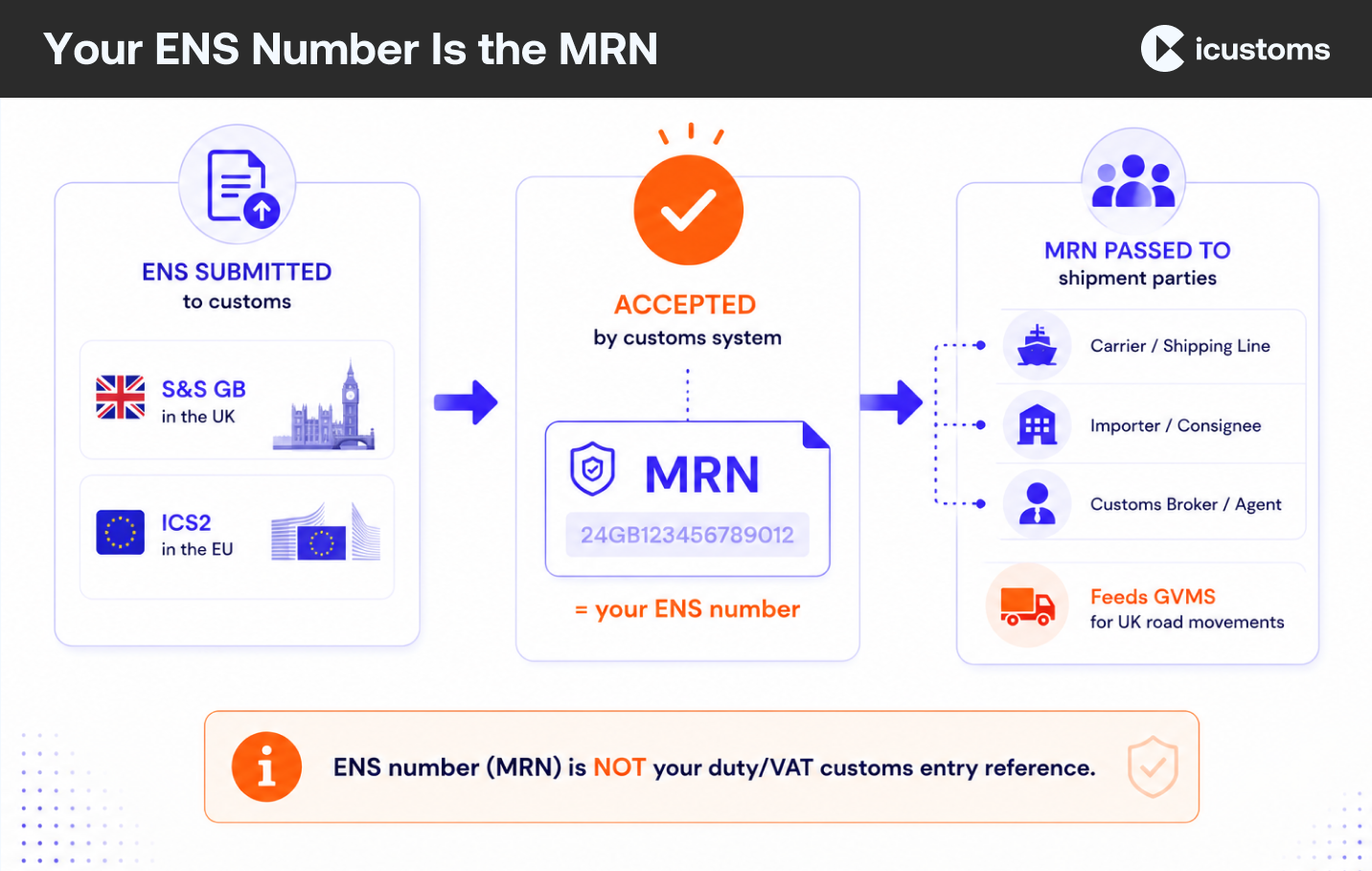
The ENS number is the Movement Reference Number (MRN) that customs issue when an Entry Summary Declaration is accepted. It is your proof that the declaration was lodged and passed validation. People often say “ENS number” and “MRN” to mean the same thing.
The carrier or forwarder receives the MRN after a successful submission and passes it to the parties who need it. In Great Britain, the MRN also links into the Goods Vehicle Movement Service (GVMS) for road movements, so the vehicle can cross. Keep the ENS number with your shipment records; it is separate from your commercial customs entry reference used for duty and VAT.
ENS cut-off and “ENS ready”: what they mean for your timeline
Because the ENS has to be lodged before arrival, and before loading for deep-sea cargo, carriers set an ENS cut-off. This is the deadline for the declaration data, and it usually falls ahead of the freight cut-off. When a booking is marked “ENS filed” or “ENS ready”, it means the declaration has been lodged and the MRN issued, so the cargo can proceed.
Miss the ENS cut-off and your cargo can be rolled to a later sailing or held, sometimes with extra charges. Timings differ by transport mode and between the UK and the EU, so confirm the cut-off for your route. Our iENS Entry Summary Declaration page shows how automated filing keeps declarations ahead of the cut-off.
UK and EU: S&S GB ENS and ICS2 ENS
Which system your ENS goes through depends on where the goods are heading. Goods entering Great Britain are declared through S&S GB, the UK safety and security service. Goods entering the EU are declared through ICS2 (Import Control System 2). It is the same idea, run by different authorities, so a return trip can involve both. The customs data and deadlines differ, which is another reason the ENS handling appears on your shipping paperwork.
Do shippers need to file the ENS themselves?
Usually not. The carrier or your freight forwarder files the ENS. Your part is to give them accurate, complete cargo data, the goods description, HS code, weights, parties and container numbers, so the declaration is correct first time. Vague or missing data is the main cause of rejected declarations, delays and avoidable charges. For more on who carries the filing duty, see our guide on who is responsible for filing the ENS.
How carriers and forwarders handle ENS at scale
A carrier or forwarder is not filing one ENS; they are filing hundreds across modes and across both S&S GB and ICS2. That is where automation earns its place. iENS from iCustoms reads the shipping documents, extracts the data, validates it before submission, and files to the customs system to return the MRN. Fewer rejections and on-time filing mean fewer of the delays and extra charges that catch shippers out.
Frequently Asked Questions
What does ENS stand for in shipping?
ENS stands for Entry Summary Declaration. It is a pre-arrival safety and security declaration filed with customs before goods arrive, so the shipment can be screened for risk. It is separate from the customs declaration used to pay duty and VAT.
What is an ENS charge in shipping?
An ENS charge is a fee the carrier or forwarder passes on for filing the Entry Summary Declaration on your consignment. It is a small, usually flat, documentation and handling fee per shipment, not a duty or tax.
Why am I being charged an ENS fee?
Because a mandatory pre-arrival declaration had to be lodged for your shipment. The party that files it carries the cost and the liability, and often recovers this as an ENS fee or surcharge on the invoice.
What is an ENS number?
The ENS number is the Movement Reference Number (MRN) issued when the Entry Summary Declaration is accepted. It proves the declaration was lodged and is passed to the parties who need it.
Is the ENS number the same as the MRN?
In practice, yes. The number people call the ENS number is the MRN generated by the customs system after a successful submission.
You may also like:
Struggling to Extract, Catagorise & Validate Your Documents?

Capture & Upload Data in Seconds with AI & Machine Learning
Subscribe to our Newsletter
About iCustoms
iCustoms is an all-in-one solution helping businesses automate customs processes more efficiently. With AI-powered and machine-learning capabilities, iCustoms is designed to streamline your all customs procedures in a few minutes, cut additional costs and save time.
Struggling to Extract, Catagorise & Validate Your Documents?
Capture & Upload Data in Seconds with AI & Machine Learning