

How Customs Warehouse Duty Deferral Improves Cash Flow
- John Hall
- Customs Specialist at iCustoms.ai
A customs warehouse suspends customs duty and import VAT on imported goods until you release them. You pay only on the stock you release into the UK market, when you release it, and nothing on goods you re-export.
Most guidance stops there and treats this as a financing benefit. Duty deferral bonded warehouse arrangements are almost always sold on the ability to delay paying customs duty, VAT and other charges until release, and that is real. It is also the smallest part of the story. A customs warehouse defers three separate decisions, and only one of them is about when the money leaves. The other two can be worth considerably more.
A customs warehouse defers three decisions, not one
- When you pay. The timing benefit. Duty follows release rather than arrival, which frees working capital. This is the part everyone writes about, and it is the smallest of the three.
- Which rate you pay. The same commodity can carry several different duty rates on the same day depending on origin and eligibility. Releasing on arrival fixes the rate before you may be able to prove the best one. Holding in bond keeps the choice open.
- Whether you pay at all. Goods re-exported from a customs warehouse never enter free circulation, so UK duty and import VAT are never charged. Not deferred. Never charged.
Work through all three and the case looks different from the usual financing calculation. If you are not yet sure which approval your goods need, start with the customs warehouse vs excise warehouse comparison, and for the application itself see the customs warehouse authorisation guide. One boundary before we start: customs warehousing is a storage procedure. If you need to process goods beyond the permitted usual forms of handling, that is Inward Processing Relief, a different authorisation, and it is outside this article.
Decision one: when you pay
Be careful what you compare against here. Most cash-flow arguments for bonded storage compare it to paying everything in cash at the border, which almost nobody does.
| Route | When customs duty is paid | When import VAT is accounted | Working capital effect |
|---|---|---|---|
| Pay at the border | On arrival, immediately. | On arrival, unless postponed VAT accounting is used. | Full tax bill funded before a single unit sells. |
| Duty deferment account | Deferred to a single monthly payment date, without any warehouse approval. | On the VAT return if postponed VAT accounting is used. | Duty delayed by weeks, not months. No link to sales. |
| Customs warehouse | Only on the stock you release, when you release it. No time limit while it stays in bond. | On the VAT return when the removal declaration is made, if postponed VAT accounting is used. | Duty follows sales. Unsold stock carries no funded duty at all. |
Table: pay at the border, duty deferment account and customs warehouse compared on payment timing and working capital.
The honest comparison is the second row against the third. A duty deferment account is easier to obtain than a warehouse authorisation and already pushes duty to a monthly payment date. What a customs warehouse adds on timing alone is the link to sales: duty is not merely delayed by a few weeks, it is not incurred until the goods leave bond, however long that takes. Real, but incremental.
Decision two: which rate you pay
This is where the argument gets genuinely interesting, and where almost no vendor content goes.
Look up any commodity on the UK Integrated Online Tariff and you will not find one duty rate. You will find several, applying to the same goods on the same day, depending on where they originate and whether a suspension applies. Take a real example.
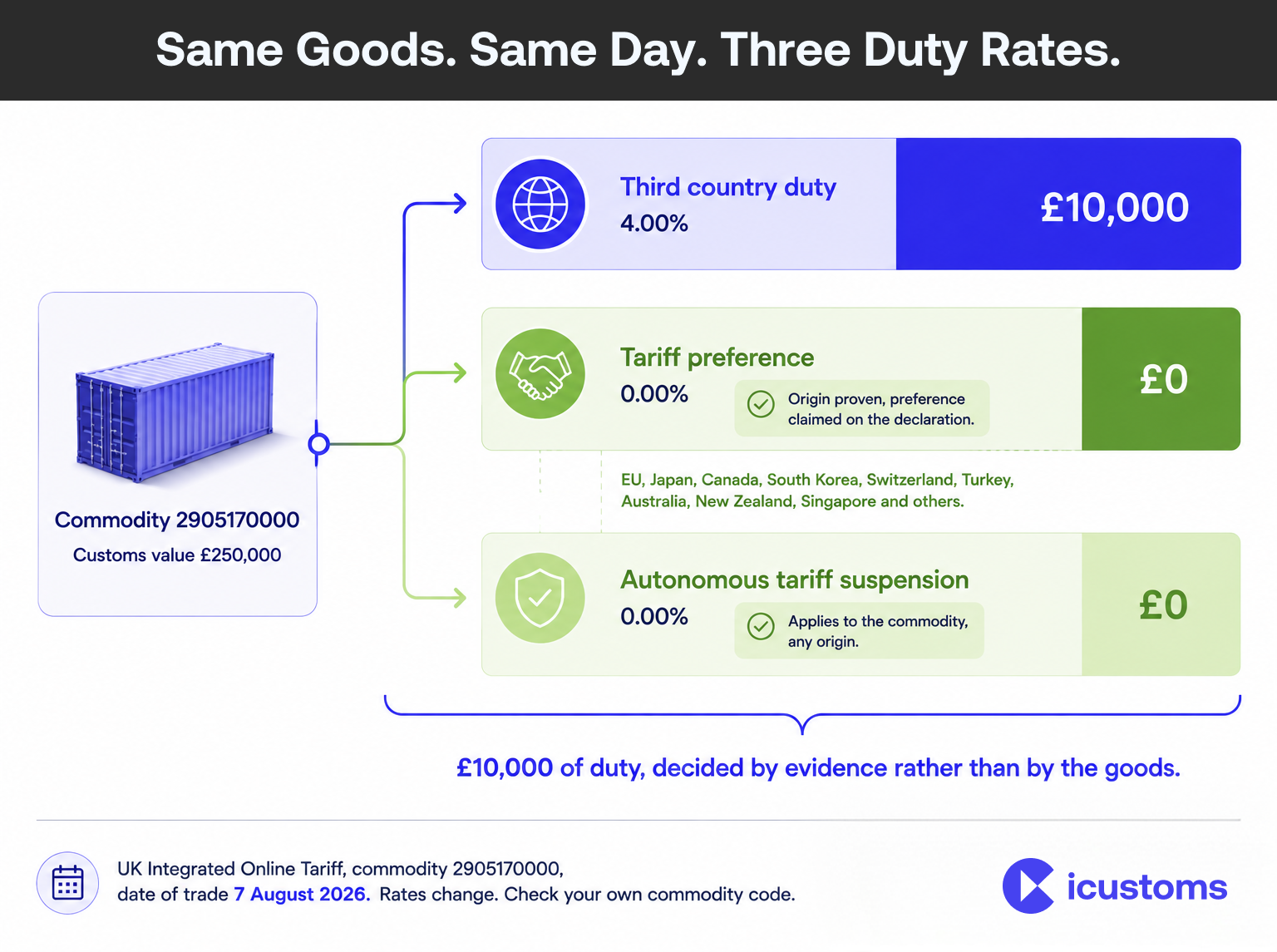
Commodity 2905170000, checked 7 August 2026
Dodecan-1-ol (lauryl alcohol), hexadecan-1-ol (cetyl alcohol) and octadecan-1-ol (stearyl alcohol). Third country duty: 4.00%. Tariff preference: 0.00% for the EU, Japan, Canada, South Korea, Switzerland, Turkey, Australia, New Zealand, Singapore and many others. Autonomous tariff suspension: 0.00%, all countries. Suspension for goods for certain categories of ships, boats and other vessels and for drilling or production platforms: 0.00%. Excise duties are not chargeable on this commodity. Source: UK Integrated Online Tariff.
So the same consignment can attract 4.00% or nothing, and the difference is not the goods. It is what you can evidence at the moment of release.
| Rate that applies | When | On a £250,000 consignment |
|---|---|---|
| Third country duty, 4.00% | Default. No preference claimed or none available. | £10,000 |
| Tariff preference, 0.00% | Origin proven under the relevant agreement, preference claimed on the declaration. | £0 |
| Autonomous tariff suspension, 0.00% | Suspension applies to the commodity, any origin. | £0 |
Table: three duty outcomes for the same commodity, from the UK Integrated Online Tariff, 7 August 2026. Rates change. Check the current position for your own commodity code before relying on this.
Now the point. A preference code is mandatory on every import entering a free circulation regime, and on any claim to tariff preference or quota established on entry to the procedure. It goes in Data Element 4/17 on a CDS declaration. Preference code 300 covers a preferential duty rate without conditions or limits. If you release goods to free circulation on arrival and you do not yet hold the origin evidence the agreement requires, you declare at the third country rate. On the example above that is £10,000 you may never get back.
Hold the same goods in a customs warehouse and the declaration that fixes the rate is the removal declaration, not the arrival. Which means the origin evidence can arrive from your supplier after the goods do. The suspension question can be checked properly rather than in the twenty minutes before a truck leaves the port. And if a preference turns out not to be provable, you have lost nothing, because the third country rate was always the fallback.
That is option value, and it is worth real money on any commodity where the spread between the third country rate and the preferential rate is meaningful. It is also why HMRC requires a duty management system to identify goods carrying a tariff preference, quota or licensing restriction and to make sure the certificate or licence is available before those goods are removed to free circulation. The rate decision is a records problem as much as a tax one.
Decision three: whether you pay at all
Everything above is about timing and rate. Re-export is about money that never leaves.
Goods that enter a customs warehouse and are then re-exported without entering free circulation never attract UK customs duty or import VAT. For any business buying centrally and distributing across multiple markets, this is the strongest financial argument for bonded storage, and re-export relief applies to the whole re-exported volume rather than to a financing period.
It also removes a familiar problem. Import, pay duty, later ship the goods onward, then try to recover what you paid, and you are into a reclaim process with its own evidence burden and delay. Holding stock in bond until the destination is known avoids paying twice and avoids the recovery exercise entirely. Minimised double-duty payments matter most for anyone using the UK as a distribution hub.
One related use worth knowing. The Tariff also records import controls, and on the example commodity there are restrictions on entry into free circulation for goods from Russia and Ukraine. A customs warehouse lets you hold goods while a control, licence or documentation question is resolved, rather than forcing a decision at the frontier. That is not a cash-flow benefit, but it is the same underlying advantage: you are buying time to be right.
The worked example
Take a single consignment of commodity 2905170000 with a customs value of £250,000, sold evenly over six months. Import VAT is charged at the standard UK rate of 20% on the customs value plus the duty, which is why the duty rate moves the VAT figure too.
| Line | Third country route | Preference or suspension route |
|---|---|---|
| Customs value | £250,000 | £250,000 |
| Customs duty | £10,000 at 4.00% | £0 at 0.00% |
| Import VAT at 20% | £52,000 on £260,000 | £50,000 on £250,000 |
| Total charges at the border | £62,000 | £50,000 |
| Due on arrival under customs warehousing | £0 | £0 |
Table: border charges on a £250,000 consignment of commodity 2905170000. Duty rates from the UK Integrated Online Tariff, 7 August 2026. VAT at the standard UK rate of 20%. Confirm both against current sources before relying on this.
Three outcomes, and they are different in kind. Adding them together overstates the benefit.
Working capital headroom: £10,000. The deferred duty you no longer fund on arrival. Capacity released, not money saved. For a business running against a facility limit this is usually the number that matters most day to day.
Financing benefit: roughly £233. Releasing evenly over six months gives an average deferral of about three and a half months. At an 8% cost of capital, £10,000 deferred for 3.5 months is around £233. Modest, and honestly stated: on a 4% commodity the pure financing case is thin. It scales with duty rate, volume and holding period.
Rate risk avoided: up to £12,000. The duty and the VAT knock-on you would have paid by releasing at the third country rate on arrival without the origin evidence in hand. This is the largest figure on the page and it is the one nobody models.
Substitute your own commodity code and the method holds. Look the code up on the UK Integrated Online Tariff, note the third country duty and any preference or suspension available, and the spread between them is your rate risk per consignment. The Tariff also carries a duty calculator if you want it to do the arithmetic.

Why import VAT is usually not the win
One correction to the common claim, because a finance director will spot it.
A UK VAT-registered business can use postponed VAT accounting to declare and recover import VAT on the same VAT return rather than paying it upfront and recovering it later. No approval is needed. HMRC confirms it is available on the declaration that removes goods into free circulation from a customs special procedure, customs warehousing included.
So for a VAT-registered importer already using postponed VAT accounting, import VAT is close to timing-neutral whether the goods enter a customs warehouse or not. What the warehouse changes on the VAT side is the amount, not the timing: because VAT is calculated on customs value plus duty, avoiding £10,000 of duty also avoids £2,000 of VAT permanently.
Where VAT deferral genuinely helps on timing is narrower: businesses not registered for UK VAT, partly exempt businesses that cannot recover all their input tax, and importers using routes where postponed VAT accounting is unavailable such as certain Royal Mail Group consignments above £135. If that is you, the deferral is real cash.
The honest headline
For most VAT-registered importers the customs warehouse cash flow benefit is a duty story, not a duty and VAT story. Anyone quoting the combined figure as working capital released is overstating it. Ask them to separate the two, and ask them separately about the rate decision, which is where the larger number usually sits
Customs warehouse benefits beyond cash flow
Cash flow is the headline, but the operational gains are easier to sell internally because they show up in headcount and error rates rather than in a financing calculation.
- Fewer declarations. Inbound goods enter on one import declaration and leave on a clearance for removal, rather than each shipment carrying its own full duty event. Less administrative burden, fewer touchpoints, fewer chances to get a figure wrong.
- Smart stock picking. Because duty is calculated on what you remove, you decide which stock leaves. Where identical goods were acquired under different consignments with different preference positions, releasing the right stock against the right order changes the duty payable. This is not FIFO, which is an age-based rotation convention. It needs consignment-level records to work at all.
- Better order fulfilment. Holding stock close to the market without paying tax on it means serving demand quickly without funding inventory twice.
- A digital record of inventory. The authorisation obliges you to keep an accurate stock account, which delivers the visibility of stock, movements and documents most warehouse operations want anyway.
Taken together these are supply chain efficiency gains rather than tax gains, and they persist whether or not your duty rate makes the financing case on its own.
When bonded storage does not pay
Worth saying plainly, because the answer is not always yes. The storage against tax trade-off is real.
- Your commodity is zero-rated for duty from all origins, with no preference spread to protect. There is nothing meaningful to defer and no rate risk to avoid.
- Stock turns in weeks and you always hold origin evidence at arrival. A duty deferment account achieves nearly the same timing with far less overhead.
- Everything sells domestically, so you lose re-export relief, which is the only outright saving of the three.
- Volumes are too low to absorb the compliance overhead. The authorisation and the records cost the same whether you put one container through or fifty.
- Your stock records cannot support consignment-level accuracy, in which case the authorisation is a risk rather than a benefit.
If two or more apply, model a duty deferment account first. It is a smaller commitment and may capture most of the timing benefit.

Building the internal case
Three figures make the case, and they come in this order. Your annual import value multiplied by your average duty rate gives the working capital headroom. That figure multiplied by your cost of capital and average holding period gives the financing benefit. And the spread between the third country rate and the best available preferential rate, across the consignments where evidence timing is tight, gives the rate risk you are currently carrying.
All three depend on the same thing: records accurate enough at consignment level to know what you hold, where it came from, what evidence supports it and what has been released. Duty deferral only works if the stock account is right, because the removal declaration is what triggers the duty calculation.
iWarehouse is built for that. It keeps the bonded stock position and movement history together, holds duty status against stock so suspended and released positions stay distinct, attaches supporting documents to the consignment they belong to so origin evidence sits with the goods it relates to, and reconciles the period so the duty you declare matches your records. You can defer duty and free up cash flow with iWarehouse across customs and excise stock on the same site.
If you are comparing systems, our bonded warehouse software buyer’s guide sets out the evaluation criteria, and our comparison of software against manual records covers what spreadsheets cost once volumes rise.
Frequently Asked Questions
How much cash flow can a customs warehouse save?
Three separate figures. Annual import value times your average duty rate gives working capital headroom. That figure times your cost of capital and average holding period gives the financing benefit. And the spread between the third country duty and the best preferential rate gives the rate risk avoided. On a £250,000 consignment of a 4.00% commodity that is £10,000 of headroom, roughly £233 of financing benefit at 8%, and up to £12,000 of rate risk including the VAT knock-on.
Does duty deferral apply to VAT too?
Import VAT is suspended in a customs warehouse, but for most VAT-registered importers this matters less than it sounds. Postponed VAT accounting already lets you declare and recover import VAT on the same VAT return rather than paying at the border, and HMRC confirms it is available on removal from customs warehousing. The larger VAT effect is indirect: because VAT is charged on customs value plus duty, avoiding duty also avoids the VAT on that duty.
What happens if goods are re-exported?
If they leave the UK without ever entering free circulation, UK customs duty and import VAT are never charged. This is a genuine saving rather than a timing benefit, and it is the strongest financial argument for bonded storage for any business distributing across multiple markets.
Can a customs warehouse help me claim a tariff preference?
Indirectly, and it is one of the most underrated benefits. The declaration that fixes your duty rate is the one removing goods to free circulation, so holding stock in bond means origin evidence can arrive after the goods do. Release on arrival without that evidence and you declare at the third country rate. A preference code is mandatory on entry to free circulation and goes in Data Element 4/17 on a CDS declaration.
Is smart stock picking the same as FIFO?
No. FIFO is a rotation and valuation convention based on age. Duty-efficient picking chooses which stock to release based on duty status, origin and cost, which can point at different stock entirely. Both need consignment-level records to work.
You may also like:
Struggling to Extract, Catagorise & Validate Your Documents?

Capture & Upload Data in Seconds with AI & Machine Learning
Subscribe to our Newsletter
About iCustoms
iCustoms is an all-in-one solution helping businesses automate customs processes more efficiently. With AI-powered and machine-learning capabilities, iCustoms is designed to streamline your all customs procedures in a few minutes, cut additional costs and save time.
Struggling to Extract, Catagorise & Validate Your Documents?
Capture & Upload Data in Seconds with AI & Machine Learning