

Customs Warehouse vs Excise Warehouse: What's the Difference?
- John Hall
- Customs Specialist at iCustoms.ai
A customs warehouse suspends customs duty and import VAT on goods that have not yet entered free circulation. An excise warehouse suspends excise duty on alcohol, tobacco and oils that are already in free circulation. “Bonded warehouse” is the umbrella term covering both.
That is the difference in three sentences, and for a lot of businesses it is enough. The reason the question keeps coming up is that the two approvals overlap in practice more often than the definitions suggest. Import a container of wine and you may need both. This page sets the two side by side, shows which goods qualify for each, explains the one test that decides between them, and points you to the application detail for whichever route applies.
Customs warehouse vs excise warehouse vs bonded warehouse: the comparison
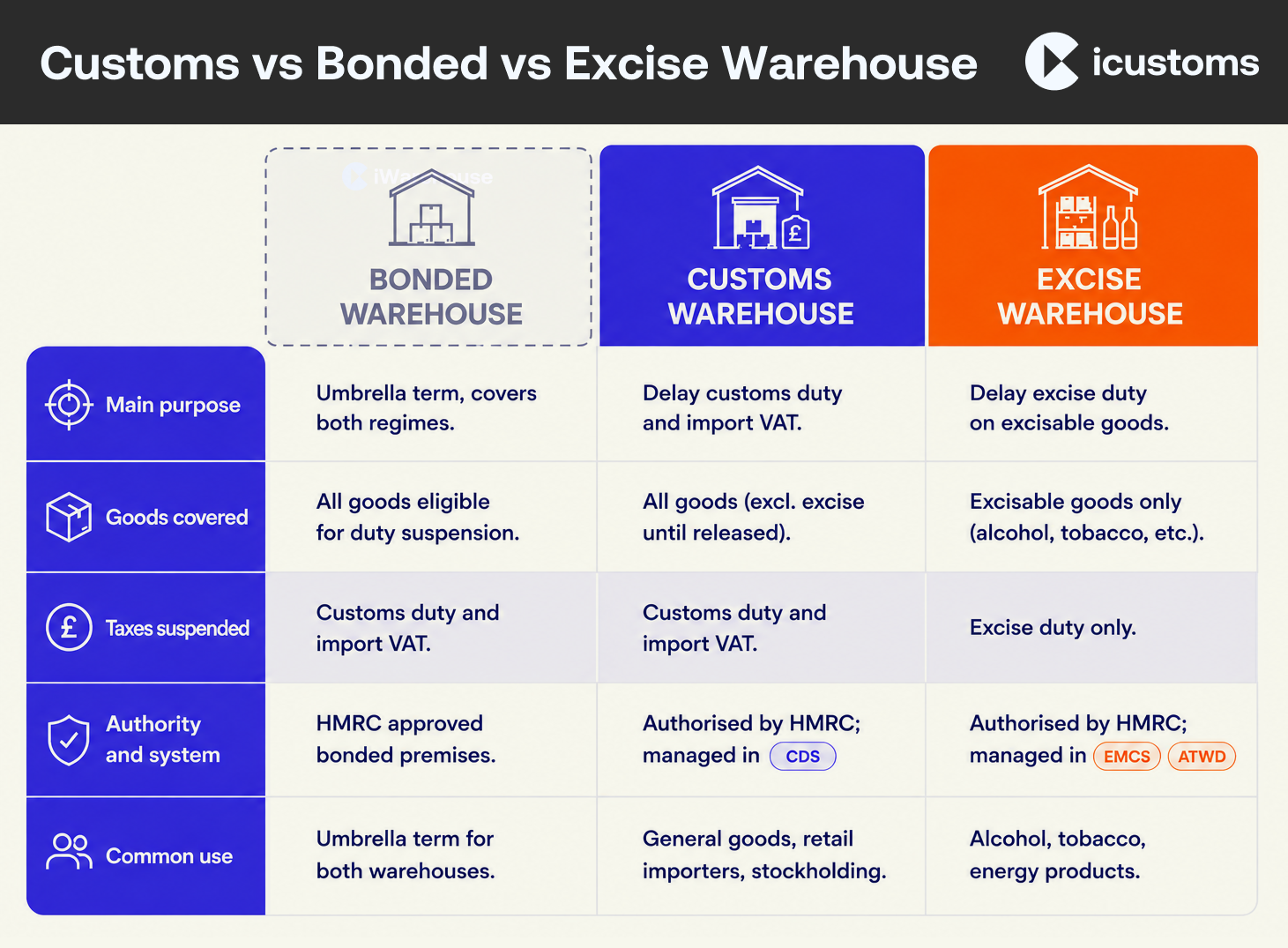
The table below is the short answer to all three terms at once.
| Bonded Warehouse | Customs Warehouse | Excise Warehouse | |
|---|---|---|---|
| Main purpose | Umbrella term for storing goods under duty suspension. Not an approval in itself. | Suspend customs duty and import VAT on imported goods until they are released or re-exported. | Suspend excise duty on excise goods until they are released for consumption or exported. |
| Goods covered | Any goods held under either regime below. | Almost any imported commodity that has not entered free circulation. | Alcoholic products, tobacco products, energy products such as hydrocarbon oils and biofuels, and vaping products from 1 October 2026. |
| Taxes suspended | Depends which approval is held. | Customs duty and import VAT. | Excise duty only. Customs duty and import VAT must already be settled. |
| Authority and system | No standalone HMRC approval exists under this name. | HMRC authorisation. Declarations run through the Customs Declaration Service (CDS). | HMRC approval of both the warehousekeeper and the premises. Movements run through EMCS. Returns run through ATWD. |
| Common use | Trade shorthand used by warehouse operators, forwarders and 3PLs. | Importers and 3PLs deferring duty on stock awaiting demand, and goods being re-exported. | Alcohol and tobacco importers, drinks brands, producers, and fuel distributors. |
Why "bonded warehouse" is the term that causes the confusion
Two of these three terms are real HMRC approvals. The third is not. “Bonded warehouse” is trade shorthand, widely used and perfectly well understood in the market, but you cannot apply for one. Ask HMRC for a bonded warehouse approval and you will be asked which of the two you mean. That is the whole reason bonded warehouse vs customs warehouse reads like a comparison when it is really a category and one of its members. If you want the term itself unpacked in full, start with our guide to what a bonded warehouse is.
The practical consequence is worth stating plainly. When a provider offers you bonded storage, that offer tells you nothing about which duties they can actually suspend on your goods. The only useful question is which approval the site holds, and whether it covers what you are shipping.
The real dividing line: free circulation
The difference between customs and excise warehouse approvals is not about the goods. Almost every mistake in this area starts there. It is about the status of the goods.
Free circulation means goods on which all import formalities have been completed and any customs duty due has been paid. A customs warehouse holds goods before they reach that point. An excise warehouse only works on goods that have already reached it. HMRC is explicit that excise goods can only move in excise duty suspension once they are in free circulation.
Read those two sentences together and the sequencing problem appears. A shipment of imported spirits arrives carrying both customs duty and excise duty. Excise warehousing cannot touch it yet, because the customs formalities are outstanding. So either the customs charges are settled on arrival and the goods then enter excise duty suspension, or the goods go into a customs warehouse first and the excise position is dealt with later. The commodity did not change. Its status did.
The one-line test Ask whether the customs formalities on the goods are finished. If they are not, you are looking at a customs warehouse. If they are, and the goods carry excise duty, you are looking at an excise warehouse. If neither applies, you do not need bonded storage at all. |
What a customs warehouse does
A customs warehouse holds imported goods under customs control with the customs duty and import VAT suspended. Nothing is written off. The charges sit against the stock and fall due when the goods are released into the UK market, or disappear entirely if the goods are re-exported without ever entering free circulation.
Three features matter commercially:
- Breadth. It applies to almost any commodity, not a defined list. If it can be imported, it can usually be warehoused.
- No time limit. Goods can remain under customs control indefinitely, provided records are accurate and the authorisation conditions are met. Most other special procedures are time-bound.
- Selective release. You decide what leaves and when, which means duty follows demand rather than arrival.
Declarations run through the Customs Declaration Service (CDS), and the authorisation itself comes in more than one form depending on whether you are storing your own stock or other people’s. Those choices, the evidence HMRC expects and the application sequence are covered in our guide to how to get a customs warehouse authorisation.
What an excise warehouse does (excise warehouse meaning)
An excise warehouse is a place of security approved by HMRC where goods liable for excise duty can be stored without payment of that duty, for such periods and subject to such conditions as HMRC sees fit. That is the excise warehouse meaning in HMRC’s own framing, and the wording matters: conditions are attached to your specific approval rather than being uniform across the regime.
The goods are a defined list, not an open field:
- alcoholic products including beers, wines and spirits
- tobacco products including cigarettes, cigars, loose tobacco and tobacco for heating
- energy products including hydrocarbon oils and biofuels for use as motor or heating fuel
- from 1 October 2026, vaping products including pods and refills, whether or not they contain nicotine
Two administrative differences separate this from customs warehousing more than anything else. First, HMRC approves two things rather than one: you as an authorised warehousekeeper, and the premises as an excise warehouse. Second, the paperwork does not stop at the door.
Duty-suspended movements are recorded on the Excise Movement and Control System, explained in full in our guide to how EMCS works. Periodic returns are filed through the Alcohol and Tobacco Warehousing Declaration service, and the authorisation, ATWD registration and W1 return cycle are covered in our excise warehouse authorisation guide.

Can a warehouse be both customs and excise?
Yes, and for imported excise goods it is often the only workable answer. HMRC states the position directly: an authorised warehousekeeper receiving imported excise goods who intends to store them free of all duties must hold customs warehouse approval for the premises as well.
So a site handling imported wine, spirits or tobacco under full duty suspension is not choosing between the two approvals. It is holding both, with the customs approval covering the import position and the excise approval covering the goods themselves. This is exactly the “two products, one platform” reality that catches businesses out when they buy software built for only one side.
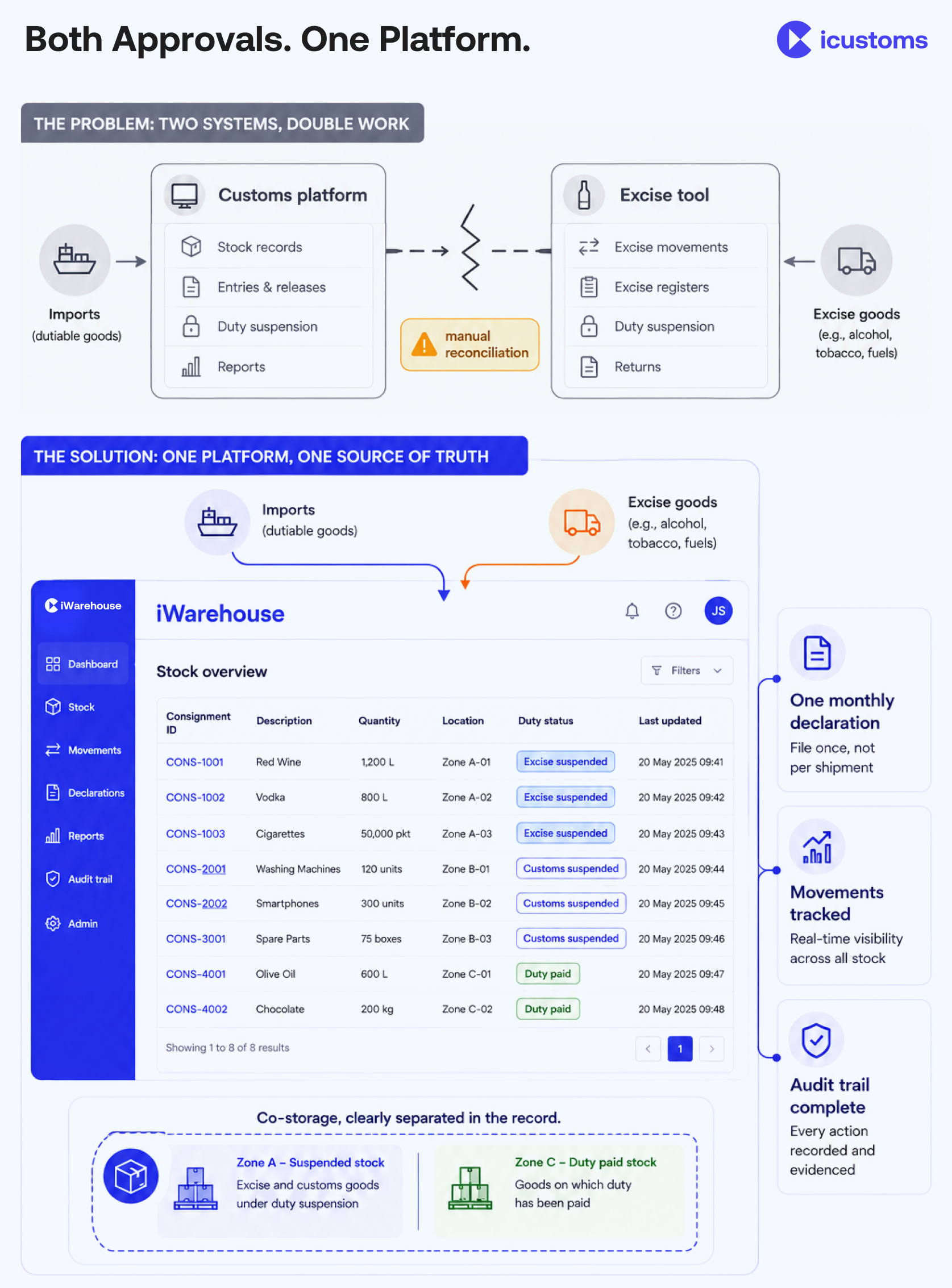
One related permission is easy to miss. If you intend to keep duty-suspended and duty-paid goods on the same premises, an arrangement known as co-storage, you need HMRC permission for it. The two populations must remain clearly distinguishable in your records, which in practice means your stock system has to carry duty status as a first-class attribute rather than a note in a comments field.
Do you need two separate authorisations?
Yes. They are two distinct approvals with separate applications, separate conditions and separate financial security. Holding one gives you no standing under the other, and an approval granted for one purpose cannot quietly be stretched to cover another.
There is also a movement-side approval that surprises people. The excise duty-suspended journey from the point where goods are released to free circulation, such as a port, to the excise warehouse must be carried out by someone approved as a registered consignor. HMRC will generally only consider approving the import agent, the receiving warehousekeeper, or the person dispatching duty-suspended goods for export. If nobody in your chain holds it, the movement cannot legally happen under suspension.
Warehousekeeper responsibilities under each regime
Both regimes put the record-keeping burden on the warehousekeeper rather than the goods owner, but they draw the boundary in different places.
Under customs warehousing the accountability is largely static. You hold the stock account, you reconcile it to physical stock, and you declare correctly when goods are released. The scrutiny sits at entry and exit.
Under excise warehousing it extends to the journey as well. Excise warehousekeepers are responsible for accounting for all excise goods entering or leaving their premises, and a duty-suspended dispatch is only valid if the consignor has a movement guarantee in place before the goods leave. Responsibility therefore follows the consignment out of the building, which is a materially different exposure from customs warehousing.
In both cases the depositor, not the warehousekeeper, generally carries the duty liability when the goods are released. That split is why a shared, timestamped record matters more than either party’s internal system: the person accountable to HMRC and the person paying the duty are usually different businesses.
Which is more demanding to run, customs or excise warehousing?
Neither has a published price, so the honest comparison is administrative load rather than cost. On that measure excise warehousing is the heavier of the two.
A customs warehouse concentrates its effort at the edges: getting classification, valuation and origin right on entry, keeping a stock account that reconciles, and declaring correctly on release. An excise warehouse carries all of that on the customs side if it also holds customs approval, and then adds:
- a movement guarantee on duty-suspended dispatches, which is the consignor’s responsibility to have in place before goods move
- an EMCS record for every duty-suspended movement, opened and discharged
- a W1 return for each set of premises, filed through the ATWD online service, plus the warrants used when goods are removed on payment or under deferment
- premises and deferment security, where HMRC requires it
The practical implication is that the gap between the two regimes is mostly a reporting gap. That is also why it is the part most often underestimated at the point of buying software.
Which one do your goods need? A three-question test
- Have the import formalities been completed and any customs duty paid? If no, a customs warehouse is the relevant approval. Excise duty suspension is not available yet, whatever the commodity.
- Are the goods on the excise list? Alcohol, tobacco, energy products, and vaping products from 1 October 2026. If no, a customs warehouse alone is enough.
- Are you importing them, or producing them? Importers of finished excise goods generally need excise warehousing. UK producers of alcoholic products may hold duty-suspended stock under their own producer approval instead, which is a materially different position.
Answer yes to questions one and two and you are almost certainly looking at both approvals rather than a choice between them. That is the outcome most businesses arrive at, and the one worth planning for from the start rather than discovering at the border.
Running both from one platform
The awkward consequence of needing two approvals is that most compliance software is built for one. Customs platforms handle declarations and stock but not EMCS movements or excise returns. Excise tools handle movements and returns but sit outside the customs entry. Running both means reconciling two systems by hand, which puts the error back exactly where the approvals were meant to remove it.
iWarehouse from iCustoms manages customs, bonded and excise warehouses from a single AI platform. Declarations are created automatically on arrival, duty can be paid immediately or deferred in bond, stock and movements are tracked without manual monitoring, and removals are accounted for in one monthly declaration rather than shipment by shipment. Duty status travels with the stock, so co-storage and mixed-regime sites stay auditable. See how it works on the iWarehouse bonded warehouse software page.
If you are still deciding which approval to apply for, the next step is the application detail itself: read the customs warehouse authorisation guide for the customs route, or the excise warehouse authorisation guide for the excise route.
Frequently Asked Questions
What's the difference between a customs warehouse, a bonded warehouse and an excise warehouse?
"Bonded warehouse" is the umbrella term and covers two distinct HMRC authorisations. A customs warehouse suspends customs duty and import VAT on goods that have not yet entered free circulation. An excise warehouse suspends excise duty on goods such as alcohol, tobacco and oils that are already in free circulation.
Can a warehouse be both customs and excise?
Yes, and imported excise goods usually require it. HMRC expects a warehouse keeper storing imported excise goods free of all duties to hold customs warehouse approval for the premises alongside the excise approval. The two work together rather than as alternatives.
What goods go in an excise warehouse?
Alcoholic products, tobacco products, energy products such as hydrocarbon oils and biofuels, and, from 1 October 2026, vaping products including pods and refills. Note that UK-manufactured tobacco intended for the UK market cannot be warehoused, only tobacco destined for a duty-free purpose such as export.
Do I need two separate authorisations?
Yes. They are separate applications with separate conditions and separate financial security, and holding one gives you no standing under the other. Duty-suspended movements from a port into an excise warehouse also need someone in the chain approved as a registered consignor.
Which is cheaper to run, customs or excise warehousing?
Neither carries a published cost, so the meaningful difference is administrative load. Excise warehousing is heavier: on top of the customs obligations it adds movement guarantees, an EMCS record for every duty-suspended movement, and periodic W1 returns for each set of premises.
Can I use one platform for both customs warehousing and excise warehousing?
Yes. iWarehouse manages both duty-suspended and excise-suspended stock from the same platform, so you are not running separate systems for separate warehouse types or reconciling between them.
You may also like:
Struggling to Extract, Catagorise & Validate Your Documents?

Capture & Upload Data in Seconds with AI & Machine Learning
Subscribe to our Newsletter
About iCustoms
iCustoms is an all-in-one solution helping businesses automate customs processes more efficiently. With AI-powered and machine-learning capabilities, iCustoms is designed to streamline your all customs procedures in a few minutes, cut additional costs and save time.
Struggling to Extract, Catagorise & Validate Your Documents?
Capture & Upload Data in Seconds with AI & Machine Learning