

Customs Warehouse Types & Authorisation: The Complete HMRC Guide
- John Hall
- Customs Specialist at iCustoms.ai
A customs warehouse authorisation is HMRC permission to operate a customs warehouse as a warehousekeeper, storing imported goods with customs duty and import VAT suspended. You apply online, and HMRC recommends applying at least two months before you want to start using the warehouse.
That is the outline. The detail is where applications get delayed, because HMRC asks for a specific set of documents and a specific kind of evidence, and the evidence differs depending on whether you are storing your own goods or other people’s. This guide covers both warehouse types, the eligibility conditions, the full document list, the application steps, realistic timelines, and the reasons applications get refused.
A customs warehouse suspends customs duty and import VAT on goods that have not yet entered free circulation. An excise warehouse suspends excise duty on alcohol, tobacco and oils that are already in free circulation. “Bonded warehouse” is the umbrella term covering both.
That is the difference in three sentences, and for a lot of businesses it is enough. The reason the question keeps coming up is that the two approvals overlap in practice more often than the definitions suggest. Import a container of wine and you may need both. This page sets the two side by side, shows which goods qualify for each, explains the one test that decides between them, and points you to the application detail for whichever route applies.
What a customs warehouse authorisation covers
The customs warehouse authorisation UK importers and 3PLs apply for approves a person, not a building alone. HMRC authorises you as the warehousekeeper, and the letter you receive sets out the conditions attached to your specific premises and goods. If you are new to the concept itself, start with our guide to what a bonded warehouse is and the customs warehouse vs excise warehouse comparison. This page assumes you already know you need the customs route.
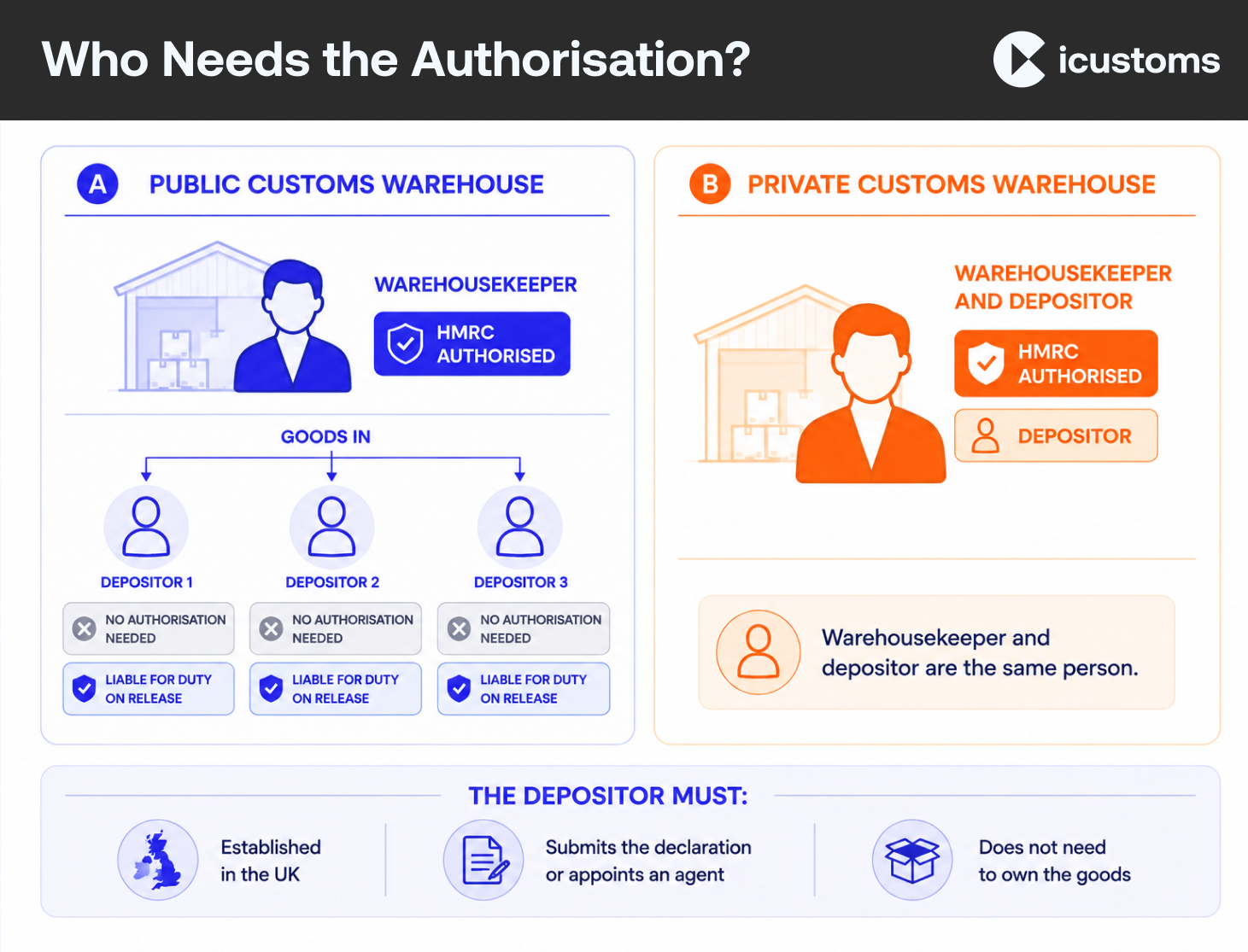
One point catches almost everybody out, so it is worth stating first. Depositors do not need their own HMRC authorisation. Only the warehousekeeper is authorised. A depositor is the person who places goods into the warehouse and takes on the liability if duty and import VAT become due, and they do not have to own the goods. They do have to be established in the UK and be the person who either submits the import declaration or arranges for an agent to submit it.
So if you are an importer looking to use somebody else’s bonded facility, you are not applying for anything. You are choosing a warehousekeeper. The application process below applies if you intend to operate the warehouse yourself.
Types of customs warehouse UK: public and private
There are two types of customs warehouse in the UK.
Public customs warehouse. For businesses that want to store goods belonging to other people, known as depositors. This is the model used by 3PLs, freight forwarders and commercial bonded storage providers.
Private customs warehouse. For businesses that want to store their own goods. The warehouse authorisation holder and the depositor are the same person.
That is the whole taxonomy. It is worth being blunt about this, because a lot of published guidance is out of date.
Ignore the type letters you will see elsewhere
Search this topic and you will find articles referring to Type R, Type U, or the older Type A to Type E system. Those letter classifications are legacy. Current HMRC guidance on GOV.UK, updated in February 2026, describes exactly two types of customs warehouse: public and private. If a consultant or a competitor quotes you a type letter, ask which HMRC page it comes from. The distinction that actually governs your application is whose goods you intend to store.
The public and private split is not a matter of scale or prestige. It changes what you have to evidence, what you are liable for, and whether you can charge for storage as a service.
| Public Customs Warehouse | Private Customs Warehouse | |
|---|---|---|
| Whose goods | Goods belonging to other businesses (depositors). | Your own goods only. Authorisation holder and depositor are the same person. |
| Typical operator | 3PLs, freight forwarders, commercial bonded storage providers. | Importers, manufacturers, retailers and brand owners holding their own stock. |
| Extra evidence at application | Letters of intent from your customers, with annual VAT and duty suspension figures, to show economic need. | No customer letters of intent required. Business need still has to be demonstrated. |
| Commercial model | Storage and compliance can be sold as a service, creating a revenue line. | Internal cost centre. The return comes from deferred duty and VAT. |
| Duty liability on release | Sits with the depositor, who does not need to own the goods. | Sits with you, because you are also the depositor. |
Public or private: which model fits your business?
Answer three questions in order and the choice usually makes itself.
- Will you ever hold stock you do not own? If yes, you need a public authorisation. There is no partial version of this, and retrofitting later means a fresh application.
- Do you have customers willing to put their intentions in writing? A public application needs letters of intent from customers carrying annual VAT and duty suspension figures. If you cannot get them yet, a public application is premature.
- Is bonded storage a product or an overhead? If you are selling it, public. If it exists to smooth your own cash flow, private is simpler, faster to evidence and cheaper to run.
One caution on ambition. Applying for a public authorisation because it sounds more flexible, without the customer evidence to support it, is one of the more common reasons an application stalls. Private authorisations are not a lesser tier, and a private warehousekeeper deferring duty on their own stock gets the same suspension benefit.
What goods can you store in a customs warehouse?
Your application asks for the commodity codes you intend to store and any processing you intend to carry out, so it helps to know the boundaries before you fill it in. A customs warehouse can be used to store goods:
- that are liable to customs duty, excise duties or import VAT
- where documents such as licences are not available when you import them
- originally imported to a special procedure and being warehoused before being re-exported
- on which duty is not due but import VAT is
- that have been released to free circulation
- now in free circulation, which are the subject of a claim under the Rejected Imports arrangements
That last pair surprises people. A customs warehouse is not exclusively for goods sitting outside free circulation, which is why the eligibility question is broader than the headline definition suggests.
Processing is more tightly drawn. You can carry out only certain operations on warehoused goods, known as usual forms of handling. If the work you need falls outside that list, the goods have to be declared to inward processing instead, which is a different authorisation with different conditions. Getting this wrong at application stage is expensive, because an authorisation granted for storage does not stretch to cover processing you later decide you need.
Who can apply: HMRC's eligibility conditions
To be approved as a warehousekeeper, HMRC requires that you:
- are established in the UK
- have an EORI (Economic Operators Registration and Identification) number
- are financially solvent
- have a good compliance record in dealing with customs
- can prove you have a business need for the warehouse
- are able or prepared to make declarations, or employ an agent who can do this for you
- are able to keep inventory records and run the warehouse to health and safety standards
- provide a guarantee if needed for customs duty and VAT, unless you are an Authorised Economic Operator or can meet Authorised Economic Operator conditions
Read that list as two halves. The first four are about you as a business and are largely a matter of record. The last four are about capability, and they are where preparation pays off. “Able to keep inventory records” in particular is not a yes or no question in practice: HMRC will want to see the system, which is covered in the documents section below.
Guarantees, AEO and the Comprehensive Customs Guarantee
A guarantee is financial security covering the duty and VAT at risk on the stock you hold. HMRC requires one where needed, and the wording matters: it is conditional, not automatic.
Two routes reduce or remove it. If you hold Authorised Economic Operator status, or can demonstrate that you meet the AEO conditions even without holding the certification, the guarantee requirement can be waived. Where security is required, a Comprehensive Customs Guarantee is the mechanism commonly used to cover customs debts across special procedures rather than arranging separate cover for each one.
The practical implication for planning is that the guarantee question should be settled early, not left until the application is drafted. If your route to a waiver is meeting AEO conditions, the evidence for that is substantially the same evidence HMRC wants for the authorisation itself: documented procedures, controlled records, and a clean compliance history. Building it once serves both.
Managing the stock is the part the authorisation does not solve HMRC approves your ability to keep an accurate stock account. Maintaining one, consignment by consignment, across every receipt, movement and release, is what happens every day afterwards. iWarehouse creates declarations automatically on arrival, tracks bonded stock and movements without manual monitoring, and accounts for removals in one monthly declaration. Book a demo of iWarehouse. |
Proving business need, and what people mean by the economic conditions test
Businesses researching this topic often arrive looking for the economic conditions test. It is worth being precise, because the terminology causes real confusion.
For customs warehousing, HMRC’s stated requirement is that you prove you have a business need for the warehouse. There is no separate scored test to pass. What HMRC is looking for is a coherent commercial reason why duty-suspended storage is necessary for your operation, evidenced rather than asserted.
For a private application, that evidence is your own trading pattern: what you import, the volumes, why the stock sits before release, and what the warehouse changes. For a public application, HMRC asks for something firmer. You must supply letters of intent from your customers, stating annual VAT and duty suspension figures for the goods they intend to store with you. That is a genuine hurdle. It means a public warehouse application is really two exercises: proving your own capability, and proving that a market for the service already exists.
If your customer conversations are not yet at the point where they will commit numbers to a letter, the honest sequence is to secure the commitments first and apply second.
How to apply for a customs warehouse: step by step
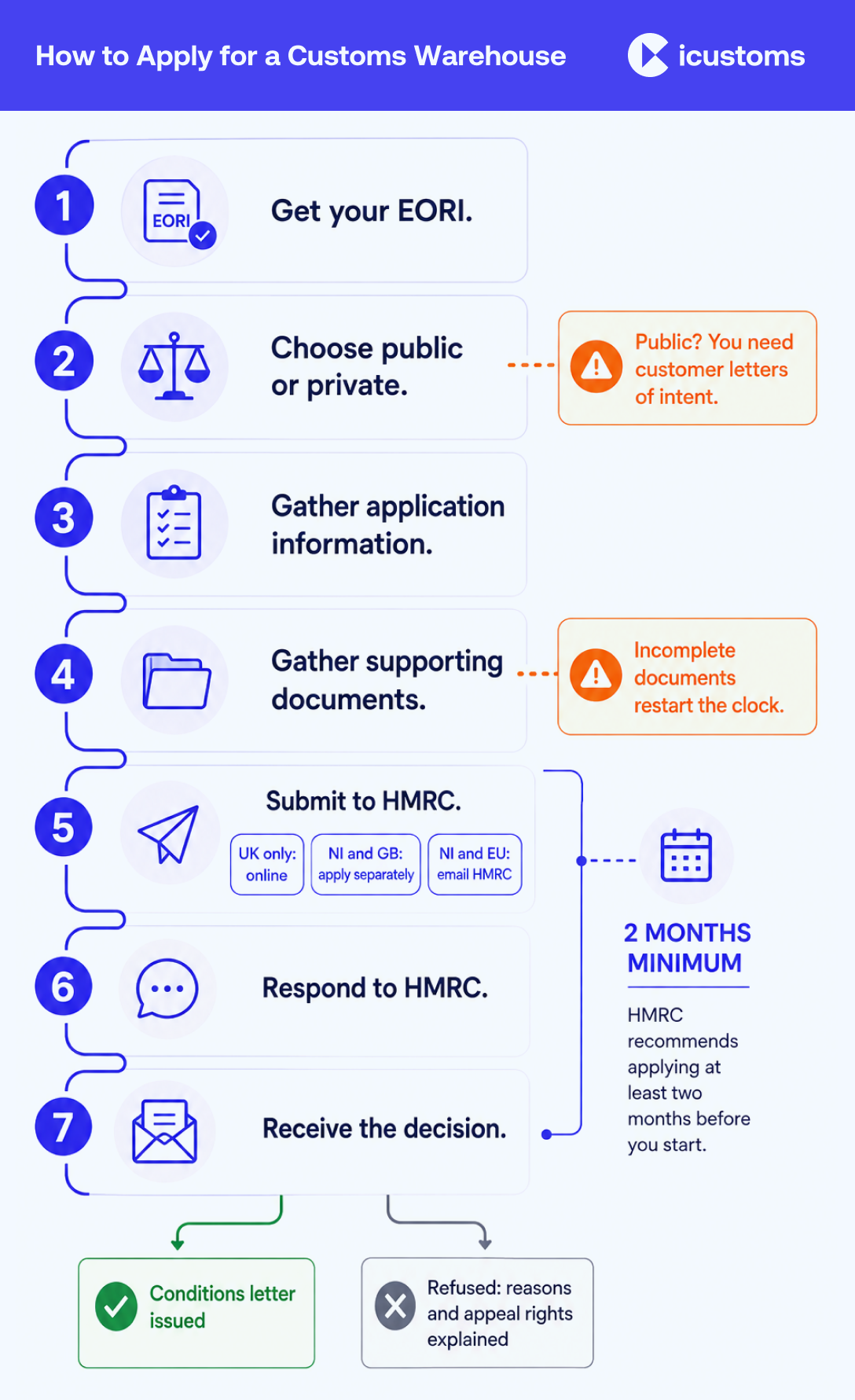
To apply for customs warehouse HMRC authorisation you use an online service, and HMRC recommends applying at least two months before you want to start using the warehouse. The process runs as follows.
Step 1. Get your EORI number. You cannot apply without one. If you trade in Northern Ireland as well, note that an XI EORI is separate.
Step 2. Decide public or private. This determines whether you need customer letters of intent, so settle it before assembling anything else.
Step 3. Assemble the application information. HMRC asks for your EORI, where your records are or will be held, the type of accounting system you use, how goods will be received, the commodity codes (at least six digits) and descriptions of the goods you intend to store, any allowable processing you intend to carry out, where the goods will be declared to customs warehousing, how the goods will be identified in the warehouse, whether you will use simplified declaration procedures, your guarantee details if needed, the address of the storage facilities, details of any anticipated losses in warehouse, details of any excise goods you intend to store, and details of any special storage facilities for goods such as frozen items or chemicals.
Step 4. Assemble the supporting documents. This is a defined list rather than a judgement call, and it is set out in the checklist below.
Step 5. Submit the application. For a UK-only authorisation, apply through HMRC’s online service, signing in with a Government Gateway account. A print and post form is available if you cannot apply online. If you are applying for customs warehousing in both Northern Ireland and Great Britain, you must complete the form separately for each. A single authorisation covering goods stored in both Northern Ireland and the EU is requested by email to HMRC, quoting your XI EORI, and HMRC replies within five days with access to the EU Trader Portal.
Step 6. Respond to HMRC. HMRC may contact you for additional information or to organise a site visit. Keep your nominated signatories available, and tell HMRC immediately if contact details change.
Step 7. Receive the decision. HMRC writes to tell you whether the application is approved. If it is refused, the letter explains why and sets out the review and appeals procedure.
Customs warehouse application document checklist
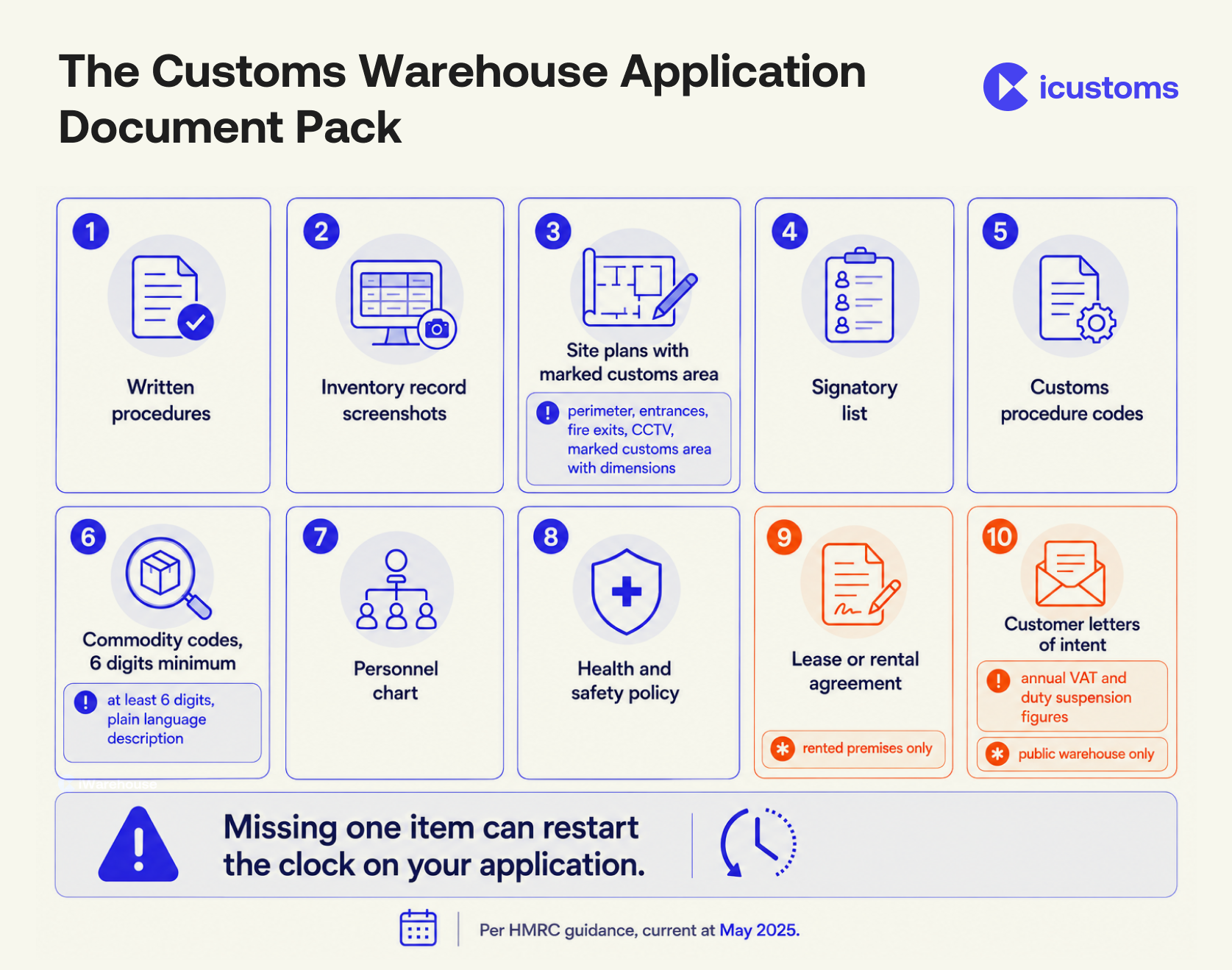
These are the documents HMRC asks you to provide with the application itself.
| Document | What HMRC Expects to See | Applies to |
|---|---|---|
| Written procedures | What happens to goods when they enter and leave the warehouse, listed in the order they happen. | All applications |
| Inventory records | Screenshots of your Warehouse Management System or Duty Management System. Include both if you use both. | All applications |
| Site plans | Address, perimeter dimensions, clearly marked entrances and fire exits, CCTV and security gates, and the dimensions of a clearly marked customs area. | All applications |
| List of signatories | The people authorised to contact HMRC to amend your application or authorisation, signed by a director or company secretary. | All applications |
| Customs procedure codes (CPCs) | The list of CPCs you intend to use. | All applications |
| Commodity codes | At least six digits, each with a plain language description. | All applications |
| Personnel chart | Who does what, so HMRC can see the control structure. | All applications |
| Lease or rental agreement | Confirming address, lessor, lessee and minimum terms. | Rented premises only |
| Letters of intent | From your customers, with annual VAT and duty suspension figures for the goods they intend to store, to show economic need. | Public warehouse applications only |
| Health and safety policy | Your current policy document. | All applications |
How long does customs warehouse authorisation take?
HMRC recommends applying at least two months before you want to start using the warehouse, and says it will make contact if it needs more time. Treat two months as the planning floor rather than a service guarantee.
The variable is not HMRC’s processing speed so much as the number of round trips your application causes. An application that arrives complete, with the written procedures, site plans and system screenshots all present, moves in one pass. An application missing the commodity code descriptions or the signatory list generates a request for information, and the clock effectively restarts on that item. A site visit adds calendar time that depends on availability rather than paperwork.
Build in longer if your premises are rented and the lease is still being negotiated, or if you are pursuing a public authorisation and the customer letters of intent are still being collected. Both are dependencies outside your control.
Why customs warehouse applications get delayed or refused
HMRC states plainly that it may delay or refuse an application if you do not provide all the information needed to complete it. In practice the recurring causes are predictable.
- Incomplete document set. The most common cause and the most avoidable. Every item in the checklist above is a stated requirement, not a nice to have.
- Commodity codes given at too high a level. HMRC requires at least six digits, each with a plain language description. Chapter-level codes will not do.
- Inventory records that cannot be evidenced. “We use spreadsheets” is difficult to screenshot convincingly as a duty management system, and this is often where an otherwise strong application weakens.
- Site plans without a marked customs area. The plan has to show a clearly marked customs area with dimensions, not just the building footprint.
- Weak business need. Particularly on public applications where the letters of intent are vague, undated or carry no figures.
- Compliance history. A poor customs compliance record undermines the eligibility conditions directly.
- Unresolved guarantee position. If security is required and no route to providing it or waiving it has been established.
If you are refused, the decision letter explains the reasons and tells you about the review and appeals procedure. A refusal is not necessarily terminal, but the fastest path is usually to fix the underlying gap and reapply rather than to appeal a decision that was correct on the evidence submitted.
After approval: what changes on day one
The authorisation letter sets out your conditions, which cover matters such as paying customs duty and other charges and keeping detailed records. From that point you are responsible for:
- security and control of the goods, including keeping stock records and accounting for shortages
- co-operating with HMRC as supervisors of your authorisation
- allowing HMRC access to the warehouse premises, your records and the goods at any reasonable time
Three operational details matter immediately. First, goods must be sent directly to the warehouse named on the declaration within five working days of being cleared by customs. Second, declarations into and out of the warehouse can be made as full declarations or through simplified declarations, using either entry in the declarant’s records or the simplified declaration procedure. If you have seen these described as CFSP, that is the older name for the same territory. Third, storage time is unlimited once authorised, although HMRC can require goods to be moved out if they pose a threat to human, animal or plant health or the environment.
Declarations run through the Customs Declaration Service (CDS), and your authorisation letter will also specify which methods you can use to move goods. Two movement scenarios are worth knowing from day one. Goods can move between sites covered by the same authorisation, for example London and Birmingham, without a declaration, although you must still keep records of the movement and the location. Goods can also move between different authorisation holders, in which case only the receiving depositor completes a declaration.
You must also tell HMRC about changes that affect the authorisation, such as a change of trading name, trading address or business ownership. Amendments and cancellations go to the address on your authorisation letter.
Running the authorisation day to day
The authorisation is a permission. What HMRC assessed was your ability to keep an accurate stock account and declare correctly, and that ability has to hold up every day afterwards, across every receipt, movement, partial release and shortage.
That is the work iWarehouse is built for. It creates customs declarations automatically on arrival, lets you pay duty immediately or defer it in bond, tracks stock and movements without manual monitoring, and accounts for removals in one monthly declaration rather than shipment by shipment. Every action lands in a secure audit trail, which is the evidence HMRC expects the conditions in your authorisation letter to be met. You can manage your customs warehouse stock with iWarehouse from the same platform that handles the excise side, so a mixed site does not become two systems.
Two natural next steps once the application is in. If you are building the internal business case, see how duty deferral improves cash flow. If you are choosing the system HMRC will be looking at, compare bonded warehouse software options.
Frequently Asked Questions
How long does customs warehouse authorisation take?
HMRC recommends applying at least two months before you want to start using the warehouse, and will make contact if more time is needed. Incomplete applications and site visits extend that, so treat two months as a planning floor rather than a guaranteed turnaround.
What documents do I need to apply for a customs warehouse?
Written procedures, inventory record screenshots from your warehouse or duty management system, site plans showing a marked customs area, a signatory list signed by a director, your customs procedure codes, commodity codes to at least six digits with plain descriptions, a personnel chart, your health and safety policy, a lease agreement if the premises are rented, and customer letters of intent if you are applying for a public warehouse.
What's the difference between a public and private customs warehouse?
A public customs warehouse stores goods belonging to other businesses, called depositors. A private customs warehouse stores only your own goods, so the authorisation holder and the depositor are the same person. Public applications additionally require customer letters of intent showing annual VAT and duty suspension figures.
Can customs warehouse authorisation be refused?
Yes. HMRC may delay or refuse an application where the required information is incomplete, and the eligibility conditions include solvency and a good customs compliance record. A refusal letter explains the reasons and sets out the review and appeals procedure.
Do depositors need their own authorisation?
No. Only the warehousekeeper is authorised by HMRC. A depositor does not need to own the goods, but must be established in the UK, must submit the import declaration or arrange for an agent to do so, and takes on liability if duty and import VAT become due.
Do I need a guarantee for a customs warehouse authorisation?
A guarantee covering customs duty and VAT is required where HMRC considers it necessary. It can be waived if you are an Authorised Economic Operator or can meet the AEO conditions. Where security is needed, a Comprehensive Customs Guarantee is commonly used to cover customs debts across special procedures.
You may also like:
Struggling to Extract, Catagorise & Validate Your Documents?

Capture & Upload Data in Seconds with AI & Machine Learning
Subscribe to our Newsletter
About iCustoms
iCustoms is an all-in-one solution helping businesses automate customs processes more efficiently. With AI-powered and machine-learning capabilities, iCustoms is designed to streamline your all customs procedures in a few minutes, cut additional costs and save time.
Struggling to Extract, Catagorise & Validate Your Documents?
Capture & Upload Data in Seconds with AI & Machine Learning