

What Is a Bonded Warehouse? A Complete UK Guide
- John Hall
- Customs Specialist at iCustoms.ai
A bonded warehouse is a secure, HMRC-authorised site where imported goods are stored under customs control without duty and VAT being paid on arrival. The charges are suspended rather than cancelled. They fall due only when the goods are released into the UK market.
That is the bonded warehouse meaning in plain terms. The complication is that “bonded warehouse” is trade shorthand rather than an authorisation you can apply for, and the trade stacks more shorthand on top: bonded storage, wet bond, dry bond, shipping warehouse. This guide sorts out the vocabulary, the rules and the roles, then points you to the one comparison that decides which HMRC approval you need.
What Is a Bonded Warehouse? UK Definition in Plain Terms
Ask what is a bonded warehouse UK importers can legally use, and the answer is an approval rather than a building type. A bonded warehouse is a place of security approved by HMRC where goods are held while the duty on them, and where relevant the import VAT, stays suspended. Nothing is written off. The liability sits against the stock and travels with it until the goods either leave the country or are released for use here.
The “bond” refers to the security behind the arrangement. HMRC bonded warehouses require a financial guarantee covering the duty at risk on the stock held, and most operators are asked for one. That security is what allows the goods to sit on UK soil, untaxed, in commercial hands, and it is why HMRC authorises the operator as well as the premises.
Be clear about one thing early: there is no single HMRC register titled “bonded warehouse UK”. The term is an umbrella covering two separate duty-suspension regimes, applied for separately, and the wording on a real approval letter is more specific than the wording used in the market.
What duty suspension actually means
Duty suspension is a timing mechanism, not a discount. While goods sit in bond the clock on the charges is paused. There are only three ways the suspension ends:
- Release to home use: the goods enter the UK market and the duty, import VAT and any excise duty become payable.
- Re-export: the goods leave the UK without ever entering free circulation, so UK duty is never paid on them at all.
- Onward duty-suspended movement: the goods pass to another approved warehouse or approved person with the suspension intact.
One piece of vocabulary decides everything that follows. Free circulation means goods on which all import formalities have been completed and any customs duty due has been paid. Some bonded storage holds goods before they reach free circulation; other bonded storage only works on goods already in it. That distinction, not the commodity, determines which approval you need.
What is a bonded warehouse used for?
The commercial case comes down to timing. Duty and VAT are usually the largest single cash outflow at the border, and paying them the moment a container lands means funding tax on bonded stock that may not sell for months. Duty deferral turns a fixed border cost into a variable one that follows demand.
Bonded storage is also used to:
- Hold stock indefinitely while waiting for demand, a licence or a customer order.
- Re-export goods that were only ever passing through the UK, avoiding UK duty entirely.
- Release stock in the most duty-efficient order, leaving the remainder suspended.
- Carry out permitted operations, such as maturing spirits or bottling, under an approval granted for that trade need.
- Replace per-shipment duty payments with a single periodic declaration.
For freight forwarders, 3PLs and e-commerce operators there is a second motive: selling bonded storage as a service. A warehousekeeper can hold duty-suspended stock for many depositor clients at once, turning a compliance capability into a revenue line.
Bonded warehouse vs shipping warehouse: two different things
This is the most common mix-up. A shipping warehouse, sometimes called a distribution or fulfillment warehouse, stores goods you already own outright: duty and VAT settled, stock yours to move, and only your own records matter. A bonded warehouse stores goods still under customs control, duty unpaid, with HMRC holding a financial interest in every pallet and every movement accountable to a standard HMRC sets.
The building can look identical. The difference is legal and administrative, which is why a shipping warehouse cannot start holding duty-suspended stock just because a client asks.
One site can hold both duty-suspended and duty-paid goods, an arrangement called co-storage, but HMRC permission is required and the two populations must stay clearly distinguishable in your records. Do not confuse any of this with ships’ stores, a duty-free removal route for goods supplied to vessels and aircraft rather than a type of warehouse.
Wet bond, dry bond and the shorthand you will hear
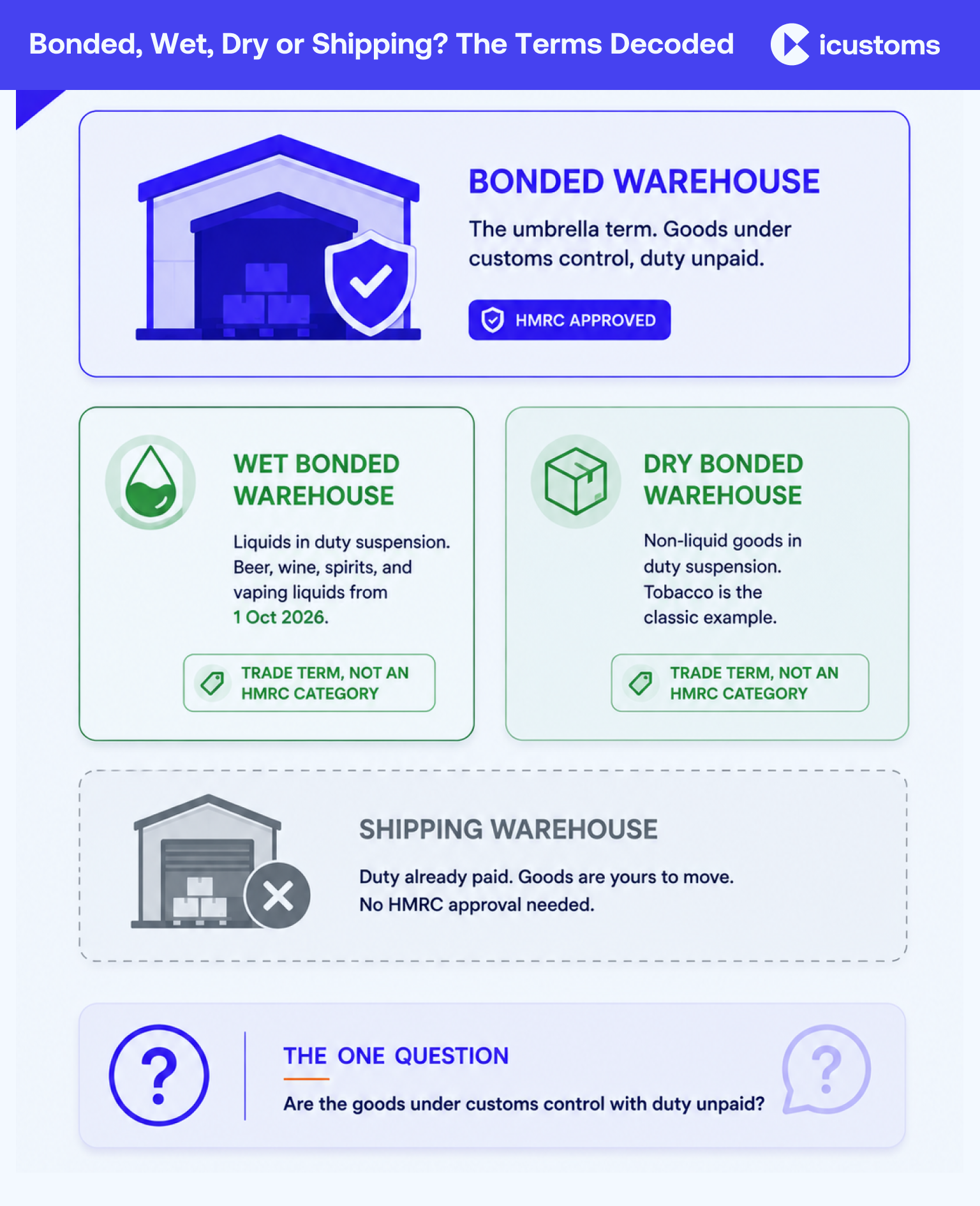
Ring round providers and the vocabulary shifts again. Two terms come up constantly, and neither appears on an HMRC approval:
A wet bonded warehouse UK operators talk about holds liquids in duty suspension: beer, wine, spirits and, from 1 October 2026, vaping liquids including pods and refills. If you are looking for an alcohol bonded warehouse in UK trade language, a wet bond is what you are being offered.
A dry bonded warehouse holds non-liquid goods in duty suspension. Tobacco is the classic example, and much of the trade also uses “dry bond” loosely for general goods under customs control with no excise element at all.
Usage varies between operators and neither is a legal classification, so treat both as the start of a conversation rather than an answer. The question is not “wet bond or dry bond” but “which HMRC approval do you hold, and does it cover my goods”. A site approved for one purpose cannot quietly take on another.
Quick orientation
Duty suspension in the UK runs through two distinct HMRC approvals: one suspends customs duty and import VAT on goods not yet in free circulation, the other suspends excise duty on goods already in it. “Bonded warehouse” is the umbrella term covering both. “Wet bond” and “dry bond” describe what is inside, not which approval is held.
Who's who in a bonded warehouse
Bonded storage involves more parties than an ordinary warehouse, and HMRC holds each to something different. Getting the roles straight is the fastest way to see who carries the risk on your arrangement.
| Roles in Bonded Warehouse | What it means | Who usually holds it |
|---|---|---|
| Warehousekeeper in Bonded Warehouse | Holds the HMRC approval for the premises and is accountable for accounting for every consignment entering or leaving. | Warehouse operator, 3PL, freight forwarder, manufacturer |
| Depositor / Owner of Bonded Warehouse | Places goods into the warehouse and generally carries the duty liability when they are released. | Importer, trader, brand owner |
| Registered Consignor | Approved to move excise goods in duty suspension from the point of release to free circulation, such as a port, into an approved warehouse. | Import agent or the receiving warehousekeeper |
| HMRC | Authorises the premises and the people, sets the conditions, holds the guarantee, and audits the records. | HM Revenue & Customs |
The friction sits between warehousekeeper and depositor. HMRC comes to the warehousekeeper when the stock account does not match physical stock, but it is the depositor’s duty at stake. Neither sees the whole picture without shared, timestamped records, which is why record-keeping rather than storage is the real challenge.
Bonded warehouse requirements UK: what HMRC expects
Anyone can apply. Nobody operates without approval. Holding duty-suspended goods without it is not a paperwork oversight, and the goods are liable to seizure.
Whichever regime applies, the bonded warehouse requirements UK applicants must satisfy follow the same shape:
- Approval of the premises as a place of security, assessed on physical security, layout and how stock is identified and separated.
- Approval of you as the operator, assessed on your compliance history and the competence of the people running the site.
- Records and systems capable of producing a complete, auditable stock account on demand, not reconstructed later.
- Financial security, usually a guarantee, covering the duty at risk on the stock you intend to hold.
- A demonstrated business case. For duty-suspended alcohol, tobacco and, from 1 October 2026, vaping products, HMRC has since 1 June 2022 assessed applications on genuine economic need and viability rather than a fixed minimum throughput figure.
Approvals are also described as public, open to goods belonging to other businesses, or private, your own stock only. That choice changes both your obligations and your commercial options, so make it deliberately. The current reference points are HMRC’s Customs Special Procedures guidance on GOV.UK, which replaced the older withdrawn notices, and Excise Notices 196 and 197.
How long can goods stay in a bonded warehouse?
Where goods are held before entering free circulation there is no time limit. Stock can remain under customs control indefinitely, provided records are accurate and the authorisation conditions are met. That is a real advantage over most other special procedures, which are time-bound, and it is why warehouses in the UK with a bonded storage model suit slow-moving, seasonal or high-value goods.
For excise goods it is less absolute. HMRC approves premises “for such periods and subject to such conditions” as it sees fit, and storage-time expectations form part of your specific approval, an area revised alongside the throughput changes from 1 June 2022. Approvals granted for a narrow trade need are limited to it, so a site approved for bottling spirits cannot drift into general storage. Check your own conditions.
The bonded warehouse journey: arrival, storage, release
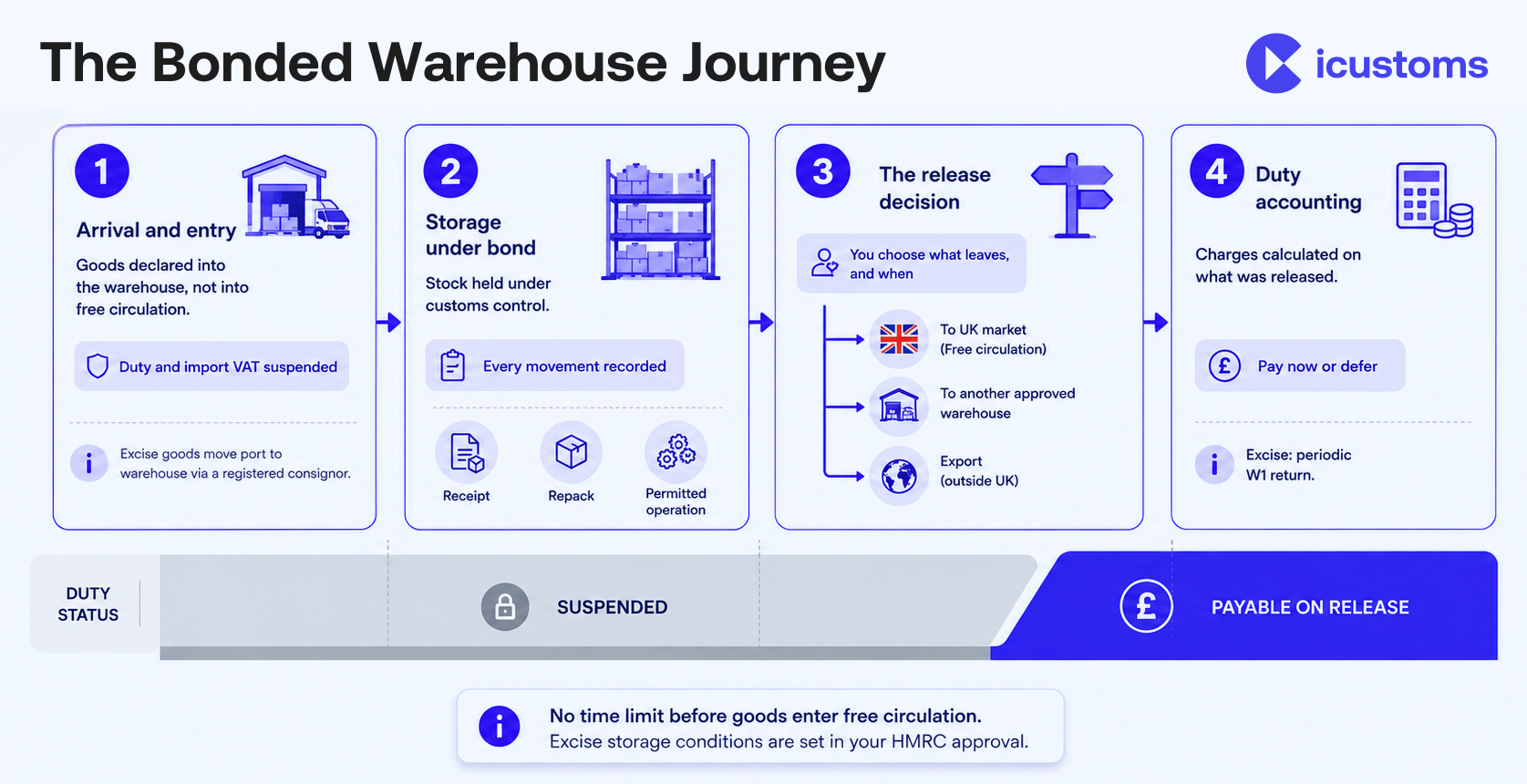
Stripped back, every bonded warehouse works the same way in four stages.
- Arrival and entry. Goods are declared into the warehouse rather than into free circulation, and duty and import VAT are suspended. Excise goods already in free circulation must move from port to warehouse via an approved registered consignor, under duty suspension.
- Storage under bond. The stock sits under customs control. Every receipt, movement, repack and permitted operation is recorded against it, and the stock account must reconcile to physical stock at all times.
- The release decision. The depositor decides what leaves and where it goes: the UK market, another approved warehouse, or out of the country. That decision, not the arrival date, determines what becomes payable.
- Duty accounting. Charges are calculated on what was released and either paid or deferred under an approved deferment arrangement. Excise warehousekeepers also account for the site through periodic returns.
None of that is conceptually difficult. The difficulty is that stages two and four have to agree perfectly, every month, across every consignment and client. That is where bonded warehouse operations either work or quietly fall apart.
Which HMRC approval do you need? The short version
The decision turns on the free circulation test above. A customs warehouse is for goods that have arrived from outside the UK and are not yet in free circulation; it suspends customs duty and import VAT, and entries are made through the Customs Declaration Service (CDS). An excise warehouse is for goods already in free circulation that carry excise duty: alcohol, tobacco, energy products and, from 1 October 2026, vaping products.
The two are separate approvals with separate applications, and importers of excise goods frequently need both: one for the import, one for the goods themselves. That is the whole answer at pillar level.
For the full side-by-side breakdown of purpose, goods covered, taxes suspended and which one fits your business, read our customs warehouse vs excise warehouse comparison.
What running a bonded warehouse demands day to day
Approval is the start, not the finish. Once authorised, the ongoing obligations are essentially informational:
- A complete, auditable stock account: what came in, what is held, what left, when, and under what authority.
- Reconciliation between system stock and physical stock, with discrepancies identified, explained and reported rather than absorbed.
- Periodic returns, including the W1 return submitted for each set of excise premises, plus the warrants used when goods are removed on payment or under deferment.
- An audit trail of who did what and when, robust enough to survive an HMRC visit years later.
- Correct treatment of every removal type, from home use to export to ships’ stores.
Spreadsheets cope at low volume and stop coping quickly. The failure mode is rarely dramatic: a movement recorded late, a duty calculation run against a superseded rate, a discrepancy never written back. By the time HMRC asks, the history needed to explain it no longer exists in defensible form. That is a systems problem, not a warehousing one.
Bonded warehouse locations: Manchester, the West Midlands and beyond
UK bonded warehouses cluster around ports, airports and inland freight corridors, for a straightforward reason. The shorter the leg between the point where goods are released and the warehouse that receives them, the less time the consignment spends in transit under suspension, and the less it costs to move.
Search bonded warehouse Manchester and you will get a mix of 3PLs, freight forwarders and general storage operators. The pull there is Manchester Airport cargo, Port Salford and the M60 and M62 corridor, with Liverpool close enough to serve the same customers. The West Midlands is the other major concentration, built around manufacturing and distribution near Birmingham Airport and the M5 and M6. This bonded warehouse guide for Stourbridge area businesses reads exactly the same as it does for one in Felixstowe or Grangemouth, because the rules are national and HMRC approval is not regional.
What actually varies by location is availability rather than regulation: how much approved capacity exists nearby, which goods types local sites are approved to hold, and what they charge. So the questions to ask a provider are the same everywhere. Which approval do you hold, public or private and customs or excise. Does it cover my goods. Do you have capacity. For excise operators you can validate the excise identifier they quote you through the SEED register before committing.
Software is the one part of this with no geography at all. If you are comparing bonded warehouse software for Manchester, the West Midlands or anywhere else in the UK, you are comparing against the same national requirements: an accurate stock account, duty status held per consignment, correct declarations on release, and records that survive an HMRC visit. Anyone selling bonded warehouse management software region by region is selling you a postcode rather than a capability.
Managing bonded stock from one platform
Most businesses that need bonded storage need both sides of it: suspension on the import and suspension on the goods. Most software handles one or the other, which means two systems and reconciliation between them, reintroducing the gap you were trying to close.
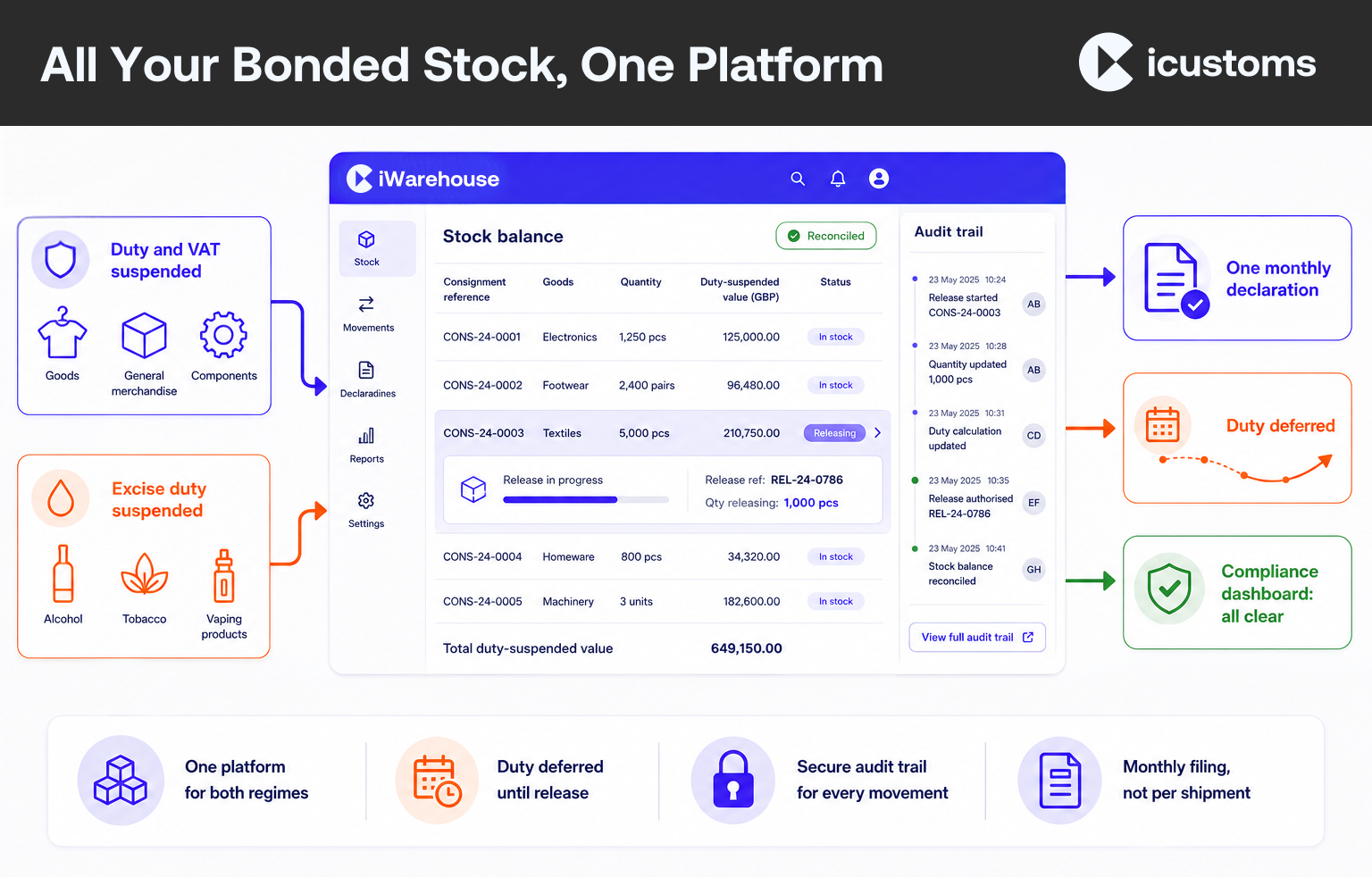
iWarehouse from iCustoms manages bonded stock across both regimes from one AI platform. Declarations are created automatically on arrival, duty can be paid immediately or deferred in bond, stock and movements are tracked without manual monitoring, and removals are accounted for in one monthly declaration. Every action is captured in a secure audit trail, with a compliance dashboard over every consignment.
See how it works on the iWarehouse bonded warehouse software page.
For a warehousekeeper or depositor that means:
- one platform covering both duty-suspension regimes, not two systems to reconcile
- duty deferred until release, so cash follows sales rather than arrivals
- monthly declarations instead of per-shipment filing, with automatic reconciliation
- an always-available audit trail, so a compliance visit is a retrieval task rather than a reconstruction
Frequently Asked Questions
What is a bonded warehouse?
A bonded warehouse is a secure, HMRC-authorised site where goods are stored under customs control without duty and VAT being paid on arrival. The charges are suspended and become payable only when the goods are released into the UK market.
What is a bonded warehouse used for?
Deferring duty and import VAT to protect cash flow, holding stock indefinitely until it is needed, re-exporting without ever paying UK duty, releasing stock selectively to manage duty cost, and offering bonded storage as a service.
Is a bonded warehouse the same as a customs warehouse?
Not quite. "Bonded warehouse" is the umbrella term. A customs warehouse is one type of bonded warehouse. An excise warehouse is the other. The two suspend different taxes and are approved separately.
Do I need a separate authorisation for customs and excise warehousing?
Yes. They are two distinct HMRC approvals with separate applications, conditions and guarantees. Importers of alcohol or tobacco often need both, because excise duty suspension only applies once goods are in free circulation.
What is an alcohol bonded warehouse in UK terms?
An alcohol bonded warehouse in UK trade language is normally a wet bond: a site approved to hold beer, wine and spirits in duty suspension. Producers with an Alcoholic Products Producer Approval may hold duty-suspended alcohol without a separate warehouse approval. Importers of finished product generally cannot.
What is the difference between a wet bonded warehouse and a dry bonded warehouse?
A wet bonded warehouse UK providers offer holds liquids in duty suspension: beer, wine, spirits and, from 1 October 2026, vaping liquids. A dry bonded warehouse holds non-liquid goods such as tobacco, and is also used loosely for general customs-controlled stock. Neither is an HMRC classification, so confirm which approval the site holds.
Is a bonded warehouse the same as a shipping warehouse?
No. A shipping warehouse holds goods you already own, duty paid and free to move. A bonded warehouse holds goods still under customs control with duty unpaid. The buildings can look identical, but only one needs HMRC approval.
Who can operate a bonded warehouse in the UK?
Any business HMRC approves. The bonded warehouse requirements UK applicants must meet cover premises security, record-keeping, compliance history and any guarantee HMRC requires. Both operator and premises are approved, and since 1 June 2022 HMRC assesses genuine economic need rather than a fixed throughput threshold.
How long can goods stay in a bonded warehouse?
Goods held before entering free circulation can stay indefinitely, provided records and conditions are maintained. Excise approvals carry conditions set by HMRC, including on storage time, so check your own approval.
Can one platform manage both types of bonded warehousing?
Yes. iWarehouse handles duty-suspended and excise-suspended stock in the same system, so you are not running separate platforms for separate warehouse types.
You may also like:


Struggling to Extract, Catagorise & Validate Your Documents?

Capture & Upload Data in Seconds with AI & Machine Learning
Subscribe to our Newsletter
About iCustoms
iCustoms is an all-in-one solution helping businesses automate customs processes more efficiently. With AI-powered and machine-learning capabilities, iCustoms is designed to streamline your all customs procedures in a few minutes, cut additional costs and save time.
Struggling to Extract, Catagorise & Validate Your Documents?
Capture & Upload Data in Seconds with AI & Machine Learning